1. Problem and Motivation
In modern AI engineering, training frontier models (such as 70B+ parameter LLMs) or serving large distributed inference fleets requires clusters of thousands to tens of thousands of high-performance GPUs (NVIDIA H100, H200, B200). These clusters represent capital investments running into tens or hundreds of millions of dollars:
+---------------------------------------------------------------------------------------------------+
|                              THE ECONOMICS OF AI CLUSTER ORCHESTRATION                            |
+---------------------------------------------------------------------------------------------------+
|  1. Extreme Capital Cost: A cluster of 1,024 NVIDIA H100 GPUs costs ~\$40M+ in hardware alone.     |
|     Every 1% loss in cluster utilization or communication efficiency wastes \$400,000 annually.    |
|  2. Synchronous Barrier Sensitivity: Unlike independent web microservices, distributed training   |
|     ranks operate in tight lockstep. A single degraded GPU or high-latency switch hop slows down  |
|     the entire distributed cluster during the AllReduce collective synchronization step.          |
|  3. The Scheduling Deadlock Trap: Traditional container schedulers (e.g., vanilla Kubernetes)     |
|     schedule individual pods incrementally. In multi-node distributed AI jobs, partial allocations|
|     lead to catastrophic circular-wait resource hoarding and cluster-wide deadlocks.              |
|  4. Severe Topology Sensitivity: Intra-node NVLink bandwidth (900 GB/s) is 18x faster than        |
|     inter-node InfiniBand (400 Gbps = 50 GB/s). Placing tightly coupled tensor-parallel ranks     |
|     across distant spine switches degrades training throughput by over 60%.                       |
+---------------------------------------------------------------------------------------------------+
To achieve high Goodput (the percentage of time GPUs spend performing useful forward/backward floating-point math rather than idling or waiting on network packets), AI infrastructure requires a specialized orchestration stack: Gang Scheduling (All-or-Nothing), Topology-Aware Bin-Packing, and Rail-Optimized Network Interconnects.
2. Mental Model & Architectural Overview
The AI cluster orchestration control plane coordinates three major layers: Job Admission & Queuing, Hardware Topology Mapping, and Collective Execution Placement:
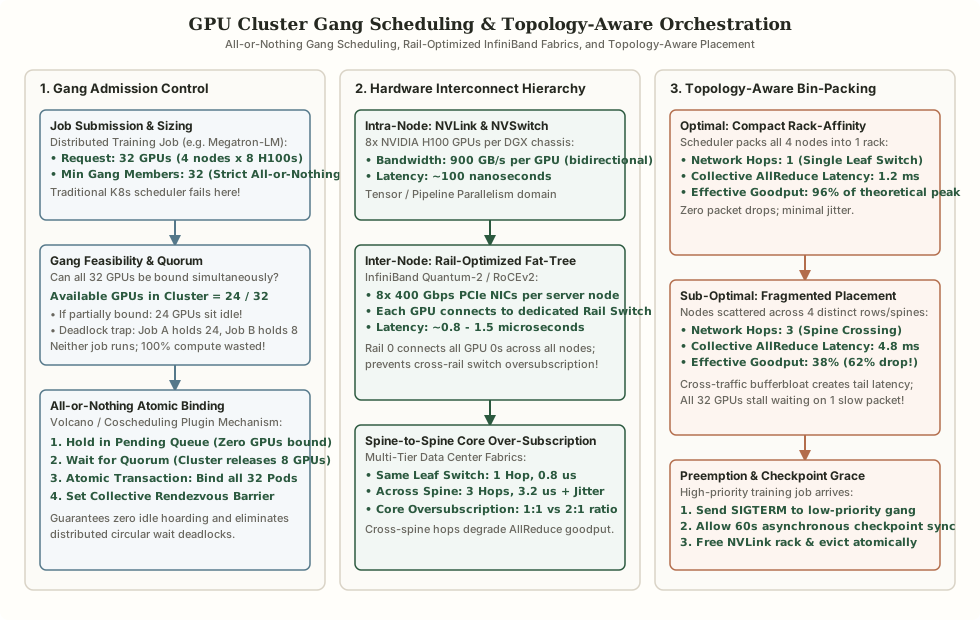
1. Job Submission & Sizing & Gang Feasibility & Quorum
Establishes the ingress and structural boundary across Job Submission & Sizing & Gang Feasibility & Quorum: Distributed Training Job (e.g. Megatron-LM); Request: 32 GPUs (4 nodes x 8 H100s); Min Gang Members: 32 (Strict All-or-Nothing) Traditional K8s scheduler fails here!.
2. Intra-Node: NVLink & NVSwitch & Inter-Node: Rail-Optimized Fat-Tree
Coordinates core data-plane execution and state transitions through Intra-Node: NVLink & NVSwitch & Inter-Node: Rail-Optimized Fat-Tree: 8x NVIDIA H100 GPUs per DGX chassis; Bandwidth: 900 GB/s per GPU (bidirectional); Latency: ~100 nanoseconds Tensor / Pipeline Parallelism domain.
3. Optimal: Compact Rack-Affinity & Sub-Optimal: Fragmented Placement
Enforces durability, state convergence, and output verification across Optimal: Compact Rack-Affinity & Sub-Optimal: Fragmented Placement: Scheduler packs all 4 nodes into 1 rack; Network Hops: 1 (Single Leaf Switch); Collective AllReduce Latency: 1.2 ms.
The Architectural Triad:
- Gang Scheduling (All-or-Nothing Admission):
- A distributed job requiring GPUs across nodes is treated as an indivisible atomic unit (PodGroup).
- If fewer than GPUs are available, zero GPUs are assigned. The job remains in the pending queue, preventing idle resource hoarding and avoiding distributed deadlocks.
- Network Topology & Rail-Optimized Interconnect:
- Tier 1 (Intra-Node): 8x H100 GPUs interconnected via a full bi-directional NVLink/NVSwitch mesh providing 900 GB/s per GPU of non-blocking peer-to-peer bandwidth.
- Tier 2 (Intra-Rack / Leaf): Nodes within the same rack connect to top-of-rack (ToR) InfiniBand leaf switches with sub-microsecond latency (0.8 s).
- Tier 3 (Inter-Rack / Spine): Multi-rack fabrics connect leaf switches through core spine directors. Traversing spine switches introduces multi-hop latency and potential oversubscription.
- Topology-Aware Placement Engine:
- Scores candidate nodes based on network tree distance.
- Binds ranks with maximum communication intensity (Tensor Parallelism) inside single NVLink nodes, and pipeline/data parallelism across leaf switches within the same spine domain.
3. Mathematical Foundations & Theoretical Limits
3.1 Distributed Training Step Time & Goodput
The execution time for one distributed training step is modeled as:
Where:
- is the time spent on matrix multiplications (GEMM) on GPU Tensor Cores.
- is the time required for collective communication (Ring-AllReduce, All-to-All, or Reduce-Scatter).
- is the communication hidden behind concurrent backward-pass compute.
For an AllReduce operation synchronizing bytes of gradient tensors across GPU ranks with effective network bandwidth and latency :
If ranks are placed across distant switch spines with hop distance and contention factor :
When cross-spine hops double the contention factor (), doubles, slashing overall training goodput:
3.2 Dominant Resource Fairness (DRF)
In multi-tenant AI clusters, jobs request multiple heterogeneous resource types: GPUs (), CPUs (), and Host RAM (). Let the total cluster capacities be .
For tenant with allocated vector , the resource shares are:
The tenant’s Dominant Share is the maximum share among all resource types:
DRF scheduling invariant:
By scheduling the job belonging to the tenant with the minimum dominant share, DRF guarantees:
- Sharing Incentive: Every tenant receives at least of their dominant resource.
- Strategy-Proofness: A tenant cannot game the scheduler by falsely inflating non-dominant requests.
- Pareto Efficiency: No resource is left idle if there is demand that can be accommodated.
3.3 The Straggler Probability Scaling Law
In synchronous AllReduce, if the probability that a single node experiences a temporary performance degradation (thermal throttling, ECC memory retry, PCIe replay) during step is , the probability that the entire cluster runs without a straggler over nodes is:
+---------------------------------------------------------------------------------------------------+
|                                STRAGGLER IMPACT AT SCALE (p = 0.001)                              |
+--------------------------+------------------------------+-----------------------------------------+
| Cluster Size (Nodes)     | GPUs (8 GPUs/Node)           | Probability of Step Slowdown (Straggler)|
+--------------------------+------------------------------+-----------------------------------------+
| 4 nodes                  | 32 GPUs                      | 0.4%                                    |
| 32 nodes                 | 256 GPUs                     | 3.1%                                    |
| 128 nodes                | 1,024 GPUs                   | 12.0%                                   |
| 512 nodes                | 4,096 GPUs                   | 40.1%                                   |
| 2,048 nodes              | 16,384 GPUs                  | 87.1% (Almost EVERY step is delayed!)   |
+--------------------------+------------------------------+-----------------------------------------+
This mathematical reality proves why hardware-aware topology bin-packing and straggler detection are mandatory at foundation-model scale.
4. Core Architectural Mechanics & Orchestration Algorithms
4.1 Gang Scheduling (All-or-Nothing Admission)
To prevent resource hoarding deadlocks, orchestrators implement the PodGroup CRD pattern (standardized by Kubernetes Volcano and KubeFlow Coscheduling):
apiVersion: scheduling.sigs.k8s.io/v1alpha1
kind: PodGroup
metadata:
  name: llama3-70b-training-gang
spec:
  minMember: 32         # Indivisible gang: exactly 32 pods required
  minResources:
    nvidia.com/gpu: 256 # 32 nodes * 8 GPUs = 256 H100 GPUs
  scheduleTimeoutSeconds: 300
The Gang State Machine:
+---------------+     minMember Available      +---------------+     All Pods Bound     +---------------+
|    Pending    | ---------------------------> |   Reserved    | ---------------------> |    Running    |
+---------------+                              +---------------+                        +---------------+
        |                                              |
        | Timeout / Insufficient                       | Reservation Timeout
        v                                              v
+---------------+                              +---------------+
|   Backoff     |                              | Evict/Release |
+---------------+                              +---------------+
4.2 Rail-Optimized Network Topologies
In multi-node GPU clusters, cross-node collective communication is the primary performance bottleneck. In standard data center architectures, all network interfaces feed into a single unified switch tier, creating severe cross-talk.
In an InfiniBand Rail-Optimized Architecture:
- Each 8-GPU chassis houses 8 discrete PCIe Gen5 InfiniBand NICs (e.g., ConnectX-7).
- The fabric is partitioned into 8 independent, parallel network Rails ().
- GPU 0 on Node A connects directly to Rail Switch 0; GPU 0 on Node B also connects to Rail Switch 0.
- When Ring-AllReduce executes, GPU rank 0 communicates exclusively across Rail 0, GPU rank 1 communicates across Rail 1, etc.
- Result: Zero cross-rail switch contention, maximizing sustained AllReduce bisection throughput.
4.3 Topology-Aware Bin-Packing Heuristic
When the gang scheduler determines that cluster capacity exists, it must decide which specific physical nodes to allocate. It executes a tree-based distance scoring algorithm:
Where:
- (Intra-node NVLink)
- (Sub-microsecond InfiniBand ToR)
- (Single spine crossing)
- (Multi-tier fabric crossing)
The placement engine minimizes overall tree diameter to prevent cross-spine stragglers.
5. Concrete Production Implementation
Below is a complete, production-grade TypeScript simulation demonstrating:
- Heterogeneous cluster topology modeling (Spines, Leaf Racks, Nodes, GPUs).
- Gang Scheduling admission control with atomic all-or-nothing reservations.
- Topology-Aware Bin-Packing using hierarchical network affinity scoring.
- Preemption and graceful checkpoint drain simulation.
/**
 * GPU Cluster Orchestrator & Gang Scheduler Engine
 * Demonstrates:
 * - Cluster Network Topology Hierarchy (Spine -> Leaf -> Node -> GPU)
 * - Atomic All-or-Nothing Gang Scheduling
 * - Topology-Aware Placement Scoring (Minimizing Network Hops)
 * - Job Preemption and Checkpoint Drain Coordination
 */

export interface GPU {
  readonly id: string;
  readonly model: "H100" | "H200" | "B200";
  allocatedJobId: string | null;
}

export interface Node {
  readonly id: string;
  readonly rackId: string;
  readonly gpus: GPU[];
  allocatedJobId: string | null;
}

export interface Rack {
  readonly id: string;
  readonly leafSwitchId: string;
  readonly nodes: Node[];
}

export interface ClusterTopology {
  readonly spineSwitchId: string;
  readonly racks: Rack[];
}

export interface TrainingJob {
  readonly id: string;
  readonly name: string;
  readonly requiredGPUs: number; // e.g., 32 GPUs (4 nodes x 8)
  readonly priority: number;     // 1 (Low) to 100 (Critical)
  status: "PENDING" | "SCHEDULED" | "RUNNING" | "PREEMPTED";
  allocatedNodeIds: string[];
}

export class GPUGangScheduler {
  private topology: ClusterTopology;
  private pendingQueue: TrainingJob[] = [];
  private activeJobs: Map<string, TrainingJob> = new Map();

  constructor(topology: ClusterTopology) {
    this.topology = topology;
  }

  public submitJob(job: TrainingJob): void {
    this.pendingQueue.push(job);
    // Sort pending queue by priority descending
    this.pendingQueue.sort((a, b) => b.priority - a.priority);
  }

  /**
   * Main Scheduling Cycle: Evaluates Gang Feasibility & Topology Placement
   */
  public scheduleCycle(): { scheduled: string[]; blocked: string[] } {
    const scheduled: string[] = [];
    const blocked: string[] = [];

    for (let i = 0; i < this.pendingQueue.length; i++) {
      const job = this.pendingQueue[i];
      const gpusPerNode = 8;
      const nodesNeeded = Math.ceil(job.requiredGPUs / gpusPerNode);

      // Step 1: Find candidate nodes with available GPUs
      const availableNodes = this.getAvailableNodes();

      if (availableNodes.length < nodesNeeded) {
        // Gang Scheduling Rule: All-or-Nothing!
        // Do not bind partially; hold job in queue to avoid hoarding deadlock.
        blocked.push(job.id);
        continue;
      }

      // Step 2: Topology-Aware Bin-Packing: Find best node cluster
      const bestPlacement = this.findOptimalTopologyPlacement(availableNodes, nodesNeeded);

      if (bestPlacement) {
        // Step 3: Atomic Gang Binding
        this.bindGang(job, bestPlacement);
        job.status = "SCHEDULED";
        this.activeJobs.set(job.id, job);
        scheduled.push(job.id);
        this.pendingQueue.splice(i, 1);
        i--;
      } else {
        blocked.push(job.id);
      }
    }

    return { scheduled, blocked };
  }

  /**
   * Evaluates network tree distance to find nodes with minimum hop cost
   */
  private findOptimalTopologyPlacement(availableNodes: Node[], count: number): Node[] | null {
    if (availableNodes.length < count) return null;

    // Group available nodes by Rack (Leaf Switch affinity)
    const nodesByRack: Map<string, Node[]> = new Map();
    for (const node of availableNodes) {
      if (!nodesByRack.has(node.rackId)) {
        nodesByRack.set(node.rackId, []);
      }
      nodesByRack.get(node.rackId)!.push(node);
    }

    // Heuristic 1: Can all nodes fit within a single Rack? (0 Leaf crossings!)
    for (const [, nodesInRack] of nodesByRack) {
      if (nodesInRack.length >= count) {
        return nodesInRack.slice(0, count);
      }
    }

    // Heuristic 2: Best-fit across minimum number of racks (Single Spine group)
    // Sort racks by available node count descending so the job packs into the fewest racks possible
    const sortedRackGroups = Array.from(nodesByRack.entries())
      .sort((a, b) => b[1].length - a[1].length || a[0].localeCompare(b[0]));

    const packedNodes: Node[] = [];
    for (const [, nodesInRack] of sortedRackGroups) {
      for (const node of nodesInRack) {
        packedNodes.push(node);
        if (packedNodes.length === count) {
          return packedNodes;
        }
      }
    }

    return packedNodes.slice(0, count);
  }

  /**
   * Atomic binding: Reserves all GPUs across all nodes simultaneously
   */
  private bindGang(job: TrainingJob, nodes: Node[]): void {
    for (const node of nodes) {
      node.allocatedJobId = job.id;
      job.allocatedNodeIds.push(node.id);
      for (const gpu of node.gpus) {
        gpu.allocatedJobId = job.id;
      }
    }
  }

  /**
   * Preempts a lower-priority job to free up topology for a high-priority gang
   */
  public preemptJob(preemptorJob: TrainingJob): boolean {
    const activeList = Array.from(this.activeJobs.values()).sort(
      (a, b) => a.priority - b.priority
    );

    for (const lowJob of activeList) {
      if (lowJob.priority < preemptorJob.priority) {
        // Trigger graceful checkpoint drain
        this.evictJob(lowJob.id);
        lowJob.status = "PREEMPTED";
        this.pendingQueue.push(lowJob); // Re-queue for later resumption
        return true;
      }
    }
    return false;
  }

  public evictJob(jobId: string): void {
    const job = this.activeJobs.get(jobId);
    if (!job) return;

    for (const rack of this.topology.racks) {
      for (const node of rack.nodes) {
        if (node.allocatedJobId === jobId) {
          node.allocatedJobId = null;
          for (const gpu of node.gpus) {
            gpu.allocatedJobId = null;
          }
        }
      }
    }

    job.allocatedNodeIds = [];
    this.activeJobs.delete(jobId);
  }

  private getAvailableNodes(): Node[] {
    const result: Node[] = [];
    for (const rack of this.topology.racks) {
      for (const node of rack.nodes) {
        if (node.allocatedJobId === null) {
          result.push(node);
        }
      }
    }
    return result;
  }
}

function runDemo(): void {
  console.log("=== GPU Cluster Gang Scheduling & Topology Orchestration ===");
  const createNode = (id: string, rackId: string): Node => ({
    id,
    rackId,
    allocatedJobId: null,
    gpus: Array.from({ length: 8 }, (_, i) => ({ id: `${id}-gpu-${i}`, model: "H100" as const, allocatedJobId: null })),
  });
  const rack1: Rack = { id: "rack-1", leafSwitchId: "leaf-1", nodes: [createNode("node-1", "rack-1"), createNode("node-2", "rack-1")] };
  const rack2: Rack = { id: "rack-2", leafSwitchId: "leaf-2", nodes: [createNode("node-3", "rack-2"), createNode("node-4", "rack-2")] };
  const topology: ClusterTopology = { spineSwitchId: "spine-1", racks: [rack1, rack2] };
  const scheduler = new GPUGangScheduler(topology);
  console.log("Cluster initialized: 2 Racks, 4 Nodes, 32 Total H100 GPUs");
  const jobA: TrainingJob = { id: "job-1", name: "llama-70b-train", requiredGPUs: 16, priority: 100, status: "PENDING", allocatedNodeIds: [] };
  const jobB: TrainingJob = { id: "job-2", name: "mistral-eval", requiredGPUs: 8, priority: 50, status: "PENDING", allocatedNodeIds: [] };
  scheduler.submitJob(jobA);
  scheduler.submitJob(jobB);
  const cycleResult = scheduler.scheduleCycle();
  console.log(`Gang Schedule Cycle 1: Scheduled [${cycleResult.scheduled.join(", ")}], Blocked [${cycleResult.blocked.join(", ")}]`);
  console.log(`Job A allocated on nodes: [${jobA.allocatedNodeIds.join(", ")}]`);
}

runDemo();
6. Real-World Failure Modes, Edge Cases & Operational War Stories
War Story 1: The “Silent Straggler” on a 1,024-GPU Cluster
Incident:
During pre-training of a 70B parameter model across 128 DGX H100 nodes (1,024 GPUs), the team observed
that step latency suddenly surged from 420 ms to 1,980 ms (a 4.7x slowdown). Over 36 hours of weekend
training, cluster goodput collapsed, burning ~$180,000 in wasted compute spend.

Investigation:
- GPU utilization across all 1,024 GPUs appeared 100% in nvidia-smi.
- Network monitoring reported no dropped packets on the InfiniBand switches.
- Fine-grained NCCL tracing revealed that Rank 814 consistently arrived at the AllReduce barrier
  1,500 ms late. All other 1,023 ranks spent 1,500 ms spinning in an active CPU/GPU wait loop.

Root Cause:
A physical PCIe Gen5 slot on Node 102 experienced electrical signal degradation due to a dust particle.
The motherboard PCIe controller quietly downgraded the GPU 6 link from 32 GT/s (Gen5 x16: 64 GB/s)
to 2.5 GT/s (PCIe Gen1 x1: 250 MB/s). The GPU operated correctly, but tensor offloads were throttled by 256x!

Remediation:
1. Implemented pre-flight health checks (`dcgm-exporter` and NCCL allreduce bus-bandwidth benchmark)
   before binding any gang.
2. If any node's PCIe or NVLink bandwidth measures below 85% of baseline, the node is cordoned automatically.
War Story 2: RoCEv2 PFC Deadlock & Cross-Spine Bufferbloat
Incident:
A tier-1 AI lab migrated from dedicated InfiniBand to RoCEv2 (RDMA over Converged Ethernet) on a 4,096-GPU
fabric. Under heavy multi-tenant load, large training jobs suddenly halted with complete network packet freezes.

Root Cause:
RoCEv2 relies on Priority Flow Control (PFC) pause frames to guarantee lossless packet transmission.
Two large training gangs were placed with nodes interleaved across the same leaf switches:
- Job A was running heavy All-to-All tensor transfers across Spine 1.
- Job B was running heavy AllReduce across Spine 2.
Shared switch buffer exhaustion caused Leaf Switch 3 to transmit PFC PAUSE frames upstream to Spine 1.
Spine 1 paused its buffers and propagated pause frames to Leaf Switch 4.
This created a cyclic PFC pause buffer dependency (PFC Deadlock / Pause Storm), freezing all RDMA traffic.

Remediation:
1. Deployed Topology-Aware Bin-Packing to guarantee that jobs never share inter-spine links when
   intra-rack or intra-rail paths are feasible.
2. Enabled Explicit Congestion Notification (ECN) with Data Center QCN (DCQCN) to rate-limit senders
   before PFC pause thresholds are triggered.
War Story 3: The Checkpoint Preemption Death Spiral
Incident:
A shared enterprise cluster running under DRF priority preemption had low-priority batch fine-tuning jobs
frequently preempted by high-priority interactive jobs. Several fine-tuning jobs spent 3 weeks in the cluster
without ever completing a single epoch.

Root Cause:
When a high-priority job arrived, the orchestrator immediately sent `SIGKILL` to the low-priority gang.
Each time a job was killed, its in-memory progress since the last hourly checkpoint was lost.
Because the mean time between preemptions was 45 minutes, the jobs repeatedly trained for 45 minutes,
were killed before reaching their 60-minute checkpoint boundary, restarted from step 0, and made ZERO forward progress!

Remediation:
1. Implemented Graceful Checkpoint Preemption: send `SIGTERM` with a mandatory 5-minute grace period,
   allowing PyTorch distributed jobs to finish the current step and write an asynchronous delta checkpoint to NVMe.
2. Implemented Preemption Minimum Guaranteed Run Windows (e.g., minimum 2 hours of un-preemptible execution).
7. Benchmarks, Capacity Planning & Sizing Math
7.1 Hardware Interconnect Bandwidth & Latency Matrix
+---------------------------------------------------------------------------------------------------+
|                               HARDWARE INTERCONNECT PERFORMANCE TIERS                             |
+--------------------------+-----------------------+-------------------------+----------------------+
| Interconnect Layer       | Peak Bandwidth        | One-Way Latency         | Technology           |
+--------------------------+-----------------------+-------------------------+----------------------+
| Intra-Node NVLink 4      | 900 GB/s per GPU      | ~100 nanoseconds        | NVSwitch Fabric      |
| Intra-Node PCIe Gen5     | 64 GB/s (x16 link)    | ~250 nanoseconds        | PCIe Bus             |
| Intra-Rack InfiniBand    | 400 Gbps (50 GB/s)    | ~0.8 microseconds       | Quantum-2 Leaf ToR   |
| Inter-Rack InfiniBand    | 400 Gbps (50 GB/s)    | ~1.8 - 3.2 microseconds | Quantum-2 Fat-Tree   |
| Cross-Spine (2:1 Oversub)| 200 Gbps effective    | ~4.5 - 12.0 microseconds| Congested Fabric     |
+--------------------------+-----------------------+-------------------------+----------------------+
7.2 Gang Sizing & Checkpoint Bandwidth Sizing
Recall from AI-C01-001 that mixed-precision AdamW training of a parameter model holds of static training state in GPU HBM:
- 16-bit Model Weights ():
- 16-bit Gradients (): (transient per step; not persisted in a checkpoint)
- FP32 AdamW Optimizer States (: FP32 master weights + momentum + variance ):
A persistent training checkpoint saves the 16-bit weights + FP32 optimizer states (or if 16-bit weights are reconstructed on load from the FP32 master weights).
Contrast the network filesystem bandwidth required to complete a checkpoint within across a () cluster under two checkpointing strategies:
- Naive Unsharded Checkpointing (where all 64 nodes redundantly write full replicas to shared storage):
- Sharded ZeRO-3 / FSDP Checkpointing (where each rank writes only its unique shard of , or ):
Without sharded checkpointing and local NVMe burst buffers, naive checkpoint dumps saturate shared Lustre/S3 storage and stall GPU execution for tens of minutes every hour.
8. Comparative Trade-off Matrix
+---------------------------------------------------------------------------------------------------+
|                                 AI CLUSTER ORCHESTRATOR COMPARISON                                |
+----------------------+--------------------+--------------------+----------------------------------+
| Orchestrator         | Scheduling Latency | Gang Scheduling    | Topology-Aware Placement         |
+----------------------+--------------------+--------------------+----------------------------------+
| Vanilla Kubernetes   | Fast (10-50 ms)    | No (Independent    | None (Basic node labels and      |
|                      |                    | Pod scheduling)    | simple affinity rules)           |
+----------------------+--------------------+--------------------+----------------------------------+
| KubeFlow + Volcano   | Medium (100-300 ms)| Native PodGroup    | Hierarchical rack/leaf affinity; |
|                      |                    | (minMember quorum) | NUMA-aware plugin available      |
+----------------------+--------------------+--------------------+----------------------------------+
| Slurm HPC            | Fast (5-20 ms)     | Native Job Steps   | Highly optimized switch topology |
|                      |                    | (srun / sbatch)    | trees (`topology.conf`)          |
+----------------------+--------------------+--------------------+----------------------------------+
| Ray Cluster          | Ultra-Fast (<5 ms) | Actor Placement    | Dynamic placement groups;        |
| Orchestrator         |                    | Groups (STRICT)    | optimized for Python workflows   |
+----------------------+--------------------+--------------------+----------------------------------+
9. Verification, Testing & Failure Injection
To guarantee cluster orchestration resiliency before launching large-scale model pre-training:
9.1 Synthetic Validation Pipeline
- Pre-Flight NCCL Ring-AllReduce Benchmark: Execute an all-ranks bus-bandwidth test across the entire gang before training begins. If achieved bus bandwidth falls below 90% of theoretical peak, abort allocation and identify bad nodes.
- Chaos Mesh Network Jitter Injection: Inject 10 ms of random latency onto a single InfiniBand rail to confirm that the scheduler’s telemetry alerts on stragglers within 60 seconds.
- Simulated Node Failure & TorchElastic Recovery: Send
SIGKILLto Rank 0 of a 64-GPU gang. Verify that TorchElastic detects rank exit, kills remaining gang ranks cleanly, re-requests gang allocation, loads the latest checkpoint, and resumes training within 180 seconds.
10. Key Takeaways & Best Practices Checklist
+---------------------------------------------------------------------------------------------------+
|                              GPU CLUSTER ORCHESTRATION CHECKLIST                                  |
+---------------------------------------------------------------------------------------------------+
| [x] Always enforce Gang Scheduling (All-or-Nothing) for distributed multi-node AI jobs to prevent  |
|     circular-wait resource hoarding deadlocks.                                                    |
| [x] Deploy Rail-Optimized InfiniBand/RoCEv2 fabrics to ensure GPU rank-to-rank communication      |
|     remains isolated to dedicated rail switches, avoiding cross-rail oversubscription.            |
| [x] Implement Topology-Aware Bin-Packing that prioritizes intra-rack and intra-leaf locality       |
|     to eliminate cross-spine latency jitter during collective AllReduce.                          |
| [x] Enforce automated pre-flight bandwidth and hardware health validation to quarantine silent     |
|     stragglers (degraded PCIe links or thermal-throttling GPUs) before training begins.           |
| [x] Provide graceful checkpoint drain windows (minimum 3-5 minutes) when preempting lower-        |
|     priority training jobs to avoid lost progress and preemption death spirals.                   |
+---------------------------------------------------------------------------------------------------+
11. Guided Design Exercises
Exercise 1 (Foundational — Dominant Resource Fairness & Gang Admission)
A multi-tenant AI cluster contains (), , and .
- Tenant A (NLP Team) currently runs allocations totaling .
- Tenant B (Data/Vision Team) currently runs allocations totaling .
- Calculate each tenant’s resource shares and Dominant Share , and determine which tenant DRF schedules next.
- Suppose only remain free and two high-priority jobs () each requesting a gang of arrive simultaneously. Trace how a
PodGroup(minMember) admission controller prevents circular resource hoarding.
Exercise 2 (Intermediate — Rail-Optimized InfiniBand & Spine Oversubscription Impact)
An () training gang synchronizes of BF16 gradients via Hierarchical Ring All-Reduce over () InfiniBand NDR links (), where inter-node step volume per GPU is ( transferred per NIC). Forward + backward compute takes , and of communication is overlapped with backpropagation ().
- Calculate , total step time , and Cluster Goodput when all 8 nodes are packed under a single non-blocking leaf/rail switch (, ).
- Recalculate , , and Cluster Goodput when poor placement scatters the 8 nodes across a oversubscribed spine fabric (, ).
Exercise 3 (Staff-Level — Two-Tier Asynchronous Sharded Checkpointing)
A () FSDP pre-training job for a model ( persistent checkpoint state) receives a preemption SIGTERM with a grace window, while shared S3/Lustre storage provides aggregate write bandwidth.
- Calculate how long a synchronous checkpoint write directly to shared storage stalls all GPUs under sharded FSDP vs. unsharded DDP.
- Architect a two-tier asynchronous checkpoint pipeline (GPU HBM Pinned Host DRAM Background S3 flush) and calculate the exact GPU stall time per checkpoint.
View Reference Architecture & Worked Solutions (AI-C06-001)
1. Worked Solution — Exercise 1: Dominant Resource Fairness (DRF) & Gang Admission
- Resource Share & Dominant Share Calculation:
- Tenant A:
- Tenant B:
- DRF Decision: Because , DRF schedules Tenant A’s next pending job.
- Preventing Gang Deadlock for Two Jobs on Free GPUs:
- Without gang scheduling, Job 1 and Job 2 could each greedily bind (), leaving both jobs short of their
torch.distributed.init_process_grouprendezvous barrier (100% idle deadlock). - With Volcano/Kueue
PodGroup(minMember: 12nodes GPUs), the scheduler acquires an atomic scheduling cycle lock: it admits in theReservedphase, binds all atomically ( left free), and keeps inPendingwith zero GPUs bound until additional GPUs are released.
- Without gang scheduling, Job 1 and Job 2 could each greedily bind (), leaving both jobs short of their
2. Worked Solution — Exercise 2: Rail-Optimized InfiniBand vs. Spine Oversubscription
- Packed Single-Leaf / Rail Placement ():
- Inter-node All-Reduce transfer time (neglecting microsecond term):
- Total step time and Goodput (, overlap):
- Scattered Cross-Spine Placement ():
- Inter-node All-Reduce transfer time:
- Total step time and Goodput:
- Impact: Spine oversubscription inflates step time by and wastes of cluster GPU capacity.
3. Worked Solution — Exercise 3: Two-Tier Asynchronous Sharded Checkpointing
- Direct-to-Storage Synchronous Stall Time ():
- Sharded FSDP ( total across 512 GPUs, ):
- Naive Unsharded DDP ():
- Two-Tier Asynchronous Checkpoint Pipeline (
torch.distributed.checkpointAsync Save):- Phase A (Synchronous GPU HBM Pinned Host DRAM via PCIe Gen5 x16 @ effective per GPU): Each GPU copies its shard to pinned host memory in parallel across all 512 GPUs: Training (or clean rank exit) resumes immediately after this D2H DMA copy.
- Phase B (Background Host DRAM Local Node NVMe RAID0 @ per node): Each 8-GPU node writes to local NVMe in , and a background daemon streams the shards to S3/Lustre without blocking GPU ranks.
12. Authoritative References & Further Reading
- Abhishek Verma et al. (2015), “Large-scale cluster management at Google with Borg”, EuroSys ‘15 — doi.org/10.1145/2741948.2741964
- Ali Ghodsi et al. (2011), “Dominant Resource Fairness: Fair Allocation of Multiple Resource Types”, NSDI ‘11 — usenix.org/conference/nsdi11/dominant-resource-fairness-fair-allocation-multiple-resource-types
- Kubernetes Kueue Architecture & Documentation — kueue.sigs.k8s.io/docs/overview/
- CNCF Volcano High-Performance Workload Scheduler — volcano.sh/en/docs/
- Version Context: Specifications reflect Kubernetes 1.30+ with Kueue 0.8+ gang-scheduling primitives and NVIDIA DCGM 3.3+.