1. The Problem & Why It Matters
In modern web applications, distributed systems, and real-time streaming engines, two questions arise constantly:
- Cardinality Estimation (Count-Distinct): “How many unique daily active users (DAUs) visited our site today?”
- Frequency Estimation (Heavy Hitters): “Which IP addresses are making the most API requests right now to detect DDoS attacks?”
The naive approach stores every seen identifier in a Hash Set or Hash Map:
- Tracking 100 million unique 64-bit user IDs in a hash set requires:
- If you need to compute distinct users across 1,000 dimensions (per country, per device type, per campaign), memory balloons into terabytes of RAM.
- Distributed sets cannot be unioned without massive network bandwidth transfers.
When an approximate answer with a small, mathematically bounded error margin (e.g. ) is acceptable, Probabilistic Data Structures provide near-miraculous efficiency:
- HyperLogLog (HLL) estimates billions of unique elements with 0.81% standard error using only 12 KB of memory.
- Count-Min Sketch (CMS) counts frequencies of billions of streaming events in fixed sub-megabyte memory with strict mathematical error bounds.
2. Intuitive Mental Model
The HyperLogLog Coin-Flip Intuition
Imagine a person flips a fair coin repeatedly and tells you: “My longest run of consecutive heads was 10 heads in a row.”
- Probability of seeing 10 heads in a single attempt:
- You can deduce with high probability that this person flipped coins roughly times. If someone tells you their longest run was 30 heads, they must have flipped coins roughly times!
- HyperLogLog applies this principle to uniform 64-bit hashes: the number of leading zeros in the hash represents consecutive coin flips.
The Count-Min Sketch Room Allocation Intuition
Imagine counting attendees wearing different colored shirts in a stadium with 5 doors. Each attendee picks 3 random rooms based on their name. If a room has 15 people in it, you know there cannot possibly be more than 15 people wearing that specific shirt. By taking the minimum count across all 3 rooms, you isolate the true count from random crowd overlaps.
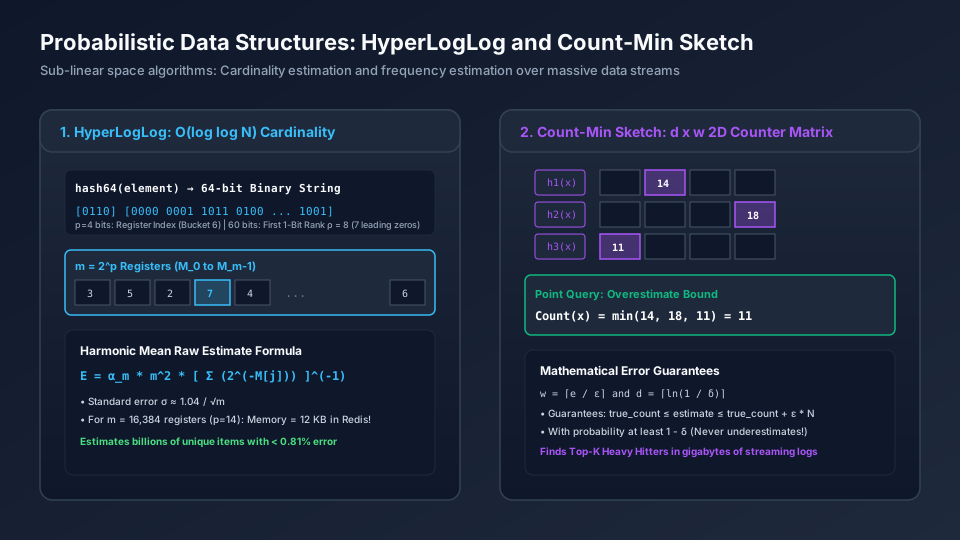
1. hash64(element) → 64-bit Binary String & m = 2^p Registers (M_0 to M_m-1)
Establishes the ingress and structural boundary across hash64(element) → 64-bit Binary String & m = 2^p Registers (M_0 to M_m-1): [0110] [0000 0001 1011 0100 ... 1001]; p=4 bits: Register Index (Bucket 6) | 60 bits: Leading Zeros Count ρ = 7.
2. Harmonic Mean Raw Estimate Formula & Mathematical Error Guarantees
Coordinates core data-plane execution and state transitions through Harmonic Mean Raw Estimate Formula & Mathematical Error Guarantees: E = α_m * m^2 * [ Σ (2^(-M[j])) ]^(-1); Standard error σ ≈ 1.04 / √m; For m = 16,384 registers (p=14): Memory = 12 KB in Redis! Estimates billions of unique items with < 0.81% error.
3. 18 & h3(x)
Enforces durability, state convergence, and output verification across 18 & h3(x): Count(x) = min(14, 18, 11) = 11.
3. Architectural Mechanisms & Concrete Topologies
3.1 HyperLogLog (HLL) Architecture
HyperLogLog partitions elements into registers:
- Hash input element with a uniform 64-bit hash function: .
- Use the first bits as the register index: .
- Count the number of leading zeros in the remaining bits, plus 1: .
- Update register :
3.2 Count-Min Sketch (CMS) Architecture
A 2D array of counters of depth (rows) and width (columns), with independent pairwise hash functions :
- Update(): For each row :
- Query(): Return the minimum value:
4. Formal Mathematical Derivations
4.1 HyperLogLog Harmonic Mean & Standard Error
The raw cardinality estimator uses the harmonic mean of across all registers:
where is a bias-correction constant: For :
Theoretical Standard Error:
For ( registers, as used in Redis):
With a 64-bit hash and prefix bits, the remaining suffix has bits, so (plus 0 for an empty register states), requiring per register:
(Redis prepends a 16-byte HYLL header, bringing a dense Redis HyperLogLog object to exactly .)
4.2 Count-Min Sketch Error Bounds
Assume a non-negative stream (cash-register / strict turnstile model where every update satisfies , and total stream mass is ) and pairwise-independent hash functions. Given additive error factor and failure probability , we dimension the matrix:
The Guarantees (derived via Markov’s inequality on per-row expected collision noise , so , and across independent rows ):
- One-Sided Lower Bound: (never underestimates when all updates ).
- Probabilistic Upper Bound: With probability at least :
Worked Sizing Example: For (additive error of total stream events ) and ( confidence):
- columns; rows.
- Using 32-bit (
4-byte) unsigned counters: —fixed memory whether is or events.
5. Edge Cases, Failure Modes & Distributed Anomalies
5.1 Small Cardinality Bias in HLL
When , many registers remain zero. The raw harmonic mean formula overestimates cardinality. The Fix (Linear Counting Fallback): Count the number of empty registers . If :
5.2 Mergeability: The Ultimate Distributed Superpower
Both HyperLogLog and Count-Min Sketch are monoids under point-wise maximum/addition!
- To compute unique users across 10 distributed Cassandra nodes: each node computes its local 12 KB HLL sketch. The coordinator fetches ten 12 KB buffers ( network transfer) and merges them: The merged sketch has the exact same accuracy as if all data had been processed on a single machine!
6. Open-Source Architectural Studies
6.1 Redis: PFADD, PFCOUNT, PFMERGE
Redis implements HyperLogLog natively. An HLL structure begins in sparse representation (run-length encoded bytes for low cardinality). When memory exceeds 3 KB, Redis converts it to the dense representation of 16,384 6-bit registers, capped permanently at 12 KB.
6.2 Apache Pinot & ClickHouse: Approximate Aggregations
ClickHouse uses uniqCombined64 (a hybrid HyperLogLog variant) to compute SELECT count(DISTINCT user_id) over billions of rows in milliseconds, scanning memory orders of magnitude faster than exact SQL hash sets.
7. Production Incident Post-Mortem (War Stories)
The Billion-Key Redis OOM Blackout
Context: An ad-tracking service counted daily unique cookie clicks per advertiser campaign using Redis SADD campaign:123:cookies <cookie_id>.
The Incident: During a global marketing event, campaigns tracked 45 million unique cookies each. Redis memory surged from 14 GB to 128 GB within 3 hours, triggering the Linux OOM killer (kill -9 redis-server).
The Remediation: Replaced SADD / SCARD with Redis HyperLogLog PFADD / PFCOUNT. Memory dropped from 128 GB to 85 MB (a memory reduction), while distinct reporting error remained below 0.8%.
8. Production-Grade TypeScript Simulation: HyperLogLog & Count-Min Sketch
/**
 * Production Probabilistic Simulation: HyperLogLog & Count-Min Sketch
 * Browser- & Server-portable (uses standard Uint8Array / TextEncoder, zero Node globals).
 */

export class HyperLogLogSimulator {
  private readonly p: number;
  private readonly m: number;
  private readonly registers: Uint8Array;
  private readonly alphaMM: number;
  private readonly encoder = new TextEncoder();

  constructor(p = 12) {
    this.p = p;
    this.m = 1 << p;
    this.registers = new Uint8Array(this.m);

    const alpha = 0.7213 / (1 + 1.079 / this.m);
    this.alphaMM = alpha * this.m * this.m;
  }

  private hash64(key: string): bigint {
    // 64-bit FNV-1a followed by MurmurHash3 fmix64 avalanche finalizer
    let hash = 0xcbf29ce484222325n;
    const fnvPrime = 0x100000001b3n;
    const mask64 = 0xffffffffffffffffn;
    const bytes = this.encoder.encode(key);

    for (let i = 0; i < bytes.length; i++) {
      hash ^= BigInt(bytes[i]);
      hash = (hash * fnvPrime) & mask64;
    }

    // fmix64 finalizer ensures uniform entropy across upper register-index bits
    hash ^= hash >> 33n;
    hash = (hash * 0xff51afd7ed558ccdn) & mask64;
    hash ^= hash >> 33n;
    hash = (hash * 0xc4ceb9fe1a85ec53n) & mask64;
    hash ^= hash >> 33n;
    return hash;
  }

  public add(element: string): void {
    const hash = this.hash64(element);
    const registerIndex = Number(hash >> BigInt(64 - this.p));
    const remainingBits = (hash << BigInt(this.p)) & 0xffffffffffffffffn;
    const maxRank = 64 - this.p + 1;

    // rho(w): 1-based position of first 1-bit in remaining (64 - p) suffix bits
    let rank = 1;
    let mask = 0x8000000000000000n;
    while ((remainingBits & mask) === 0n && rank < maxRank) {
      rank++;
      mask >>= 1n;
    }

    if (rank > this.registers[registerIndex]) {
      this.registers[registerIndex] = rank;
    }
  }

  public count(): number {
    let sum = 0;
    let emptyRegisters = 0;

    for (let i = 0; i < this.m; i++) {
      const val = this.registers[i];
      sum += Math.pow(2, -val);
      if (val === 0) emptyRegisters++;
    }

    let estimate = this.alphaMM / sum;

    // Small cardinality bias correction (Linear Counting)
    if (estimate <= 2.5 * this.m && emptyRegisters > 0) {
      estimate = this.m * Math.log(this.m / emptyRegisters);
    }
    return Math.round(estimate);
  }
}

export class CountMinSketchSimulator {
  private readonly width: number;
  private readonly depth: number;
  private readonly table: Int32Array[];

  constructor(width = 500, depth = 5) {
    this.width = width;
    this.depth = depth;
    this.table = Array.from({ length: depth }, () => new Int32Array(width));
  }

  private hash(key: string, seed: number): number {
    let h = seed >>> 0;
    for (let i = 0; i < key.length; i++) {
      h = Math.imul(h ^ key.charCodeAt(i), 0x5bd1e995) >>> 0;
    }
    h ^= h >>> 13;
    h = Math.imul(h, 0x5bd1e995) >>> 0;
    h ^= h >>> 15;
    return (h >>> 0) % this.width;
  }

  public add(key: string, count = 1): void {
    for (let row = 0; row < this.depth; row++) {
      const col = this.hash(key, row * 0x9e3779b1 + 17);
      this.table[row][col] += count;
    }
  }

  public addConservative(key: string, count = 1): void {
    const targetValue = this.estimate(key) + count;
    for (let row = 0; row < this.depth; row++) {
      const col = this.hash(key, row * 0x9e3779b1 + 17);
      if (this.table[row][col] < targetValue) {
        this.table[row][col] = targetValue;
      }
    }
  }

  public estimate(key: string): number {
    let minCount = Infinity;
    for (let row = 0; row < this.depth; row++) {
      const col = this.hash(key, row * 0x9e3779b1 + 17);
      minCount = Math.min(minCount, this.table[row][col]);
    }
    return minCount;
  }
}

export function runProbabilisticExperiment(): void {
  console.log("=== 1. HyperLogLog Cardinality Verification ===");
  const hll = new HyperLogLogSimulator(12); // m=4096, theoretical sigma = 1.04 / 64 = 1.625%
  const TRUE_DISTINCT = 20000;

  for (let i = 0; i < TRUE_DISTINCT; i++) {
    hll.add(`user_${i}`);
  }

  const estimated = hll.count();
  const errorPercent = (Math.abs(estimated - TRUE_DISTINCT) / TRUE_DISTINCT) * 100;
  console.log(`True Distinct: ${TRUE_DISTINCT} | HLL Estimated: ${estimated} | Error: ${errorPercent.toFixed(2)}%`);

  console.log("=== 2. Count-Min Sketch (Standard vs. Conservative Update) ===");
  const standardCms = new CountMinSketchSimulator(256, 5);
  const conservativeCms = new CountMinSketchSimulator(256, 5);

  standardCms.add("ip_192.168.1.1", 450);
  conservativeCms.addConservative("ip_192.168.1.1", 450);

  for (let i = 0; i < 5000; i++) {
    const noiseKey = `ip_noise_${i % 400}`;
    standardCms.add(noiseKey, 1);
    conservativeCms.addConservative(noiseKey, 1);
  }

  console.log(
    `Heavy Hitter True: 450 | Standard CMS: ${standardCms.estimate("ip_192.168.1.1")} | Conservative CMS: ${conservativeCms.estimate("ip_192.168.1.1")}`
  );
}

runProbabilisticExperiment();
9. Operational Checklist, Failure Runbooks & Sizing Rules
When to Use Probabilistic Data Structures
- Use HyperLogLog: When counting unique entities (DAU/MAU, IP addresses, search queries) where accuracy is acceptable and dataset exceeds – items.
- Use Count-Min Sketch: For point frequency estimation, DDoS heavy-hitter tracking (paired with a bounded Top-K Min-Heap), and frequency-aware cache admission (
W-TinyLFU). - Never Use Probabilistic Structures: For financial accounting balances, exact billing ledgers, inventory deductions, or security revocation lists where exactness is mandatory.
10. Design Alternatives & Trade-offs Matrix
| Structure | Query Answered | Memory Complexity | Error Mode | Distributed Merge? | Best Production Fit |
|---|---|---|---|---|---|
| Exact Hash Set / Map | Membership, exact distinct, exact frequency | linear in unique keys | (exact) | Expensive ( payload transfer) | Billing ledgers, small cardinalities () |
| Bloom Filter | Set membership (mightContain) | bits ( bits/key at FPR) | False positives ; zero false negatives | Yes (bitwise OR across identical shapes) | SSTable negative-lookup gating, cache miss shielding |
| HyperLogLog (HLL) | Cardinality (COUNT(DISTINCT)) | ( for ) | Two-sided unbiased () | Yes (register-wise max in ) | DAU/MAU analytics, multi-dimensional OLAP rollups |
| Count-Min Sketch (CMS) | Point frequency (count(x)) | counters | One-sided overestimate ( w.p. ) | Yes (cell-wise + for standard CMS) | Streaming rate limiting, W-TinyLFU cache admission |
| Space-Saving / Misra-Gries | Top- heavy hitters directly | deterministic counters | Deterministic additive bound | Approximate merge | Direct Top- tracking when key labels must be retained |
11. Guided Applied System Design Exercises & Debugging Drills
Drill 1: Distributed HLL Union across Edge PoPs
Your CDN operates 50 edge Points of Presence (PoPs) globally. Each PoP logs 100 million HTTP requests daily.
- Prove why transmitting raw user IP sets to central servers requires gigabytes of bandwidth, whereas transmitting local 12 KiB HLL sketches requires only total.
- Write the register-wise
maxmerge algorithm to compute the global unique user count from the 50 regional sketches, and state what breaks if two PoPs used different hash seeds or precision parameters .
Drill 2: Top-K Heavy Hitters with CMS & Min-Heap
Design a real-time DDoS mitigation engine that identifies the top 100 IP addresses generating traffic over a 10 Gbps network link.
- Combine a Count-Min Sketch (which stores no keys) with an in-memory Min-Heap of size keyed by estimated frequency.
- Outline how you prevent stale historical spikes from dominating continuous long-lived windows using tumbling dual-sketch rotation or exponential counter halving.
View Reference Architecture & Worked Solutions (CORE-M08-005)
1. Worked Solution — Drill 1: Distributed HLL Union Across 50 Edge PoPs
-
Bandwidth Proof (Raw Set Shipping vs. HLL Sketch Shipping):
- Because the same roaming user or bot IP can hit multiple PoPs, PoPs cannot simply send scalar integers
count_ito be summed centrally ( due to cross-PoP duplicates). - Naive Exact Union: Assuming each of the 50 PoPs observes unique IPv6 (
16-byte) or hashed (8-byte) identifiers out of requests, shipping raw deduplicated sets to the central aggregator transfers: - HyperLogLog Sketch Shipping ( registers ): This achieves a reduction in WAN payload while preserving standard error on the global union .
- Because the same roaming user or bot IP can hit multiple PoPs, PoPs cannot simply send scalar integers
-
Register-Wise
maxMerge Algorithm & Compatibility Invariants:function mergeHLLSketches(sketches: Uint8Array[], m = 16384): Uint8Array { const merged = new Uint8Array(m); for (const sketch of sketches) { if (sketch.length !== m) { throw new Error(`Incompatible HLL precision: expected m=${m}, got ${sketch.length}`); } for (let j = 0; j < m; j++) { if (sketch[j] > merged[j]) { merged[j] = sketch[j]; } } } return merged; }- Why Identical Hash Seeds & Precision Are Mandatory:
- Different Hash Seeds: If uses seed and uses seed , the same user hashes to two independent registers with two independent ranks . Merging them treats as two distinct users, inflating the union toward instead of .
- Different Precision : If () and (), register indices do not align 1-to-1. To merge them, the higher-precision sketch () must first be folded (downsampled) to before merging.
- Why Identical Hash Seeds & Precision Are Mandatory:
2. Worked Solution — Drill 2: Top-K Heavy Hitters with CMS & Min-Heap
-
Combined CMS + Bounded Min-Heap () Architecture:
- A Count-Min Sketch is a counter matrix (
d x w) that does not store original keys, so you cannot enumerate the top 100 IPs from the CMS alone. - Pair the CMS (e.g., , using Conservative Update) with an auxiliary
MinHeap<IpEntry>of maximum capacity and a companionMap<string, HeapNode>for membership lookup:- On packet arrival for
ip, update the CMS:cms.addConservative(ip, 1)and readest = cms.estimate(ip). - If
ipis already in theMinHeap, update its key toestandsiftDownin . - Else if
heap.size < K, insert(ip, est)into theMinHeapin . - Else if
est > heap.peekMin().est, evictheap.popMin()and insert(ip, est)in .
- On packet arrival for
- Memory Footprint: for the CMS plus for the Top-100 Min-Heap ( total RAM to monitor a link at line rate!).
- A Count-Min Sketch is a counter matrix (
-
Preventing Stale Historical Spikes (Windowed Aging):
- Because standard and conservative CMS counters only increase monotonically, a bursty IP from 6 hours ago would permanently occupy the Top-100 heap unless aged out. Two production aging strategies solve this:
- Strategy A — Tumbling Dual-Sketch Rotation (
Active/Warmup): Maintain two CMS + Heap pairs covering windows staggered by . Every , zero out the older sketch (table.fill(0)) so queries always read from a sketch warmed over the last . - Strategy B — Exponential Counter Decay (Halving, as in
W-TinyLFU): Every events (e.g., packets), right-shift every counter in the CMS and Min-Heap by 1 bit (counter >>>= 1), exponentially decaying historical bursts with a predictable half-life while preserving recent heavy hitters.
- Strategy A — Tumbling Dual-Sketch Rotation (
- Because standard and conservative CMS counters only increase monotonically, a bursty IP from 6 hours ago would permanently occupy the Top-100 heap unless aged out. Two production aging strategies solve this:
12. Authoritative References & Version Context
- Flajolet, P., Fusy, É., Gandouet, O., & Meunier, F. (2007). HyperLogLog: the analysis of a near-optimal cardinality estimation algorithm. Conference on Analysis of Algorithms (AofA ‘07), DMTCS Proceedings, pp. 127–146. https://algo.inria.fr/flajolet/Publications/FlFuGaMe07.pdf
- Heule, S., Nunkesser, M., & Hall, A. (2013). HyperLogLog in Practice: Algorithmic Engineering of a State of The Art Cardinality Estimation Algorithm. Proceedings of EDBT 2013 (Google). https://research.google/pubs/hyperloglog-in-practice-algorithmic-engineering-of-a-state-of-the-art-cardinality-estimation-algorithm/
- Cormode, G., & Muthukrishnan, S. (2005). An Improved Data Stream Summary: The Count-Min Sketch and its Applications. Journal of Algorithms, 55(1), pp. 58–75. https://dimacs.rutgers.edu/~graham/pubs/papers/cm-full.pdf
- Estan, C., & Varghese, G. (2002). New Directions in Traffic Measurement and Accounting (Conservative Update). ACM SIGCOMM ‘02. https://dl.acm.org/doi/10.1145/633025.633056
- Redis Official Documentation (Redis 7.x baseline). HyperLogLog (
PFADD,PFCOUNT,PFMERGE) Sparse/Dense 12 KiB Representation. https://redis.io/docs/latest/develop/data-types/probabilistic/hyperloglog/