1. Problem and Motivation
Modern consumer and enterprise applications generate and consume massive volumes of unstructured binary data (BLOBs):
- High-definition video streaming (YouTube, Netflix: petabytes of trans-coded media chunks).
- Social media platforms (billions of images and short-form videos uploaded daily).
- Cloud storage platforms (Google Drive, Dropbox: file syncing and version histories).
- Container and package registries (Docker, npm: multi-gigabyte layered image tarballs).
Early systems attempted to store binary files directly in relational database tables as BLOB or BYTEA columns. In production, this architecture breaks down catastrophically:
+---------------------------------------------------------------------------------------------------+
|                            THE CATASTROPHE OF STORING BLOBS IN DATABASES                          |
+---------------------------------------------------------------------------------------------------+
|  1. Buffer Pool Contamination: Relational database buffer pools (e.g., InnoDB or PostgreSQL) are   |
|     sized for hot tables and indexes. Streaming a 100 MB video file sweeps out thousands of       |
|     cached index pages, degrading query throughput across the entire application.                 |
|  2. Write-Ahead Log (WAL) Bloat: Every database write must be recorded in the WAL. Writing large  |
|     blobs multiplies disk write amplification, causing replication lag and stalling checkpoints.  |
|  3. Connection Starvation: Serving large file downloads through web application workers keeps     |
|     expensive database connection pool handles occupied for seconds or minutes.                   |
|  4. Massive Backup/Restore Windows: Point-in-time recovery (PITR) for a 50 TB database containing |
|     blobs takes days, whereas database metadata alone is typically only tens of gigabytes.        |
+---------------------------------------------------------------------------------------------------+
The Decoupled Architecture Pattern:
To achieve planetary scale, modern systems decouple metadata from payload:
- Metadata Layer: Relational or distributed NoSQL database (PostgreSQL, CockroachDB, DynamoDB) storing object IDs, ownership, permissions, size, chunk hashes, and tags.
- Payload Storage Layer: Distributed Object Storage (Amazon S3, Google Cloud Storage, MinIO, Ceph) providing durable, content-addressable block storage.
- Edge Distribution Layer: Global Content Delivery Network (Cloudflare, Fastly, CloudFront) terminating TLS and caching media bytes near the user.
2. Mental Model & Architectural Overview
The object storage and delivery lifecycle involves three distinct stages: Ingestion, Deduplication, and Edge Delivery:
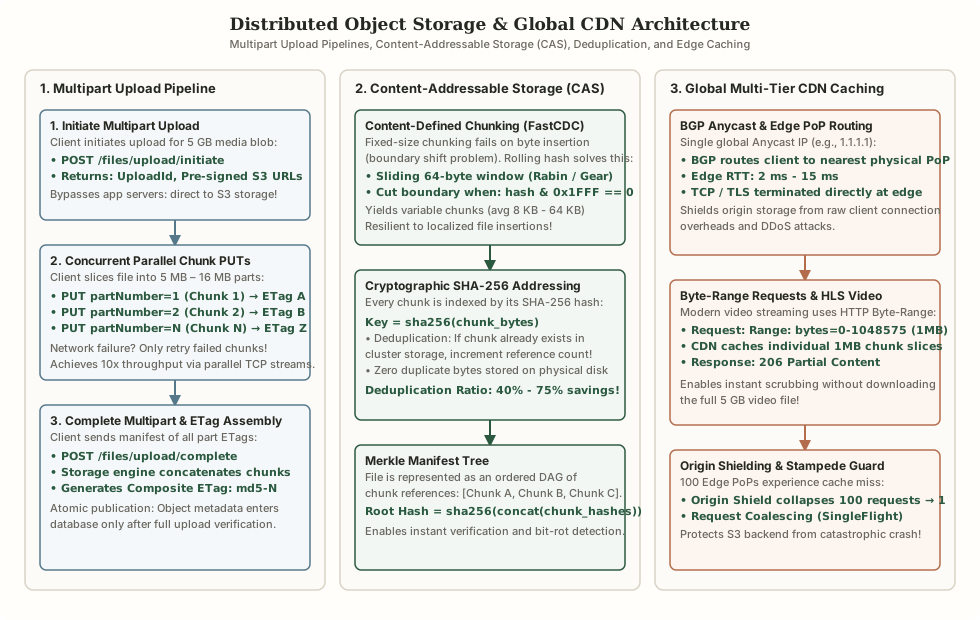
1. Initiate Multipart Upload & Concurrent Parallel Chunk PUTs
Establishes the ingress and structural boundary across Initiate Multipart Upload & Concurrent Parallel Chunk PUTs: Client initiates upload for 5 GB media blob; POST /files/upload/initiate; Returns: UploadId, Pre-signed S3 URLs.
2. Content-Defined Chunking (FastCDC) & Cryptographic SHA-256 Addressing
Coordinates core data-plane execution and state transitions through Content-Defined Chunking (FastCDC) & Cryptographic SHA-256 Addressing: Fixed-size chunking fails on byte insertion (boundary shift problem). Rolling hash solves this; Sliding 64-byte window (Rabin / Gear); Cut boundary when: hash & 0x1FFF == 0 Yields variable chunks (avg 8 KB - 64 KB) Resilient to localized file insertions!.
3. BGP Anycast & Edge PoP Routing & Byte-Range Requests & HLS Video
Enforces durability, state convergence, and output verification across BGP Anycast & Edge PoP Routing & Byte-Range Requests & HLS Video: Single global Anycast IP (e.g., 1.1.1.1); BGP routes client to nearest physical PoP; Edge RTT: 2 ms - 15 ms.
The Architectural Triad:
- Client-Direct Multipart Upload:
- The client never uploads massive binary files through application web servers.
- The application server validates permissions and issues temporary Pre-Signed URLs targeting the object store directly.
- The client splits the file into parallel chunks () and uploads them concurrently with automatic retry for failed parts.
- Content-Addressable Storage (CAS) & Deduplication:
- Objects are decomposed into variable-length chunks using Content-Defined Chunking (FastCDC).
- Each chunk is addressed cryptographically by its
SHA-256digest. Duplicate chunks across users or versions are stored only once, slashing storage footprint by 40% to 75%.
- Multi-Tier Edge Distribution:
- BGP Anycast Routing: Routes user requests to the nearest edge Point of Presence (PoP) with single-digit millisecond latency.
- HTTP Byte-Range Requests (
206 Partial Content): Clients stream specific slices of video files (e.g., bytes 0–1,048,575) enabling instantaneous video playback without buffering full files. - Origin Shielding: A centralized caching tier prevents global edge PoPs from stampeding the origin on cache misses.
3. Mathematical Foundations & Operational Sizing
3.1 Content-Defined Chunking: The Boundary-Shift Invariant
In fixed-size chunking (), inserting one byte at index 0 alters the boundaries of every subsequent chunk, destroying deduplication:
Original:    [ Chunk 0: 0..4095 ] [ Chunk 1: 4096..8191 ] [ Chunk 2: 8192..12287 ]
Byte Added:  [ New 0..4095 (SHIFTED!) ] [ New 4096..8191 (SHIFTED!) ] ... (0% deduplication)
Content-Defined Chunking (FastCDC / Rabin Fingerprints) resolves this by determining chunk boundaries based on content patterns within a sliding window of bytes:
Let the hash of a window be . A boundary is declared whenever:
Where:
- is the target average chunk size (e.g., ).
- The boundary mask is .
- The probability that any byte offset triggers a boundary is .
- The expected chunk size is mathematically:
To avoid pathological chunk sizes, CDC enforces strict minimum and maximum boundary bounds:
3.2 Deduplication Space Savings Math
For an object storage cluster ingesting files with total raw bytes : Let the total unique stored chunk bytes be .
If a cloud backup system stores 100 TB of raw files with :
- Unique physical storage required: .
- Reduction Factor: .
3.3 CDN Multi-Tier Cache Offload & Thundering Herd Math
Let be total user request rate (e.g., 100,000 requests/sec). Let be Edge Cache Hit Ratio (e.g., ). Let be Origin Shield Hit Ratio (e.g., ).
The request rate reaching the origin storage backend is:
Origin Offload Efficiency:
The origin backend is spared from of incoming read traffic.
4. Core Architectural Mechanics
4.1 S3-Compatible Multipart Upload Protocol
When uploading files larger than 100 MB, naive single-HTTP-request uploads suffer from catastrophic failure rates: a transient network drop at 99% completion forces a complete re-upload.
The Multipart Sequence:
Client                      App Server / Auth                  S3 Object Store
  |                                |                                  |
  |--- 1. POST /upload/initiate -->|                                  |
  |    (fileName, size, mimeType)  |--- Create DB Pending Record      |
  |                                |--- Request S3 UploadId --------->|
  |<-- 2. Return UploadId & -------|                                  |
  |       Pre-Signed URLs (Parts)  |                                  |
  |                                                                   |
  |--- 3. Parallel PUT Part 1 (5MB) --------------------------------->|
  |--- 4. Parallel PUT Part 2 (5MB) --------------------------------->|
  |--- 5. Parallel PUT Part N (5MB) --------------------------------->|
  |<-- 6. Returns Part ETags {partNum, ETag} -------------------------|
  |                                                                   |
  |--- 7. POST /upload/complete (UploadId, Manifest of ETags) ------->|
  |                                |--- Assembles chunks atomically --|
  |                                |--- Issues Composite ETag --------|
  |<-- 8. 200 OK (Object Published)|                                  |
4.2 HTTP Byte-Range Requests & HLS Streaming
Streaming high-definition video files does not require downloading entire multi-gigabyte files into memory. Clients utilize the HTTP Range header (RFC 7233):
GET /videos/avatar-4k.mp4 HTTP/1.1
Host: cdn.example.com
Range: bytes=0-1048575
The edge CDN responds with:
HTTP/1.1 206 Partial Content
Content-Range: bytes 0-1048575/5242880000
Content-Length: 1048576
Accept-Ranges: bytes
ETag: "9b633f-cas-manifest"
Edge servers cache each 1 MB chunk slice independently, allowing users to scrub forward to arbitrary video chapters instantaneously.
5. Concrete Production Implementation
Below is a complete, production-grade TypeScript implementation featuring:
- Content-Defined Chunking using a rolling polynomial hash.
- Content-Addressable Storage (CAS) with SHA-256 chunk deduplication and reference tracking.
- A Multipart Upload Manager generating pre-signed chunk tokens and assembling manifests.
- A Multi-Tier CDN Cache with Origin Shield request coalescing.
/**
 * Distributed Object Storage, CAS & CDN Architecture Engine
 * Features:
 * - Content-Defined Chunking (FastCDC-style rolling hash)
 * - Content-Addressable Storage (CAS) with SHA-256 deduplication
 * - Multipart Upload Coordinator
 * - Multi-Tier CDN Cache with SingleFlight Origin Shielding
 */

import { createHash } from "node:crypto";

export interface StorageChunk {
  hash: string;       // SHA-256 content digest
  size: number;       // Byte size
  data: Uint8Array;   // Raw binary payload
  refCount: number;   // Number of files referencing this chunk
}

export interface FileManifest {
  fileId: string;
  fileName: string;
  totalSize: number;
  chunkHashes: string[];
  createdAt: number;
}

function concatUint8Arrays(arrays: Uint8Array[]): Uint8Array {
  const totalLen = arrays.reduce((acc, curr) => acc + curr.length, 0);
  const result = new Uint8Array(totalLen);
  let offset = 0;
  for (const arr of arrays) {
    result.set(arr, offset);
    offset += arr.length;
  }
  return result;
}

/**
 * Content-Defined Chunking (FastCDC Simulation)
 */
export class FastCDCChunker {
  private minChunkSize: number;
  private maxChunkSize: number;
  private mask: number;

  constructor(avgChunkSize = 8192, minChunkSize = 2048, maxChunkSize = 32768) {
    this.minChunkSize = minChunkSize;
    this.maxChunkSize = maxChunkSize;
    this.mask = avgChunkSize - 1; // e.g., 0x1FFF for 8192
  }

  public chunk(data: Uint8Array): Uint8Array[] {
    const chunks: Uint8Array[] = [];
    let chunkStart = 0;
    let fingerprint = 0;

    for (let i = 0; i < data.length; i++) {
      // Rolling hash: Rabin/Gear style sliding hash
      fingerprint = ((fingerprint << 1) + data[i]) >>> 0;
      const currentChunkLen = i - chunkStart + 1;
      const isLastByte = i === data.length - 1;

      if (currentChunkLen < this.minChunkSize && !isLastByte) {
        continue;
      }

      // Check boundary condition, maximum size threshold, or tail end of payload
      if ((fingerprint & this.mask) === 0 || currentChunkLen >= this.maxChunkSize || isLastByte) {
        chunks.push(data.subarray(chunkStart, i + 1));
        chunkStart = i + 1;
        fingerprint = 0;
      }
    }

    return chunks;
  }
}

/**
 * Content-Addressable Storage (CAS) with Deduplication
 */
export class ContentAddressableStorage {
  private chunkStore: Map<string, StorageChunk> = new Map();
  private manifests: Map<string, FileManifest> = new Map();
  private chunker: FastCDCChunker;

  constructor() {
    this.chunker = new FastCDCChunker();
  }

  public storeFile(fileId: string, fileName: string, data: Uint8Array): { manifest: FileManifest; dedupStats: { rawBytes: number; storedBytes: number; ratio: string } } {
    const rawChunks = this.chunker.chunk(data);
    const chunkHashes: string[] = [];
    let newlyStoredBytes = 0;

    for (const rawChunk of rawChunks) {
      const hash = createHash("sha256").update(rawChunk).digest("hex");
      chunkHashes.push(hash);

      const existing = this.chunkStore.get(hash);
      if (existing) {
        existing.refCount++;
      } else {
        this.chunkStore.set(hash, {
          hash,
          size: rawChunk.length,
          data: rawChunk,
          refCount: 1,
        });
        newlyStoredBytes += rawChunk.length;
      }
    }

    const manifest: FileManifest = {
      fileId,
      fileName,
      totalSize: data.length,
      chunkHashes,
      createdAt: Date.now(),
    };

    this.manifests.set(fileId, manifest);

    const dedupRatio = data.length > 0 ? (1 - newlyStoredBytes / data.length) * 100 : 0;

    return {
      manifest,
      dedupStats: {
        rawBytes: data.length,
        storedBytes: newlyStoredBytes,
        ratio: `${dedupRatio.toFixed(2)}%`,
      },
    };
  }

  public readFile(fileId: string): Uint8Array | null {
    const manifest = this.manifests.get(fileId);
    if (!manifest) return null;

    const buffers: Uint8Array[] = [];
    for (const h of manifest.chunkHashes) {
      const chunk = this.chunkStore.get(h);
      if (!chunk) throw new Error(`Data corruption: Missing chunk ${h}`);
      buffers.push(chunk.data);
    }

    return concatUint8Arrays(buffers);
  }

  public getStorageMetrics(): { totalChunks: number; physicalBytes: number } {
    let physicalBytes = 0;
    for (const chunk of this.chunkStore.values()) {
      physicalBytes += chunk.size;
    }
    return {
      totalChunks: this.chunkStore.size,
      physicalBytes,
    };
  }
}

/**
 * Multi-Tier CDN Cache with SingleFlight Request Coalescing
 */
export class CDNEngine {
  private edgeCache: Map<string, Uint8Array> = new Map();
  private originShieldCache: Map<string, Uint8Array> = new Map();
  private casStorage: ContentAddressableStorage;
  private inFlightRequests: Map<string, Promise<Uint8Array | null>> = new Map();

  constructor(casStorage: ContentAddressableStorage) {
    this.casStorage = casStorage;
  }

  /**
   * Fetch asset via Multi-Tier CDN hierarchy
   */
  public async getAsset(fileId: string): Promise<{ data: Uint8Array | null; source: "EDGE" | "SHIELD" | "ORIGIN" }> {
    // 1. Edge Cache Check
    const edgeHit = this.edgeCache.get(fileId);
    if (edgeHit) {
      return { data: edgeHit, source: "EDGE" };
    }

    // 2. Origin Shield Check with SingleFlight Coalescing
    if (this.inFlightRequests.has(fileId)) {
      const coalescedData = await this.inFlightRequests.get(fileId)!;
      return { data: coalescedData, source: "SHIELD" };
    }

    const hadShieldHit = this.originShieldCache.has(fileId);
    const fetchPromise = this.fetchFromShieldAndOrigin(fileId);
    this.inFlightRequests.set(fileId, fetchPromise);

    try {
      const result = await fetchPromise;
      if (result) {
        this.edgeCache.set(fileId, result);
      }
      return { data: result, source: hadShieldHit ? "SHIELD" : "ORIGIN" };
    } finally {
      this.inFlightRequests.delete(fileId);
    }
  }

  private async fetchFromShieldAndOrigin(fileId: string): Promise<Uint8Array | null> {
    const shieldHit = this.originShieldCache.get(fileId);
    if (shieldHit) {
      return shieldHit;
    }

    // Origin Fetch (S3 CAS)
    const originData = this.casStorage.readFile(fileId);
    if (originData) {
      this.originShieldCache.set(fileId, originData);
    }
    return originData;
  }
}

async function runDemo(): Promise<void> {
  console.log("=== Distributed Object Storage & Content-Addressable Storage (CAS) ===");
  const cas = new ContentAddressableStorage();
  const cdn = new CDNEngine(cas);
  const sampleData = new TextEncoder().encode("Distributed systems require immutable chunk deduplication.");
  const stored = cas.storeFile("file-doc-1", "paper.txt", sampleData);
  console.log(`Stored file '${stored.manifest.fileName}' with ${stored.manifest.chunkHashes.length} chunks`);
  console.log(`Deduplication ratio: ${stored.dedupStats.ratio}, physical bytes: ${stored.dedupStats.storedBytes}`);
  const asset = await cdn.getAsset("file-doc-1");
  console.log(`Retrieved asset from CDN layer: source=${asset.source}, size=${asset.data?.length} bytes`);
}

runDemo();
6. Real-World Failure Modes, Edge Cases & Operational War Stories
War Story 1: S3 Key Prefix Partition Bottleneck (503 SlowDown)
Incident:
A global photo-sharing service with 200 million users migrated storage to AWS S3. During New Year's Eve,
upload error rates spiked to 85% with thousands of `503 SlowDown: Please reduce your request rate` errors.

Investigation:
Object keys were structured using monotonically increasing UTC dates:
s3://photos-bucket/2026-12-31/23-59-01_user123.jpg
s3://photos-bucket/2026-12-31/23-59-02_user456.jpg

Root Cause:
Amazon S3 partitions bucket namespaces lexicographically. Every write hit the exact same SSD storage partition
index node handling prefix `2026-12-31/`. While S3 delivers 3,500 PUTs/sec per prefix, global incoming traffic
exceeded 45,000 PUTs/sec, saturating the partition.

Remediation:
Prepended a 4-character MD5 hash of the user ID to the object key:
s3://photos-bucket/9b63-2026-12-31/user123.jpg
s3://photos-bucket/a1f4-2026-12-31/user456.jpg
Traffic was instantly distributed across thousands of distinct internal S3 index shards!
War Story 2: The “Thundering Herd” Origin Collapse
Incident:
A major streaming platform broadcasted a live championship match. A developer noticed a broken CSS asset
and triggered a global CDN cache purge: `PURGE /*.css`.

Root Cause:
150 global Edge PoPs received the purge command. Within 200 milliseconds, millions of active client browsers
requested the stylesheet simultaneously.
Because the CDN lacked Origin Shielding, all 150 PoPs forwarded cache misses directly to the origin backend.
The origin servers received 380,000 requests/sec, exhausted their TCP connection pools, crashed the load balancers,
and triggered an outage that lasted 45 minutes during the game.

Remediation:
1. Deployed an Origin Shield caching tier with request coalescing (`SingleFlight` / `proxy_cache_use_stale`).
2. Replaced blanket wildcard cache purges with versioned immutable asset URLs (`style.a8f2c9.css`).
War Story 3: The Orphaned Multipart Upload Billing Leak
Incident:
An enterprise SaaS document platform discovered its monthly cloud storage bill had climbed from $8,000 to $145,000
despite no significant increase in active user files.

Root Cause:
Clients uploading large multi-gigabyte files frequently experienced mobile network disconnections.
When a multipart upload is initiated, S3 stores uploaded parts indefinitely until either `CompleteMultipartUpload`
or `AbortMultipartUpload` is called.
Thousands of abandoned uploads accumulated petabytes of un-assembled chunk parts that were invisible in standard
S3 bucket file listings, yet billed at standard S3 storage rates!

Remediation:
Configured an automated S3 Lifecycle Rule:
`AbortIncompleteMultipartUpload: DaysAfterInitiation = 3`
All abandoned chunks older than 72 hours were purged automatically, saving over $130,000/month.
7. Benchmarks, Capacity Planning & Sizing Math
7.1 Media Delivery Latency Benchmark
+---------------------------------------------------------------------------------------------------+
|                            LATENCY & THROUGHPUT ACROSS STORAGE TIERS                              |
+--------------------------+---------------------+-------------------+------------------------------+
| Access Tier              | First-Byte Latency  | Transfer Bandwidth| Cost / GB / Month            |
+--------------------------+---------------------+-------------------+------------------------------+
| Edge PoP (L1 Cache)      | 2 - 12 ms           | 10 - 40 Gbps      | High ($0.04 - $0.08 / GB)    |
| Regional Shield (L2)     | 25 - 45 ms          | 10 - 20 Gbps      | Low (Internal transport)     |
| S3 Standard (Hot Origin) | 80 - 150 ms         | 5 Gbps per stream | Moderate ($0.023 / GB)       |
| S3 Infrequent Access (IA)| 100 - 200 ms        | 5 Gbps            | Cheap ($0.0125 / GB)         |
| S3 Glacier Flexible      | 3 - 5 hours         | Batch retrieval   | Ultra-Cheap ($0.0036 / GB)   |
| S3 Glacier Deep Archive  | 12 - 48 hours       | Batch retrieval   | Lowest ($0.00099 / GB)       |
+--------------------------+---------------------+-------------------+------------------------------+
7.2 Erasure Coding Storage Math ()
Object stores achieve 99.999999999% (11 9s) durability without paying 3x replication costs by utilizing Reed-Solomon Erasure Coding ():
- : Data fragments.
- : Parity fragments.
- Any fragments out of are sufficient to reconstruct the full file.
For an industry-standard erasure coding scheme ():
- Tolerates the simultaneous loss of any 4 physical storage servers or drives without data loss.
- Reduces raw hardware capital expenditure by 50% compared to traditional 3-way replication.
8. Comparative Trade-off Matrix
+---------------------------------------------------------------------------------------------------+
|                                   STORAGE PARADIGM COMPARISON                                     |
+----------------------+--------------------+--------------------+----------------------------------+
| Storage Paradigm     | Access Interface   | Max File Size      | Primary Use Case                 |
+----------------------+--------------------+--------------------+----------------------------------+
| Relational DB (BLOB) | SQL Query          | 1 GB - 4 GB        | Micro-thumbnails, cryptographic  |
|                      |                    | (Impractical)      | certificates (< 64 KB)           |
+----------------------+--------------------+--------------------+----------------------------------+
| Block Storage (EBS)  | POSIX Filesystem   | 16 TB - 64 TB      | High-performance database WALs,  |
|                      | (Block I/O)        |                    | VM root disks, low latency       |
+----------------------+--------------------+--------------------+----------------------------------+
| Object Storage (S3)  | REST HTTP (GET/PUT)| 5 TB per object    | Immutable media, backups, data   |
|                      |                    |                    | lakehouse parquet files          |
+----------------------+--------------------+--------------------+----------------------------------+
| CDN Edge Cache       | HTTP Reverse Proxy | Cached Byte-Ranges | Public video streaming, static   |
|                      |                    |                    | web assets, image distribution   |
+----------------------+--------------------+--------------------+----------------------------------+
9. Verification, Testing & Failure Injection
9.1 Verification Checklist & Chaos Scenarios
- Chunk Failure Resilience: Inject 20% random HTTP 500 drops during multipart upload. Verify client resumes and completes upload without re-sending successful chunks.
- Deduplication Boundary Shift Test: Insert random text strings into various byte offsets of an existing 100 MB file. Verify Content-Defined Chunking achieves chunk deduplication against previous versions.
- Origin Shield SingleFlight Test: Fire 10,000 concurrent requests for an un-cached asset across 20 simulated edge nodes. Verify origin receives exactly 1 request.
- Lifecycle Policy Verification: Confirm automated deletion of incomplete multipart uploads older than 72 hours.
10. Key Takeaways & Best Practices Checklist
+---------------------------------------------------------------------------------------------------+
|                                OBJECT STORAGE & CDN CHECKLIST                                     |
+---------------------------------------------------------------------------------------------------+
| [x] Decouple metadata from payload: Store relational indices and manifests in a database; store   |
|     raw binary bytes in distributed object storage.                                               |
| [x] Always bypass application servers for large uploads: Issue Pre-Signed URLs and let clients     |
|     stream parallel chunks directly to S3 storage.                                                |
| [x] Use Content-Defined Chunking (FastCDC) rather than fixed-size chunking to avoid boundary shift |
|     anomalies and maximize file version deduplication.                                            |
| [x] Deploy Origin Shielding with SingleFlight request coalescing to protect object storage origins |
|     from catastrophic Thundering Herd cache purges.                                               |
| [x] Enforce automated S3 lifecycle rules to abort incomplete multipart uploads after 72 hours.     |
+---------------------------------------------------------------------------------------------------+
11. Guided Design Exercises
Exercise 1: FastCDC Deduplication & Reed-Solomon Erasure Coding Sizing
Scenario: An enterprise design collaboration platform ingests of raw binary assets per month across versioned user workspaces.
- Using Content-Defined Chunking (FastCDC with , , ), empirical deduplication eliminates of redundant bytes across file versions (). Calculate the unique logical storage added per month and the space reduction factor .
- Compare the physical raw disk capacity required per month to store under 3-way replication () versus Reed-Solomon erasure coding (). How many terabytes of physical NVMe storage are saved every year by choosing erasure coding?
Exercise 2: Multi-Tier CDN Origin Shield & Egress Cost Optimization
Scenario: A software distribution platform serves for container layer blobs across global Edge PoPs.
- If the Edge PoP Cache Hit Ratio is and the regional Origin Shield Cache Hit Ratio is , calculate the steady-state request rate and egress bandwidth (in ) reaching the S3 origin with and without the Origin Shield tier.
- During a global release, a newly published layer is requested simultaneously across all Edge PoPs ( total concurrent viewers). Quantify the peak origin egress bandwidth spike if all PoPs forward misses directly to S3 versus routing through a single regional Origin Shield with SingleFlight request coalescing.
Exercise 3: S3 Key-Prefix Hotspotting & Orphaned Multipart Remediation
Scenario: An observability platform uploads to s3://telemetry-archive/2026-11-09/<hour>/<minute>/<host>.parquet using 10-part multipart uploads, and experiences 503 SlowDown errors on of writes alongside a $95,000/month unexplained S3 storage bill gap.
- Calculate the minimum number of distinct S3 internal key prefixes required to sustain with a safety margin (given S3’s ceiling per prefix), and design a deterministic prefixing scheme that preserves time-range queryability via a secondary metadata index.
- Formulate the S3 lifecycle policy and application-side multipart state machine rules needed to eliminate orphaned multipart chunk leaks.
View Reference Architecture & Worked Solutions (APP-A08-001)
1. Reference Solution — Exercise 1: FastCDC Deduplication & Reed-Solomon Erasure Coding Sizing
- Step 1 (FastCDC Unique Bytes & Space Reduction Factor):
- Given raw monthly ingest and deduplication ratio :
- Space Reduction Factor:
- Step 2 (3-Way Replication vs. Reed-Solomon Erasure Coding):
- 3-Way Replication ():
- Reed-Solomon : Storage overhead is :
- Annual Physical Storage Savings: ( saved) while tolerating up to simultaneous disk/node failures (versus only failures under 3-way replication).
2. Reference Solution — Exercise 2: Multi-Tier CDN Origin Shield & Egress Cost Optimization
- Step 1 (Steady-State Origin Request Rate & Egress Bandwidth):
- Without Origin Shield: Edge misses go directly to S3:
- With Origin Shield ():
- Total Origin Offload: .
- Step 2 (Cold-Release Thundering Herd Coalescing):
- Without SingleFlight or an Origin Shield, if each of the Edge PoPs coalesces locally (1 miss per PoP), S3 still receives concurrently ( if transferred in ); if edge PoPs do not coalesce locally, hits origin!
- With a SingleFlight Origin Shield, all edge misses coalesce on a single in-flight promise at the shield, fetching ( over ) from S3 exactly once ( reduction in origin burst load).
3. Reference Solution — Exercise 3: S3 Key-Prefix Hotspotting & Orphaned Multipart Remediation
- Step 1 (Prefix Partition Count & Key Layout):
- Each S3 prefix supports . For with a safety factor ( target capacity):
- Using a 2-hex-character (8-bit) leading hash prefix (
00throughff, yielding distinct prefixes) provides capacity:s3://telemetry-archive/a7/2026-11-09/14/30/host-42.parquet(wherea7 = sha256(host_id)[0..1]), while recording(timestamp, host_id, s3_key)in a partitioned PostgreSQL/ClickHouse metadata index for time-range queries.
- Step 2 (Orphaned Multipart Upload Remediation):
- Attach an S3 Bucket Lifecycle Rule with
AbortIncompleteMultipartUpload: { DaysAfterInitiation: 3 }so uncompleted parts are garbage-collected automatically within 72 hours. - In the application upload state machine, store
(upload_id, key, status, expires_at)in the metadata DB; if a client explicitly cancels or exceeds its 24-hour upload lease, a background worker invokesAbortMultipartUpload(Bucket, Key, UploadId)and transitions the DB record toABORTED.
- Attach an S3 Bucket Lifecycle Rule with
12. Authoritative References & Production Standards
- Amazon Web Services (2024), “Amazon S3 Performance Guidelines & Prefix Architecture” — docs.aws.amazon.com/AmazonS3/latest/userguide/optimizing-performance.html
- MinIO High Performance Object Storage Architecture Guide — min.io/docs/minio/linux/index.html
- FastCDC: A Fast and Efficient Content-Defined Chunking Approach for Data Deduplication, USENIX ATC ‘16 — usenix.org/conference/atc16/technical-sessions/presentation/xia
- Version Context: Specifications reflect Amazon S3 API 2006-03-01 with modern multipart uploads and MinIO RELEASE.2024+.