1. The Problem & Why It Matters
In traditional data center architecture, security relied on the Castle-and-Moat perimeter model:
- The perimeter firewall is the moat.
- Any traffic originating inside the private internal network (
10.0.0.0/8) is implicitly trusted. - Internal service-to-service RPCs communicate over unencrypted HTTP/1.1 without authentication.
In modern multi-tenant cloud environments, the castle-and-moat model is an invitation to disaster:
- Lateral Movement: An attacker exploiting a vulnerability in an uncritical public documentation server instantly gains access to the internal network, eavesdrops on plaintext credit card RPCs via packet sniffing (
tcpdump), and queries internal databases without credentials. - The Multi-Tenant Leak Nightmare: In a B2B SaaS application hosting thousands of corporate tenants in a shared database, a single missing
WHERE tenant_id = ?clause in an API query exposes sensitive medical records or financial statements of Fortune 500 companies to their direct competitors. - Noisy Neighbor Starvation: A script written by a single enthusiastic customer runs an unindexed query across 10 million rows, locking database tables and starving hundreds of other customers of service.
Enterprise systems engineering requires Zero Trust Architecture and mathematically robust Multi-Tenant Isolation.
2. Intuitive Mental Model
Imagine an office building with hundreds of independent corporate tenants:
- Perimeter Security: A security guard stands at the front lobby door. Once a person enters the building, all interior doors are completely unlocked. A thief who enters as a pizza delivery driver can walk into any bank vault or law firm office inside the building.
- Zero Trust Security: Every single office door, file cabinet, and conference room has a biometric card reader. An employee must scan their badge every time they cross a doorway. The badge expires every 60 minutes and must be re-issued by the central security office.
- Row-Level Security (RLS): The building filing room contains folders for all companies in one filing cabinet. However, the clerk wears special polarized glasses: when Company A’s clerk looks at the cabinet, all Company B folders are literally invisible.
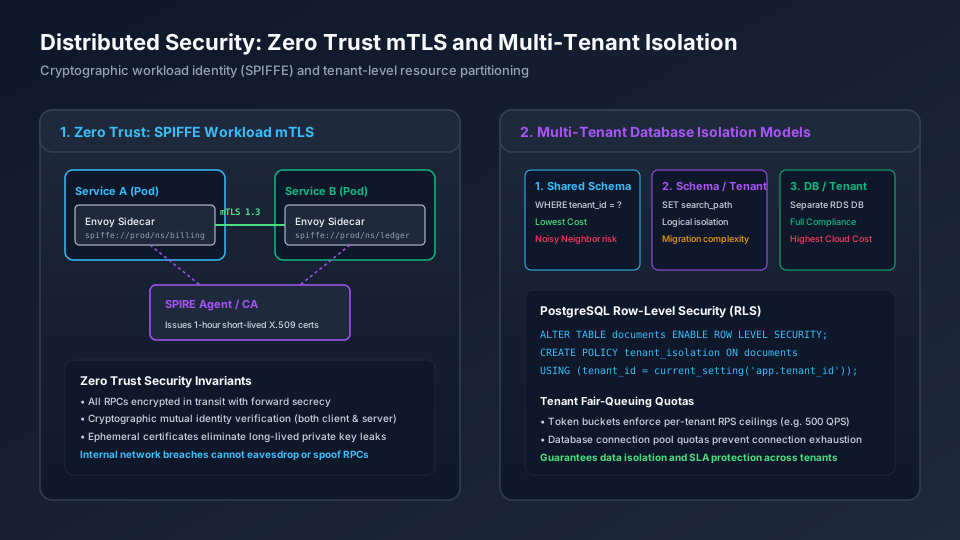
1. Service A (Pod) & Envoy Sidecar
Establishes the ingress and structural boundary across Service A (Pod) & Envoy Sidecar: spiffe://prod/ns/billing; spiffe://prod/ns/ledger; Issues 1-hour short-lived X.509 certs.
2. Shared Schema & Schema / Tenant
Coordinates core data-plane execution and state transitions through Shared Schema & Schema / Tenant: WHERE tenant_id = ?; Lowest Cost Noisy Neighbor risk; SET search_path Logical isolation Migration complexity.
3. Shared Schema & Schema / Tenant
Enforces durability, state convergence, and output verification across Shared Schema & Schema / Tenant: WHERE tenant_id = ?; Lowest Cost Noisy Neighbor risk; SET search_path Logical isolation Migration complexity.
Foundational Bridge: Linux Container Isolation (cgroups v2, Namespaces, seccomp) & Kubernetes Scheduler Internals
Before enforcing service-mesh mTLS or database Row-Level Security, multi-tenant compute workloads rely on Linux kernel isolation primitives and cluster scheduling loops:
- Linux Kernel Container Primitives:
- Namespaces (
clone()flags): Partition visibility so a process sees only its own virtualized Process ID tree (CLONE_NEWPID), network stack and routing tables (CLONE_NEWNET), mount table (CLONE_NEWNS), and UID/GID mapping (CLONE_NEWUSER). - Control Groups (
cgroups v2): Enforce hard physical resource ceilings: CPU bandwidth throttling (cpu.maxCFS quota/period), memory limits (memory.max, triggering the kernel OOM-killer if breached, andmemory.highfor reclaim pressure), and block/NVMe I/O weights (io.weight,io.max). - Syscall Sandboxing (
seccomp-bpf) & MicroVMs: Because containers share a single host Linux kernel, untrusted multi-tenant code requiresseccomp-bpfsyscall filters plus hardware-virtualized sandboxes (AWS Firecracker KVM microVMs or gVisor user-space kernel interception) to prevent kernel privilege-escalation escapes.
- Namespaces (
- Kubernetes Control-Plane & Scheduler Pipeline (
kube-scheduler):- Every Kubernetes controller operates as a level-triggered reconciliation loop watching
etcdrevisions viaInformercaches (ReflectorDeltaFIFOIndexer). - When an unscheduled Pod appears,
kube-schedulerruns a two-stage pipeline: Filtering (Predicates) eliminates nodes lacking sufficient allocatable CPU/RAM, matchingnodeSelector/taints, or zone topology constraints, followed by Scoring (Priorities) which ranks surviving nodes by image locality, bin-packing vs. spread (topologySpreadConstraints), and affinity weights before writing aBindingback toetcd.
- Every Kubernetes controller operates as a level-triggered reconciliation loop watching
3. Architectural Mechanisms & Concrete Topologies
3.1 Mutual TLS (mTLS) with SPIFFE/SPIRE
In standard TLS (one-way), the client verifies the server’s identity (e.g. your browser verifies google.com).
In Mutual TLS (mTLS):
- The client verifies the server’s X.509 certificate.
- The server also demands and verifies the client’s X.509 certificate!
- Both sides cryptographically prove their identity before a single application byte is transmitted.
SPIFFE (Secure Production Identity Framework for Everyone):
Defines a standard URI for workload identity:
spiffe://prod.acme.internal/ns/payments/sa/payment-processor
SPIRE (The SPIFFE Runtime Engine): Attests local container processes using kernel metadata (Linux cgroups, Kubernetes pod namespaces) and issues short-lived (1-hour) X.509 SVID certificates to Envoy sidecars automatically.
3.2 Multi-Tenant Database Models
Model                 Isolation Level   Cloud Cost     Migration Complexity   Compliance
1. Shared Schema      Low (Logical)     Lowest         Trivial                Difficult (SOC2)
2. Schema-per-Tenant  Medium (Schema)   Moderate       High (DDL across 1000s)Moderate
3. DB-per-Tenant      Highest (Physical)Highest        Moderate               Trivial (HIPAA/FedRAMP)
4. Formal Mathematical Derivations
4.1 Deficit Weighted Round-Robin (DWRR) Fair Queuing
To prevent noisy-neighbor starvation across tenants, queues use Deficit Weighted Round-Robin (DWRR). Each tenant has weight and quantum . Each tenant maintains a deficit counter , initialized to 0.
In each round:
- Counter is incremented: .
- While queue is non-empty and head packet size :
- Packet of size is transmitted.
- Deficit updated: .
- If queue becomes empty, deficit is reset: .
Fairness Guarantee: Over any time window, the maximum service differential between two tenants with equal weights is bounded by at most one maximum transmission packet size:
No tenant can starve another, regardless of arrival burstiness!
5. Edge Cases, Failure Modes & Distributed Anomalies
5.1 The JWT Revocation Dilemma
Stateless JSON Web Tokens (JWTs) are signed using asymmetric cryptography (RSA/ECDSA). An API gateway validates the token locally using the public key without touching a central database.
The Vulnerability: If a user is fired or their token is stolen, the token remains valid until its exp timestamp (e.g. 24 hours later).
The Remediation (Dual-Layer Token Architecture):
- Access Token: Short-lived (5 to 15 minutes), completely stateless.
- Refresh Token: Long-lived (7 to 30 days), stored in a central database (Redis/PostgreSQL).
- Revocation Blacklist: To immediately revoke an access token before expiration, publish the token ID (
jti) to a low-latency Redis cluster that API gateways check in memory.
6. Open-Source Architectural Studies
6.1 Envoy & Istio: Ambient Service Mesh
Istio configures Envoy sidecars to enforce mTLS and authorization policies (AuthorizationPolicy) transparently. In Istio’s Ambient Mesh architecture, a node-level Layer 4 proxy (ztunnel) handles mutual TLS encryption between nodes, while dedicated Layer 7 waypoint proxies enforce tenant RBAC and rate limiting.
6.2 PostgreSQL: Row-Level Security Implementation
PostgreSQL’s Row-Level Security feature intercepts SQL queries inside the query planner:
-- Enable RLS
ALTER TABLE orders ENABLE ROW LEVEL SECURITY;

-- Define tenant filter policy
CREATE POLICY tenant_isolation_policy ON orders
  USING (tenant_id = NULLIF(current_setting('app.current_tenant', true), '')::UUID);
When an application worker borrows a connection from the pool, it executes:
SET LOCAL app.current_tenant = 'tenant-uuid-123';
Every query on that transaction is restricted to that tenant’s rows.
7. Production Incident Post-Mortem (War Stories)
The Stolen Secret Lateral Movement Breach
Context: A major cryptocurrency exchange maintained a Kubernetes cluster with 40 microservices behind a corporate perimeter firewall.
The Incident: An attacker discovered an SSRF (Server-Side Request Forgery) vulnerability on a public-facing customer support webhook server.
The Breach: The attacker used the webhook server to query the internal AWS EC2 metadata service (169.254.169.254), extracting IAM credentials. Because internal microservices communicated over unencrypted HTTP on flat private IPs without mTLS, the attacker sniffed inter-service RPCs, extracted hot-wallet signing keys, and drained $35 million before intrusion detection tripped.
The Remediation: Implemented Zero Trust:
- Every service now communicates via mTLS with SPIRE X.509 certs.
- Service accounts enforce least-privilege RBAC: only the
withdrawal-coordinatorcan contact thewallet-signer. - Blocked access to instance metadata via IMDSv2 and network security policies.
8. Production-Grade TypeScript Simulation: Multi-Tenant RLS & Fair-Queuing Scheduler
/**
 * Production Security Simulation: Row-Level Security & DWRR Fair Queuing
 */

export interface DocumentRow {
  id: string;
  tenantId: string;
  content: string;
}

export class MultiTenantDatabase {
  private rows: DocumentRow[] = [];

  public insert(row: DocumentRow): void {
    this.rows.push(row);
  }

  // Row-Level Security Query: Enforces tenant_id filter at the engine level
  public query(currentTenantId: string): DocumentRow[] {
    return this.rows.filter((r) => r.tenantId === currentTenantId);
  }
}

export class DWRRFairQueue {
  private queues = new Map<string, number[]>(); // tenantId -> packet sizes
  private deficits = new Map<string, number>();
  private readonly quantum: number;

  constructor(quantum = 100) {
    this.quantum = quantum;
  }

  public enqueue(tenantId: string, packetSize: number): void {
    const q = this.queues.get(tenantId) ?? [];
    q.push(packetSize);
    this.queues.set(tenantId, q);
    if (!this.deficits.has(tenantId)) {
      this.deficits.set(tenantId, 0);
    }
  }

  public dispatchRound(): { tenantId: string; size: number }[] {
    const dispatched: { tenantId: string; size: number }[] = [];

    for (const [tenantId, q] of this.queues.entries()) {
      if (q.length === 0) continue;

      let deficit = (this.deficits.get(tenantId) ?? 0) + this.quantum;

      while (q.length > 0 && q[0] <= deficit) {
        const size = q.shift()!;
        deficit -= size;
        dispatched.push({ tenantId, size });
      }

      this.deficits.set(tenantId, q.length === 0 ? 0 : deficit);
    }

    return dispatched;
  }
}

// Verification Routine
export function runSecurityExperiment() {
  console.log("=== 1. Multi-Tenant Row-Level Security (RLS) Verification ===");
  const db = new MultiTenantDatabase();
  db.insert({ id: "doc-1", tenantId: "tenant-acme", content: "ACME Secret Roadmap" });
  db.insert({ id: "doc-2", tenantId: "tenant-globex", content: "Globex Financials" });

  const acmeDocs = db.query("tenant-acme");
  console.log("ACME Session Query Results:", acmeDocs);
  console.log("Verified: Globex data completely invisible to ACME session!");

  console.log("\n=== 2. Deficit Weighted Round-Robin (DWRR) Fair Queuing Verification ===");
  const dwrr = new DWRRFairQueue(150);

  // Tenant A floods queue with 5 large requests (Noisy Neighbor)
  for (let i = 0; i < 5; i++) dwrr.enqueue("tenant-noisy", 120);
  // Tenant B submits 2 normal requests
  dwrr.enqueue("tenant-calm", 50);
  dwrr.enqueue("tenant-calm", 50);

  console.log("Round 1 Dispatch:", dwrr.dispatchRound());
  console.log("Round 2 Dispatch:", dwrr.dispatchRound());
  console.log("Verified: Noisy tenant cannot starve calm tenant of bandwidth!");
}

runSecurityExperiment();
9. Operational Checklist, Failure Runbooks & Security Standards
Zero Trust Architecture Checklist
- No Cleartext Traffic: 100% of internal RPCs must mandate TLS 1.3 with forward-secure cipher suites (
TLS_AES_256_GCM_SHA384). - Ephemeral Identity Rotation: Configure SPIRE agents to rotate SVID X.509 certificates every 60 minutes.
- Database RLS Verification: Every relational schema containing multi-tenant data must enforce Row-Level Security in automated migration tests.
10. Guided Applied System Design Exercises & Debugging Drills
Drill 1: Preventing Cross-Tenant SQL Injection Leaks
A B2B SaaS application uses a shared database with a tenant column: SELECT * FROM invoices WHERE id = '$id' AND tenant_id = '$tenant_id'. A SQL injection attack passes ' OR 1=1 --.
- Explain why parameter binding + PostgreSQL Row-Level Security (RLS) prevents data exposure even during SQL injection.
- Formulate the PostgreSQL session policy configuration.
Drill 2: Revoking Compromised Microservice Identity
A security alert indicates that a compromised pod running the reporting-service has been exfiltrating database credentials.
- Outline the steps to revoke the pod’s SPIFFE ID in SPIRE without restarting other reporting pods.
- How do Envoy Layer 7 authorization policies enforce immediate blacklisting?
View Reference Architecture & Worked Solutions (CORE-M25-001)
1. Worked Solution — Drill 1: Preventing Cross-Tenant SQL Injection Leaks (Parameterized Queries + PostgreSQL RLS)
- Part 1 — Defense-in-Depth Mechanics:
- Primary Defense (Prepared Statement Parameter Binding): Replacing string interpolation with bound parameters (
SELECT * FROM invoices WHERE id = $1 AND tenant_id = $2) sends the SQL AST structure and literal parameter values in separate protocol frames (Parsevs.Bind), so' OR 1=1 --is evaluated purely as a literal string value foridrather than executable SQL syntax. - Secondary Kernel-Enforced Defense (PostgreSQL RLS): Even if a legacy ORM or raw query endpoint introduces a SQL injection flaw or omits
AND tenant_id = $2entirely (so the query becomesSELECT * FROM invoices WHERE true), PostgreSQL’s query rewriter wraps the table scan with the mandatory RLS security barrier predicate(tenant_id = current_setting('app.current_tenant', true)::uuid)before execution. The attacker can at most read rows belonging to their own authenticatedapp.current_tenantsession!
- Primary Defense (Prepared Statement Parameter Binding): Replacing string interpolation with bound parameters (
- Part 2 — Production PostgreSQL RLS Configuration & Transaction-Scoped Context:
-- 1. Enable and force RLS even for table owners ALTER TABLE invoices ENABLE ROW LEVEL SECURITY; ALTER TABLE invoices FORCE ROW LEVEL SECURITY; -- 2. Enforce both read (USING) and write/insert (WITH CHECK) tenant isolation CREATE POLICY invoices_tenant_isolation ON invoices AS RESTRICTIVE FOR ALL TO app_worker_role USING (tenant_id = NULLIF(current_setting('app.current_tenant', true), '')::uuid) WITH CHECK (tenant_id = NULLIF(current_setting('app.current_tenant', true), '')::uuid);- Connection Pool Safety (
PgBouncerTransaction Mode): Always useSET LOCAL app.current_tenant = '<tenant-uuid>';insideBEGIN ... COMMIT(never session-levelSET), so the setting automatically resets to empty (NULL) as soon as the transaction ends and cannot leak to the next tenant borrowing that pooled connection.
- Connection Pool Safety (
2. Worked Solution — Drill 2: Revoking Compromised Microservice Identity (SPIFFE/SPIRE + Envoy RBAC)
- Part 1 — Targeted SPIRE Workload Attestation Eviction Without Fleet Restart:
- Every SPIRE workload registration entry binds the SPIFFE ID
spiffe://prod.acme.internal/ns/analytics/sa/reporting-serviceto specific node/pod selectors (or individual node agent attestation records). - To isolate a single compromised pod (
reporting-service-pod-7f9b) without disrupting healthy sibling pods:- Delete or ban the specific pod/node attestation registration entry on the SPIRE Server (
spire-server entry delete -entryID <id>or evict the compromised node agent viaspire-server agent ban), preventing the local SPIRE Agent from renewing that pod’s short-lived X.509-SVID. - Terminate the compromised pod via Kubernetes (
kubectl delete pod reporting-service-pod-7f9b) paired with aNetworkPolicyquarantine.
- Delete or ban the specific pod/node attestation registration entry on the SPIRE Server (
- Every SPIRE workload registration entry binds the SPIFFE ID
- Part 2 — Immediate Sub-Second Blacklisting at Envoy Layer-7 Waypoint / Sidecar Proxies:
- Because the compromised pod’s existing X.509-SVID may still have up to 30–60 minutes of remaining TTL before natural expiration, push an immediate Istio / Envoy
AuthorizationPolicyDENYrule via the xDS control plane (istiod) to all downstream database/service proxies:apiVersion: security.istio.io/v1 kind: AuthorizationPolicy metadata: name: deny-compromised-reporting-identity namespace: production-db spec: action: DENY rules: - from: - source: principals: ["prod.acme.internal/ns/analytics/sa/reporting-service"] ipBlocks: ["10.244.3.89/32"] # Compromised pod IP or specific SVID serial number - Envoy’s RBAC filter evaluates the peer’s mTLS client certificate SAN (
URI:spiffe://...) and source identity in memory on every request, dropping traffic from the compromised workload within milliseconds of xDS propagation.
- Because the compromised pod’s existing X.509-SVID may still have up to 30–60 minutes of remaining TTL before natural expiration, push an immediate Istio / Envoy
11. Design Alternatives & Multi-Tenancy Trade-Off Matrix
| Multi-Tenancy Model | Data Isolation Level | Cost / Resource Efficiency | Blast Radius | Best Architectural Fit |
|---|---|---|---|---|
| Silo Model (Database per Tenant) | Highest (Separate DB / Schema) | Low (Resource overhead per tenant) | Isolated to single tenant | Enterprise / HIPAA / PCI-DSS compliance tiers |
| Pool Model (Shared Tables + Tenant ID) | Moderate (Enforced via RLS) | Maximum (Packs thousands of tenants) | High (Shared table corruption / noise) | Self-serve SaaS, freemium tiers, cost-sensitive workloads |
| Bridge Model (Shared App, Silo DB) | High | Moderate | Database-isolated | Growing B2B SaaS balancing enterprise tiers with shared code |
| Cell-Based Multi-Tenancy | Very High | High | Bounded to 1 cell | High-availability global SaaS (Stripe, Slack, Salesforce) |
12. Authoritative References & Version Context
- NIST Special Publication 800-207 (2020), “Zero Trust Architecture” — doi.org/10.6028/NIST.SP.800-207
- SPIFFE / SPIRE Documentation (v1.9+), Secure Production Identity Framework for Everyone — spiffe.io/docs/latest/spiffe-about/overview/
- AWS SaaS Architecture Fundamentals, “Multi-Tenant Data Isolation Strategies” — docs.aws.amazon.com/wellarchitected/latest/saas-lens/saas-lens.html
- Version Context: Security architecture reflects TLS 1.3 (RFC 8446), SPIFFE/SPIRE 1.9+, and PostgreSQL 16 Row-Level Security (RLS).