1. Problem and Motivation
Project Identity, Version & License Baseline
| Project Component | Canonical Repository | Pinned Release | Governance / License | Edition Boundary |
|---|---|---|---|---|
| etcd | etcd-io/etcd | v3.5 (LTS) | CNCF Graduated (Apache 2.0) | Open source |
In modern cloud architectures, operating complex distributed systems requires solving fundamental control-plane synchronization challenges:
- Service Discovery: How does a microservice find the dynamic IP addresses of 500 auto-scaled worker pods?
- Configuration Management: How do hundreds of services receive instant, atomic configuration updates without polling?
- Distributed Master Election: When three scheduler nodes run concurrently, how does exactly one node become active while two remain standby, without split-brain?
- Distributed Locking: How can multiple independent processes coordinate exclusive access to a shared resource across unreliable networks?
+---------------------------------------------------------------------------------------------------+
|                              THE DISTRIBUTED COORDINATION PROBLEM                                 |
+---------------------------------------------------------------------------------------------------+
|  1. The Split-Brain Disaster: Under a datacenter network partition, two isolated nodes both       |
|     believe they are the active primary, writing conflicting records to storage simultaneously.    |
|  2. Zombie Leaders & GC Pauses: A process holding a lock experiences a 15-second Stop-The-World   |
|     Garbage Collection pause. Its lock expires, but upon waking, it continues writing as leader.  |
|  3. The Polling Overhead Tax: 10,000 microservices polling a relational database every second for |
|     configuration changes consumes 10,000 QPS of pure wasteful read traffic.                      |
|  4. Ephemeral Cleanup Failure: If a service instance crashes abruptly, its registry entry must   |
|     be purged automatically to prevent dead traffic routing.                                      |
+---------------------------------------------------------------------------------------------------+
These challenges led to the development of etcd (a CNCF graduated project), the distributed key-value store that acts as the brains of Kubernetes, storing all cluster states, pod manifests, and API objects.
2. Mental Model & Architectural Overview
etcd integrates a Raft Consensus Engine, an In-Memory B-Tree Index, an On-Disk MVCC Storage Engine (bbolt), and an HTTP/2 gRPC API:
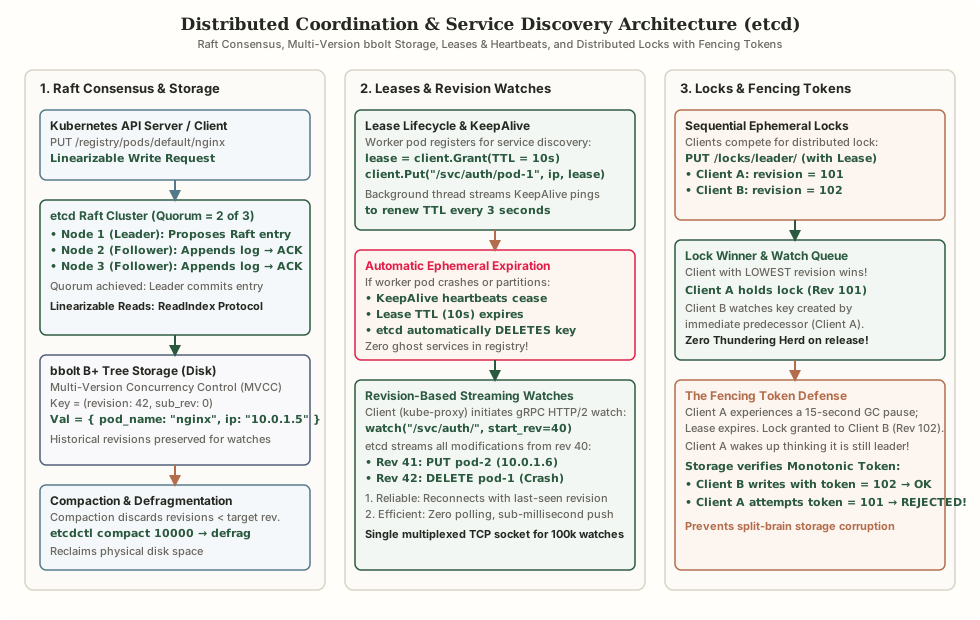
1. Kubernetes API Server / Client & etcd Raft Cluster (Quorum = 2 of 3)
Establishes the ingress and structural boundary across Kubernetes API Server / Client & etcd Raft Cluster (Quorum = 2 of 3): PUT /registry/pods/default/nginx Linearizable Write Request; Node 1 (Leader): Proposes Raft entry; Node 2 (Follower): Appends log → ACK.
2. Compaction & Defragmentation & Lease Lifecycle & KeepAlive
Coordinates core data-plane execution and state transitions through Compaction & Defragmentation & Lease Lifecycle & KeepAlive: Compaction discards revisions < target rev. etcdctl compact 10000 → defrag Reclaims physical disk space; Worker pod registers for service discovery: lease = client.Grant(TTL = 10s) client.Put("/svc/auth/pod-1", ip, lease) Background thread streams KeepAlive pings to renew TTL every 3 seconds; If worker pod crashes or partitions.
3. Sequential Ephemeral Locks & Lock Winner & Watch Queue
Enforces durability, state convergence, and output verification across Sequential Ephemeral Locks & Lock Winner & Watch Queue: Clients compete for distributed lock: PUT /locks/leader/ (with Lease); Client A: revision = 101; Client B: revision = 102.
The Three Foundational Subsystems:
- Raft-Backed State Machine Replication:
- Cluster typically operates with 3 or 5 nodes to tolerate failures ( nodes).
- All mutations are proposed to the Raft Leader, replicated to a quorum of followers, and committed before updating disk storage.
- Multi-Version bbolt Storage & Revision Watches:
- Implements a global 64-bit monotonically increasing Revision counter.
- Every mutation increments the revision.
- Clients establish gRPC Streaming Watches on keys or prefixes. If a client disconnects, it reconnects specifying its
start_revisionto receive a complete, gapless replay of all intermediate mutations.
- Leases, KeepAlives & Fencing Tokens:
- Clients bind ephemeral keys to a Lease with a time-to-live (e.g., 10 seconds).
- If the client fails to stream periodic KeepAlive heartbeats, etcd automatically deletes all associated keys.
- Distributed locks issue monotonically increasing Fencing Tokens (derived from the key creation revision) to protect storage engines against zombie lock holders.
3. Terminology & Core Mechanics
- Revision: A 64-bit integer tracking the total logical age of the etcd database. Every
PUTorDELETEoperation advances the global revision by 1. - bbolt: An embedded, ACID-compliant, single-process B+ Tree key-value database written in Go, used by etcd for persistent disk storage.
- Lease: An allocation of time that a client can attach to keys; when the lease expires, all attached keys are automatically deleted.
- KeepAlive: A bidirectional gRPC stream where a client periodically sends refresh requests to reset the TTL of its active lease.
- ReadIndex: A consensus protocol allowing the Raft leader to execute linearizable reads by confirming quorum leadership with followers without appending a disk-bound Raft log entry.
- Fencing Token: A monotonically increasing integer assigned to a distributed lock holder; backing storage engines reject any write with a token lower than the highest token observed so far.
4. Internal Workings & Algorithms
1. The Multi-Version Concurrency Control (MVCC) Engine
Unlike Redis or ZooKeeper, etcd does not overwrite data in-place:
- It maintains an in-memory B-Tree index (
keyIndex) mapping human-readable keys (e.g.,"/services/auth") to their physical revision numbers. - The on-disk bbolt database uses the Revision as its physical key:
Client Operation: PUT /foo "bar"  (at global revision 10)
Client Operation: PUT /foo "baz"  (at global revision 11)

In-Memory keyIndex:
  "/foo" -> [Rev 10, Rev 11]

On-Disk bbolt Storage:
  Key: {main: 10, sub: 0} -> Value: "bar"
  Key: {main: 11, sub: 0} -> Value: "baz"
Because old revisions are preserved on disk, a client can execute a point-in-time query at revision = 10 and receive "bar", even though the current database revision is 11!
2. Linearizable Reads via ReadIndex
In distributed systems, reading from a leader without verification risks reading stale data if the leader was silently deposed during a network partition (a Stale Leader Read).
How etcd ReadIndex Solves This Without Disk I/O:
- Client issues a read request to the Raft Leader.
- The Leader records its current
commit_indexasReadIndex. - The Leader broadcasts a lightweight heartbeat round (zero disk writes) to a quorum of followers.
- Once a majority responds, the Leader knows with mathematical certainty that it is still the legitimate leader and no newer term has begun.
- The Leader waits until its local state machine processes changes up to
ReadIndex. - The Leader reads the value directly from bbolt memory and returns it to the client.
5. Mathematical & Failure Models
1. Cluster Quorum Formulation
Let be the number of nodes in an etcd cluster. The cluster can tolerate up to simultaneous failures:
| Total Nodes () | Quorum Required | Tolerated Failures () | Recommendation |
|---|---|---|---|
| 1 | 1 | 0 | Development only |
| 3 | 2 | 1 | Standard Production |
| 5 | 3 | 2 | High-Resilience Production |
| 7 | 4 | 3 | Specialized Multi-DC |
| Even numbers (e.g. 4) | 3 | 1 | Anti-Pattern: Tolerates same failures as 3 nodes, but higher network cost! |
2. The Martin Kleppmann GC Pause Dilemma & Fencing Tokens
Consider what occurs when a distributed lock relies strictly on time leases:
Timeline:
T0: Client 1 acquires Lock with Lease = 10s.
T1: Client 1 enters an unexpected Stop-The-World Garbage Collection (GC) pause.
T2: 10 seconds elapse -> etcd Lease expires!
T3: Client 2 requests Lock -> Granted Lock with Lease = 10s.
T4: Client 2 writes data to Backing Storage (Database).
T5: Client 1's GC finishes -> Wakes up unaware of pause!
T6: Client 1 sends its pending write to Backing Storage -> OVERWRITES Client 2!
Result: Silent Data Corruption!
+------------------------------------------------------+
| THE FENCING TOKEN SOLUTION |
+------------------------------------------------------+
| 1. Lock issued with Monotonic Token: |
| Client 1 receives Token = 101 |
| Client 2 receives Token = 102 |
| |
| 2. Backing Storage Enforces Rule: |
| Write accepted ONLY IF Token >= StorageLastToken! |
| |
| 3. Execution: |
| Client 2 writes (Token 102) -> Storage sets 102 |
| Client 1 wakes and writes (Token 101) |
| Storage checks: 101 < 102 -> REJECTED (409)! |
+------------------------------------------------------+By leveraging etcd’s CreateRevision as the monotonic fencing token, backing storage engines can immediately reject stale zombie writes.
6. Real Implementation & Systems Comparison
| Feature | etcd (CNCF) | Apache ZooKeeper | HashiCorp Consul | Redis (Redlock) |
|---|---|---|---|---|
| Consensus Algorithm | Raft | Zab (ZooKeeper Atomic Broadcast) | Raft | None (Asynchronous master-replica) |
| Data Model | Hierarchical Keyspace (MVCC) | Hierarchical Filesystem (ZNodes) | Key-Value / Service Catalog | In-Memory Data Structures |
| Watch Model | Continuous HTTP/2 gRPC by Revision | One-shot triggers (Race-prone) | Long-polling HTTP/1.1 | Pub/Sub (At-most-once) |
| Storage Engine | bbolt (B+ Tree on disk) | In-Memory RAM + Snapshots/WAL | In-Memory + BoltDB | In-Memory RAM + AOF |
| Primary Use Case | Kubernetes Control Plane | Hadoop, Kafka, HBase | HashiCorp Nomad, Vault | Caching, Ephemeral sessions |
7. Production Code Engine: Distributed Coordinator Simulator
The following TypeScript implementation demonstrates:
- An etcd-like Multi-Version Store with atomic revisions.
- A Lease Manager with heartbeat renewals and automatic expiration.
- A Distributed Mutex that issues monotonic fencing tokens based on key creation revisions.
/**
 * Production-Grade Distributed Coordinator Simulator (etcd Model)
 * Demonstrates MVCC Revisions, Leases, and Distributed Locks with Fencing Tokens.
 */

export interface VersionedRecord {
  key: string;
  value: string;
  createRevision: number;
  modRevision: number;
  version: number;
  leaseId?: number;
}

export class EtcdCoordinatorSimulator {
  private globalRevision = 0;
  private store = new Map<string, VersionedRecord>();
  private leases = new Map<number, { ttlMs: number; expiresAt: number; keys: Set<string> }>();
  private nextLeaseId = 1000;

  // ==========================================
  // MVCC KEY-VALUE OPERATIONS
  // ==========================================
  public put(key: string, value: string, leaseId?: number): { revision: number } {
    this.globalRevision++;
    const current = this.store.get(key);

    const record: VersionedRecord = {
      key,
      value,
      createRevision: current ? current.createRevision : this.globalRevision,
      modRevision: this.globalRevision,
      version: current ? current.version + 1 : 1,
      leaseId,
    };

    this.store.set(key, record);

    if (leaseId && this.leases.has(leaseId)) {
      this.leases.get(leaseId)!.keys.add(key);
    }

    return { revision: this.globalRevision };
  }

  public get(key: string): VersionedRecord | null {
    return this.store.get(key) ?? null;
  }

  // ==========================================
  // LEASE MANAGEMENT
  // ==========================================
  public grantLease(ttlSeconds: number, nowMs = Date.now()): number {
    const leaseId = ++this.nextLeaseId;
    this.leases.set(leaseId, {
      ttlMs: ttlSeconds * 1000,
      expiresAt: nowMs + ttlSeconds * 1000,
      keys: new Set(),
    });
    return leaseId;
  }

  public keepAlive(leaseId: number, nowMs = Date.now()): boolean {
    const lease = this.leases.get(leaseId);
    if (!lease) return false;
    lease.expiresAt = nowMs + lease.ttlMs;
    return true;
  }

  public sweepExpiredLeases(nowMs = Date.now()): number {
    let expiredCount = 0;

    for (const [leaseId, lease] of this.leases.entries()) {
      if (nowMs > lease.expiresAt) {
        // Automatically delete all keys attached to expired lease
        for (const key of lease.keys) {
          this.store.delete(key);
        }
        this.leases.delete(leaseId);
        expiredCount++;
      }
    }
    return expiredCount;
  }

  // ==========================================
  // DISTRIBUTED LOCK WITH FENCING TOKENS
  // ==========================================
  public acquireLock(
    lockPrefix: string,
    leaseId: number,
    nowMs = Date.now()
  ): { success: boolean; holderLeaseId?: number; fencingToken: number } {
    this.sweepExpiredLeases(nowMs);

    // Check if any existing key under lockPrefix is already held by an active (unexpired) lease
    for (const [key, rec] of this.store.entries()) {
      if (key.startsWith(`${lockPrefix}/`) || key === lockPrefix) {
        const activeLease = rec.leaseId !== undefined ? this.leases.get(rec.leaseId) : undefined;
        if (activeLease && nowMs <= activeLease.expiresAt) {
          return {
            success: false,
            holderLeaseId: rec.leaseId,
            fencingToken: 0,
          };
        }
      }
    }

    // Generate unique sequential ephemeral key
    const lockKey = `${lockPrefix}/${this.globalRevision + 1}`;
    this.put(lockKey, 'LOCKED', leaseId);
    const record = this.store.get(lockKey)!;
    return {
      success: true,
      holderLeaseId: leaseId,
      fencingToken: record.createRevision,
    };
  }
}

function runDemo(): void {
  console.log("=== etcd Architecture: Distributed Leases, MVCC & Leader Coordination ===");
  const etcd = new EtcdCoordinatorSimulator();
  const leaseId = etcd.grantLease(10);
  console.log(`Granted distributed lease #${leaseId} with 10s TTL`);
  const put1 = etcd.put("/services/payment/leader", "node-prod-01", leaseId);
  console.log(`Put key with lease attached: revision=${put1.revision}`);
  const lock = etcd.acquireLock("/locks/orders", leaseId);
  console.log(`Acquired distributed lock: success=${lock.success}, fencingToken=${lock.fencingToken}`);
  const record = etcd.get("/services/payment/leader");
  console.log(`Read active leader: '${record?.value}' (modRevision=${record?.modRevision})`);
}

runDemo();
8. Operational Perspective: Compaction & Defragmentation
Because etcd maintains an immutable history of revisions, its disk file (member/snap/db) grows continuously over time:
[ Operations Continue Over Days ]
Revisions: Rev 1 ... Rev 500,000 ... Rev 2,000,000
Database File: Reaches 2.1 GB (Default Quota: 2 GB!)
Alarm Triggered: NOSPACE! Cluster rejects all subsequent PUT/DELETE operations!
The Two-Step Maintenance Lifecycle:
- Compaction (
etcdctl compact <revision>): Informs etcd to discard the historical index entries prior to the specified revision. However, bbolt does not immediately release disk space to the OS; it keeps the pages in its internal free list for future allocations. - Defragmentation (
etcdctl defrag): Takes an exclusive database lock, copies live pages to a new physical file on disk, and releases unallocated blocks back to the Linux filesystem. Must be run in a rolling fashion across cluster nodes to avoid cluster downtime.
9. Failure Modes & Cluster Recovery
| Operational Failure | Root Cause | Production Mitigation |
|---|---|---|
NOSPACE Alarm Triggered | Disk file exceeded quota due to missing compaction. | Set --quota-backend-bytes=8589934592 (8GB); configure Kubernetes API server with --etcd-compaction-interval=5m. |
High Disk fsync Latency | Slow disk hardware causes Raft heartbeat timeouts, triggering leader election thrashing. | Deploy etcd exclusively on dedicated NVMe SSDs; ensure disk fdatasync latency is at p99. |
| Split-Brain during 2-Node Cluster | 2-node cluster loses 1 node; remaining node cannot achieve majority ( not allowed). | Never deploy an even number of nodes. Always maintain 3 or 5 nodes in production. |
| Zombie Leader Write | Former master resumes execution after network split. | Backing storage validates monotonic Fencing Tokens on all writes. |
10. Knowledge Check
Review the core distributed coordination principles, then complete the 4-question interactive assessment quiz at the end of this lesson:
- Fencing Tokens: Explain why monotonic tokens prevent zombie lock holders from corrupting storage after long process pauses.
- ReadIndex Efficiency: Describe how etcd serves linearizable reads without appending to disk-bound Raft logs.
- Revision-Based Watches: Contrast continuous streaming watches with legacy one-shot ZooKeeper triggers.
- Compaction vs. Defrag: Articulate the difference between logical revision compaction and physical disk defragmentation.
11. Practical Exercises & Deliverables
Exercise 1: Simulate the Martin Kleppmann GC Pause Lock Hazard
Problem: Demonstrate how time-based locks fail without fencing tokens.
Deliverable:
- Using the
EtcdCoordinatorSimulatorclass from Section 7, grant a lease to Worker 1. - Advance time past the lease TTL without calling
keepAlive(). - Simulate Worker 2 acquiring the lock and receiving a newer fencing token.
- Create a mock storage engine that verifies
writeToken >= currentStorageToken. Verify that Worker 1’s delayed write is rejected.
Exercise 2: Benchmark Revision Reconnection Playback
Problem: Measure event streaming efficiency across network drops.
Deliverable:
- Generate 1,000 sequential key-value mutations in an etcd cluster.
- Simulate a client that disconnects at revision 400 and reconnects at revision 1,000.
- Stream the missed events using
watch(start_rev=400). Measure the time required to catch up to the current revision.
View Reference Architecture & Worked Solutions (INF-I05-001)
1. Worked Solution — Exercise 1: Simulate the Martin Kleppmann GC Pause Lock Hazard
- Deterministic Simulation with
EtcdCoordinatorSimulatorand a Fenced Storage Engine:const etcd = new EtcdCoordinatorSimulator(); let currentStorageToken = 0; const fencedWrite = (payload: string, token: number): boolean => { if (token < currentStorageToken) { console.log(`REJECTED stale zombie write '${payload}' (token ${token} < ${currentStorageToken})`); return false; } currentStorageToken = token; console.log(`ACCEPTED write '${payload}' at fencing token ${token}`); return true; }; // T = 0ms: Worker 1 grants 10s lease and acquires lock const lease1 = etcd.grantLease(10, 0); const lock1 = etcd.acquireLock("/locks/ledger", lease1, 0); // lock1 -> { success: true, holderLeaseId: 1001, fencingToken: 1 } // T = 5000ms: Worker 2 tries to acquire lock while Worker 1's lease is still active const lease2 = etcd.grantLease(10, 5000); const blockedAttempt = etcd.acquireLock("/locks/ledger", lease2, 5000); // blockedAttempt -> { success: false, holderLeaseId: 1001, fencingToken: 0 } // T = 12000ms: Worker 1 pauses in GC past 10s TTL; Worker 2 acquires lock const lock2 = etcd.acquireLock("/locks/ledger", lease2, 12000); // lock2 -> { success: true, holderLeaseId: 1002, fencingToken: 2 } fencedWrite("Worker-2-Valid-Batch", lock2.fencingToken); // ACCEPTED (currentStorageToken = 2) // T = 13000ms: Worker 1 wakes from GC pause and dispatches delayed write with old token=1 fencedWrite("Worker-1-Zombie-Batch", lock1.fencingToken); // REJECTED (1 < 2)! - Key Takeaway: Mutual exclusion requires both lease-based ephemeral lock cleanup in
etcdand monotoniccreateRevisionfencing token verification at the target storage layer.
2. Worked Solution — Exercise 2: Benchmark Revision Reconnection Playback
- MVCC Revision Playback Mechanics:
- When 1,000 sequential
PUToperations execute,etcdincrementsglobalRevisionfrom to , appending each(mainRevision, subRevision)tuple into thebboltB+ Tree and indexing revision spans per key in the in-memorykeyIndex. - When a client disconnects at
revision = 400and reconnects atrevision = 1000withWatchRequest(key, start_revision = 401),etcdperforms a single B+ Tree range seek inbboltstarting at key{main: 401, sub: 0}and sequentially scans the 600 contiguous leaf entries{main: 401} .. {main: 1000}over a single HTTP/2 gRPC stream. - Quantitative Catch-Up Time: For 600 events averaging each ( total), a sequential
bboltmmap page-cache scan takes of CPU/memory time and transmits over a link in (under total catch-up latency), providedstart_revision() has not yet been purged byetcdctl compact.
- When 1,000 sequential
12. Summary & Architectural Decision Guide
- Always Use Fencing Tokens: Distributed locks must pass monotonically increasing revision numbers to storage to reject zombie writes.
- Keep Leases Short but Heartbeat Resilient: 5–10s TTL with KeepAlive interval at ensures quick failover without spurious expiration.
- ReadIndex for Linearizable Reads: Avoid expensive Raft disk writes on read paths by verifying leadership via heartbeat quorums.
- Compact Historical MVCC Revisions: Regularly compact etcd bbolt revisions to prevent disk bloat and memory fragmentation.
13. Authoritative References & Version Context
- Martin Kleppmann (2016), “How to do distributed locking”, Cambridge University Computer Laboratory — martin.kleppmann.com/2016/02/08/how-to-do-distributed-locking.html
- etcd Project Documentation (v3.5+) — Distributed Locks and Fencing Tokens — etcd.io/docs/v3.5/learning/
- Diego Ongaro and John Ousterhout (2014), “In Search of an Understandable Consensus Algorithm”, USENIX ATC ‘14 — usenix.org
- Version Context: Architecture reflects etcd v3.5/v3.6 with bbolt MVCC storage and Kubernetes 1.28+ cluster coordination.