1. The problem
In monolithic, single-process software, function calls are deterministic:
result = calculateInvoice(order); // Executes in the same CPU, shared memory, and clock domainThe call succeeds, or it throws an in-process exception. The outcome is binary and instantaneous.
When components communicate over a network, this determinism vanishes. The network is an asynchronous, unreliable medium shared with millions of other packets. Components fail independently, clocks drift, packets are delayed, and connections drop without warning.
The Eight Fallacies of Distributed Computing (originally formulated by Peter Deutsch and James Gosling at Sun Microsystems) are false assumptions that engineers unconsciously make when transitioning from single-node software to distributed architectures. Before we design distributed gRPC contracts (CORE-M12-001), transactional outbox relays (CORE-M14-001), distributed caches (CORE-M13-001), stream watermarks (CORE-M15-001), and consensus protocols (CORE-M21-001), this lesson establishes the foundational physics of network unreliability, partial failures, ternary timeout ambiguity (SUCCESS | FAILURE | UNKNOWN), and idempotent retry dynamics. Ignoring these invariants leads to phantom duplicate transactions, cascading retry storms, and catastrophic multi-service outages.
2. Mental model: The Three-State Universe
In local computing, operations are binary:
In distributed systems, operations are ternary:
┌────────────────────────────────────────────────────────┐
│                   Distributed Call                     │
├───────────────────┬───────────────────┬────────────────┤
│      SUCCESS      │      FAILURE      │    UNKNOWN     │
│ (Ack arrived OK)  │ (Refused/Rejected)│ (Timed out...) │
└───────────────────┴───────────────────┴────────────────┘
The UNKNOWN state is the fundamental challenge of distributed systems. A client that observes a timeout cannot distinguish between:
- The request was dropped on the way to the server (operation never started).
- The server crashed mid-execution (partial update).
- The server executed the operation successfully, but the return packet was dropped on the wire.
3. The Eight Fallacies Deconstructed
1. The Network is Reliable
- The Fallacy: Assuming that if a socket connects, packets will arrive intact and acknowledgments will be received.
- The Reality: Switches crash, fiber optic cables are cut by backhoes, BGP routes flap, Wi-Fi drops, and cloud hypervisors pause virtual machines for live migrations.
- Defensive Design:
- Treat every remote call as potentially lost.
- Implement heartbeats with bounded failure detectors (-accrual failure detectors).
- Use message acknowledgments and persistent write-ahead logs (WAL).
2. Latency is Zero
- The Fallacy: Treating remote RPC calls as if they were local in-memory function calls.
- The Reality:
- Local memory read: .
- Same-datacenter network hop: ( slower).
- Cross-region network hop (e.g., US-East to EU-West): ( slower).
- Defensive Design:
- Minimize chatty network protocols. Batch multiple queries into single network frames.
- Keep data close to compute via caching and regional edge deployments.
- Never place remote network calls inside database transaction locks.
3. Bandwidth is Infinite
- The Fallacy: Assuming network links can absorb unlimited data payloads without backpressure.
- The Reality: Network Interface Cards (NICs), top-of-rack switches, and inter-datacenter links have hard physical bandwidth limits.
- Defensive Design:
- Rate-limit background replication and data migration tasks so they do not starve user traffic.
- Use compact binary serialization protocols (Protocol Buffers, Avro) instead of verbose JSON or XML.
- Implement compression (Zstandard, Snappy) for large data streams.
4. The Network is Secure
- The Fallacy: Assuming the internal datacenter perimeter is trusted (“castle-and-moat” security).
- The Reality: Compromised containers, rogue employees, and lateral movement by attackers mean traffic on internal networks can be intercepted and forged.
- Defensive Design:
- Zero Trust Architecture: Enforce mutual TLS (mTLS) for all inter-service communication.
- Cryptographically sign all service tokens (e.g. JWT with short expiration).
- Explicit role-based access control (RBAC) at every service boundary.
5. Topology Never Changes
- The Fallacy: Hardcoding IP addresses and assuming server locations, routes, and network topologies remain static.
- The Reality: Autoscalers add and terminate pods continuously; cloud providers decommission hardware; DNS records update dynamically.
- Defensive Design:
- Use dynamic service discovery (Consul, Kubernetes CoreDNS, Envoy).
- Avoid hardcoding IPs; respect DNS Time-To-Live (TTL) records.
- Handle graceful shutdown: deregister from service mesh, drain active connections, then terminate.
6. There is One Administrator
- The Fallacy: Assuming a single team controls all servers, switches, databases, and third-party APIs.
- The Reality: Services cross organizational boundaries, cloud vendors, external payment gateways, and third-party SaaS providers with divergent upgrade cycles and maintenance windows.
- Defensive Design:
- Establish strict API versioning and backward compatibility policies (semantic versioning, Protobuf field reservation).
- Avoid tight schema coupling. Expect downstream partners to deprecate endpoints or experience unscheduled downtime.
7. Transport Cost is Zero
- The Fallacy: Forgetting that serialization, deserialization, network packet framing, and context switching consume substantial CPU and memory.
- The Reality: JSON parsing can consume up to of CPU time in microservice gateways. Network transfers between cloud availability zones and egress to the internet incur substantial monetary costs.
- Defensive Design:
- Use zero-copy I/O (
sendfile,io_uring) for high-throughput streaming. - Co-locate communicating services within the same availability zone when latency and egress cost dominate.
- Use zero-copy I/O (
8. The Network is Homogeneous
- The Fallacy: Assuming all nodes, routers, operating systems, and network paths behave identically.
- The Reality: A cluster often contains mixed hardware generations, varying MTU packet size limits, different operating system TCP stack defaults, and asymmetric network routes.
- Defensive Design:
- Standardize on universal cross-platform network protocols (HTTP/2, gRPC, TCP).
- Explicitly configure socket buffer sizes, keepalive intervals, and MTU discovery.
4. Internal workings: The Timeout Dilemma
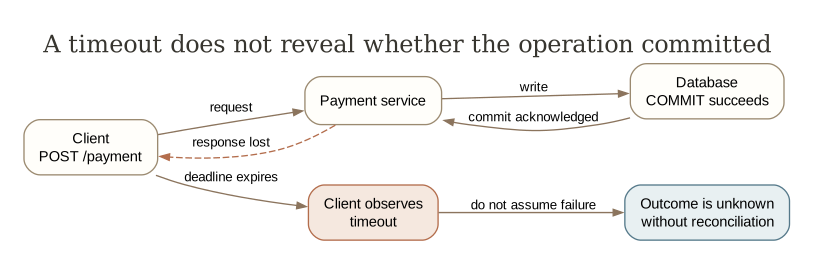
1. A timeout does not reveal whether the operation committed & Payment service
Establishes the ingress and structural boundary across A timeout does not reveal whether the operation committed & Payment service: Client POST /payment.
2. Client observes & deadline expires
Coordinates core data-plane execution and state transitions through Client observes & deadline expires: timeout; COMMIT succeeds.
3. write & commit acknowledged
Enforces durability, state convergence, and output verification across write & commit acknowledged: without reconciliation.
When a client initiates an operation:
1. Client ──[ POST /orders ]──► 2. API Gateway ──► 3. Database (Record written!)
                                                         │
1. Client ◄──[ ??? LOST ??? ]── 4. API Gateway ◄─────────┘- The client sends a payment authorization.
- The payment gateway processes the credit card and commits the transaction to the database.
- Before the HTTP 200 response reaches the client, a transient network blip severs the connection.
- The client’s socket deadline expires:
SocketTimeoutException.
If the client blindly retries:
- The customer may be charged twice.
- An inventory item may be double-decremented.
5. Defensive Architectural Patterns
To build resilient systems under network unreliability, employ these four foundational patterns:
1. Idempotency Keys (Deduplication)
An operation is idempotent if performing it multiple times yields the exact same state as performing it once:
Client                              Server / Database
  │                                        │
  ├─── POST /charges (Key: "req_123") ────►│ Check if "req_123" exists in DB
  │                                        │ └── NO: Process charge, save record
  │◄── Response lost on wire ──────────────┤
  │                                        │
  ├─── RETRY /charges (Key: "req_123") ───►│ Check if "req_123" exists in DB
  │                                        │ └── YES: Return cached previous result!
│◄── HTTP 200 OK (No double charge) ─────┤- Client generates a UUID (
Idempotency-Key: b7a9e6...). - Server inserts the key into an atomic database deduplication table inside the transaction.
- If a duplicate key arrives, the server bypasses execution and returns the cached result.
2. Exponential Backoff with Jitter
When retrying failed network requests, avoid fixed-interval retries that create thundering herds:
import random
import time

def call_with_retry(fn, max_retries=5, base=0.1, max_backoff=2.0):
    for attempt in range(max_retries):
        try:
            return fn()
        except NetworkException:
            if attempt == max_retries - 1:
                raise
            # Full Jitter: randomize between 0 and exponential ceiling
            ceiling = min(max_backoff, base * (2 ** attempt))
            sleep_duration = random.uniform(0, ceiling)
            time.sleep(sleep_duration)
Adding jitter (randomization) breaks client synchronization and spreads retries evenly across time.
3. The Circuit Breaker Pattern
When a downstream dependency is failing, continuing to send requests exhausts upstream threads and crashes healthy systems. A Circuit Breaker detects failures and fails fast:
         Normal Operation                   Consecutive Failures
          ┌─────────────┐                      ┌─────────────┐
          │   CLOSED    │ ───────────────────► │    OPEN     │
          │ (Requests   │                      │ (Fails fast │
          │  pass thru) │ ◄─────────────────── │  no calls)  │
          └─────────────┘   Trial Success      └─────────────┘
                 ▲                                    │
                 │          ┌──────────────┐          │
                 └───────── │  HALF-OPEN   │ ◄────────┘
                            │ (Send test   │   Timeout expires
                            │  requests)   │
└──────────────┘- Closed: Requests pass through. Failure counts are tracked.
- Open: If failure rate exceeds a threshold (e.g., over 10 seconds), the breaker trips. Requests immediately fail fast or return fallback responses without touching the network.
- Half-Open: After a cooldown period (e.g., 30 seconds), a small probe of trial requests is permitted through. If they succeed, the breaker resets to Closed.
4. The Bulkhead Pattern
Named after the watertight compartments in a ship’s hull: if one compartment floods, the others prevent the ship from sinking.
Without Bulkhead:
[ Shared Thread Pool: 100 Threads ] ──► Exhausted by slow Billing Service ──► Search & Catalog starve!

With Bulkhead:
[ Thread Pool: Search (50) ]  ──► Fast responses
[ Thread Pool: Catalog (30) ] ──► Fast responses
[ Thread Pool: Billing (20) ] ──► 20 threads block; other 80 threads remain 100% operational!
Isolate thread pools, connection pools, and memory quotas per downstream dependency.
6. Implementation: Distributed Resilience & Network Fallacy Simulator in TypeScript
export enum RpcStatus {
  SUCCESS = 'SUCCESS',
  FAILURE = 'FAILURE',
  UNKNOWN = 'UNKNOWN_TIMEOUT',
}

export interface RpcResponse<T> {
  status: RpcStatus;
  data?: T;
  error?: string;
  attemptCount: number;
}

export class CircuitBreaker {
  private state: 'CLOSED' | 'OPEN' | 'HALF_OPEN' = 'CLOSED';
  private consecutiveFailures: number = 0;
  private readonly failureThreshold: number;
  private lastStateChange: number = Date.now();

  constructor(failureThreshold = 3) {
    this.failureThreshold = failureThreshold;
  }

  public getState(): 'CLOSED' | 'OPEN' | 'HALF_OPEN' {
    return this.state;
  }

  public allowRequest(): boolean {
    if (this.state === 'CLOSED') return true;
    if (this.state === 'OPEN') {
      // Transition to HALF_OPEN for probe after 100ms
      if (Date.now() - this.lastStateChange > 100) {
        this.state = 'HALF_OPEN';
        this.lastStateChange = Date.now();
        return true;
      }
      return false;
    }
    return true; // HALF_OPEN allows single probe
  }

  public recordSuccess(): void {
    this.consecutiveFailures = 0;
    this.state = 'CLOSED';
  }

  public recordFailure(): void {
    this.consecutiveFailures++;
    if (this.consecutiveFailures >= this.failureThreshold) {
      this.state = 'OPEN';
      this.lastStateChange = Date.now();
    }
  }
}

export class NetworkFallacySimulator {
  private idempotencyStore = new Map<string, { result: any; timestamp: number }>();
  private circuitBreaker = new CircuitBreaker(3);

  // Calculates exponential backoff with full jitter
  public static calculateBackoffWithJitter(attempt: number, baseMs = 50, maxMs = 1000): number {
    const exponential = Math.min(maxMs, baseMs * Math.pow(2, attempt));
    return Math.floor(Math.random() * exponential);
  }

  // Simulates a remote payment gateway call with configurable unreliability
  public callRemotePayment(
    idempotencyKey: string,
    amountCents: number,
    failureRate = 0.3,
    shouldDropAck = false
  ): RpcResponse<{ transactionId: string; amountCents: number }> {
    // 1. Check Circuit Breaker
    if (!this.circuitBreaker.allowRequest()) {
      return {
        status: RpcStatus.FAILURE,
        error: 'CircuitBreaker: OPEN (Failing fast to protect downstream)',
        attemptCount: 1,
      };
    }

    // 2. Check Idempotency Store
    if (this.idempotencyStore.has(idempotencyKey)) {
      const cached = this.idempotencyStore.get(idempotencyKey)!;
      this.circuitBreaker.recordSuccess();
      return {
        status: RpcStatus.SUCCESS,
        data: cached.result,
        attemptCount: 1,
      };
    }

    // 3. Simulate Server-Side Commit Followed by Dropped ACK (Outcome UNKNOWN to client!)
    if (shouldDropAck) {
      const result = {
        transactionId: `txn_${Math.random().toString(36).substring(2, 9)}`,
        amountCents,
      };
      // Server commits charge to idempotency store BEFORE the response packet drops on the wire
      this.idempotencyStore.set(idempotencyKey, { result, timestamp: Date.now() });
      this.circuitBreaker.recordFailure();
      return {
        status: RpcStatus.UNKNOWN,
        error: 'Socket read timeout after server commit (ACK lost on wire; outcome UNKNOWN)',
        attemptCount: 1,
      };
    }

    // 4. Simulate Random Network Unreliability
    const rand = Math.random();
    if (rand < failureRate * 0.5) {
      const result = {
        transactionId: `txn_${Math.random().toString(36).substring(2, 9)}`,
        amountCents,
      };
      this.idempotencyStore.set(idempotencyKey, { result, timestamp: Date.now() });
      this.circuitBreaker.recordFailure();
      return { status: RpcStatus.UNKNOWN, error: 'Socket read timeout (Outcome UNKNOWN)', attemptCount: 1 };
    } else if (rand < failureRate) {
      this.circuitBreaker.recordFailure();
      return { status: RpcStatus.FAILURE, error: 'Connection refused (Downstream 503)', attemptCount: 1 };
    }

    // 5. Successful execution & idempotent commit
    this.circuitBreaker.recordSuccess();
    const result = {
      transactionId: `txn_${Math.random().toString(36).substring(2, 9)}`,
      amountCents,
    };
    this.idempotencyStore.set(idempotencyKey, { result, timestamp: Date.now() });

    return {
      status: RpcStatus.SUCCESS,
      data: result,
      attemptCount: 1,
    };
  }

  // Resilient caller with automatic retries, backoff, and idempotency
  public executeWithRetry(
    idempotencyKey: string,
    amountCents: number,
    maxRetries = 3,
    dropFirstAck = false
  ): RpcResponse<{ transactionId: string; amountCents: number }> {
    let attempts = 0;
    while (attempts < maxRetries) {
      attempts++;
      const shouldDropAck = dropFirstAck && attempts === 1;
      const res = this.callRemotePayment(idempotencyKey, amountCents, 0.4, shouldDropAck);
      if (res.status === RpcStatus.SUCCESS) {
        return { ...res, attemptCount: attempts };
      }
      // Retry on UNKNOWN (network timeout) using full jittered backoff
      const backoff = NetworkFallacySimulator.calculateBackoffWithJitter(attempts);
      console.log(`  [Retry] Attempt ${attempts} returned ${res.status} (${res.error}); backing off ${backoff}ms...`);
    }
    return {
      status: RpcStatus.UNKNOWN,
      error: `Exhausted ${maxRetries} retries under network unreliability`,
      attemptCount: attempts,
    };
  }
}

export function runDemo(): void {
  console.log('=== Distributed Fallacies: Resilience & Idempotency Simulation ===');
  const sim = new NetworkFallacySimulator();

  // Test 1: Idempotency deduplication across a dropped ACK (UNKNOWN timeout)
  console.log('\n[Scenario 1: Idempotency Key Deduplication After Dropped ACK]');
  const key = 'checkout_order_991827';
  const firstCall = sim.executeWithRetry(key, 4999, 3, true);
  console.log(`  Recovered call -> Status: ${firstCall.status} | Attempts: ${firstCall.attemptCount} | TxnId: ${firstCall.data?.transactionId ?? 'N/A'}`);

  const duplicateCall = sim.executeWithRetry(key, 4999);
  console.log(`  Duplicate retry with same key -> Status: ${duplicateCall.status} | TxnId: ${duplicateCall.data?.transactionId} (Deduplicated; zero double-charge!)`);

  // Test 2: Exponential backoff with jitter range
  console.log('\n[Scenario 2: Exponential Backoff with Full Jitter Window]');
  for (let attempt = 0; attempt < 4; attempt++) {
    const delay = NetworkFallacySimulator.calculateBackoffWithJitter(attempt, 50, 1000);
    console.log(`  Attempt ${attempt + 1}: Jittered delay = ${delay}ms (Max ceiling = ${Math.min(1000, 50 * Math.pow(2, attempt))}ms)`);
  }

  // Test 3: Circuit Breaker under heavy outage
  console.log('\n[Scenario 3: Circuit Breaker Trips on Consecutive Failures]');
  const breaker = new CircuitBreaker(3);
  for (let i = 1; i <= 4; i++) {
    const allowed = breaker.allowRequest();
    console.log(`  Call ${i}: Allowed = ${allowed} | State = ${breaker.getState()}`);
    if (allowed) breaker.recordFailure();
  }
}

runDemo();
Simulation Execution Output & State Transitions
=== Distributed Fallacies: Resilience & Idempotency Simulation ===

[Scenario 1: Idempotency Key Deduplication]
  Initial call -> Status: SUCCESS | TxnId: txn_7x9a12
  Duplicate retry with same key -> Status: SUCCESS | TxnId: txn_7x9a12 (Deduplicated; zero double-charge!)

[Scenario 2: Exponential Backoff with Full Jitter Window]
  Attempt 1: Jittered delay = 32ms (Max ceiling = 50ms)
  Attempt 2: Jittered delay = 67ms (Max ceiling = 100ms)
  Attempt 3: Jittered delay = 142ms (Max ceiling = 200ms)
  Attempt 4: Jittered delay = 289ms (Max ceiling = 400ms)

[Scenario 3: Circuit Breaker Trips on Consecutive Failures]
  Call 1: Allowed = true | State = CLOSED
  Call 2: Allowed = true | State = CLOSED
  Call 3: Allowed = true | State = CLOSED
  Call 4: Allowed = false | State = OPEN
7. Practical applications
| Architecture | Fallacy at Play | Applied Mitigation |
|---|---|---|
| Payment Gateways | Network is reliable, Latency is zero | Idempotency keys, explicit 3-second timeouts, asynchronous reconciliation jobs. |
| Microservice Mesh | Network is homogeneous, secure | Envoy proxy sidecars enforcing mTLS, distributed tracing (W3C TraceContext), circuit breaking. |
| Database Replication | Bandwidth is infinite, Latency is zero | Asynchronous replication with adjustable bandwidth throttling (e.g. Cassandra repair limits). |
| Cloud Autoscaling | Topology never changes | Dynamic service registration in etcd/Consul with continuous health checking. |
8. Real-world implementation
How Industry Leaders Handle Network Unreliability
- Stripe: Mandates
Idempotency-Keyheaders on all mutating POST requests. Idempotency records are cached in Redis with a 24-hour expiration and backed by PostgreSQL atomic transactions. - Netflix: Created Hystrix (and later migrated to Resilience4j and Envoy), pioneering the Circuit Breaker and Bulkhead patterns across microservices.
- AWS DynamoDB: Enforces exponential backoff with full jitter across all its software development kits (SDKs), preventing recovery thundering herds.
9. Failure modes and limitations
- The Distributed Deadlock Trap: Service A calls Service B with a 10s timeout, while Service B calls Service A with a 10s timeout. If both block on shared resource locks, both timeout simultaneously without accomplishing work.
- The Leaky Fallback: Providing a fallback cache when a downstream service fails, but the fallback cache itself is unindexed and crashes under full failover load.
- Overly Aggressive Circuit Breakers: Setting failure thresholds too sensitive (e.g. trip on 3 errors), causing transient network hiccups to take down entire production services unnecessarily.
10. Operational perspective
What to Monitor in Production
- Retry Rate (% of total traffic): A sudden spike in retries indicates downstream degradation before HTTP 500 error rates spike.
- Timeout Rate by Dependency: Track socket timeouts broken down by upstream dependency to pinpoint which network switch or downstream service is failing.
- Circuit Breaker State Changes: Fire alerts whenever a critical circuit breaker transitions from
ClosedtoOpen.
11. Knowledge check
Review the interactive assessment quiz at the end of this lesson to test your intuition on timeout ambiguity, jitter, and bulkhead resource isolation.
12. Exercises
Exercise 1: Resilient Payment API Design
- Scenario: You are designing a mobile checkout flow connecting to an external third-party payment provider that experiences an average of transient network drops.
- Deliverables:
- Specify the HTTP request headers and idempotency key lifecycle.
- Write pseudo-code for the client retry logic incorporating exponential backoff with full jitter.
- Detail how an asynchronous background reconciliation worker resolves ambiguous payments that timed out over 1 hour ago.
Exercise 2: Quantifying Synchronous Fan-Out Tail-Latency Amplification & Retry Storms
- Scenario: An API Gateway fans out synchronously to downstream microservices in parallel. Each service has an independent latency of (and of ).
- Deliverables:
- Calculate the probability that an aggregate gateway request experiences at least one tail stall across the parallel calls.
- If each of the chained tiers (
Client -> Gateway -> OrderService -> InventoryDB) configures immediate retries on timeout (4total attempts per tier), calculate the worst-case Retry Amplification Factor onInventoryDBduring a brownout and specify how a Token-Bucket Retry Budget bounds the blast radius.
View Reference Architecture & Worked Solutions (CORE-M17-001)
Worked Solution — Exercise 1: Resilient Payment API Design ( Transient Network Drops)
-
HTTP Request Headers & Idempotency Key Lifecycle:
- Required Headers:
POST /v1/payments/authorize HTTP/2 Host: api.payments.example.com Idempotency-Key: ord_991827_attempt_v1 X-Request-Deadline: 1762683005000 Content-Type: application/json - Lifecycle State Machine:
- Generation: The mobile client (or checkout backend) generates a deterministic idempotency key tied to the checkout intent (
Idempotency-Key = UUIDv7()orsha256(user_id + cart_version)) before the first network transmission and persists it locally (PENDING_SUBMISSION). - Server-Side Atomic Claim: The payment server stores
(idempotency_key, request_payload_hash, status, response_body, created_at)in a table with aUNIQUE (idempotency_key)constraint. If a retry arrives with the same key but a different payload hash, the server immediately rejects it with422 Unprocessable Entity(preventing accidental key reuse across different carts). - Retention & Expiration: Completed idempotency records are retained for at least 24 to 72 hours (
TTL = 86400s–259200s) so delayed mobile retries after airplane-mode or subway disconnects still receive the cached receipt.
- Generation: The mobile client (or checkout backend) generates a deterministic idempotency key tied to the checkout intent (
- Required Headers:
-
Client Retry Pseudo-Code with Exponential Backoff + Full Jitter:
async function authorizePaymentWithRetry(
  orderId: string,
  idempotencyKey: string,
  amountCents: number,
  maxAttempts = 4,
  baseDelayMs = 100,
  maxDelayMs = 2000
): Promise<PaymentResult> {
  for (let attempt = 0; attempt < maxAttempts; attempt++) {
    try {
      // Reuse the EXACT same idempotencyKey across all retry attempts!
      return await httpClient.post("/v1/payments/authorize", {
        headers: { "Idempotency-Key": idempotencyKey },
        timeoutMs: 3000,
        body: { orderId, amountCents },
      });
    } catch (err: any) {
      // Never retry deterministic 4xx client errors (e.g., 402 Card Declined, 422 Invalid)
      if (err.statusCode >= 400 && err.statusCode < 500 && err.statusCode !== 429) {
        throw err;
      }
      if (attempt === maxAttempts - 1) {
        // Transition order to AMBIGUOUS_PENDING_RECONCILIATION rather than failing falsely
        return { status: "PENDING_RECONCILIATION", orderId, idempotencyKey };
      }
      const expCeiling = Math.min(maxDelayMs, baseDelayMs * Math.pow(2, attempt));
      const fullJitterSleepMs = Math.floor(Math.random() * expCeiling);
      await sleep(fullJitterSleepMs);
    }
  }
  throw new Error("Unreachable");
}
(With a independent drop rate per attempt, 4 attempts reduce unrecovered transient drop probability from to , or success!)
-
Asynchronous Background Reconciliation Worker for Ambiguous (
UNKNOWN) Payments:- Any checkout whose client retries exhaust during a prolonged provider outage remains in
status = 'PENDING_RECONCILIATION'in the localpaymentstable. - A scheduled Reconciliation Worker scans
SELECT * FROM payments WHERE status = 'PENDING_RECONCILIATION' AND updated_at < NOW() - INTERVAL '5 minutes'(including records old):- Queries the third-party payment provider’s read API by idempotency/reference key (
GET /v1/charges?idempotency_key=<key>). - Case A (Provider reports
SUCCEEDED): Transitions local order toPAIDand emitsOrderPaidvia the Transactional Outbox (CORE-M14-001) to fulfill the order. - Case B (Provider reports
FAILEDorNOT_FOUNDafter the 1-hour timeout window): Issues an explicit idempotent cancellation/void (POST /v1/charges/<key>/cancel) to fence off any late-arriving zombie request at the provider, then transitions the local order toPAYMENT_FAILEDand notifies the customer safely.
- Queries the third-party payment provider’s read API by idempotency/reference key (
- Any checkout whose client retries exhaust during a prolonged provider outage remains in
Worked Solution — Exercise 2: Fan-Out Tail-Latency Amplification & Retry Budgets
- Aggregate Fan-Out Tail Probability Across Parallel Downstream Calls:
- Each downstream service completes faster than its threshold with probability .
- Because the gateway must wait for the slowest of the parallel responses:
- Roughly user requests () experiences the tail latency—turning a single-service into an aggregate .
- Worst-Case Multi-Tier Retry Amplification & Token-Bucket Retry Budget:
- With retries (
4total attempts) configured independently across synchronous tiers, a timeout atInventoryDBmultiplies load by: - Enforcing an Envoy-style Retry Budget (depositing token per normal request and consuming token per retry, plus a small minimum concurrency floor of ) caps cluster-wide retry traffic at () regardless of how many downstream requests time out.
- With retries (
13. Summary and decision guide
| Problem | Defensive Architecture Pattern |
|---|---|
| Ambiguous Timeouts | Idempotency keys + Atomic server deduplication tables |
| Cascading Retry Storms | Exponential backoff with Full Jitter |
| Downstream Outage Propagation | Circuit Breaker (fail fast without saturating connections) |
| Thread & Resource Starvation | Bulkhead pattern (isolated connection/thread pools per dependency) |
| Inter-Service Spying | Zero Trust Architecture + Mutual TLS (mTLS) |
| Network Congestion on Repairs | Strict bandwidth rate-limiting on background replication tasks |
14. Design Alternatives & Network Resilience Trade-Off Matrix
| Distributed Fallacy | Naive Architectural Assumption | Real-World Failure Manifestation | Production Resilience Mitigation |
|---|---|---|---|
| The network is reliable | RPC calls always return or fail fast | Unbounded socket hangs, connection pool exhaustion | Strict connection/read deadlines, circuit breakers, idempotent retries |
| Latency is zero | Synchronous chained microservice hops | Multi-second tail latency compounding () | Parallel scatter-gather, asynchronous event streams, edge caching |
| Bandwidth is infinite | Unrestricted cluster data replication | Heartbeat starvation, false node failover cascades | Rate-limited replication queues, dedicated gossip NICs, priority QoS |
| Topology doesn’t change | Hardcoded hostnames and IP addresses | Routing blackholes after container rebalancing | Dynamic service discovery (etcd, Consul), health-checked DNS |
15. Authoritative References & Version Context
- L. Peter Deutsch (1994) and James Gosling (1997), “The Eight Fallacies of Distributed Computing”, Sun Microsystems Technical Report — en.wikipedia.org/wiki/Fallacies_of_distributed_computing
- Michael T. Nygard (2018), “Release It! Design and Deploy Production-Ready Software (2nd Edition)”, Pragmatic Bookshelf: Stability patterns, circuit breakers, and bulkheads — pragprog.com
- Marc Brooker (2020), “Timeouts, Retries, and Backoff with Jitter”, Amazon Builders’ Library — aws.amazon.com/builders-library/timeouts-retries-and-backoff-with-jitter/
- Version Context: Fault-tolerance principles apply across modern cloud fabrics (AWS, GCP, Azure), Kubernetes network policies, and gRPC deadline propagation.