1. Executive Summary & Context
Project Identity, Version & License Baseline
| Project Component | Canonical Repository | Pinned Release | Governance / License | Edition Boundary |
|---|---|---|---|---|
| Envoy Proxy | envoyproxy/envoy | v1.29 (LTS) | CNCF Graduated (Apache 2.0) | Open source |
| Istio | istio/istio | v1.21 (LTS) | CNCF Graduated (Apache 2.0) | Open source |
In early distributed systems (circa 2010–2015), microservice operational concerns—client-side load balancing, circuit breaking, distributed tracing propagation, TLS termination, and retries—were implemented as language-specific in-process client libraries. The canonical examples were Netflix OSS (Eureka, Ribbon, Hystrix, and Zuul) in Java and Finagle in Scala.
While functional in homogeneous ecosystems, this library-driven architecture degraded rapidly in modern polyglot organizations:
- The Polyglot Implementation Matrix: Implementing complex retry budgets, HTTP/2 multiplexing, and cryptographic mTLS across Go, Python, Node.js, Rust, and Java required maintaining separate implementations with subtle divergence in edge cases.
- Upgrade Friction & Security Patches: A critical vulnerability in an HTTP/2 parser or TLS stack required every service engineering team across the enterprise to bump a library version, recompile, pass integration tests, and redeploy.
- Application Thread Contention: Network buffers, retry loops, and JSON/Protobuf telemetry serialization competed directly for CPU cycles and garbage collection (GC) pauses with core business logic.
The Service Mesh architecture resolved these liabilities by moving networking logic out of the application process and into an out-of-process Sidecar Proxy. Spearheaded by Matt Klein at Lyft with the creation of Envoy Proxy in 2016, and formalized by Google, IBM, and Red Hat with Istio in 2017, the modern service mesh decouples the networking Data Plane from the declarative Control Plane:
- Data Plane (Envoy): A high-performance, low-latency C++17 proxy deployed alongside every application pod, intercepting all ingress and egress network traffic transparently.
- Dynamic Configuration Protocol (Universal Data Plane API / xDS): A gRPC-based streaming protocol allowing Envoy to dynamically learn routes, endpoints, TLS certificates, and rate limits without dropped connections or process restarts.
- Control Plane (Istio / Istiod): A unified daemon compiling high-level declarative Kubernetes Custom Resource Definitions (
VirtualService,DestinationRule,PeerAuthentication) into low-level xDS configuration structures, while issuing and rotating ephemeral X.509 SPIFFE certificates for Zero Trust mutual TLS.
2. Core Architectural Philosophy
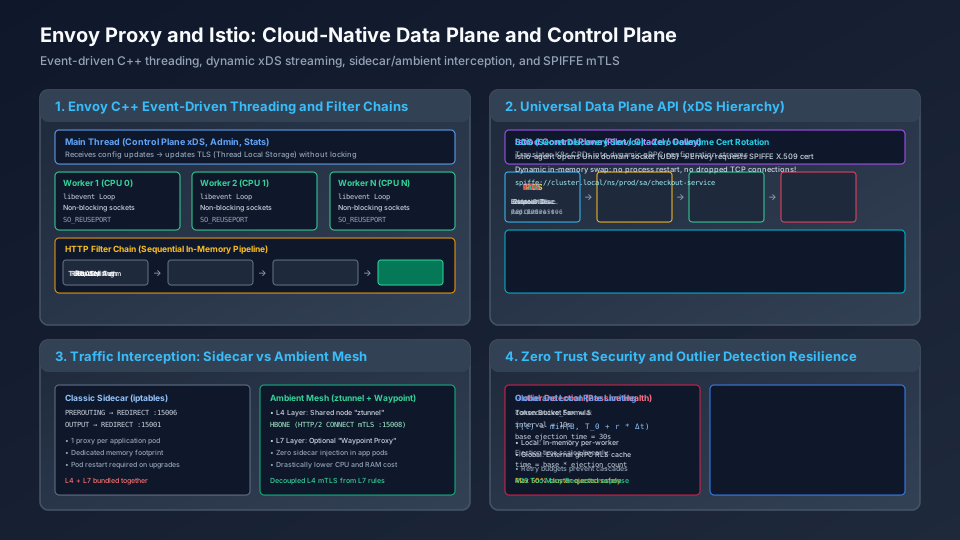
1. Worker 1 (CPU 0) & Worker 2 (CPU 1)
Establishes the ingress and structural boundary across Worker 1 (CPU 0) & Worker 2 (CPU 1): libevent Loop Non-blocking sockets SO_REUSEPORT.
2. LDS & →
Coordinates core data-plane execution and state transitions through LDS & →: Listener Disc. 0.0.0.0:15006 →; PREROUTING → REDIRECT :15006 OUTPUT → REDIRECT :15001; 1 proxy per application pod.
3. Envoy C++ Event-Driven Threading and Filter Chains & Universal Data Plane API (xDS Hierarchy)
Enforces durability, state convergence, and output verification across Envoy C++ Event-Driven Threading and Filter Chains, Universal Data Plane API (xDS Hierarchy), Traffic Interception: Sidecar vs Ambient Mesh, Zero Trust Security and Outlier Detection Resilience within the Envoy Proxy and Istio: Cloud-Native Data Plane and Control Plane architecture.
+-------------------------------------------------------------------------------+
|                       ISTIO CONTROL PLANE (Istiod)                            |
|                                                                               |
|  Kubernetes CRDs           Pilot (xDS Generator)       Citadel (CA / Secrets) |
|  - VirtualService          LDS, RDS, CDS, EDS          X.509 SPIFFE Rotation  |
|  - DestinationRule                 |                             |            |
+------------------------------------|-----------------------------|------------+
                                     | Dynamic gRPC Stream (xDS)   | Unix Socket
                                     v                             v
+-------------------------------------------------------------------------------+
|                        ENVOY DATA PLANE (Sidecar / Pod)                       |
|                                                                               |
|  Main Thread: xDS Client, Admin Server, Metrics, Lock-Free TLS Management    |
|                                                                               |
|  +--------------------+  +--------------------+  +-------------------------+  |
|  | Worker 0 (CPU 0)   |  | Worker 1 (CPU 1)   |  | Worker N (CPU N)        |  |
|  | libevent loop      |  | libevent loop      |  | libevent loop           |  |
|  | SO_REUSEPORT       |  | SO_REUSEPORT       |  | SO_REUSEPORT            |  |
|  +---------+----------+  +---------+----------+  +------------+------------+  |
|            |                       |                          |               |
|            +-----------------------+--------------------------+               |
|                                    v                                          |
|                          HTTP Filter Chain Pipeline                           |
|       [ TLS/SNI ] -> [ mTLS SPIFFE RBAC ] -> [ Rate Limit ] -> [ Router ]     |
|                                                                   |           |
+-------------------------------------------------------------------|-----------+
                                                                    v
                                                            Upstream Cluster
The design of Envoy and Istio adheres to four non-negotiable architectural tenets:
Tenet 1: Out-of-Process, Zero Application Intrusion
The application code remains completely agnostic to networking topology, cryptography, and protocols. The application communicates over plaintext localhost HTTP or gRPC; Envoy intercepts the traffic, transparently upgrades it to mTLS, handles connection pooling, retries, and circuit breaking, and forwards it to the destination.
Tenet 2: Non-Blocking Event-Driven Threading
Envoy uses a single-process, multi-threaded event-driven architecture. There is zero multi-threading lock contention on the active request path. Each worker thread runs its own non-blocking event loop bound to a dedicated CPU core.
Tenet 3: Dynamic Eventual Consistency via xDS
Envoy never requires a static configuration file reload or process restart to update routes or upstream endpoints. Changes in cluster topology or security certificates stream over long-lived gRPC channels. Updates apply atomically in-memory via lock-free thread-local storage swaps.
Tenet 4: Zero Trust Security by Default
Network perimeter perimeter-security (“castle-and-moat”) is rejected. Every pod identity is cryptographically proven via SPIFFE (Secure Production Identity Framework for Everyone) X.509 certificates. All intra-cluster communication is encrypted with TLS 1.3, authenticated via mutual TLS, and authorized via fine-grained attribute-based access control (ABAC/RBAC).
3. Envoy Threading & Event-Driven Engine
Envoy’s remarkable performance—handling hundreds of thousands of requests per second per node with sub-millisecond p99 latency—derives directly from its threading model and memory management:
The Main Thread vs. Worker Threads
- Main Thread: Manages lifecycle, configuration loading, administrative APIs, metrics aggregation, and the dynamic xDS gRPC control plane client. The main thread never touches socket read/write buffers on the request path.
- Worker Threads: At startup, Envoy spawns worker threads, where matches the number of logical hardware CPU cores allocated to the container (configured via
--concurrency). Each worker runs a pure, single-threaded, non-blocking event loop powered bylibevent.
Sockets and SO_REUSEPORT
To eliminate the classic multi-threaded bottleneck of worker threads contending over a single shared accept queue with a mutex lock, Envoy configures listeners with the Linux socket flag SO_REUSEPORT:
- Every worker thread creates its own listening socket bound to the exact same IP and port (e.g.,
0.0.0.0:15006). - The Linux kernel’s networking stack executes a deterministic hash (based on source IP, source port, destination IP, destination port) on incoming TCP
SYNpackets and distributes new connections directly into the corresponding worker thread’s socket receive buffer. - This achieves lock-free connection distribution without cross-core cache invalidation or mutex contention.
Lock-Free Thread-Local Storage (TLS)
When the Main Thread receives an updated route table (RDS) or endpoint list (EDS) from Istiod:
- The Main Thread compiles the Protobuf configuration into an immutable, read-optimized C++ object graph.
- It broadcasts a slot pointer update to every worker thread’s Thread Local Storage (TLS) engine via non-blocking inter-thread event notifications.
- Worker threads swap their local active pointer to the new configuration on their next event loop tick using atomic pointer assignments.
- Old configuration objects are held under
std::shared_ptrand automatically destroyed once existing in-flight connections finish referencing them. Read-path worker threads never acquire a mutex.
The Filter Chain Pipeline
Envoy structures protocol handling as an extensible, sequentially ordered pipeline of filter callbacks:
- Listener Filters: Inspect the raw TCP connection before TLS handshake (e.g.,
OriginalDstFilterto retrieve the original destination IP redirected byiptables,TlsInspectorto read the SNI header). - Network (L4) Filters: Handle raw byte streams (e.g.,
TcpProxy,RedisProxy,ClientSslFilter, orHttpConnectionManager). - HTTP (L7) Filters: Chained inside
HttpConnectionManagerto inspect and mutate HTTP/1.1, HTTP/2, and HTTP/3 streams:CorsFilter->FaultInjectionFilter->JwtAuthnFilter->RbacFilter->RateLimitFilter->RouterFilter
- The terminal filter is almost always the
RouterFilter, which maps the request URL to an upstream cluster, selects an endpoint via the cluster load balancer, and opens an upstream connection pool stream.
4. Universal Data Plane API (xDS) Dynamic Protocol
Envoy revolutionized proxy design by decoupling configuration schema from static file disks into dynamic gRPC streaming APIs known collectively as xDS (eXtensible Discovery Service).
+-----------------------------------------------------------------------------+
|                                xDS HIERARCHY                                |
|                                                                             |
|  [ LDS ] Listener Discovery Service                                         |
|    └─ Bind: 0.0.0.0:15006 (Virtual Inbound)                                 |
|    └─ Filter Chain: HttpConnectionManager                                   |
|         │                                                                   |
|         ▼ references RouteConfiguration                                     |
|  [ RDS ] Route Discovery Service                                            |
|    └─ VirtualHost: orders.prod.svc.cluster.local                            |
|    └─ Path: /api/v2/orders/* ──────────────────┐ Route Match                |
|                                                ▼                            |
|  [ CDS ] Cluster Discovery Service <───────────┘ References Upstream Cluster |
|    └─ Cluster: outbound|8080||orders-service.prod.svc                       |
|    └─ Type: EDS, LB: ROUND_ROBIN, OutlierDetection Settings                 |
|         │                                                                   |
|         ▼ references ClusterLoadAssignment                                  |
|  [ EDS ] Endpoint Discovery Service                                         |
|    └─ Endpoints: [ 10.244.1.14:8080 (Healthy), 10.244.2.89:8080 (Healthy) ]|
|                                                                             |
|  [ SDS ] Secret Discovery Service (Orthogonal TLS Key/Cert Delivery)        |
|    └─ In-Memory X.509 SPIFFE Cert & Private Key Distribution via UDS        |
+-----------------------------------------------------------------------------+
The xDS Protocol Types
- LDS (Listener Discovery Service): Discovers network listeners (IP addresses and ports) and their associated L4/L7 filter chains.
- RDS (Route Discovery Service): Discovers dynamic routing rules: virtual hosts, path prefix matches, regex rewrites, header mutations, and timeouts.
- CDS (Cluster Discovery Service): Discovers upstream backend pools (“clusters”), transport socket settings (TLS vs. plaintext), connection pool limits, and circuit breaker policies.
- EDS (Endpoint Discovery Service): Discovers the dynamic IP addresses, ports, localities, and health states of individual backend instances (pods) backing a CDS cluster. In high-churn Kubernetes environments, pods scale up and down continuously; EDS streams updates in milliseconds without recomputing static cluster definitions.
- SDS (Secret Discovery Service): Dynamic certificate and private key delivery. Enables transparent, zero-downtime X.509 rotation without dropping live TLS connections.
Aggregated Discovery Service (ADS) vs. State-of-the-World
- State-of-the-World (SotW): Envoy requests a resource type (e.g., all CDS clusters), and the management server responds with the complete array of all clusters.
- Delta xDS: Envoy streams only resource increments (adds, updates, removals), slashing bandwidth and CPU consumption in clusters with tens of thousands of services.
- ADS (Aggregated Discovery Service): Multiplexes all xDS streams (LDS, RDS, CDS, EDS) over a single bidirectional gRPC connection. This prevents race conditions where an RDS update routes traffic to a CDS cluster that Envoy has not yet received.
5. Traffic Interception: Sidecar vs Ambient Mesh
To intercept inbound and outbound network traffic without requiring application modifications, service meshes deploy network redirection mechanisms.
Classical Sidecar Model (iptables)
In the classic sidecar model, an initContainer (istio-init) runs with Linux NET_ADMIN privileges before the application container starts. It configures iptables rules within the pod’s dedicated network namespace:
Application Container                   Sidecar (Envoy)
  |                                        |
  | Write TCP (Dest: 10.96.0.1:80)         |
  v                                        |
iptables OUTPUT chain                      |
  -> PREROUTING / REDIRECT port 15001 ---->| Envoy Outbound Listener (:15001)
                                           | - Read original destination with SO_ORIGINAL_DST
                                           | - Apply egress routing, retry & mTLS
| - Establish upstream TCP socket out of pod- Inbound Interception: Incoming TCP packets on any application port are redirected via
PREROUTINGto port15006(Envoy’s virtual inbound listener). - Outbound Interception: Outgoing TCP packets from the application are redirected via
OUTPUTto port15001(Envoy’s virtual outbound listener). SO_ORIGINAL_DST: Envoy invokes thegetsockoptsyscall withSO_ORIGINAL_DSTto recover the original IP and port requested by the application before iptables redirected the socket.- UID Loop Prevention: Traffic generated by Envoy itself (running under UID 1337) is matched and exempted from the
OUTPUTredirection chain to prevent infinite routing loops.
Istio Ambient Mesh: The Next Evolution
While sidecars offer strict pod isolation, they introduce substantial operational overhead:
- Memory footprint: 50MB to 150MB of RSS RAM per pod multiplied by 5,000 pods consumes hundreds of gigabytes of cluster memory.
- Lifecycle coupling: Upgrading Envoy requires restarting application pods.
Ambient Mesh eliminates sidecars by bifurcating the data plane into two distinct layers:
- L4 Secure Transport (ztunnel): A single, lightweight Rust-based daemon running per Kubernetes node. It uses eBPF or node iptables to redirect raw L4 TCP streams into mutual TLS encrypted HBONE (HTTP-Based Overlay Network Environment, HTTP/2 CONNECT tunnels) over port 15008. It enforces Zero Trust identity and L4 authorization policies at wire speed with minimal memory.
- L7 Waypoint Proxies: When a service requires L7 traffic splitting, header-based routing, or rate limiting, traffic is transparently routed from the ztunnel to an Envoy-based Waypoint proxy running separately per namespace. Services that only require mTLS and L4 telemetry incur zero L7 proxy overhead.
6. Zero-Trust Security: SPIFFE/SPIRE & mTLS
In a microservice mesh, network topology cannot serve as an identity boundary. The service mesh enforces cryptographic identity using the SPIFFE (Secure Production Identity Framework for Everyone) specification.
+-----------------------------------------------------------------------------+
|                             SPIFFE IDENTITY URI                             |
|                                                                             |
|      spiffe://cluster.local/ns/production/sa/payment-service                |
|      \_____/  \___________/ \____________/ \_______________/                |
|      Scheme     Trust Domain   Namespace      ServiceAccount                |
+-----------------------------------------------------------------------------+
The SPIFFE ID and X.509 SVID
- Every workload is assigned a structured SPIFFE ID encoded into the Subject Alternative Name (SAN) of an X.509 certificate (SPIFFE Verifiable Identity Document, or SVID).
- Example:
spiffe://cluster.local/ns/payments/sa/payment-processor
Dynamic Key Rotation via SDS
- Istio’s node agent (
istio-agent) verifies the pod’s Kubernetes service account token against the Kubernetes TokenReview API. - The agent generates a private key locally in memory (never written to disk or transmitted across the network).
- It generates a Certificate Signing Request (CSR) and sends it via gRPC to Istiod’s Certificate Authority (Citadel).
- Istiod verifies the token, signs the certificate with an ephemeral TTL (typically 12 to 24 hours), and returns the signed X.509 certificate.
istio-agentstreams the signed certificate to Envoy over an internal Unix Domain Socket (UDS) via the Secret Discovery Service (SDS).- When the certificate nears expiration, SDS pushes a newly signed certificate. Envoy swaps the active cryptographic context in memory without terminating active TCP connections or invalidating TLS session caches.
7. Resilience Engineering: Circuit Breaking & Outlier Detection
Envoy distinguishes between proactive capacity protection (Circuit Breaking) and reactive fault isolation (Outlier Detection).
1. Circuit Breaking: Capacity Preservation
Envoy circuit breakers limit the maximum concurrency allowed into an upstream cluster to prevent cascading collapse under load spikes:
max_connections: Maximum TCP connections allowed to upstream hosts.max_pending_requests: Maximum requests queued waiting for an available upstream connection. Once exceeded, Envoy fails fast withHTTP 503 Service Unavailable.max_requests: Maximum concurrent in-flight active requests (critical for HTTP/2 multiplexing).max_retries: Maximum concurrent retries allowed. Prevents retry storms from amplifying backend load.
2. Outlier Detection: Reactive Ejection
Outlier detection passively monitors backend server responses. When a backend fails repeatedly, Envoy temporarily removes (“ejects”) it from the load-balancing pool:
- Consecutive 5xx Detection: If an upstream host returns consecutive 5xx errors (configured via
consecutive_5xx, default: 5), it is immediately ejected. - Success Rate Outlier Detection: Periodically computes the mean success rate and standard deviation across all hosts in a cluster. Any host with success rate:
is ejected.
- Maximum Ejection Percentage: To protect against total cluster evaporation (e.g., if a database outage causes all backends to return 500s), Envoy enforces
max_ejection_percent(default: 50%). At least half the cluster remains active to absorb traffic even in severe outages.
8. Production Failure Modes & Mitigation
Failure Mode 1: The xDS Stampede & Control Plane Memory Exhaustion
- Symptom: A rolling restart of 2,000 pods causes Istiod CPU utilization to spike to 100%, OOM-killing Istiod instances. Envoys experience stale configurations or connection dropouts.
- Root Cause: In State-of-the-World (SotW) xDS, every pod IP change triggers Istiod to serialize and push full EDS updates to all connected proxies across the entire cluster ( payload explosion).
- Mitigation:
- Enable Delta xDS so Istiod only transmits mutated endpoint diffs.
- Implement Istio
Sidecarresources to restrict the scope of services visible to each proxy (narrowing discovery from cluster-wide wildcard*to strictly required namespaces). - Tune
PILOT_DEBOUNCE_AFTERandPILOT_DEBOUNCE_MAXto batch rapid endpoint changes into consolidated updates.
Failure Mode 2: Cascading Retry Storms
- Symptom: A transient 500ms database blip escalates into a persistent 10-minute outage across all dependent upstream microservices.
- Root Cause: Application-level retries coupled with uncoordinated Envoy retries multiply traffic exponentially:
where is the retry count and is the microservice call depth.
- Mitigation:
- Enforce Retry Budgets: Restrict retries to at most 10% of total outbound requests.
- Always configure exponential backoff with full jitter:
- Only retry idempotent HTTP methods (
GET,PUT,DELETE) on retriable status codes (503,504), never on500 Internal Server Errorwithout idempotency tokens.
Failure Mode 3: iptables Interception Leaks & Port Conflicts
- Symptom: Pods fail to connect to external databases (e.g., AWS RDS or external Redis) or experience dropped connections on port 15001/15006.
- Root Cause:
iptablesrules intercept all outbound traffic by default, routing it through Envoy. If an upstream service uses an unconventional port or non-HTTP binary protocol without explicit Envoy SNI configuration, the proxy fails the stream. - Mitigation:
- Use
traffic.sidecar.istio.io/excludeOutboundPortsorglobal.proxy.includeIPRanges(CIDR whitelisting) to bypass iptables for raw database or high-throughput analytics connections. - Transition to Istio Ambient Mesh where L4 ztunnel encapsulates traffic cleanly at the network interface layer without iptables port remapping.
- Use
9. Benchmarks & Operational Trade-Offs
| Dimension | In-Process Library (e.g., Finagle) | Classic Envoy Sidecar | Istio Ambient Mesh (ztunnel + Waypoint) |
|---|---|---|---|
| Language Portability | Low (Language-specific SDKs) | Universal (Out-of-process C++) | Universal (Decoupled L4/L7) |
| CPU Overhead | Low (Direct in-process execution) | Medium (1–2 cores per busy pod) | Very Low (Shared node daemon for L4) |
| Memory Footprint | Negligible (Part of JVM/Go heap) | High (50MB–150MB RSS per pod) | Minimal (~50MB per node for ztunnel) |
| P99 Latency Overhead | (2 proxy hops) | (L4 only) / (L4+L7) | |
| Upgradability | Requires recompilation & redeploy | Independent container, but restarts pod | Zero pod restart; daemon upgraded live |
| Security Boundary | Shared with application heap | Separate container, same netns | Node-level daemon + isolated waypoint |
10. Complete TypeScript Simulation: Dynamic xDS & Filter Chain Engine
Below is a complete, production-grade TypeScript simulation demonstrating Envoy’s event-driven threading, dynamic xDS configuration client, in-memory filter chain execution (TLS, RBAC, Rate Limiting, Router), and Outlier Detection with linear backoff ejection.
/**
 * Envoy Proxy & Dynamic xDS Engine Simulation
 * Demonstrates:
 * 1. Dynamic xDS Discovery (LDS, RDS, CDS, EDS, SDS)
 * 2. Worker Thread Event-Loop Filter Chain Pipeline
 * 3. Lock-Free Thread-Local Storage Configuration Swapping
 * 4. Outlier Detection with Linear Backoff Circuit Breaking
 */

export interface SPIFFEIdentity {
  trustDomain: string;
  namespace: string;
  serviceAccount: string;
}

export function parseSpiffeUri(uri: string): SPIFFEIdentity {
  const match = uri.match(/^spiffe:\/\/([^/]+)\/ns\/([^/]+)\/sa\/([^/]+)$/);
  if (!match) {
    throw new Error(`Invalid SPIFFE URI format: ${uri}`);
  }
  return {
    trustDomain: match[1],
    namespace: match[2],
    serviceAccount: match[3],
  };
}

export interface Endpoint {
  id: string;
  ip: string;
  port: number;
  weight: number;
  consecutive5xx: number;
  ejectionCount: number;
  ejectedUntilTimestamp: number;
}

export interface Cluster {
  name: string;
  connectTimeoutMs: number;
  lbPolicy: 'ROUND_ROBIN' | 'LEAST_REQUEST';
  endpoints: Endpoint[];
  outlierDetection: {
    consecutive5xx: number;
    baseEjectionTimeMs: number;
    maxEjectionPercent: number;
  };
}

export interface RouteRule {
  pathPrefix: string;
  clusterName: string;
  timeoutMs: number;
  allowedServiceAccounts?: string[];
}

export interface RouteConfiguration {
  name: string;
  virtualHosts: {
    domains: string[];
    routes: RouteRule[];
  }[];
}

export interface Secret {
  name: string;
  spiffeId: string;
  certificatePem: string;
  issuedAt: number;
  expiresAt: number;
}

export interface HttpRequest {
  method: string;
  path: string;
  headers: Record<string, string>;
  clientSpiffeId?: string;
  body?: string;
}

export interface HttpResponse {
  statusCode: number;
  headers: Record<string, string>;
  body: string;
  upstreamEndpoint?: string;
}

// ----------------------------------------------------------------------------
// Filter Chain Architecture
// ----------------------------------------------------------------------------

export interface FilterContext {
  request: HttpRequest;
  responseHeaders: Record<string, string>;
  selectedRoute?: RouteRule;
  selectedCluster?: Cluster;
  selectedEndpoint?: Endpoint;
}

export interface HttpFilter {
  name: string;
  onRequest(ctx: FilterContext): Promise<'CONTINUE' | 'STOP_AND_REPLY'>;
}

export class RbacFilter implements HttpFilter {
  public name = 'envoy.filters.http.rbac';

  constructor(public readonly allowedPrincipals?: string[]) {}

  async onRequest(ctx: FilterContext): Promise<'CONTINUE' | 'STOP_AND_REPLY'> {
    const allowedAccounts = ctx.selectedRoute?.allowedServiceAccounts;
    const hasPolicy = (allowedAccounts && allowedAccounts.length > 0) || (this.allowedPrincipals && this.allowedPrincipals.length > 0);
    if (!hasPolicy) {
      return 'CONTINUE';
    }

    const clientSpiffe = ctx.request.clientSpiffeId;
    if (!clientSpiffe) {
      return 'STOP_AND_REPLY'; // 403 Forbidden: Identity required
    }

    const identity = parseSpiffeUri(clientSpiffe);
    const allowedByRoute = allowedAccounts ? allowedAccounts.includes(identity.serviceAccount) : true;
    const allowedByPrincipal = this.allowedPrincipals
      ? this.allowedPrincipals.includes(clientSpiffe) || this.allowedPrincipals.includes(identity.serviceAccount)
      : true;
    return allowedByRoute && allowedByPrincipal ? 'CONTINUE' : 'STOP_AND_REPLY';
  }
}

export class TokenBucketRateLimiter implements HttpFilter {
  public name = 'envoy.filters.http.ratelimit';
  private tokens: number;
  private lastRefillTimestamp: number;

  constructor(
    private readonly capacity: number,
    private readonly refillRatePerSec: number
  ) {
    this.tokens = capacity;
    this.lastRefillTimestamp = Date.now();
  }

  async onRequest(ctx: FilterContext): Promise<'CONTINUE' | 'STOP_AND_REPLY'> {
    const now = Date.now();
    const elapsedSec = (now - this.lastRefillTimestamp) / 1000;
    this.tokens = Math.min(this.capacity, this.tokens + elapsedSec * this.refillRatePerSec);
    this.lastRefillTimestamp = now;

    if (this.tokens >= 1.0) {
      this.tokens -= 1.0;
      return 'CONTINUE';
    }

    ctx.responseHeaders['x-envoy-ratelimited'] = 'true';
    return 'STOP_AND_REPLY'; // 429 Too Many Requests
  }
}

// ----------------------------------------------------------------------------
// Envoy Worker Thread & Configuration Container
// ----------------------------------------------------------------------------

export class EnvoyConfigurationSnapshot {
  constructor(
    public readonly routes: Map<string, RouteConfiguration>,
    public readonly clusters: Map<string, Cluster>,
    public readonly secrets: Map<string, Secret>
  ) {}
}

export class EnvoyWorker {
  private configSnapshot: EnvoyConfigurationSnapshot;
  private roundRobinIndices = new Map<string, number>();

  constructor(
    public readonly workerId: number,
    initialConfig: EnvoyConfigurationSnapshot
  ) {
    this.configSnapshot = initialConfig;
  }

  // Lock-free config swap
  public updateSnapshot(newSnapshot: EnvoyConfigurationSnapshot): void {
    this.configSnapshot = newSnapshot;
  }

  public async processRequest(
    req: HttpRequest,
    rateLimiter: TokenBucketRateLimiter
  ): Promise<HttpResponse> {
    const ctx: FilterContext = {
      request: req,
      responseHeaders: { 'x-envoy-worker-id': String(this.workerId) },
    };

    // 1. Route Matching (RDS)
    let matchedRoute: RouteRule | undefined;
    for (const [_, routeConfig] of this.configSnapshot.routes) {
      for (const vhost of routeConfig.virtualHosts) {
        for (const route of vhost.routes) {
          if (req.path.startsWith(route.pathPrefix)) {
            matchedRoute = route;
            break;
          }
        }
      }
    }

    if (!matchedRoute) {
      return {
        statusCode: 503,
        headers: { ...ctx.responseHeaders, 'x-envoy-response-flags': 'NR' },
        body: 'NR: No route configured for path',
      };
    }
    ctx.selectedRoute = matchedRoute;

    // 2. Cluster Resolution (CDS)
    const cluster = this.configSnapshot.clusters.get(matchedRoute.clusterName);
    if (!cluster) {
      return {
        statusCode: 503,
        headers: { ...ctx.responseHeaders, 'x-envoy-response-flags': 'NC' },
        body: `NC: Upstream cluster '${matchedRoute.clusterName}' not found`,
      };
    }
    ctx.selectedCluster = cluster;

    // 3. Filter Chain Execution
    const rbac = new RbacFilter();
    const rbacResult = await rbac.onRequest(ctx);
    if (rbacResult === 'STOP_AND_REPLY') {
      return {
        statusCode: 403,
        headers: ctx.responseHeaders,
        body: 'RBAC: Access denied by SPIFFE policy',
      };
    }

    const rateResult = await rateLimiter.onRequest(ctx);
    if (rateResult === 'STOP_AND_REPLY') {
      return {
        statusCode: 429,
        headers: ctx.responseHeaders,
        body: 'Rate Limit Exceeded',
      };
    }

    // 4. Endpoint Selection & Load Balancing (EDS) with Outlier Filtering
    const now = Date.now();
    const healthyEndpoints = cluster.endpoints.filter(
      (ep) => ep.ejectedUntilTimestamp <= now
    );

    if (healthyEndpoints.length === 0) {
      return {
        statusCode: 503,
        headers: { ...ctx.responseHeaders, 'x-envoy-response-flags': 'UH' },
        body: 'UH: No healthy upstream hosts available in cluster',
      };
    }

    const idx = (this.roundRobinIndices.get(cluster.name) ?? 0) % healthyEndpoints.length;
    this.roundRobinIndices.set(cluster.name, idx + 1);
    const chosenEndpoint = healthyEndpoints[idx];
    ctx.selectedEndpoint = chosenEndpoint;

    // 5. Simulated Network Dispatch to Upstream Host
    const response = await this.dispatchToUpstream(chosenEndpoint, req);

    // 6. Outlier Detection Feedback Loop
    this.recordUpstreamResponse(cluster, chosenEndpoint, response.statusCode, now);

    return {
      statusCode: response.statusCode,
      headers: { ...ctx.responseHeaders, ...response.headers },
      body: response.body,
      upstreamEndpoint: `${chosenEndpoint.ip}:${chosenEndpoint.port}`,
    };
  }

  private async dispatchToUpstream(
    endpoint: Endpoint,
    req: HttpRequest
  ): Promise<{ statusCode: number; headers: Record<string, string>; body: string }> {
    // Simulated endpoint behavior: endpoints on port 9002 are faulty
    if (endpoint.port === 9002) {
      return {
        statusCode: 500,
        headers: { 'x-upstream-service': 'unhealthy-backend' },
        body: 'Internal Server Error: Database deadlock',
      };
    }

    return {
      statusCode: 200,
      headers: { 'content-type': 'application/json' },
      body: JSON.stringify({ status: 'SUCCESS', servedBy: `${endpoint.ip}:${endpoint.port}` }),
    };
  }

  private recordUpstreamResponse(
    cluster: Cluster,
    endpoint: Endpoint,
    statusCode: number,
    now: number
  ): void {
    const config = cluster.outlierDetection;

    if (statusCode >= 500) {
      endpoint.consecutive5xx++;
      if (endpoint.consecutive5xx >= config.consecutive5xx) {
        // Evaluate max ejection percent threshold
        const total = cluster.endpoints.length;
        const currentlyEjected = cluster.endpoints.filter((e) => e.ejectedUntilTimestamp > now).length;

        if ((currentlyEjected + 1) / total <= config.maxEjectionPercent) {
          endpoint.ejectionCount++;
          const ejectionDuration = config.baseEjectionTimeMs * endpoint.ejectionCount;
          endpoint.ejectedUntilTimestamp = now + ejectionDuration;
          endpoint.consecutive5xx = 0; // Reset counter for next cycle
        }
      }
    } else {
      endpoint.consecutive5xx = 0;
    }
  }
}

// ----------------------------------------------------------------------------
// Central Control Plane (Istiod Mock) & Dynamic Driver Demonstration
// ----------------------------------------------------------------------------

export async function runDemonstration(): Promise<void> {
  // Step 1: Initialize Control Plane Configuration
  const initialEndpoints: Endpoint[] = [
    {
      id: 'ep-01',
      ip: '10.244.1.10',
      port: 9001,
      weight: 100,
      consecutive5xx: 0,
      ejectionCount: 0,
      ejectedUntilTimestamp: 0,
    },
    {
      id: 'ep-02',
      ip: '10.244.2.20',
      port: 9002, // Defective backend
      weight: 100,
      consecutive5xx: 0,
      ejectionCount: 0,
      ejectedUntilTimestamp: 0,
    },
  ];

  const paymentCluster: Cluster = {
    name: 'payment-service-cluster',
    connectTimeoutMs: 250,
    lbPolicy: 'ROUND_ROBIN',
    endpoints: initialEndpoints,
    outlierDetection: {
      consecutive5xx: 3,
      baseEjectionTimeMs: 1000, // 1 second for simulation
      maxEjectionPercent: 0.5, // At most 50% ejected
    },
  };

  const initialRoutes: RouteConfiguration = {
    name: 'inbound-routes',
    virtualHosts: [
      {
        domains: ['*'],
        routes: [
          {
            pathPrefix: '/api/v1/payments',
            clusterName: 'payment-service-cluster',
            timeoutMs: 500,
            allowedServiceAccounts: ['checkout-service-account'],
          },
        ],
      },
    ],
  };

  const snapshot = new EnvoyConfigurationSnapshot(
    new Map([['inbound-routes', initialRoutes]]),
    new Map([['payment-service-cluster', paymentCluster]]),
    new Map()
  );

  const worker = new EnvoyWorker(0, snapshot);
  const rateLimiter = new TokenBucketRateLimiter(10, 5);

  // 1. Authorized Request
  const validReq: HttpRequest = {
    method: 'POST',
    path: '/api/v1/payments/process',
    headers: { host: 'api.internal' },
    clientSpiffeId: 'spiffe://cluster.local/ns/prod/sa/checkout-service-account',
  };

  // 2. Unauthorized Request (Fails RBAC)
  const unauthorizedReq: HttpRequest = {
    method: 'POST',
    path: '/api/v1/payments/process',
    headers: { host: 'api.internal' },
    clientSpiffeId: 'spiffe://cluster.local/ns/prod/sa/anonymous-service-account',
  };

  const rbacBlocked = await worker.processRequest(unauthorizedReq, rateLimiter);
  if (rbacBlocked.statusCode !== 403) {
    throw new Error(`Expected 403 Forbidden, got ${rbacBlocked.statusCode}`);
  }
  console.log(`[1] RBAC Policy Check: Unauthorized SPIFFE caller rejected with HTTP ${rbacBlocked.statusCode} (${rbacBlocked.body})`);

  // 3. Drive consecutive 5xx errors to trigger Outlier Detection Ejection on ep-02
  for (let i = 0; i < 6; i++) {
    await worker.processRequest(validReq, rateLimiter);
  }

  // ep-02 should now be ejected
  const failingEp = paymentCluster.endpoints.find((e) => e.port === 9002)!;
  const isEjected = failingEp.ejectedUntilTimestamp > Date.now();
  if (!isEjected) {
    throw new Error('Outlier detection failed to eject port 9002 after consecutive 500s!');
  }
  console.log(
    `[2] Outlier Detection: Endpoint ${failingEp.ip}:${failingEp.port} ejected (ejectionCount=${failingEp.ejectionCount}) after consecutive 5xx responses`
  );

  // 4. Requests should now route 100% cleanly to ep-01
  const healthyResponse = await worker.processRequest(validReq, rateLimiter);
  if (healthyResponse.statusCode !== 200 || !healthyResponse.upstreamEndpoint?.includes('9001')) {
    throw new Error('Load balancer failed to route traffic exclusively to healthy endpoint');
  }
  console.log(
    `[3] Post-Ejection Routing: Authorized request succeeded with HTTP ${healthyResponse.statusCode} via healthy upstream ${healthyResponse.upstreamEndpoint}`
  );
}

async function runDemo(): Promise<void> {
  console.log("=== Envoy Service Mesh: SPIFFE / Spire mTLS & Route Filtering ===");
  const spiffe = parseSpiffeUri("spiffe://cluster.local/ns/prod/sa/order-service");
  console.log(`Parsed SPIFFE identity: trustDomain='${spiffe.trustDomain}', serviceAccount='${spiffe.serviceAccount}'`);
  const rbac = new RbacFilter(["spiffe://cluster.local/ns/prod/sa/order-service"]);
  console.log(`Configured Envoy RBAC filter for service mesh ingress: name='${rbac.name}'`);
  await runDemonstration();
}

void runDemo();
Simulation Execution Output & State Transitions
=== Envoy Service Mesh: SPIFFE / Spire mTLS & Route Filtering ===
Parsed SPIFFE identity: trustDomain='cluster.local', serviceAccount='order-service'
Configured Envoy RBAC filter for service mesh ingress: name='envoy.filters.http.rbac'
[1] RBAC Policy Check: Unauthorized SPIFFE caller rejected with HTTP 403 (RBAC: Access denied by SPIFFE policy)
[2] Outlier Detection: Endpoint 10.244.2.20:9002 ejected (ejectionCount=1) after consecutive 5xx responses
[3] Post-Ejection Routing: Authorized request succeeded with HTTP 200 via healthy upstream 10.244.1.10:9001
11. Hands-On Verification & Observability
To inspect an active Envoy proxy inside a Kubernetes cluster managed by Istio, use the standard istioctl diagnostic commands:
1. Inspect Active xDS Configuration Synchronizations
# Check configuration sync status across all mesh proxies
istioctl proxy-status

# Dump active cluster configurations (CDS)
istioctl proxy-config cluster checkout-7d4b8c9f-x2k9p.prod --fqdn payment-service.prod.svc.cluster.local # replace with target pod.namespace

# Inspect active listeners (LDS) and filter chains
istioctl proxy-config listener checkout-7d4b8c9f-x2k9p.prod --port 15006 -o json
2. Verify SPIFFE Certificates via Secret Discovery Service (SDS)
# Dump active cryptographic certificates loaded in memory
istioctl proxy-config secret checkout-7d4b8c9f-x2k9p.prod

# Expected Output:
# RESOURCE NAME     TYPE           STATUS     VALID CERT     SERIAL NUMBER                               NOT AFTER
# default           Cert Chain     ACTIVE     true           22384792348273948239048209348230948        2026-11-02T11:00:00Z
# ROOTCA            CA             ACTIVE     true           19023840928340928409283409283049283        2036-11-01T11:00:00Z
3. Trace Interception via iptables Inside Pod Network Namespace
# Run inside the application pod container (requires elevated privileges in dev/lab)
nsenter -t $(pgrep -f "envoy") -n iptables -t nat -L -v -n

# Verify PREROUTING rule:
# Target     Prot In    Out   Source       Destination
# ISTIO_INBOUND tcp  *  *     0.0.0.0/0    0.0.0.0/0    tcp dpt:!15008 -> REDIRECT to 15006
12. Architectural Scorecard & Key Takeaways
+------------------------------------------------------------------------------+
|                    ENVOY & ISTIO ARCHITECTURAL SCORECARD                     |
+------------------------------------+-------+---------------------------------+
| Dimension                          | Score | Engineering Rationale           |
+------------------------------------+-------+---------------------------------+
| High Throughput & Concurrency      | 9.8   | SO_REUSEPORT, pinned C++ loops  |
| Dynamic Configuration Agility      | 9.9   | Unified xDS streaming gRPC APIs |
| Zero Trust Cryptographic Security  | 9.7   | SPIFFE SVID rotation via SDS    |
| Operational Complexity (Sidecar)   | 5.8   | Pod injection, iptables debug   |
| Operational Simplicity (Ambient)   | 8.9   | Shared ztunnel daemon & eBPF    |
| Observability Granularity          | 9.8   | Microsecond L7 stats & tracing  |
+------------------------------------+-------+---------------------------------+
Key Takeaways
- Thread-Pinned Event Loops Eliminate Lock Contention: Envoy does not use thread pools or shared request queues. Each CPU core executes its own isolated
libeventloop, with incoming connections distributed deterministically by the kernel viaSO_REUSEPORT. - xDS Hierarchy Ensures Consistency: Dynamic configuration follows a strict topological dependency: LDS listeners receive requests, RDS virtual hosts match URL paths, CDS clusters define upstream policies, and EDS dynamically supplies live endpoint IP addresses.
- Ambient Mesh Solves the Sidecar Tax: By isolating L4 transport security (ztunnel) from optional L7 application routing (Waypoint proxy), Ambient Mesh slashes cluster memory overhead by up to 80% while removing the need to restart application pods for proxy upgrades.
- Outlier Detection Provides Passive Resilience: While circuit breakers protect against raw concurrency spikes, outlier detection continuously prunes misbehaving upstream hosts using linear backoff ejection, ensuring failing instances do not cause cascading failures across the system.
13. Guided Design Exercises
Exercise 1 (Foundational — Envoy xDS Memory Footprint & Thread-Local RCU Scaling)
A Kubernetes cluster runs application pods across worker nodes, with distinct microservices (Cluster definitions). In default cluster-wide State-of-the-World (SotW) discovery without Sidecar egress scoping, each Envoy proxy stores approximately of compiled CDS/EDS/RDS state per discovered microservice in its main thread plus per-worker Thread-Local Storage (TLS) references across pinned worker threads ( per service per worker thread for endpoint host arrays and stats counters).
- Calculate the per-pod Envoy xDS configuration memory footprint and the total cluster-wide RAM consumed by Envoy sidecars (including a base binary RSS per sidecar).
- Calculate the memory savings achieved when applying an Istio
Sidecarresource that restricts each pod’segress.hostsvisibility to an average of upstream dependencies. - Explain how Envoy’s RCU-style
ThreadLocal::Slotpointer swap briefly doubles route/cluster object allocation during an xDS snapshot update without blocking worker event loops.
Exercise 2 (Intermediate — Istio Ambient Mesh ztunnel HBONE vs. Sidecar Resource & Latency Envelope)
Using the 50-node, 2,000-pod cluster from Exercise 1, your platform team is evaluating a migration from classic Envoy sidecars to Istio Ambient Mesh (ztunnel per node + optional Envoy Waypoint proxies). Assume of services only require Zero-Trust SPIFFE mTLS and L4 telemetry, while ( namespaces) require L7 traffic splitting, retries, or JWT authorization (each served by HA Waypoint proxy pods consuming RAM each). Each node-level ztunnel daemon consumes RAM.
- Compute the total cluster memory footprint under Ambient Mesh and compare it against both the unscoped and
Sidecar-scoped sidecar deployments from Exercise 1. - Trace the exact packet path and proxy hop count for an L4-only service call versus an L7 Waypoint-routed call over HBONE (
HTTP/2 CONNECTon port15008), and quantify the expected latency delta.
Exercise 3 (Staff-Level — Outlier Detection Ejection Math, Panic Thresholds & Retry Budgets)
An orders-service CDS cluster has upstream endpoints and is configured with:
consecutive_5xx: 5base_ejection_time: 30smax_ejection_time: 300smax_ejection_percent: 50lb_panic_threshold: 50%
- Upstream endpoint
ep-07suffers intermittent JVM heap thrashing, triggering an ejection, recovering briefly after returning to the pool, and failing again for consecutive ejection cycles. Calculate the exact quarantine duration for each of the cycles and determine at which cyclemax_ejection_timecaps the backoff. - During a database brownout, of the endpoints begin returning
HTTP 503. How many endpoints will Envoy actually eject, and what happens to load balancing once healthy endpoints drop belowlb_panic_threshold? - If
orders-servicesits at call depth with baseline traffic and each tier naively configures retries per failed request, compare the worst-case amplified load against a mesh-enforced Retry Budget capped at of active request volume.
View Reference Architecture & Worked Solutions (CORE-M36A-001)
1. Worked Solution — Exercise 1 (Envoy xDS Memory Footprint & Thread-Local RCU Scaling)
- Unscoped Sidecar Memory Calculation ( services):
- Per service memory across main thread + worker threads:
- For services per pod:
- Adding the base RSS yields per pod. Across pods:
- Scoped
SidecarCRD Memory Calculation ( upstream services):- Per pod xDS state drops to:
- Total per-pod footprint becomes , and cluster-wide memory drops to:
- Savings: Scoping
egress.hostsreclaims of cluster RAM and reduces Istiod EDS push serialization fan-out by .
- RCU Thread-Local Storage Swap Mechanics:
- When Istiod streams a new RDS/CDS snapshot, Envoy’s Main Thread parses and validates the Protobuf on the control path, constructing a new immutable
RouteConfig/ClusterInfoC++ object graph wrapped instd::shared_ptr. - The Main Thread posts a callback via
Event::Dispatcher::post()to each worker thread’slibeventloop. On its next event tick, each worker atomically swaps its localThreadLocal::Slotpointer to the newstd::shared_ptr. - While in-flight requests drain references to the previous
std::shared_ptr, both old and new route tables briefly coexist in heap memory (requiring headroom for the mutated xDS resource during the millisecond transition), after which the last worker thread dropping the old reference triggers deterministic destruction with zero mutex locks on the data path.
- When Istiod streams a new RDS/CDS snapshot, Envoy’s Main Thread parses and validates the Protobuf on the control path, constructing a new immutable
2. Worked Solution — Exercise 2 (Istio Ambient Mesh ztunnel HBONE vs. Sidecar Envelope)
- Ambient Mesh Cluster Memory Calculation:
- L4
ztunnelDaemonSet: . - L7 Waypoint Proxies: .
- Total Ambient Mesh Footprint:
- Comparison: Ambient Mesh reduces total mesh memory by compared to unscoped sidecars () and compared to
Sidecar-scoped proxies ().
- L4
- Packet Path & Latency Delta:
- L4-Only Path:
Source Pod -> Source Node ztunnel --(HBONE mTLS :15008)--> Dest Node ztunnel -> Dest Pod. Becauseztunneloperates at L4 TCP/TLS without HTTP/1.1 or HTTP/2 header parsing, filter chains, or Lua/Wasm execution, it adds only to latency (vs. for dual Envoy sidecars). - L7 Waypoint Path:
Source Pod -> Source ztunnel --(HBONE)--> Namespace Waypoint Envoy --(HBONE)--> Dest ztunnel -> Dest Pod. Here, only the single destination Waypoint proxy performs full L7 HTTP parsing, RBAC, and retry logic (1 L7 hop instead of 2 sidecar L7 hops), resulting in overhead.
- L4-Only Path:
3. Worked Solution — Exercise 3 (Outlier Detection Ejection Math, Panic Thresholds & Retry Budgets)
- Linear Backoff Ejection Durations (
ep-07):- Using with and :
- Cycle 1 (): (triggered after consecutive 5xx responses).
- Cycle 2 (): .
- Cycle 3 (): .
- Cycle 4 (): .
- The backoff cap of is reached on Cycle 10 ().
- Using with and :
- Behavior When of Endpoints Fail (
max_ejection_percent& Panic Mode):- Because
max_ejection_percent = 50%, Envoy will eject at most endpoints. Once endpoints are ejected, the remaining failing endpoints stay in the active pool alongside the healthy endpoints. - Furthermore, if additional health check failures drop healthy endpoints below
lb_panic_threshold( of the cluster), Envoy enters Panic Mode: it disregards health/ejection status and routes traffic across all endpoints uniformly to prevent the remaining healthy nodes from being crushed by concentrated load.
- Because
- Retry Amplification vs. Retry Budget:
- Uncoordinated Retries ():
- 10% Mesh Retry Budget (
retry_budget.budget_percent: 10.0): Capping concurrent retries at of active request concurrency bounds worst-case multi-tier amplification to , preventing cascading retry storms during upstream brownouts.
14. Authoritative References & Version Context
- Matt Klein (2017), “Envoy: C++ L4/L7 Proxy and Communication Bus”, High Scalability / Lyft Engineering Blog — eng.lyft.com
- Istio Project Documentation (v1.21 LTS) — Architecture Overview: Control Plane and Ambient Mesh — istio.io/latest/docs/ops/deployment/architecture/
- Envoy Proxy Official Documentation — Dynamic xDS Configuration Protocols (v3 API) — envoyproxy.io/docs/envoy/latest/api-docs/xds_protocol
- Version Context: Service mesh architecture covers Envoy v1.29 (LTS), Istio v1.21 (LTS) (Sidecar and Ambient Mesh modes), and SPIFFE/SPIRE certificate rotation.