When a user visits a modern application, their device establishes a secure cryptographic session, negotiates protocol versions, and transmits requests that may require authentication, quota validation, and path routing. Exposing application servers directly to this internet traffic is an architectural disaster: application runtimes (Node.js, Python, Java, Go) are optimized for domain business transactions, not for mitigating Slowloris DDoS attacks, buffering low-bandwidth cellular connections, or managing thousands of TLS session handshakes.
This lesson explores the edge tier: Reverse Proxies, SSL/TLS Termination Topologies, and API Gateways.
1. Problem and Motivation
Building high-throughput edge systems requires addressing several fundamental operational challenges:
- The Slow-Client Worker Exhaustion Problem: A mobile client on a poor 3G connection uploads a photo at . If an application server (e.g., Gunicorn or Spring Boot) connects directly to this client, its execution thread is locked waiting for network socket reads for . A fleet of worker threads collapses under just concurrent slow uploads.
- Cryptographic CPU Overhead: Modern TLS 1.3 handshakes utilize Elliptic Curve Diffie-Hellman (ECDHE) key exchange and AES-256-GCM symmetric ciphers. Performing asymmetric handshakes on every backend microservice consumes massive CPU cycles and forces every service to manage private keys and certificate lifecycle rotations.
- Cross-Cutting Concerns Sprawl: If every microservice independently implements rate limiting, JWT token parsing, CORS header validation, and IP blocking, business logic becomes polluted with infrastructure boilerplate.
- Edge Protocol Impedance: Internet clients connect over HTTP/1.1, HTTP/2, and HTTP/3 (QUIC) over public networks, whereas internal microservices communicate most efficiently over high-performance binary gRPC or multiplexed HTTP/2 connection pools.
2. Mental Model & Architectural Pipeline
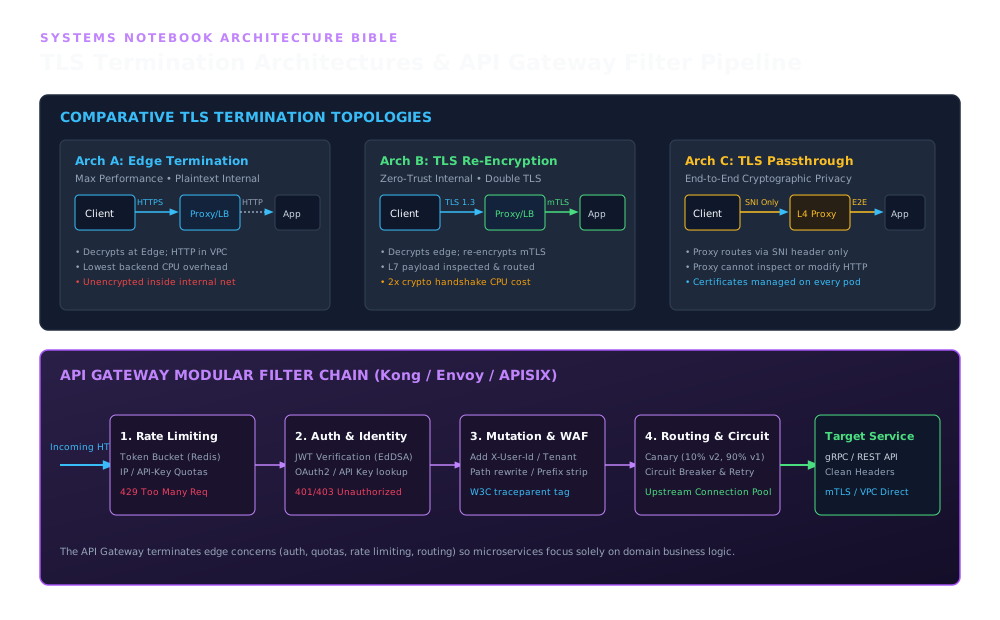
1. Arch A: Edge Termination & Client
Establishes the ingress and structural boundary across Arch A: Edge Termination & Client: Max Performance • Plaintext Internal.
2. Arch B: TLS Re-Encryption & Client
Coordinates core data-plane execution and state transitions through Arch B: TLS Re-Encryption & Client: Zero-Trust Internal • Double TLS; TLS 1.3; End-to-End Cryptographic Privacy.
3. API GATEWAY MODULAR FILTER CHAIN (Kong / Envoy / APISIX) & Rate Limiting
Enforces durability, state convergence, and output verification across API GATEWAY MODULAR FILTER CHAIN (Kong / Envoy / APISIX) & Rate Limiting: Incoming HTTP; Token Bucket (Redis) IP / API-Key Quotas 429 Too Many Req; JWT Verification (EdDSA) OAuth2 / API Key lookup 401/403 Unauthorized.
[ Internet Client ]
        │ HTTPS (TLS 1.3)
        ▼
[ Reverse Proxy / Edge LB ] ──> Terminates TLS; buffers slow socket I/O; pools upstream conns
        │ HTTP / Cleartext or mTLS
        ▼
[ API Gateway Filter Pipeline ]
  ├─ 1. Rate Limiting Filter (Token Bucket via Redis)
  ├─ 2. Auth Filter (EdDSA / RSA JWT signature verification)
  ├─ 3. Header Mutation & Trace Injection (W3C traceparent)
  └─ 4. Dynamic Router & Circuit Breaker (Canary traffic splitting)
        │
        ▼
[ Internal Microservices Fleet ]
3. Core Terminology
- Reverse Proxy: An intermediate server that sits in front of backend web servers, intercepting requests and returning resources as if it were the origin server.
- TLS Termination: Decrypting encrypted HTTPS client traffic at the edge proxy and forwarding the decrypted traffic (or re-encrypted mTLS) to backend servers.
- TLS Passthrough: Forwarding encrypted raw TCP packets directly to backend servers without decrypting at the intermediate proxy, routing solely based on the unencrypted SNI header.
- mTLS (Mutual TLS): Bidirectional cryptographic authentication where both client and server present and verify X.509 digital certificates.
- Connection Pooling: Pre-establishing and reusing a pool of persistent TCP/HTTP connections from the proxy to backend services, avoiding TCP three-way handshake and slow-start penalties for every request.
- Request Buffering: Storing incoming request headers and bodies in proxy memory or temporary disk before forwarding to backend servers, shielding backends from slow-upload socket stalls.
4. Deep Dive: SSL/TLS Termination Architectures
Architecture A: Edge TLS Termination (Offloading)
- Mechanics: The edge proxy terminates TLS. Traffic traverses the private data center or VPC network as unencrypted HTTP.
- Pros: Lowest backend CPU consumption; simplified certificate management (certificates exist only on edge proxies); backend servers can run lightweight HTTP runtimes.
- Cons: Traffic is unencrypted on internal networks. Violates strict zero-trust compliance standards (e.g., PCI-DSS, HIPAA) if internal network segments are multi-tenant or untrusted.
Architecture B: TLS Termination with Internal Re-Encryption (mTLS)
- Mechanics: Edge proxy terminates client HTTPS, inspects and mutates headers/payloads, and establishes a brand-new internal mutual TLS (mTLS) session to the target service pod using internal private certificates (e.g., issued via HashiCorp Vault or cert-manager).
- Pros: Complete end-to-end cryptographic encryption across all network hops; full Layer 7 visibility at the gateway; strict zero-trust workload identity.
- Cons: Double cryptographic processing overhead; higher edge proxy CPU and latency overhead.
Architecture C: TLS Passthrough
- Mechanics: The edge load balancer operates at Layer 4. It inspects the initial TLS
ClientHellopacket’s Server Name Indication (SNI) extension to identify the requested hostname (e.g.,api.example.com), then forwards the raw encrypted TCP stream directly to the backend pod without decrypting. - Pros: Complete end-to-end privacy (the load balancer cannot read sensitive client payloads); edge proxy cannot be compromised to steal private keys.
- Cons: Zero Layer 7 visibility at the proxy (no path-based routing, no edge rate limiting, no header transformation, no WAF inspection). Every backend container must independently maintain TLS certificates.
5. Mathematical Foundations & Formal Analysis
5.1 Token Bucket Algorithm for Edge Rate Limiting
The Token Bucket algorithm regulates incoming request bursts. The bucket has capacity tokens and is replenished at a constant rate of tokens per second.
Let be the timestamp of the last request, and be the current arrival timestamp. The updated token balance is:
If :
- Request is allowed.
- .
- .
If :
- Request is rejected immediately with HTTP
429 Too Many Requests. - The
Retry-Afterheader is computed as:
5.2 TLS 1.3 vs. TLS 1.2 Handshake Latency
In TLS 1.2, full session establishment requires 2 Round Trips (2 RTT) before application data can be transmitted:
In TLS 1.3, key exchange (ECDHE) parameters are transmitted directly inside the ClientHello, reducing the handshake to 1 RTT:
With TLS 1.3 Zero Round-Trip Resumption (0-RTT), returning clients can send encrypted application data in the very first flight of packets:
6. Production TypeScript Simulation: API Gateway Filter Chain
Below is an enterprise API Gateway filter pipeline featuring Token Bucket Rate Limiting, JWT Identity Extraction, and Header Sanitization:
export interface GatewayRequest {
  ip: string;
  path: string;
  headers: Record<string, string>;
  body: string;
}

export interface GatewayResponse {
  statusCode: number;
  headers: Record<string, string>;
  body: string;
}

export interface GatewayContext {
  userId?: string;
  tenantId?: string;
  requestId: string;
}

export type GatewayFilter = (
  req: GatewayRequest,
  ctx: GatewayContext,
  next: () => Promise<GatewayResponse>
) => Promise<GatewayResponse>;

export class TokenBucketRateLimiter {
  private tokens: number;
  private lastRefillMs: number;

  constructor(
    private readonly capacity: number,
    private readonly refillRatePerSec: number
  ) {
    this.tokens = capacity;
    this.lastRefillMs = Date.now();
  }

  public tryConsume(): boolean {
    const now = Date.now();
    const elapsedSec = (now - this.lastRefillMs) / 1000;
    this.tokens = Math.min(this.capacity, this.tokens + elapsedSec * this.refillRatePerSec);
    this.lastRefillMs = now;

    if (this.tokens >= 1.0) {
      this.tokens -= 1.0;
      return true;
    }
    return false;
  }
}

export class ApiGateway {
  private filters: GatewayFilter[] = [];
  private rateLimiters = new Map<string, TokenBucketRateLimiter>();

  public use(filter: GatewayFilter): void {
    this.filters.push(filter);
  }

  public getRateLimiter(key: string): TokenBucketRateLimiter {
    if (!this.rateLimiters.has(key)) {
      this.rateLimiters.set(key, new TokenBucketRateLimiter(10, 5)); // 10 burst, 5 req/sec
    }
    return this.rateLimiters.get(key)!;
  }

  public async execute(req: GatewayRequest): Promise<GatewayResponse> {
    const ctx: GatewayContext = {
      requestId: `req-${Math.random().toString(36).substring(2, 9)}`,
    };

    let index = 0;
    const next = async (): Promise<GatewayResponse> => {
      if (index < this.filters.length) {
        const filter = this.filters[index++];
        return filter(req, ctx, next);
      }
      // Target Upstream Service Execution (Mock)
      return {
        statusCode: 200,
        headers: {
          "Content-Type": "application/json",
          "X-Request-Id": ctx.requestId,
          "x-latency-ms": "1.2",
        },
        body: JSON.stringify({ message: "Success", user: ctx.userId }),
      };
    };

    return next();
  }
}

// Instantiate Gateway with Production Filter Pipeline
export function createProductionGateway(): ApiGateway {
  const gw = new ApiGateway();

  // 1. Rate Limiting Filter
  gw.use(async (req, ctx, next) => {
    const clientKey = req.headers["x-api-key"] || req.ip;
    const limiter = gw.getRateLimiter(clientKey);
    if (!limiter.tryConsume()) {
      return {
        statusCode: 429,
        headers: { "Retry-After": "1" },
        body: JSON.stringify({ error: "Too Many Requests" }),
      };
    }
    return next();
  });

  // 2. Authentication Filter
  gw.use(async (req, ctx, next) => {
    const authHeader = req.headers["authorization"];
    if (!authHeader || !authHeader.startsWith("Bearer ")) {
      return {
        statusCode: 401,
        headers: { "WWW-Authenticate": "Bearer" },
        body: JSON.stringify({ error: "Missing or invalid bearer token" }),
      };
    }
    const token = authHeader.substring(7);
    // Simplified JWT subject extraction
    if (token === "invalid-token") {
      return {
        statusCode: 403,
        headers: {},
        body: JSON.stringify({ error: "Forbidden: Signature invalid" }),
      };
    }
    ctx.userId = "usr-4299";
    ctx.tenantId = "tenant-enterprise";
    return next();
  });

  // 3. Header Sanitization & Context Injection Filter
  gw.use(async (req, ctx, next) => {
    // Strip untrusted incoming internal headers
    delete req.headers["x-internal-user-id"];
    // Inject verified identity down to upstream services
    req.headers["x-user-id"] = ctx.userId!;
    req.headers["x-tenant-id"] = ctx.tenantId!;
    req.headers["x-request-id"] = ctx.requestId;

    return next();
  });

  return gw;
}

async function runDemo(): Promise<void> {
  console.log("=== Reverse Proxies & Production API Gateway Simulation ===");
  const gateway = createProductionGateway();
  const req1: GatewayRequest = {
    ip: "203.0.113.42",
    path: "/api/v1/orders",
    headers: {
      "x-api-key": "user-pro-100",
      authorization: "Bearer valid-jwt-token",
    },
    body: "",
  };
  const res1 = await gateway.execute(req1);
  console.log(
    `Handled API Request: status=${res1.statusCode}, latency=${res1.headers["x-latency-ms"]}ms, body=${res1.body}`
  );
}

runDemo();
7. Open-Source Implementation Analysis
A. NGINX: Connection Pooling & Request Buffering
In NGINX, reverse proxy behavior is governed by the ngx_http_proxy_module:
upstream backend_cluster {
    server 10.0.1.10:8080 max_fails=3 fail_timeout=10s;
    server 10.0.1.11:8080 max_fails=3 fail_timeout=10s;
    keepalive 64; # Maintains 64 idle connections per worker to upstream
}

server {
    listen 443 ssl http2;
    server_name api.example.com;

    ssl_certificate     /etc/ssl/certs/api.crt;
    ssl_certificate_key /etc/ssl/private/api.key;
    ssl_protocols       TLSv1.2 TLSv1.3;

    proxy_buffering on;
    proxy_buffer_size 8k;
    proxy_buffers 64 8k;

    location / {
        proxy_pass http://backend_cluster;
        proxy_http_version 1.1;
        proxy_set_header Connection ""; # Clear Connection: close for keepalive
        proxy_set_header X-Forwarded-For $proxy_add_x_forwarded_for;
    }
}
B. Kong Gateway: Lua Plugin Execution Pipeline
Kong runs atop OpenResty (NGINX + LuaJIT). It breaks request processing into discrete phases:
certificate: Dynamic SNI certificate resolution from database without config reload.rewrite: Path mutations and header rewriting.access: Executes rate limiting, OAuth2/JWT verification, and IP ACLs before upstream proxying.header_filter&body_filter: Response inspection, compression, and data transformation.
8. Failure Modes & Operational War Stories
War Story: The HTTP Request Smuggling Attack (CL.TE Desync)
- Vulnerability: An e-commerce platform ran NGINX as the edge reverse proxy and a legacy Java application server on the backend over persistent HTTP/1.1 connections.
- Root Cause: An attacker submitted an HTTP request containing both:
NGINX prioritizedPOST / HTTP/1.1 Host: vulnerable.com Content-Length: 13 Transfer-Encoding: chunked 0 SMUGGLEDContent-Length: 13and forwarded all bytes to the backend. The Java backend prioritizedTransfer-Encoding: chunked, terminated the chunk at0, and interpreted the leftoverSMUGGLEDstring as the starting prefix of the next innocent customer’s incoming request! - Mitigation:
- Configured NGINX with
proxy_http_version 1.1;and disabled ambiguity handling. - Mandated HTTP/2 or gRPC between edge proxies and backend servers, eliminating chunked text ambiguity completely.
- Configured NGINX with
9. Operational Decision Guide
| Architectural Need | Recommended Architecture | Key Considerations |
|---|---|---|
| Public Internet API endpoint | Edge TLS Termination + API Gateway | Centralizes OAuth2/JWT auth, DDoS rate limiting, and Let’s Encrypt certificates. |
| PCI-DSS / HIPAA Sensitive Workload | TLS Re-Encryption (Edge TLS Internal mTLS) | Guaranteed zero-trust cryptographic isolation across internal switches and pods. |
| Database / Redis TCP Proxying | TLS Passthrough (L4 Stream) | End-to-end client-to-DB cryptographic session; zero proxy key management. |
| Microservice-to-Microservice Mesh | Envoy mTLS with SPIFFE/SPIRE Identity | Cryptographically verified x509 SVIDs rotated every hour with zero downtime. |
10. Hands-on Operational Drills
- Verify Token Bucket Quota Exhaustion: Execute 20 concurrent requests against the TypeScript simulation. Verify that requests 1–10 succeed with 200, while requests 11–20 are rejected with HTTP 429 and valid
Retry-Afterheaders. - Inspect Upstream Keep-Alive Re-use: Use
tcpdump -nn -i lo port 8080while sending 100 HTTP requests through NGINX to observe zeroSYN/FINpackets after the initial connection handshake.
View Reference Architecture & Worked Solutions (CORE-M06A-002)
Drill 1: Token Bucket Quota Exhaustion Verification (20 Concurrent Burst Requests)
export async function verifyTokenBucketBurst(): Promise<void> {
  const gateway = createProductionGateway(); // Capacity C = 10, refill r = 5 tokens/sec
  const statuses: number[] = [];

  for (let i = 1; i <= 20; i++) {
    const res = await gateway.execute({
      ip: '203.0.113.42',
      path: '/api/v1/orders',
      headers: {
        'x-api-key': 'tenant-burst-test',
        authorization: 'Bearer valid-jwt-token',
      },
      body: '',
    });
    statuses.push(res.statusCode);
  }

  console.log(`Requests 1..10 statuses: ${statuses.slice(0, 10).join(', ')}`);   // 200 x 10
  console.log(`Requests 11..20 statuses: ${statuses.slice(10, 20).join(', ')}`); // 429 x 10
}- Mathematical Verification: At , the bucket starts full at tokens. Requests each consume token () and pass through the Auth and Header Sanitization filters with HTTP
200. Requests arrive within the same millisecond (), observe , and short-circuit at Filter #1 with HTTP429 Too Many RequestsandRetry-After: 1(, rounded up to ) before touching JWT verification or upstream workers.
Drill 2: Upstream Keep-Alive Connection Pooling & Handshake Savings
tcpdumpVerification:- Without
keepalive 64;(NGINX default for upstream HTTP/1.0), 100 sequential requests generate 100 TCP 3-way handshakes (300SYN/SYN-ACK/ACKpackets) and 100 connection teardowns (FIN/ACK), leaving 100 sockets inTIME_WAIT. - With
keepalive 64; proxy_http_version 1.1; proxy_set_header Connection "";,tcpdump -nn -i lo port 8080captures exactly 1 TCP handshake on Request #1, followed by 100PSH, ACKHTTP request/response exchanges over the same ephemeral source port with zero subsequentSYNorFINpackets.
- Without
- Latency & CPU Savings: Assuming an intra-AZ RTT of plus an internal mTLS 1.3 handshake of ( setup tax per unpooled connection), pooling across saves of ECDHE cryptographic and kernel socket allocation overhead.
11. Design Alternatives & Gateway Trade-Offs
| Ingress Technology | Concurrency Model | TLS Overhead | Extension Model | Best Architectural Fit |
|---|---|---|---|---|
| NGINX / OpenResty | Multi-process, single-threaded epoll | Low (OpenSSL/kTLS) | C modules, LuaJIT scripts | Static assets, high-concurrency reverse proxy, edge caching |
| Envoy Proxy | Multi-threaded worker pool, epoll/eventfd | Minimal (BoringSSL + kTLS) | C++, Wasm plugins, dynamic xDS | Cloud-native microservices, dynamic service mesh ingress |
| Kong Gateway | OpenResty master/worker with PostgreSQL/DB-less | Low | Lua, Go, Wasm plugins | Enterprise API governance, plugin marketplace, OAuth2/OIDC |
| Traefik | Go goroutines per connection | Moderate (Go crypto/tls) | Go plugins, Let’s Encrypt auto-TLS | Container/Kubernetes native ingress, automatic routing discovery |
12. Authoritative References & Version Context
- Eric Rescorla (2018), “The Transport Layer Security (TLS) Protocol Version 1.3”, IETF RFC 8446 — datatracker.ietf.org/doc/html/rfc8446
- Mark Nottingham and Roy Fielding (2022), “HTTP Semantics”, IETF RFC 9110 — datatracker.ietf.org/doc/html/rfc9110
- Envoy Project Documentation (v1.30+), Architecture Overview: Threading Model and Dynamic xDS Configuration — envoyproxy.io/docs/envoy/latest/intro/arch_overview/arch_overview
- Version Context: Specifications align with TLS 1.3 (RFC 8446), HTTP/2 (RFC 9113), HTTP/3 (RFC 9114), Envoy 1.30+, and NGINX 1.26 LTS.