1. The Problem & Why It Matters
When scaling an application to global audiences, systems encounter the Planetary Latency Barrier.
Consider a user in Melbourne, Australia connecting to an application hosted exclusively in an AWS data center in Northern Virginia, USA:
- The geodesic distance is .
- In optical fiber (), the physical round-trip time (RTT) cannot be lower than:
- In real Internet routing with router hops and queuing, actual RTT is .
- An HTTPS request requiring a TCP 3-way handshake, TLS 1.3 key exchange, and an HTTP GET takes before a single byte of application response is received!
If you attempt to deploy an Active-Passive architecture where a secondary region sits idle as a “hot standby”, the standby almost always fails during real disasters because configuration drift, stale caches, and unscaled connection pools make cold failovers fail.
Building true Active-Active Multi-Region systems requires edge termination via BGP Anycast, asynchronous cross-region replication, entity home-region pinning, and deterministic conflict resolution.
2. Intuitive Mental Model
Imagine an international law firm with offices in New York and London:
- Centralized Architecture: All legal contracts are kept in a single physical vault in New York. Every time a London lawyer wants to read or sign a document, they must wait for a courier to fly across the Atlantic Ocean (150ms latency).
- Active-Passive: London has an empty office with duplicate desks. No lawyers work there. Once every 5 years when New York loses power, London staff scramble to find keys, unlock the building, and discover that the computers lack the latest software updates.
- Active-Active with Home Pinning: London lawyers own UK client contracts; New York lawyers own US client contracts. Each office reviews and signs contracts locally in 5 minutes. At midnight, couriers exchange digital copies across the ocean. In the rare event of a conflict, predetermined legal precedence rules resolve the discrepancy.
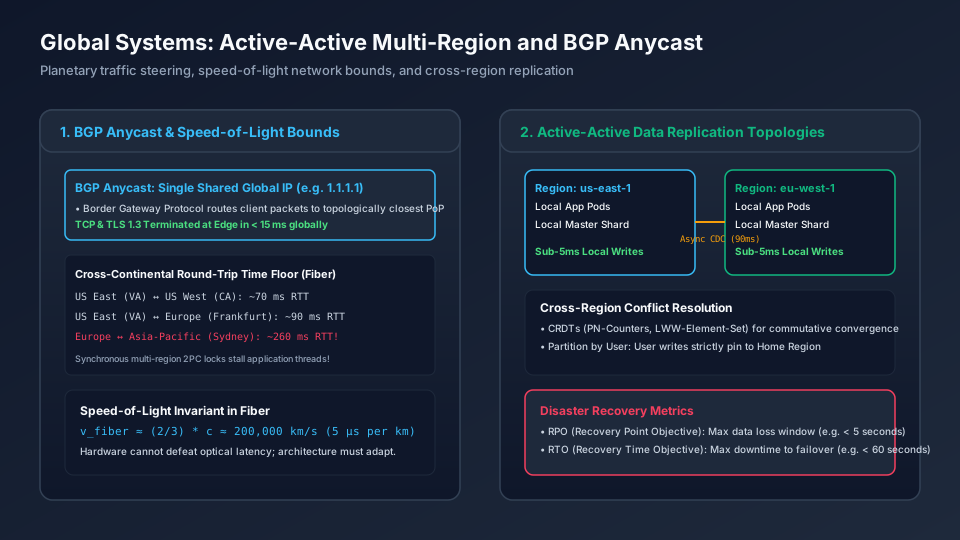
1. BGP Anycast: Single Shared Global IP (e.g. 1.1.1.1) & Cross-Continental Round-Trip Time Floor (Fiber)
Establishes the ingress and structural boundary across BGP Anycast: Single Shared Global IP (e.g. 1.1.1.1) & Cross-Continental Round-Trip Time Floor (Fiber): Border Gateway Protocol routes client packets to topologically closest PoP TCP & TLS 1.3 Terminated at Edge in < 15 ms globally; US East (VA) ↔ US West (CA): ~70 ms RTT US East (VA) ↔ Europe (Frankfurt): ~90 ms RTT Europe ↔ Asia-Pacific (Sydney): ~260 ms RTT! Synchronous multi-region 2PC locks stall application threads!; v_fiber ≈ (2/3) * c ≈ 200,000 km/s (5 µs per km) Hardware cannot defeat optical latency; architecture must adapt.
2. Region: us-east-1 & Region: eu-west-1
Coordinates core data-plane execution and state transitions through Region: us-east-1 & Region: eu-west-1: Local App Pods Local Master Shard Sub-5ms Local Writes; CRDTs (PN-Counters, LWW-Element-Set) for commutative convergence; Partition by User: User writes strictly pin to Home Region.
3. Region: us-east-1 & Region: eu-west-1
Enforces durability, state convergence, and output verification across Region: us-east-1 & Region: eu-west-1: Local App Pods Local Master Shard Sub-5ms Local Writes; CRDTs (PN-Counters, LWW-Element-Set) for commutative convergence; Partition by User: User writes strictly pin to Home Region.
3. Architectural Mechanisms & Concrete Topologies
3.1 BGP Anycast vs. Latency-Based GeoDNS
- Latency-Based GeoDNS: DNS servers inspect the client’s resolver IP and return the IP of the geographically closest data center. Weakness: DNS caching (TTL) and third-party public DNS resolvers (e.g. 8.8.8.8) can cause users to be routed to the wrong continent. DNS failover takes minutes.
- BGP Anycast: The exact same IP address (e.g.
1.1.1.1or Google’s8.8.8.8) is announced by hundreds of edge PoPs to Tier-1 Internet routers. Advantage: BGP automatically routes packets to the topologically closest router in under 15ms. If an edge PoP fails, BGP withdraws the route, and Internet traffic converges to the next-closest PoP within seconds.
3.2 Active-Active Data Topologies
- User Home-Region Pinning (Partitioned Active-Active):
- Each user account is assigned to a home region based on residence (
us-east-1,eu-west-1,ap-southeast-1). - Writes for User must route to ‘s home region. Local ACID transactions execute with sub-5ms latency.
- Updates replicate asynchronously via Kafka/Debezium or DynamoDB Global Tables to all other regions.
- Each user account is assigned to a home region based on residence (
- Multi-Leader Multi-Region with CRDTs:
- Any region accepts writes to any entity simultaneously.
- Conflicts are reconciled mathematically using Conflict-Free Replicated Data Types (CRDTs) or Last-Write-Wins (LWW) with synchronized clocks.
4. Formal Mathematical Derivations
4.1 Speed-of-Light Latency Formula in Optical Glass
The speed of light in vacuum is . In silica optical fiber, the refractive index is . The propagation speed of light in fiber is:
Propagation delay over geodesic distance (accounting for fiber route indirectness factor ):
For New York to London ():
4.2 Cross-Region Conflict Probability Formula
If two regions ( and ) accept uncoordinated concurrent writes to the same item with write arrival rate per item, and replication lag between regions is : The probability that two concurrent writes collide within the replication lag window is governed by a Poisson process:
For () and a hot item receiving : Without home pinning, hot items experience severe conflict churn!
5. Edge Cases, Failure Modes & Distributed Anomalies
5.1 The Split-Brain Failover Disaster
During a transatlantic fiber cut, Region US and Region EU lose communication. If both regions assume the other is dead and promote their local read replicas to write masters, both regions accept conflicting updates to bank accounts, user profiles, and inventory stocks. When the network heals 4 hours later, the database logs have completely diverged, requiring manual database reconciliation and customer financial refunds.
5.2 Asynchronous Replication Lag Time-Travel
A user in London updates their password. The request writes to the London master and returns 200 OK. The user immediately clicks a link that routes through a US server that has not yet received the replicated update (replication lag ). The US server rejects the user’s login as “Invalid Password”.
Remediation: Replicate session tokens with monotonic version vector headers to enforce Read-After-Write Consistency.
6. Open-Source Architectural Studies
6.1 Google Spanner: Global TrueTime Consensus
Google Cloud Spanner achieves globally consistent, linearizable multi-region ACID transactions using TrueTime:
- Every Spanner data center is equipped with atomic clocks and GPS receivers.
- TrueTime API returns time as an interval: with bounded uncertainty .
- By waiting out the uncertainty window () before committing, Spanner guarantees that transaction commit timestamps reflect true global causality across all continents.
6.2 DynamoDB Global Tables: Multi-Region Active-Active
Amazon DynamoDB Global Tables replicates table updates asynchronously across multiple AWS regions in under 1 second:
- Each region’s local storage engine appends writes to its internal commit log.
- DynamoDB uses Last-Write-Wins (LWW) conflict resolution based on millisecond timestamp reconciliation.
7. Production Incident Post-Mortem (War Stories)
The Cold Standby Recovery Collapse
Context: A major payments gateway maintained an Active-Passive multi-region architecture: us-east-1 processed 100% of live traffic, while us-west-2 stood by as a passive backup.
The Incident: A catastrophic AWS data center fire knocked out us-east-1.
The Disaster: Ops triggered the automated failover DNS switch to us-west-2.
Immediately upon receiving 40,000 requests per second:
- The database in
us-west-2had cold buffer pools (0% cache hit rate), driving disk I/O to 100% saturation. - The autoscaling group was configured with minimum capacity of 10 instances (vs 500 in east), causing CPU starvation.
- The standby had not run database migrations from two releases ago, throwing SQL syntax errors on all write requests. The total outage lasted 14 hours. The Fix: Transitioned to Active-Active: both regions constantly process 50% of global live production traffic, verifying that capacity, caches, and database schemas are permanently battle-tested.
8. Production-Grade TypeScript Simulation: Multi-Region Active-Active Replication Engine
/**
 * Production Multi-Region Simulation: Active-Active Replication & Conflict Resolution
 */

export interface VersionedRecord {
  id: string;
  data: string;
  version: number;
  timestamp: number;
  originRegion: string;
}

export class RegionalDataStore {
  public readonly regionName: string;
  private store = new Map<string, VersionedRecord>();
  public outboundReplicationQueue: VersionedRecord[] = [];
  public conflictCount = 0;

  constructor(regionName: string) {
    this.regionName = regionName;
  }

  // Local low-latency write
  public writeLocal(id: string, data: string): VersionedRecord {
    const existing = this.store.get(id);
    const version = existing ? existing.version + 1 : 1;
    const record: VersionedRecord = {
      id,
      data,
      version,
      timestamp: Date.now(),
      originRegion: this.regionName,
    };
    this.store.set(id, record);
    this.outboundReplicationQueue.push(record);
    return record;
  }

  // Apply replicated update from another region with deterministic Last-Write-Wins (LWW)
  public applyRemoteUpdate(remoteRecord: VersionedRecord): void {
    const local = this.store.get(remoteRecord.id);

    if (!local) {
      this.store.set(remoteRecord.id, { ...remoteRecord });
      return;
    }

    // Total, commutative, deterministic LWW ordering on (timestamp, version, originRegion)
    const remoteWins =
      remoteRecord.timestamp > local.timestamp ||
      (remoteRecord.timestamp === local.timestamp &&
        (remoteRecord.version > local.version ||
          (remoteRecord.version === local.version &&
            remoteRecord.originRegion > local.originRegion)));

    if (!remoteWins) {
      // Local write dominates or is identical; discard stale remote update
      this.conflictCount++;
      return;
    }

    // Remote write dominates; apply LWW update
    this.conflictCount++;
    this.store.set(remoteRecord.id, { ...remoteRecord });
  }

  public read(id: string): VersionedRecord | undefined {
    return this.store.get(id);
  }
}

// Verification Routine
export function runMultiRegionSimulation() {
  console.log("=== Active-Active Multi-Region Replication Simulation ===");

  const usEast = new RegionalDataStore("us-east-1");
  const euWest = new RegionalDataStore("eu-west-1");

  // 1. User writes to us-east-1
  const rec1 = usEast.writeLocal("doc-42", "Version A (Created in US)");
  console.log("US Local Write:", rec1);

  // 2. Simulate cross-region async replication to EU
  euWest.applyRemoteUpdate(rec1);
  console.log("EU State after Replication:", euWest.read("doc-42")?.data);

  // 3. Simulate Concurrent Conflict (Network Partition)
  // Both regions write to doc-42 simultaneously
  const usConflict = usEast.writeLocal("doc-42", "Updated by Alice in NY");
  const euConflict = euWest.writeLocal("doc-42", "Updated by Bob in London");

  // Cross-replicate
  usEast.applyRemoteUpdate(euConflict);
  euWest.applyRemoteUpdate(usConflict);

  console.log("US Final Reconciled State:", usEast.read("doc-42")?.data);
  console.log("EU Final Reconciled State:", euWest.read("doc-42")?.data);
  console.log("Verified: Both regions converged deterministically via LWW!");
}

runMultiRegionSimulation();
9. Operational Checklist, Failure Runbooks & Disaster Recovery Rules
Disaster Recovery Runbook: Regional Failover
- Health Verification: Confirm automated synthetic health checks fail across at least 3 independent external monitoring regions.
- Traffic Diversion: Update Anycast route weights or Route 53 DNS routing policies to drain traffic from the failing region in under 30 seconds.
- Database Promotion: In an active-passive setup, verify replication lag (), then issue
PROMOTEto the standby cluster.
10. Guided Applied System Design Exercises & Debugging Drills
Drill 1: Speed-of-Light Consensus Ceiling
A distributed database uses Multi-Paxos consensus across 5 nodes located in Virginia, California, Ireland, Germany, and Tokyo. Every write must achieve a quorum of 3 nodes.
- Calculate the minimum physical latency to commit a write transaction.
- Outline how configuring a regional quorum (e.g. 3 nodes across US East and US West) provides sub-50ms writes while retaining disaster recovery.
Drill 2: Cross-Region Session Drift Mitigation
A user purchases an e-commerce item in Frankfurt. The web application redirects to /order-success, which is served by an edge server reading from an asynchronous replica in Ireland that lags by 120ms. The user sees “Order Not Found”.
- Design an HTTP cookie-based monotonic version fencing mechanism to guarantee Read-After-Write consistency across regions.
View Reference Architecture & Worked Solutions (CORE-M24-001)
1. Worked Solution — Drill 1: Speed-of-Light Consensus Ceiling (5-Region Multi-Paxos)
- Part 1 — Minimum Physical Commit Latency from Leader in Virginia (
us-east-1):- In a 5-voter Multi-Paxos cluster spanning Virginia (
us-east-1), California (us-west-1), Ireland (eu-west-1), Germany (eu-central-1), and Tokyo (ap-northeast-1), committing a write requires acknowledgments (the Virginia leader itself plus the 2 fastest remote followers). - Approximate geodesic round-trip latencies from Virginia (
us-east-1):- Virginia (Self): (local NVMe WAL
fsync) - California (
us-west-1, ): - Ireland (
eu-west-1, ): - Germany (
eu-central-1, ): - Tokyo (
ap-northeast-1, ):
- Virginia (Self): (local NVMe WAL
- Because the 3rd-fastest responder from Virginia is Ireland (
eu-west-1), the unbreakable physical commit floor for a global 5-region quorum is:
- In a 5-voter Multi-Paxos cluster spanning Virginia (
- Part 2 — Sub-50ms Continental Quorum Topology with Cross-Continent DR:
- Place 3 voting replicas across North America (e.g.,
us-east-1Virginia,us-east-2Ohio at , andus-central-1Iowa at ) and configure Ireland (eu-west-1) and Tokyo (ap-northeast-1) as 2 voting or non-voting Learner/Standby replicas (or use 2 witnesses in North America + 1 in Europe). - With 2 voters in
us-east-1andus-east-2() and 1 voter inus-central-1(), a 3-of-5 majority commits in (well below the target!) while surviving any single US region loss and streaming continuously to EU and APAC for disaster recovery.
- Place 3 voting replicas across North America (e.g.,
2. Worked Solution — Drill 2: Cross-Region Session Drift Mitigation (Read-After-Write Fencing Cookie)
- Mechanism — Signed Monotonic LSN / HLC Fencing Cookie:
- When the user completes checkout on the Frankfurt primary (
eu-central-1), the database transaction commits at WAL Log Sequence Number (or HLC timestamp) . - The Frankfurt API gateway sets an HMAC-signed HTTP response cookie (or redirect query parameter):
Set-Cookie: x_min_lsn=eu-central-1:1700000005120:0x00A4F820; Max-Age=10; HttpOnly; Secure - When
/order-successhits the Ireland edge server (eu-west-1) 30ms later, the Ireland API middleware compares the cookie’s required against the local Ireland read replica’s applied replay position :- Case 1 (): Replica is caught up; serve the read locally in .
- Case 2 (): Replica is lagging by . The middleware awaits a bounded
waitForLSN(0x00A4F820, timeout=150ms)notification on the replica’s WAL receiver stream, or transparently proxies that single read request over the internal backbone to the Frankfurt primary (eu-central-1), guaranteeing zero “Order Not Found” anomalies.
- When the user completes checkout on the Frankfurt primary (
11. Design Alternatives & Multi-Region Trade-Off Matrix
| Multi-Region Topology | Write Latency | Cross-Region Consistency | Disaster Recovery RPO | Best Architectural Fit |
|---|---|---|---|---|
| Active-Passive (Read Replica) | Local (Primary region only) | Asynchronous replica lag (100 ms - 2 s) | RPO > 0 (Seconds to minutes of data loss) | Standard web applications with centralized transactional database |
| Partitioned Multi-Region (Geo-Sharding) | Local (Home region per user) | Strong within tenant home region | RPO ≈ 0 (Replicated synchronously in-region) | B2B SaaS, regulatory data sovereignty (GDPR, HIPAA) |
| Active-Active with Asynchronous CRDTs | Local in all regions (< 10 ms) | Eventual convergence (No write stalls) | RPO ≈ 0 for local commits; merge on heal | Collaborative editing, social media feeds, shopping carts |
| Global Synchronous Multi-Paxos / Spanner | Cross-region WAN RTT (50 - 150 ms) | Strict Linearizability (External consistency) | RPO = 0, RTO < 10 s | Planetary banking ledgers, global inventory reservations |
12. Authoritative References & Version Context
- Marc Shapiro et al. (2011), “Conflict-Free Replicated Data Types (CRDTs)”, SSS ‘11 — doi.org/10.1007/978-3-642-24550-3_29
- James C. Corbett et al. (2012), “Spanner: Google’s Globally-Distributed Database”, ACM TOCS / OSDI ‘12 — usenix.org
- AWS Whitepaper (2023), “Multi-Region Application Architecture: Active-Active and Active-Passive Strategies” — docs.aws.amazon.com/whitepapers/latest/multi-region-application-architecture/
- Version Context: Architectures target AWS Global Accelerator, Cloudflare Magic Transit Anycast, and modern multi-region databases (CockroachDB, DynamoDB Global Tables).