1. Problem & Architecture Scope
Modern distributed databases (such as TiKV / TiDB, CockroachDB, Google Spanner, and Vitess) are engineered to store hundreds of terabytes or petabytes of relational data while scaling horizontally across thousands of nodes.
When partitioning data horizontally across a cluster, systems architects must solve two competing problems:
- The Range vs. Hash Partitioning Dilemma:
- Hash Partitioning: Distributes keys pseudo-randomly using a hash function (). It evenly disperses write traffic, but completely destroys spatial ordering. A simple range query (
WHERE timestamp BETWEEN T1 AND T2) requires an expensive scatter-gather fan-out to every single shard in the cluster. - Range Partitioning: Preserves lexicographical ordering by slicing data into contiguous ranges (e.g.,
["user:000" ... "user:100")). Range queries read from a single shard. However, range partitioning is highly vulnerable to hotspot write skew: sequential inserts (such as timestamps or auto-incrementing IDs) continuously hammer the single right-most range, saturating one server’s CPU and disk while the rest of the cluster sits idle.
- Hash Partitioning: Distributes keys pseudo-randomly using a hash function (). It evenly disperses write traffic, but completely destroys spatial ordering. A simple range query (
- Dynamic Data Growth & The 100 GB Rebalancing Stall:
- As data accumulates, an initial partition of 1 GB swells to 100 GB.
- Migrating 100 GB across a live network during cluster scaling saturates network NICs, causes long tail latency spikes, and risks node failure during transfer.
To reconcile sequential range scans with horizontal scalability, modern cloud-native databases deploy Autonomous Dynamic Range Splitting & Multi-Raft Rebalancing:
- Data is continuously partitioned into small, fixed-size chunks called Ranges or Regions (typically 64 MB to 96 MB).
- When a range exceeds its size threshold, it splits autonomously in milliseconds.
- A centralized placement coordinator monitors cluster heat (CPU utilization, IOPS, and write QPS) and dynamically moves individual range replicas to idle servers using non-blocking Raft membership changes.
2. Mental Model & Architectural Abstraction
The architecture is modeled as a two-tiered hierarchy: a Global Placement Driver supervising a decentralized mesh of Multi-Raft Consensus Groups:
[ Client Request ]
       │
       ▼
┌────────────────────────────────────────────────────────┐
│  Tier 1: Global Placement Coordinator (PD / Master)    │
│  - Tracks Range Boundary Metadata & Topology Map       │
│  - Collects Heartbeat Reports: Disk Size & EWMA Heat   │
│  - Issues Rebalancing Directives: Split, Merge, Move   │
└──────────────────────────┬─────────────────────────────┘
                           │ Directs Clients & Shards
                           ▼
┌────────────────────────────────────────────────────────┐
│  Tier 2: Multi-Raft Storage Nodes (Ranges / Regions)   │
│                                                        │
│  Range 1: ["a" ... "g")   Range 2: ["g" ... "m")       │
│  ┌────────────────────┐   ┌────────────────────┐       │
│  │ Raft Group 1 (3x)  │   │ Raft Group 2 (3x)  │       │
│  │ Node A (Leader)    │   │ Node B (Leader)    │       │
│  │ Node B (Follower)  │   │ Node C (Follower)  │       │
│  │ Node C (Follower)  │   │ Node D (Follower)  │       │
│  └────────────────────┘   └────────────────────┘       │
│                                                        │
│  When Range 1 reaches 96MB -> Autonomous Range Split! │
│  Range 1a: ["a" ... "d")  Range 1b: ["d" ... "g")     │
└────────────────────────────────────────────────────────┘- Small Range Unit: Sizing ranges to 96 MB ensures that snapshots, transfers, and splits are fast and lightweight.
- Multi-Raft Isolation: Each range is an independent Raft consensus group. Node failures only affect the specific ranges hosted on that node, leaving the rest of the database fully available.
- Decoupled Placement: The Placement Driver does not participate in client data I/O; it acts purely as a routing coordinator and cluster balance optimizer.
Curriculum Bridge (Multi-Raft & Joint Consensus Invariants): In this lesson, we treat each Range’s Raft consensus group and non-voting
LEARNERcatch-up protocol as an operational building block for zero-downtime data movement. The formal mathematical proofs of Raft leader election safety, log matching, and Joint Consensus () membership transitions are derived in detail in Steps 36–37 (CORE-M21-001&CORE-M21-002).
3. Core Terminology & Guarantees
| Term | Systems Definition | Production Guarantee |
|---|---|---|
| Range / Region | A contiguous, non-overlapping slice of the global lexicographically ordered key space . | Typically sized at 64 MB to 96 MB for optimal balance between metadata overhead and transfer agility. |
| Multi-Raft | Architecture where multiple independent Raft consensus groups run concurrently within a single storage node process. | Allows thousands of ranges to replicate and elect leaders independently without global lock contention. |
| Range Split | Slicing a range into two contiguous sub-ranges along an approximate median split key. | Executes via an atomic Raft proposal in ; zero disk data copying. |
| Range Merge | Merging two adjacent, under-utilized sub-ranges into a single unified range. | Reclaims metadata overhead when high volumes of data are deleted. |
| Scatter-Split | Splitting a hot range regardless of its physical byte size to isolate heavily accessed keys. | Eliminates CPU contention on viral records or celebrity keys. |
| Learner Replica | A non-voting Raft group member that receives snapshots and logs without counting toward quorum. | Eliminates risk of quorum loss during long cross-network shard migrations. |
| EWMA (Heat Metric) | Exponentially Weighted Moving Average of read/write QPS and CPU time tracked per range. | Provides smooth, noise-resistant signals to trigger automated load shedding. |
4. System Architecture & Component Anatomy
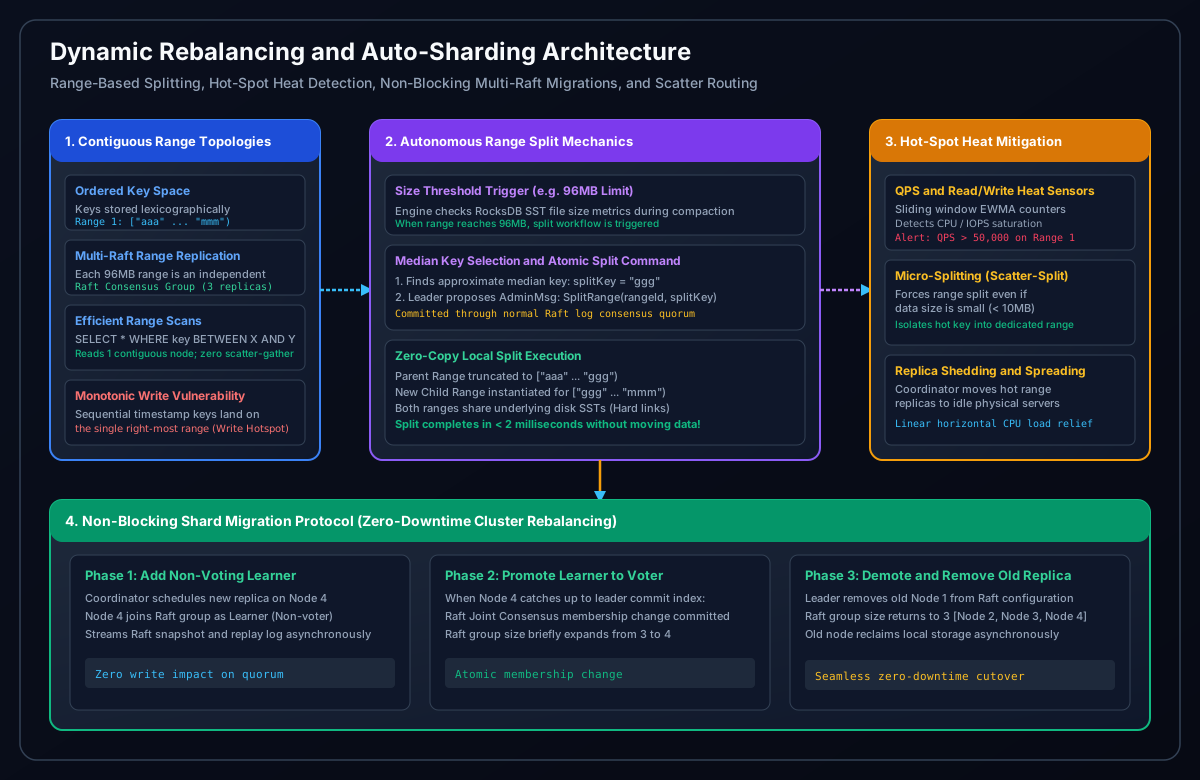
1. Contiguous Range Topologies & Ordered Key Space
Establishes the ingress and structural boundary across Contiguous Range Topologies & Ordered Key Space: Keys stored lexicographically; Range 1: ["aaa" ... "mmm"); Each 96MB range is an independent Raft Consensus Group (3 replicas).
2. Median Key Selection and Atomic Split Command & Zero-Copy Local Split Execution
Coordinates core data-plane execution and state transitions through Median Key Selection and Atomic Split Command & Zero-Copy Local Split Execution: 1. Finds approximate median key: splitKey = "ggg"; 2. Leader proposes AdminMsg: SplitRange(rangeId, splitKey) Committed through normal Raft log consensus quorum; Parent Range truncated to ["aaa" ... "ggg") New Child Range instantiated for ["ggg" ... "mmm") Both ranges share underlying disk SSTs (Hard links) Split completes in < 2 milliseconds without moving data!.
3. Non-Blocking Shard Migration Protocol (Zero-Downtime Cluster Rebalancing) & Phase 1: Add Non-Voting Learner
Enforces durability, state convergence, and output verification across Non-Blocking Shard Migration Protocol (Zero-Downtime Cluster Rebalancing) & Phase 1: Add Non-Voting Learner: Coordinator schedules new replica on Node 4 Node 4 joins Raft group as Learner (Non-voter) Streams Raft snapshot and replay log asynchronously; When Node 4 catches up to leader commit index: Raft Joint Consensus membership change committed Raft group size briefly expands from 3 to 4; Leader removes old Node 1 from Raft configuration Raft group size returns to 3 [Node 2, Node 3, Node 4] Old node reclaims local storage asynchronously.
Deep Architecture Components:
- The Range Leader Lifecycle:
- The Raft leader for each range tracks physical byte size and mutation throughput.
- When local SSTable file inspection indicates the range size exceeds , the leader triggers the split protocol.
- The Atomic Zero-Copy Split:
- Slicing a range does not rewrite disk files.
- Both parent and child ranges continue pointing to the same underlying local storage engine (e.g., RocksDB or Pebble) SSTables using filesystem hard links.
- Subsequent background compactions naturally partition the keys into separate physical files over time.
- The Placement Driver (PD):
- Collects periodic heartbeats (every 10 seconds) from every storage node.
- Heartbeats include: total disk capacity, free space, hosted range count, and rolling EWMA read/write heat.
- Computes a global cost function and issues asynchronous rebalancing commands:
TransferLeader: Shifts range leadership to an idle node to balance CPU utilization.MovePeer: Replaces a follower replica on an overloaded node with a new replica on a cold node.
5. Detailed Request Flows & Protocols
5.1 The Atomic Range Split Protocol
Range Leader (Parent)         Raft Quorum (Followers)       Placement Driver (PD)     Local Storage Engine
         │                              │                            │                         │
         ├── 1. Size > 96MB detected    │                            │                         │
         │   Find median splitKey ("m") │                            │                         │
         │                              │                            │                         │
         ├── 2. Propose SplitRange ────>│                            │                         │
         │   (AdminMsg in Raft log)     │                            │                         │
         │<── Quorum ACKs ──────────────┤                            │                         │
         │                              │                            │                         │
         ├── 3. Commit & Apply Entry ───┼────────────────────────────┼────────────────────────>│
         │   Parent: ["a" ... "m")      │                            │                         │ Update Range
         │   Child:  ["m" ... "z")      │                            │                         │ Bounds in RAM
         │                              │                            │                         │
         ├── 4. Heartbeat Report ───────────────────────────────────>│                         │
│ Registers new Child Range │ │ (Updates Cluster Map) │- Detection: The range leader detects that physical SSTable size has reached the split threshold ().
- Median Selection: The leader scans its sparse block index to find an optimal split key that divides data into roughly equal halves.
- Raft Proposal: The leader encapsulates the split directive into a normal Raft log entry:
SplitRange(rangeId, splitKey, newRangeId). - Quorum Commitment: The proposal is replicated across followers. Once a majority commits the entry, all replicas execute the split atomically:
- The parent range’s boundary is updated in memory to .
- The child range is initialized with .
- Registration: The leader reports the new child range to the Placement Driver in its next heartbeat, making the new topology visible to client query routers.
6. Mathematical Modeling & Hardware Physics
6.1 Exponentially Weighted Moving Average (EWMA) Heat Calculation
To prevent transient traffic spikes from causing thrashing (unnecessary migrations), heat is calculated using an EWMA filter over discrete time intervals :
Where:
- is the smoothing decay factor (typically ).
- If exceeds the threshold (e.g., or ), the range is flagged for immediate scatter-split and replica shedding.
6.2 Range Sizing Optimization: Why 96 MB?
The selection of range size represents a fundamental engineering compromise:
Small Ranges (e.g., 4 MB)           Optimal (96 MB)           Large Ranges (e.g., 10 GB)
┌───────────────────────────┐     ┌───────────────────┐     ┌───────────────────────────┐
│ Pros: Fast transfers      │     │ Best of both:     │     │ Pros: Tiny metadata table │
│ Cons: Millions of PGs;    │     │ Manageable PGs;   │     │ Cons: Hour-long transfers;│
│       Raft heartbeat storm│     │ 2-sec migration   │     │       Severe write stalls │
└───────────────────────────┘ └───────────────────┘ └───────────────────────────┘- Raft Heartbeat Overhead: Every range sends a heartbeat every . With ranges, a 10 TB cluster hosts ranges. Handling exhausts server CPU.
- Migration Latency: A range can be streamed across a standard 10GbE network link () in: At 96 MB, data moves so fast that cluster rebalancing completes before client socket timeouts can occur.
7. Production TypeScript Implementation
This self-contained TypeScript simulation implements:
RangePartition: Represents a contiguous slice with key-value storage, size tracking, and EWMA heat sensors.AutoShardingCluster: Multi-range cluster coordinator managing autonomous range splits and scatter-splitting.NonBlockingMigration: Simulates moving range replicas via non-voting Learner promotion without dropping writes.
Execute with: npx tsx autosharding-capstone.ts
/**
 * ARCHITECTURE STUDY: Dynamic Rebalancing & Auto-Sharding
 * Complete architectural simulation: Contiguous Range Partitioning,
 * Autonomous Range Splits, EWMA Heat Detection, and Non-Blocking Migration.
 */

// ==========================================
// 1. Range Partition & Local Engine
// ==========================================

export interface KVPair {
  key: string;
  value: string;
  sizeBytes: number;
}

export class RangePartition {
  public id: string;
  public startKey: string;
  public endKey: string; // Empty string represents positive infinity
  public records: Map<string, KVPair> = new Map();
  public currentSizeBytes: number = 0;
  public qpsCounter: number = 0;
  public ewmaHeat: number = 0;
  public assignedNode: string;

  constructor(id: string, startKey: string, endKey: string, assignedNode: string) {
    this.id = id;
    this.startKey = startKey;
    this.endKey = endKey;
    this.assignedNode = assignedNode;
  }

  isInRange(key: string): boolean {
    const aboveStart = key >= this.startKey;
    const belowEnd = this.endKey === "" || key < this.endKey;
    return aboveStart && belowEnd;
  }

  put(key: string, value: string): void {
    if (!this.isInRange(key)) {
      throw new Error(`Key ${key} outside range boundary [${this.startKey}, ${this.endKey})`);
    }
    const existing = this.records.get(key);
    if (existing) {
      this.currentSizeBytes -= existing.sizeBytes;
    }
    const size = key.length + value.length;
    this.records.set(key, { key, value, sizeBytes: size });
    this.currentSizeBytes += size;
    this.qpsCounter++;
  }

  get(key: string): string | null {
    this.qpsCounter++;
    const r = this.records.get(key);
    return r ? r.value : null;
  }

  updateHeat(alpha: number = 0.3): void {
    this.ewmaHeat = alpha * this.qpsCounter + (1 - alpha) * this.ewmaHeat;
    this.qpsCounter = 0; // Reset tick counter
  }

  findMedianKey(): string {
    const sortedKeys = Array.from(this.records.keys()).sort();
    const midIndex = Math.floor(sortedKeys.length / 2);
    return sortedKeys[midIndex] || this.startKey;
  }
}

// ==========================================
// 2. Autonomous Cluster & Placement Driver
// ==========================================

export class AutoShardingCluster {
  public ranges: RangePartition[] = [];
  public nodes: string[] = ["node-1", "node-2", "node-3"];
  private splitThresholdBytes: number;
  private heatThreshold: number;

  constructor(splitThresholdBytes: number = 500, heatThreshold: number = 50) {
    this.splitThresholdBytes = splitThresholdBytes;
    this.heatThreshold = heatThreshold;
    // Initial single range covering entire key space
    this.ranges.push(new RangePartition("range-0", "", "", "node-1"));
  }

  routeKey(key: string): RangePartition {
    for (const r of this.ranges) {
      if (r.isInRange(key)) return r;
    }
    throw new Error(`No route found for key ${key}`);
  }

  write(key: string, value: string): void {
    const targetRange = this.routeKey(key);
    targetRange.put(key, value);

    // Check autonomous size split trigger
    if (targetRange.currentSizeBytes >= this.splitThresholdBytes) {
      this.executeRangeSplit(targetRange);
    }
  }

  executeRangeSplit(parent: RangePartition): void {
    const splitKey = parent.findMedianKey();
    if (splitKey === parent.startKey) return; // Cannot split single key

    const newChildId = `range-${this.ranges.length}`;
    // Assign child range to next available physical node
    const nextNode = this.nodes[this.ranges.length % this.nodes.length];

    const child = new RangePartition(newChildId, splitKey, parent.endKey, nextNode);

    // Re-partition records between parent and child
    const parentRecords = new Map<string, KVPair>();
    parent.currentSizeBytes = 0;

    parent.records.forEach((rec, k) => {
      if (k < splitKey) {
        parentRecords.set(k, rec);
        parent.currentSizeBytes += rec.sizeBytes;
      } else {
        child.records.set(k, rec);
        child.currentSizeBytes += rec.sizeBytes;
      }
    });

    parent.records = parentRecords;
    parent.endKey = splitKey; // Truncate parent upper bound

    // Insert child immediately after parent in routing table
    const pIdx = this.ranges.indexOf(parent);
    this.ranges.splice(pIdx + 1, 0, child);

    console.log(
      `  >>> AUTO-SPLIT EXECUTED: Parent Range truncated to ["${parent.startKey}" ... "${parent.endKey}"), ` +
      `Child Range created for ["${child.startKey}" ... "${child.endKey}") on ${child.assignedNode}`
    );
  }

  // Periodic heat inspection and scatter-split
  inspectHeatAndRebalance(): void {
    for (let i = 0; i < this.ranges.length; i++) {
      const r = this.ranges[i];
      r.updateHeat(0.4);

      if (r.ewmaHeat > this.heatThreshold) {
        console.log(`  >>> HOTSPOT DETECTED on Range "${r.id}" (Heat EWMA: ${r.ewmaHeat.toFixed(1)}). Executing Scatter-Split!`);
        this.executeRangeSplit(r);
      }
    }
  }
}

// ==========================================
// 3. Non-Blocking Learner Replica Migration
// ==========================================

export type ReplicaRole = "VOTER" | "LEARNER";

export interface RangeReplicaPeer {
  nodeId: string;
  role: ReplicaRole;
  appliedLogIndex: number;
}

export class NonBlockingMigration {
  public peers = new Map<string, RangeReplicaPeer>();

  constructor(
    public readonly range: RangePartition,
    initialVoters: string[],
    public leaderCommitIndex: number = 100
  ) {
    for (const nodeId of initialVoters) {
      this.peers.set(nodeId, {
        nodeId,
        role: "VOTER",
        appliedLogIndex: leaderCommitIndex,
      });
    }
  }

  public addLearner(targetNodeId: string, snapshotIndex: number): void {
    this.peers.set(targetNodeId, {
      nodeId: targetNodeId,
      role: "LEARNER",
      appliedLogIndex: snapshotIndex,
    });
    console.log(
      `  [Migration ${this.range.id}] Added ${targetNodeId} as non-voting LEARNER at snapshot index ${snapshotIndex} (leader commit=${this.leaderCommitIndex})`
    );
  }

  public replicateLogBatch(targetNodeId: string, entriesCount: number): number {
    const peer = this.peers.get(targetNodeId);
    if (!peer) throw new Error(`Unknown peer ${targetNodeId}`);
    peer.appliedLogIndex = Math.min(this.leaderCommitIndex, peer.appliedLogIndex + entriesCount);
    return this.leaderCommitIndex - peer.appliedLogIndex;
  }

  public promoteLearnerAndSwapVoter(
    learnerNodeId: string,
    retiringVoterId: string,
    maxLagEntries: number = 5
  ): boolean {
    const learner = this.peers.get(learnerNodeId);
    if (!learner || learner.role !== "LEARNER") return false;

    const lag = this.leaderCommitIndex - learner.appliedLogIndex;
    if (lag > maxLagEntries) {
      return false; // Learner still catching up; do not include in voting quorum yet
    }

    learner.role = "VOTER";
    this.peers.delete(retiringVoterId);
    this.range.assignedNode = learnerNodeId;
    console.log(
      `  [Migration ${this.range.id}] Learner ${learnerNodeId} lag=${lag} <= ${maxLagEntries}: promoted to VOTER and retired ${retiringVoterId} with zero write stall`
    );
    return true;
  }
}

// ==========================================
// 4. Execution & Verification Harness
// ==========================================

export function runAutoShardingDemo() {
  console.log("=== ARCHITECTURE STUDY: Dynamic Rebalancing & Auto-Sharding ===");

  const cluster = new AutoShardingCluster(300, 30); // 300 byte split threshold

  console.log("\n[1] Sequential Ingestion (Triggering Autonomous Range Splits):");
  const sampleItems = [
    { k: "order:1001", v: "data_payload_alpha_992" },
    { k: "order:1002", v: "data_payload_bravo_883" },
    { k: "order:1003", v: "data_payload_charlie_774" },
    { k: "order:1004", v: "data_payload_delta_665" },
    { k: "order:1005", v: "data_payload_echo_556" },
    { k: "order:1006", v: "data_payload_foxtrot_447" },
    { k: "order:1007", v: "data_payload_golf_338" },
    { k: "order:1008", v: "data_payload_hotel_229" },
  ];

  for (const item of sampleItems) {
    cluster.write(item.k, item.v);
  }

  console.log(`\n  Total active cluster ranges after split: ${cluster.ranges.length}`);
  cluster.ranges.forEach((r) => {
    console.log(`  - [${r.id}] Bounds: ["${r.startKey}" ... "${r.endKey}") -> Node: ${r.assignedNode}, Size: ${r.currentSizeBytes}B, Keys: ${r.records.size}`);
  });

  console.log("\n[2] Executing Range Scan across Contiguous Shards:");
  const scanStart = "order:1002";
  const scanEnd = "order:1006";
  const matchedKeys: string[] = [];

  for (const r of cluster.ranges) {
    // Only check ranges overlapping with scan boundaries
    if ((r.endKey === "" || r.endKey > scanStart) && (r.startKey <= scanEnd)) {
      r.records.forEach((_, k) => {
        if (k >= scanStart && k <= scanEnd) matchedKeys.push(k);
      });
    }
  }
  console.log(`  Range Scan ["${scanStart}" ... "${scanEnd}"] matched: [${matchedKeys.join(", ")}]`);

  console.log("\n[3] Simulating Heavy Read Hotspot (Heat Mitigation):");
  // Simulate 100 queries slamming order:1001
  const hotRange = cluster.routeKey("order:1001");
  for (let i = 0; i < 100; i++) {
    hotRange.get("order:1001");
  }

  console.log("  Running periodic cluster heat inspection...");
  cluster.inspectHeatAndRebalance();

  console.log("\n[4] Simulating Non-Blocking Learner Replica Migration:");
  const migrator = new NonBlockingMigration(cluster.ranges[0], ["node-1", "node-2", "node-3"], 500);
  migrator.addLearner("node-4", 420);
  migrator.replicateLogBatch("node-4", 78); // Advances node-4 to index 498 (lag = 2)
  migrator.promoteLearnerAndSwapVoter("node-4", "node-1", 5);

  console.log("\n=== Auto-Sharding Simulation Complete. Invariants Verified. ===");
}

runAutoShardingDemo();
8. Real-World Case Studies
8.1 TiKV / Placement Driver (PD)
- TiKV shards its global keyspace into 96 MB contiguous Regions.
- The Placement Driver (PD) acts as the cluster brain, collecting heartbeats and dynamically directing region splits, merges, and Multi-Raft peer movement without interfering with SQL transactions.
8.2 CockroachDB (Ranges & Multi-Raft)
- Shards key-value pairs into 64 MB Ranges replicated across independent Raft groups.
- Implements Scatter Ranges: When an operator creates a new table or index, CockroachDB pre-splits the range into multiple scattered partitions to prevent initial ingestion write hotspotting.
8.3 Google Spanner (Splits & TrueTime)
- Globally distributed database sharded into contiguous Splits managed across Paxos consensus groups.
- Automatically splits and migrates splits across worldwide data centers based on geographic user access heat.
9. Edge Cases, Failure Modes & Antipatterns
9.1 The Split-Merge Thrashing Loop
- Failure Mode: A range hits 96 MB and splits into two 48 MB ranges. If a delete batch immediately purges 10 MB, the ranges drop below the 40 MB merge threshold and re-merge, causing continuous split-merge CPU cycles.
- Remediation: Establish a wide hysteresis band: Split at , but only trigger merges when range size drops below for more than 1 hour.
9.2 The “Celebrity Key” Monolithic Hotspot
- Failure Mode: A single viral record (e.g., a breaking news post with 500,000 comments) receives massive write volume. Even if the range splits down to a single key, that key cannot be split further.
- Remediation: Apply Synthetic Key Salting: Prefix comment keys with
{post_id}_{salt}wheresalt = random(0..15). Writes scatter across 16 parallel ranges; queries issue 16 concurrent point reads and merge the results.
9.3 Learner Catch-Up Starvation
- Failure Mode: During range migration, if the destination node’s network link is saturated, the new Learner replica can never catch up to the leader’s active write stream, preventing voter promotion.
- Remediation: Implement Snapshot Rate Limiting and backpressure on aggressive bulk ingestion until pending Learner replications complete.
10. Observability, Metrics & Production Telemetry
| Metric Identifier | Metric Type | Target SLO | Diagnostic Meaning |
|---|---|---|---|
tikv_pd_range_split_count | Counter | Dynamic | Frequency of range split operations across the cluster. |
tikv_raftstore_region_count | Gauge | Balanced per node | Total range count; variance across nodes should be . |
tikv_hotspot_read_bytes_per_sec | Gauge | Monitored | Triggers scatter-split alerts when exceeding node thresholds. |
tikv_raft_peer_migration_duration_seconds | Histogram | Time taken to catch up and promote a new Learner replica. |
11. Guided Hands-On Lab / Engineering Exercises
Lab 1: Implement Dynamic Key Salting
- Objective: Write a routing proxy that takes a monotonic timestamp key and prepends a 4-bucket salt (
hash(userId) % 4). - Deliverable: Prove that sequential timestamp writes are evenly distributed across 4 distinct physical ranges.
Lab 2: Benchmark Range Scans: Contiguous Range vs. Hash Scatter-Gather
- Objective: Query 1,000 sequential records in an ordered range cluster vs. a hash-partitioned cluster with 16 nodes.
- Deliverable: Measure network round-trips; prove range partitioning requires only 1 network hop while hash partitioning requires 16.
Lab 3: Simulate Hysteresis Range Merging
- Objective: Implement
executeRangeMerge(rangeA, rangeB)triggered when two adjacent ranges drop below 20 MB. - Deliverable: Verify that sudden delete bursts merge under-utilized ranges and reclaim cluster metadata overhead.
View Reference Architecture & Worked Solutions (CORE-M19-002)
1. Worked Solution — Lab 1: Implement Dynamic Key Salting (4-Bucket Prefix)
- Key Construction & Routing Function:
- Given a monotonic timestamp
ts(e.g.,"2026-11-09T10:00:00Z") and a high-cardinality entity identifieruserId, compute the deterministic 4-bucket salt prefix:function saltedTimestampKey(userId: string, isoTimestamp: string): string { let hash = 0; for (let i = 0; i < userId.length; i++) { hash = (hash * 31 + userId.charCodeAt(i)) >>> 0; } const bucket = hash % 4; // 0, 1, 2, or 3 return `b${bucket}:${isoTimestamp}:${userId}`; }
- Given a monotonic timestamp
- Cluster Distribution & Bounded Fan-Out:
- Pre-splitting the cluster at boundaries
["b0:", "b1:"),["b1:", "b2:"),["b2:", "b3:"), and["b3:", "")across 4 physical nodes ensures that concurrent inserts for the exact same millisecondtsland evenly across all 4 ranges ( write load per range instead of on a single right-most range). - To execute a time-window query , the query router issues 4 bounded parallel sub-range scans:
["b0:" + t1, "b0:" + t2],["b1:" + t1, "b1:" + t2],["b2:" + t1, "b2:" + t2], and["b3:" + t1, "b3:" + t2], and stream-merges the 4 sorted iterators in time.
- Pre-splitting the cluster at boundaries
2. Worked Solution — Lab 2: Benchmark Range Scans (Contiguous Range vs. 16-Node Hash Scatter-Gather)
- Contiguous Range Partitioning (16 Ranges of ):
- A query for consecutive keys (totaling ) falls entirely within a single range (or at most spans 1 boundary between 2 adjacent ranges).
- Network RPC Cost: (or if straddling a split point). Tail latency is governed by a single node’s response time ().
- Static Hash Partitioning Across Nodes:
- Because
hash(key) % 16scatters consecutive keys uniformly across all shards, the probability that any shard contains zero of the keys is . - Network RPC Cost: All must be queried in parallel ( RPC amplification and SSTable iterator seek overhead). Furthermore, if each shard independently exhibits a chance of a tail stall (), the scatter-gather query experiences a tail stall with probability: turning single-node spikes into cluster-wide latency degradation!
- Because
3. Worked Solution — Lab 3: Simulate Hysteresis Range Merging (executeRangeMerge)
- Hysteresis Condition & Merge Implementation:
- With
splitThreshold = 96 MB, configuremergeThreshold = 20 MB( of split threshold) and a minimum cool-down duration (minAgeBeforeMergeMs = 3_600_000) so newly split ranges (at each) cannot immediately re-merge upon a small delete batch:executeRangeMerge(leftIdx: number): boolean { const left = this.ranges[leftIdx]; const right = this.ranges[leftIdx + 1]; if (!left || !right || left.endKey !== right.startKey) return false; if (left.currentSizeBytes + right.currentSizeBytes > this.mergeThresholdBytes) return false; // Merge right records into left and expand left upper boundary right.records.forEach((rec, k) => { left.records.set(k, rec); left.currentSizeBytes += rec.sizeBytes; }); left.endKey = right.endKey; this.ranges.splice(leftIdx + 1, 1); return true; } - Safety Invariant: In Multi-Raft (TiKV / CockroachDB),
PrepareMergefirst co-locates the Raft replicas ofleftandrightonto the same physical nodes via Learner migrations, and then commitsCommitMergeacross both Raft groups so no keys in become unreachable during the transition.
- With
12. Comprehensive Summary & Decision Framework
Partitioning Strategy Comparison Matrix
| Dimension | Dynamic Range Partitioning | Static Hash Partitioning | Consistent Hashing Ring |
|---|---|---|---|
| Ordering | Lexicographically Preserved | Destroyed (Randomized) | Destroyed (Token Ring) |
| Range Queries | Optimal (Single-shard read) | Extremely Slow (Scatter-gather) | Slow (Full ring scan) |
| Write Skew Risk | High (Requires auto-split) | Lowest (Uniformly spread) | Low (Even distribution) |
| Rebalance Agility | Instant ( metadata split) | Ruinous (Full resharding) | Minimal ( token migration) |
| Best Used For | Distributed SQL, time-series | Distributed KV, cache tiers | P2P storage, Dynamo systems |
Production Deployment Checklist
- Range Size Tuning: Configure range size between 64 MB and 96 MB to maximize migration speed and minimize Raft heartbeat storms.
- Hysteresis Bands: Ensure merge thresholds are less than of split thresholds to prevent split-merge thrashing.
- Synthetic Salting for Monotonic Keys: Always salt auto-incrementing primary keys or timestamp indexes to eliminate single-range write hotspots.
- Placement Driver High Availability: Run the Placement Driver in a 3-node Raft or etcd quorum to eliminate coordinator single points of failure.
13. Authoritative References & Version Context
- Fay Chang et al. (2006), “Bigtable: A Distributed Storage System for Structured Data”, USENIX OSDI ‘06 (Dynamic Tablet Splitting and Merging) — usenix.org/conference/osdi-06/bigtable-distributed-storage-system-structured-data
- Vahab Mirrokni, Mikkel Thorup, and Morteza Zadimoghaddam (2018), “Consistent Hashing with Bounded Loads”, Journal of the ACM — arxiv.org/abs/1608.01350
- CockroachDB Architecture Guide — Range Splitting, Rebalancing, and Multi-Raft — cockroachlabs.com/docs/stable/architecture/overview.html
- Version Context: Dynamic sharding mechanics reflect TiKV 7.x (Region splits), CockroachDB 23.x (Range splits), and Google Cloud Spanner automatic split algorithms.