Replication is the primary mechanism for achieving fault tolerance, durability, and low-latency data access in distributed storage. While foundational single-leader (primary-backup) and leaderless quorum architectures (Dynamo-style) are well known, advanced production architectures often require higher read concurrency with strict linearizability, or multi-datacenter active-active write availability.
This lesson explores advanced replication engineering:
- Chain Replication & CRAQ: Achieving linearizable consistency with pipelined writes and high-throughput apportioned reads.
- Multi-Leader WAN Topologies: Scaling writes across multiple geographic regions.
- Causality & Conflict Resolution: Vector Clocks, Version Vectors, and Conflict-Free Replicated Data Types (CRDTs).
1. Context & Architecture Setting
+-------------------------------------------------------------------------------+
|                       REPLICATION TOPOLOGY COMPARISON                         |
+-------------------------------------------------------------------------------+
| Topology                | Consistency Model         | Read / Write Trade-Off  |
+-------------------------+---------------------------+-------------------------+
| Classic Chain           | Strict Linearizability    | Write: O(N) pipeline    |
| Replication             | (Strong Consistency)      | Read: Bottlenecked at Tail|
+-------------------------+---------------------------+-------------------------+
| CRAQ (Apportioned)      | Strict Linearizability    | Write: O(N) pipeline    |
|                         | (Strong Consistency)      | Read: O(1) All nodes!   |
+-------------------------+---------------------------+-------------------------+
| Multi-Leader            | Eventual Consistency      | Write: Local sub-ms     |
| (Active-Active WAN)     | (Causal / Convergence)    | Conflict: Needs CRDT/Vec|
+-------------------------+---------------------------+-------------------------+
| Dynamo Leaderless       | Tunable Consistency       | Write: W quorums        |
| (W + R > N)             | (Sloppy / Read Repair)    | Read: R quorums         |
+-------------------------+---------------------------+-------------------------+
2. Architectural Mental Model: Chain Replication & CRAQ
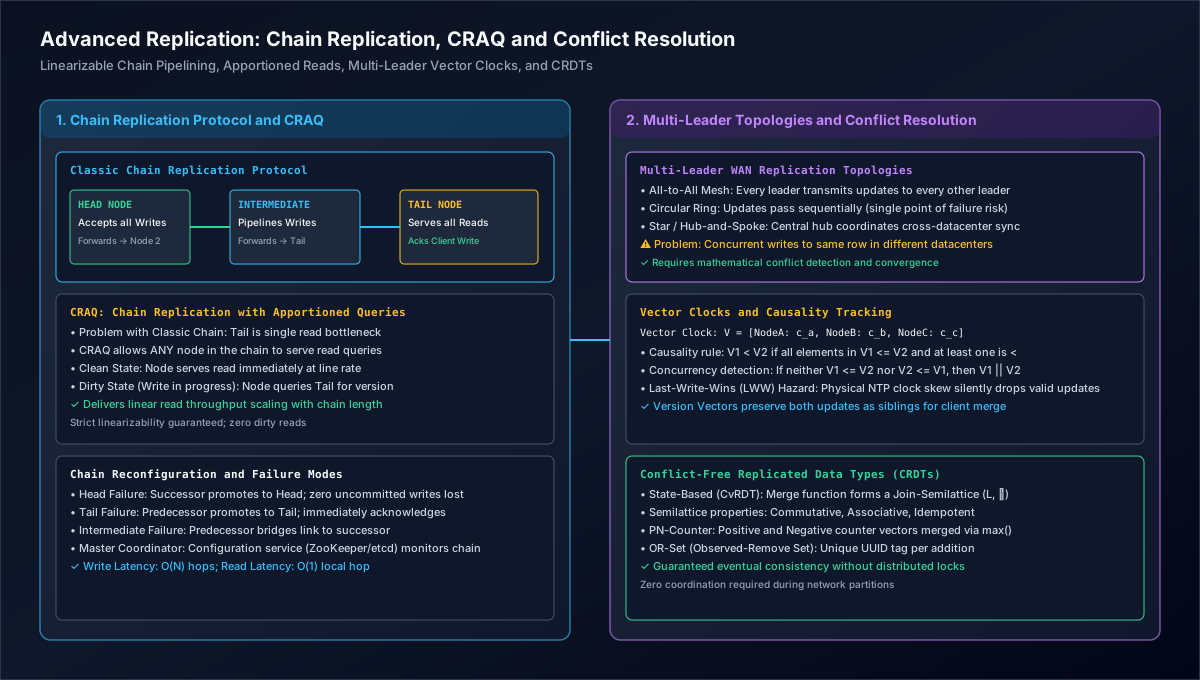
1. Chain Replication Protocol and CRAQ
Establishes the ingress and structural boundary across Chain Replication Protocol and CRAQ to uphold deterministic distributed systems guarantees within Advanced Replication: Chain Replication, CRAQ and Conflict Resolution.
2. Classic Chain Replication Protocol & HEAD NODE
Coordinates core data-plane execution and state transitions through Classic Chain Replication Protocol & HEAD NODE: Accepts all Writes Forwards → Node 2; Pipelines Writes Forwards → Tail; Serves all Reads Acks Client Write.
3. Multi-Leader Topologies and Conflict Resolution & Multi-Leader WAN Replication Topologies
Enforces durability, state convergence, and output verification across Multi-Leader Topologies and Conflict Resolution & Multi-Leader WAN Replication Topologies: All-to-All Mesh: Every leader transmits updates to every other leader; Circular Ring: Updates pass sequentially (single point of failure risk); Star / Hub-and-Spoke: Central hub coordinates cross-datacenter sync ⚠ Problem: Concurrent writes to same row in different datacenters.
The Classic Chain Replication Protocol
Developed by Robbert van Renesse and Fred B. Schneider (2004), Chain Replication organizes nodes into a linear sequence:
- Write Path:
- Clients send write requests exclusively to the Head.
- The Head updates its local state and forwards the write down the chain.
- Each intermediate node applies the update and forwards it to its successor.
- When the Tail applies the update, the write is officially committed. The Tail sends the final acknowledgment to the client.
- Read Path:
- Clients send read queries exclusively to the Tail.
- Because the Tail only holds updates that have been processed by every node in the chain, all reads are strictly linearizable (serializable point-in-time state).
CRAQ: Chain Replication with Apportioned Queries
While Classic Chain Replication guarantees linearizability, the Tail node becomes a severe read bottleneck. CRAQ (Terrace & Freedman, 2009) solves this by allowing any node in the chain to serve read queries:
- Clean vs. Dirty States:
- Each object version on a node has a status:
CLEANorDIRTY. - When a node receives a new write version, it stores the version and marks the object
DIRTY. It forwards the write to the next node. - When the Tail receives the write, the write is committed. The Tail sends an acknowledgment backwards up the chain, marking the version
CLEAN.
- Each object version on a node has a status:
- Read Resolution:
- If a client reads an object from a node and the latest version is
CLEAN, the node immediately returns the value. - If the latest version is
DIRTY, the node queries the Tail: “What is the latest committed version for Key X?” The Tail responds with the version, and the node serves that exact committed version.
- If a client reads an object from a node and the latest version is
3. Multi-Leader Topologies & Conflict Resolution
In multi-leader active-active deployments (e.g., across US, Europe, and Asia), each region accepts writes locally to avoid cross-continental latency.
The Conflict Problem
Consider two users editing the same document simultaneously:
- User A in Virginia updates title to
"Architecture Guide"at timestamp . - User B in Frankfurt updates title to
"Systems Notebook"at timestamp .
Because network latency delays cross-region sync, both leaders commit locally. When updates cross the Atlantic, a conflict emerges.
The Hazard of Last-Write-Wins (LWW)
Naive systems resolve conflicts using physical timestamps (NTP): Why LWW causes silent data loss: NTP clock drift between data centers ranges from to . If User B’s server clock is slightly behind, User B’s write is permanently erased, even if User B’s action occurred later in physical wall-clock time.
4. Vector Clocks & Version Vectors
Vector Clocks track causal ordering without synchronized physical clocks.
For a cluster of nodes, a vector clock is an array of logical counters:
Causal Ordering Rules
Given two vector clocks and :
- if and only if .
- (V1 causally caused V2) if and .
- Concurrent Conflict (): If neither nor , the writes are concurrent. Both values must be preserved as siblings for application-level resolution or merged via CRDTs.
5. Conflict-Free Replicated Data Types (CRDTs)
A CRDT guarantees that distributed replicas can accept writes independently and converge to the exact same state without locks.
State-Based CRDTs (CvRDT) and Join-Semilattices
Replicas send their entire state to other nodes. The merge function forms a Join-Semilattice :
- Commutative: (Update arrival order does not matter).
- Associative: (Message batching does not matter).
- Idempotent: (Duplicate network delivery causes no side effects).
Example: Positive-Negative Counter (PN-Counter)
A distributed counter supporting increments and decrements:
- State: (Increments) and (Decrements).
- Value: .
- Merge: , .
6. Practical Engineering Simulation: CRAQ Pipeline & Vector Clock Conflict Detector
The following self-contained TypeScript simulation implements a CRAQ replication chain with clean/dirty versioning and a multi-leader Vector Clock conflict detector.
/**
 * Systems Notebook - CRAQ Pipeline & Vector Clock Conflict Simulation
 */

interface ObjectVersion {
  version: number;
  value: string;
  isClean: boolean;
}

class CRAQNode {
  public readonly id: string;
  private predecessor: CRAQNode | null = null;
  private successor?: CRAQNode;
  private storage: Map<string, ObjectVersion[]> = new Map();
  public isTail: boolean = false;

  constructor(id: string) {
    this.id = id;
  }

  public setSuccessor(node: CRAQNode): void {
    this.successor = node;
    node.predecessor = this;
  }

  /**
   * Write Path: Propagate down chain.
   * When deferCleanAck is false (default), the Tail automatically propagates
   * markClean(key, version) backward up the chain via predecessor links.
   */
  public write(key: string, value: string, version: number, deferCleanAck: boolean = false): void {
    let history = this.storage.get(key) ?? [];
    const isClean = this.isTail; // Tail is immediately clean!

    history.push({ version, value, isClean });
    this.storage.set(key, history);

    if (this.successor) {
      // Forward down chain
      this.successor.write(key, value, version, deferCleanAck);
    } else {
      // We are the Tail! Propagate clean acks backwards unless deferred for testing
      console.log(`[Tail ${this.id}] Write committed for key: ${key} (v${version})`);
      if (!deferCleanAck && this.predecessor) {
        this.predecessor.markClean(key, version);
      }
    }
  }

  /**
   * Tail sends clean confirmation backwards up the chain
   */
  public markClean(key: string, version: number): void {
    const history = this.storage.get(key);
    if (!history) return;
    const item = history.find((v) => v.version === version);
    if (item) {
      item.isClean = true;
      // Garbage-collect superseded older versions once latest version is clean
      this.storage.set(
        key,
        history.filter((v) => v.version >= version)
      );
    }
    if (this.predecessor) {
      this.predecessor.markClean(key, version);
    }
  }

  /**
   * Read Path: CRAQ Apportioned Read
   */
  public read(key: string, tailNode: CRAQNode): { value: string; version: number; servedLocally: boolean } {
    const history = this.storage.get(key);
    if (!history || history.length === 0) {
      throw new Error('Key not found');
    }

    const latest = history[history.length - 1];

    if (latest.isClean || this.isTail) {
      // Fast path: Clean read locally
      return { value: latest.value, version: latest.version, servedLocally: true };
    }

    // Slow path: Key is dirty, query Tail for latest committed version
    const committedVersion = tailNode.getTailCommittedVersion(key);
    const committedItem = history.find((v) => v.version === committedVersion)!;

    return { value: committedItem.value, version: committedItem.version, servedLocally: false };
  }

  public getTailCommittedVersion(key: string): number {
    const history = this.storage.get(key);
    if (!history || history.length === 0) return 0;
    return history[history.length - 1].version;
  }
}

// -------------------------------------------------------------
// Vector Clock Engine
// -------------------------------------------------------------
type VectorClock = Record<string, number>;

class VectorClockEngine {
  public static compare(v1: VectorClock, v2: VectorClock): 'BEFORE' | 'AFTER' | 'CONCURRENT' | 'EQUAL' {
    const allKeys = new Set([...Object.keys(v1), ...Object.keys(v2)]);

    let v1Greater = false;
    let v2Greater = false;

    for (const key of allKeys) {
      const c1 = v1[key] ?? 0;
      const c2 = v2[key] ?? 0;

      if (c1 > c2) v1Greater = true;
      if (c2 > c1) v2Greater = true;
    }

    if (v1Greater && !v2Greater) return 'AFTER';      // v1 > v2
    if (!v1Greater && v2Greater) return 'BEFORE';     // v1 < v2
    if (v1Greater && v2Greater) return 'CONCURRENT';  // v1 || v2 (Conflict!)
    return 'EQUAL';
  }
}

// -------------------------------------------------------------
// Verification Execution
// -------------------------------------------------------------
function runReplicationDemo(): void {
  console.log('=== Step 1: CRAQ Chain Replication Execution ===');
  const head = new CRAQNode('node-head');
  const mid = new CRAQNode('node-mid');
  const tail = new CRAQNode('node-tail');
  tail.isTail = true;

  head.setSuccessor(mid);
  mid.setSuccessor(tail);

  // Write v1 through chain (Tail automatically propagates clean ACK backwards)
  head.write('user:101', 'Alice v1', 1);

  // Read from intermediate node (Clean read served locally)
  const cleanRead = mid.read('user:101', tail);
  console.log(`Clean read from MID node: ${cleanRead.value} (Served Locally: ${cleanRead.servedLocally})`);

  // Simulate in-flight dirty write v2 where backward clean ACK has not yet arrived at MID
  head.write('user:101', 'Alice v2', 2, true);
  const dirtyRead = mid.read('user:101', tail);
  console.log(`Dirty read from MID node (queries Tail): ${dirtyRead.value} v${dirtyRead.version} (Served Locally: ${dirtyRead.servedLocally})`);
  mid.markClean('user:101', 2);

  console.log('\n=== Step 2: Vector Clock Causality & Conflict Detection ===');
  const vc1: VectorClock = { 'us-east': 2, 'eu-central': 1 };
  const vc2: VectorClock = { 'us-east': 2, 'eu-central': 2 };
  const vc3: VectorClock = { 'us-east': 3, 'eu-central': 1 };

  console.log('VC1 vs VC2:', VectorClockEngine.compare(vc1, vc2)); // BEFORE
  console.log('VC2 vs VC3 (Concurrent Branch):', VectorClockEngine.compare(vc2, vc3)); // CONCURRENT
}

runReplicationDemo();
7. Observability & SRE Metrics
+-------------------------------------------------------------------------------+
|                       REPLICATION TELEMETRY DASHBOARD                         |
+-------------------------------------------------------------------------------+
| Metric Indicator       | Source Metric           | Alert Threshold & Action   |
+------------------------+-------------------------+----------------------------+
| CRAQ Dirty Read Ratio  | craq_dirty_read_ratio   | Alert if > 15%; indicates  |
|                        |                         | slow Tail write throughput |
| Vector Clock Siblings  | vclock_sibling_count    | Alert if > 1; unhandled    |
|                        |                         | application concurrency    |
| Chain Reconfiguration  | chain_reconfig_total    | Alert if > 0 in 1 hour;    |
| Events                 |                         | node failure in chain      |
| CRDT State Merge Delay | crdt_merge_latency_ms   | Alert if p99 > 200ms;      |
|                        |                         | cross-region network lag   |
+------------------------+-------------------------+----------------------------+
8. Comprehensive Architectural Summary
Advanced distributed replication moves beyond simple master-slave models:
- Chain Replication & CRAQ provide the gold standard for linearizable strong consistency without consensus leader elections, offloading read queries across all chain nodes while preserving zero-dirty-read safety.
- Multi-Leader Topologies maximize write availability across global regions by trading off immediate consistency for local write speed.
- Vector Clocks and CRDTs replace fragile, clock-skew-prone physical timestamps with rigorous mathematical causality tracking and monotonic join-semilattices that guarantee conflict-free convergence.
9. Design Alternatives & Conflict Resolution Trade-Off Matrix
| Replication Pattern | Read Scaling Factor | Write Pipeline Depth | Linearizability Guarantee | Best Architectural Fit |
|---|---|---|---|---|
| Standard Chain Replication | (Tail only) | hops (Head to Tail) | Strict Linearizability | High-integrity block/object storage metadata |
| CRAQ (Apportioned Queries) | (All nodes serve reads) | hops + clean/dirty state | Strict Linearizability | Read-dominated storage services needing linearizability |
| Multi-Paxos / Raft | (Leader) or ReadIndex | 1 RTT (Leader to quorum) | Strict Linearizability | Distributed SQL and consensus state machines |
| Primary-Backup with Sync Replica | (Primary) | 1 RTT (Parallel flush) | Strict Linearizability | Enterprise relational databases with warm standby |
10. Failure Modes, Network Partitions & Recovery
- Head Node Crash: Predecessor is null. The configuration manager designates the second node as the new Head; no writes in flight are lost because clients retry unacknowledged writes.
- Tail Node Crash: Predecessor becomes the new Tail. Any update committed on the old Tail was already committed on the predecessor, preserving linearizability.
- Intermediate Node Crash: Predecessor connects directly to successor; in-flight write lists are compared and re-sent.
- Split-Brain Mitigation: Chain membership must be managed by an external consensus coordinator (etcd or ZooKeeper) with monotonic fencing epochs.
11. Guided Design Exercises
Exercise 1 (Foundational — CRAQ Read Throughput & Dirty-Query Overhead)
Consider a 5-node CRAQ chain () where each node can execute , and the Tail node reserves of capacity for write commits and for answering lightweight version queries from intermediate nodes.
- Calculate the cluster’s maximum aggregate linearizable read throughput under a clean-read workload vs. a workload where of intermediate-node reads hit
DIRTYkeys. - Derive the critical dirty-read fraction at which the Tail becomes the cluster-wide bottleneck.
Exercise 2 (Intermediate — Vector Clock Sibling Explosion & PN-Counter Merge)
Three active-active regions (us-east, eu-west, ap-south) maintain a state-based PN-Counter for an inventory item initialized at .
- During a transatlantic partition,
us-eastapplies and ;eu-westapplies and ;ap-southapplies and .us-eastandeu-westexchange gossip twice (with duplicate packet delivery), and thenap-southmerges witheu-west. Compute the exact state vectors at each step and verify idempotence. - Explain why a simple PN-Counter cannot enforce a non-negative inventory invariant () during a partition, and specify how Bounded Counter (escrow token) CRDTs resolve this.
Exercise 3 (Staff-Level — CRAQ Node Crash Recovery & In-Flight Write Reconciliation)
In a 4-node CRAQ chain (), writes for key acct:9 have reached the following states when intermediate node abruptly crashes:
- (Head): has
- : has
- (Tail): has Formulate the exact reconfiguration handshake between , , and the ZooKeeper/etcd control plane so zero committed writes are lost, in-flight writes complete in order, and no client observes a non-linearizable read during recovery.
View Reference Architecture & Worked Solutions (CORE-M18-002)
1. Worked Solution — Exercise 1 (CRAQ Read Throughput & Dirty-Query Overhead)
- Case A ( Clean Reads, ):
- The 4 non-Tail nodes () serve locally.
- The Tail () has remaining capacity.
- Total Clean Read Throughput: (compared to just in classic Chain Replication!).
- Case B ( Dirty Reads on Intermediate Nodes):
- If the 4 intermediate nodes run at full capacity (), of those reads () must query the Tail for the latest committed version.
- Because the Tail only has budgeted for version queries, the Tail saturates first! Intermediate read throughput is capped at .
- Critical Dirty-Read Fraction ():
- The Tail version-query budget saturates when . When , CRAQ should fall back to multicast clean-acknowledgments or route hot-key reads directly to the Tail.
2. Worked Solution — Exercise 2 (PN-Counter Join-Semilattice & Escrow Invariants)
- Step-by-Step State Vectors:
- Local mutations during partition:
- First gossip merge (element-wise ):
- Value .
- Duplicate gossip replay :
- Because , the second delivery produces the exact same vectors , proving idempotence (unlike operation-based counters without deduplication).
- Final merge with
ap-south:- .
- Local mutations during partition:
- Why Standard PN-Counters Violate :
- Suppose total stock is , and both
us-eastandeu-westconcurrently decrement by during a partition. Each local view sees , so both succeed locally, but the merged state is (oversold!). A Bounded Counter (Escrow CRDT) solves this by partitioning the permission to decrement into regional quotas (e.g.,us-eastholds rights,eu-westholds rights); a region can decrement locally up to its local escrow balance without coordination, and regions asynchronously transfer unused quota tokens in the background.
- Suppose total stock is , and both
3. Worked Solution — Exercise 3 (CRAQ Intermediate Node Crash Recovery)
- Step 1 — Control Plane Fencing & Chain Stitching:
- The configuration manager (etcd/ZooKeeper) detects ‘s lease expiration, increments the chain configuration epoch , notifies that its new successor is , and notifies that its new predecessor is . Any late packets from a zombie with epoch are rejected.
- Step 2 — Forward Reconciliation of Dirty Prefix ():
- reports its highest received version for
acct:9() to its new predecessor . - inspects its local version list and forwards all versions strictly greater than ‘s highest version—specifically —downstream to .
- reports its highest received version for
- Step 3 — Backward Clean Propagation ():
- Simultaneously, because is the Tail and already committed , immediately sends
markClean("acct:9", 11)backward to (and ). Once persists the forwarded , it sendsmarkClean("acct:9", 12)up the chain, garbage-collecting and across all surviving nodes. Linearizability is preserved throughout because any intermediate read ofacct:9on or while or isDIRTYqueries the Tail for the authoritative committed version.
- Simultaneously, because is the Tail and already committed , immediately sends
12. Authoritative References & Version Context
- Robbert van Renesse and Fred B. Schneider (2004), “Chain Replication for Supporting High Throughput and Availability”, USENIX OSDI ‘04 — usenix.org/conference/osdi-04/chain-replication-supporting-high-throughput-and-availability
- Jeff Terrace and Michael J. Freedman (2009), “Object Storage on CRAQ: High-throughput chain replication for read-mostly workloads”, USENIX ATC ‘09 — usenix.org/conference/usenix-09/object-storage-craq-high-throughput-chain-replication-read-mostly-workloads
- Sage A. Weil et al. (2006), “CRUSH: Controlled, Scalable, Decentralized Placement of Replicated Data”, SC ‘06 — doi.org/10.1145/1188455.1188582
- Version Context: Chain replication principles reflect implementation in Ceph CRUSH / RADOS and Microsoft Azure Storage internal object layers.