1. The Problem & Why It Matters
Distributed systems are inherently subject to partial failures. In a network of 50 microservices, at any given moment, several machines are experiencing high GC pauses, network packet retransmissions, or disk I/O saturation.
When an unshielded system encounters a slow dependency:
- Thread Starvation: Service A calls Service B with a 3-second timeout. If Service B begins taking 3.1 seconds per request, all worker threads in Service A block waiting for Service B. Within seconds, Service A runs out of threads and cannot serve requests to Service C, D, or direct users.
- Cascading Meltdown: Service A fails. Upstream services calling Service A also run out of threads and crash. A minor glitch in an uncritical recommendation service cascades backward, collapsing the entire global application within minutes.
- The Retry Storm (Thundering Herd): When a database slows down, thousands of client apps retry simultaneously with aggressive timeouts. The retry traffic doubles or triples the load on the already struggling database, guaranteeing it can never recover.
Building resilient systems requires active self-defense: Circuit Breakers to fail fast, Bulkheads to isolate blast radiuses, Token Buckets to throttle traffic, and Adaptive Load Shedding to drop excess load before collapse.
2. Intuitive Mental Model
Consider an ocean liner and an electrical home panel:
- The Electrical Circuit Breaker: If you plug 5 space heaters into a single bedroom outlet, the wiring overheats. Rather than letting the house catch fire, the circuit breaker in the basement trips open, cutting off power to that single room immediately. The rest of the house remains powered.
- The Ship Bulkhead: If an iceberg tears a hole in compartment 3 of a ship, watertight steel doors slam shut on either side of compartment 3. Compartment 3 fills with water, but compartments 1, 2, 4, and 5 stay dry. The ship stays afloat.
- Adaptive Load Shedding (The Lifeboat Protocol): If a ship is taking on water and can only carry 1,000 passengers, the captain does not let 3,000 passengers crowd onto the lifeboats and drown everyone. The captain enforces strict capacity limits: exactly 1,000 passengers survive, and the boats launch safely.
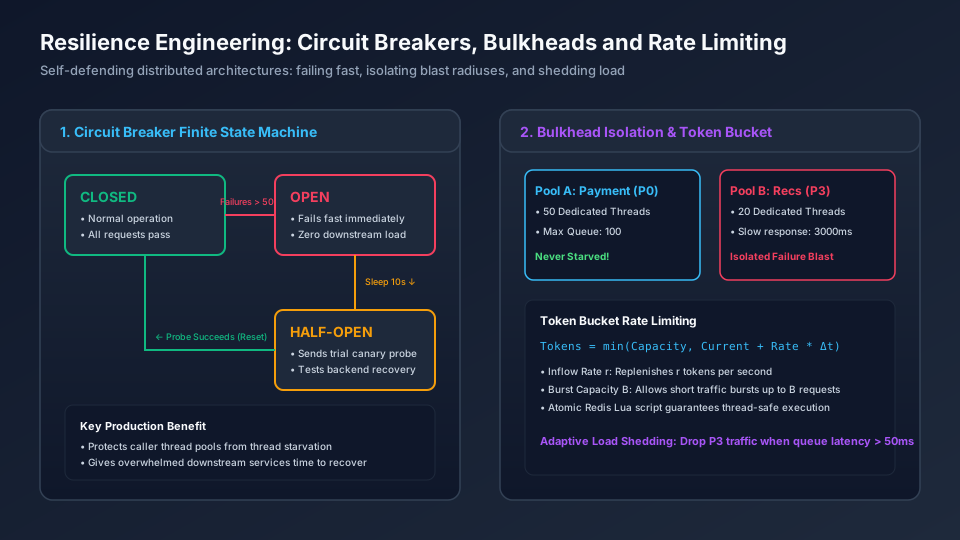
1. CLOSED & OPEN
Establishes the ingress and structural boundary across CLOSED & OPEN: Normal operation; All requests pass Failures > 50% →; Fails fast immediately.
2. Pool A: Payment (P0) & Pool B: Recs (P3)
Coordinates core data-plane execution and state transitions through Pool A: Payment (P0) & Pool B: Recs (P3): 50 Dedicated Threads; Max Queue: 100 Never Starved!; 20 Dedicated Threads.
3. Pool A: Payment (P0) & Pool B: Recs (P3)
Enforces durability, state convergence, and output verification across Pool A: Payment (P0) & Pool B: Recs (P3): 50 Dedicated Threads; Max Queue: 100 Never Starved!; 20 Dedicated Threads.
3. Architectural Mechanisms & Concrete Topologies
3.1 The Circuit Breaker State Machine
A Circuit Breaker wraps remote RPC calls in a state machine with three states:
- CLOSED: Normal state. All requests flow through to the downstream service. The breaker records success and failure counts in a sliding time window (e.g. 10 seconds). If failure rate exceeds threshold (e.g. 50%), the breaker trips to OPEN.
- OPEN: Failing state. All calls fail fast immediately (returning a fallback response or HTTP 503) without touching the network. Calling threads return in sub-milliseconds. A sleep timer (e.g. 10 seconds) begins.
- HALF-OPEN: Trial state. When expires, the breaker allows a small number of canary probe requests through. If all probes succeed, the breaker resets to CLOSED. If any probe fails, it resets the sleep timer and returns to OPEN.
3.2 Bulkhead Isolation Topologies
- Thread Pool Isolation: Every external dependency is assigned its own fixed-size thread pool and bounded task queue (e.g.
PaymentPool= 50 threads,RecommendationPool= 15 threads). If recommendations stall, all 15 threads block, but the 50 payment threads continue processing. - Semaphore Isolation: Instead of separate thread pools (which add context switching overhead), caller threads acquire an atomic semaphore ticket before executing. If tickets are exhausted, the call is rejected immediately.
4. Formal Mathematical Derivations
4.1 Token Bucket Mathematical Formulation
Let bucket capacity be tokens. Let token replenishment rate be tokens/second. Let be the arrival time of request . Let be the arrival time of request . The number of available tokens at the arrival of request is:
If :
- Request is admitted.
- New token balance becomes .
- Recorded timestamp updates to .
If :
- Request is rejected (HTTP 429 Too Many Requests).
- Token balance remains .
Burst Allowance: The maximum number of requests that can be processed in a time interval of duration is:
4.2 Queue Delay & Adaptive Load Shedding (Little’s Law)
Let be the number of requests currently queued in memory waiting for a worker thread. Let be the service processing rate (requests/sec). The expected queuing delay before execution begins is:
When a server is overloaded, incoming request rate . Queue length grows linearly, driving . If a client has a 500ms timeout, and , executing the request is useless: the client will have already disconnected by the time the server responds! Load Shedding Invariant: Drop incoming requests immediately at the front of the queue if:
5. Edge Cases, Failure Modes & Distributed Anomalies
5.1 The Half-Open Herd Thundering
When an OPEN circuit breaker’s sleep window expires, transitioning to HALF-OPEN, thousands of concurrent threads may attempt to send “probe” requests simultaneously, overwhelming the fragile recovering downstream service and forcing the breaker back into OPEN immediately. Remediation: Use strict semaphore gating in HALF-OPEN mode: permit strictly 1 to 3 concurrent probe requests, while immediately rejecting all other requests until the probe results are confirmed.
5.2 Distributed Rate Limiter Clock Drift
When implementing distributed rate limiting across a Redis cluster, if multiple application servers pass their local wall-clock timestamps into Redis Lua scripts, unsynchronized NTP clocks cause token balance calculation corruption.
Remediation: Use Redis’s internal server clock via the redis.call('TIME') primitive inside the Lua script, ensuring a single authoritative monotonic time source.
6. Open-Source Architectural Studies
6.1 Envoy: Outlier Detection & Circuit Breaking
Envoy provides transparent sidecar resilience without application code changes:
- Consecutive 5xx Outlier Detection: If an upstream host returns 5 consecutive HTTP 5xx errors, Envoy automatically ejects that host from the load balancing pool for 30 seconds.
- Connection & Request Limits: Envoy limits max active connections and pending requests per upstream cluster, failing fast before socket buffers saturate.
6.2 Netflix Hystrix & Resilience4j
Resilience4j implements lightweight, in-memory circuit breakers, rate limiters, and bulkheads in Java using lock-free atomic variables and RingBitSet sliding windows, avoiding thread synchronization locks and processing millions of operations per second with sub-microsecond overhead.
7. Production Incident Post-Mortem (War Stories)
The Recommendation Service Blackout
Context: An online fashion retailer deployed an AI recommendation engine widget on the home page. The Failure: A database migration on the recommendation backend caused queries to slow from 30ms to 4,500ms. The Cascade: The main web application server used a single unified thread pool of 200 Tomcat worker threads. Within 4 seconds of the slowdown, all 200 Tomcat worker threads were blocked waiting on the recommendation widget. User login, product search, and cart checkout all failed with HTTP 504 Gateway Timeout, even though the primary catalog and checkout databases were completely idle! The Cost: $1.2 million in lost sales over 45 minutes of peak shopping traffic. The Fix:
- Wrapped the recommendation RPC call in a Resilience4j Circuit Breaker with a 200ms timeout.
- Enforced a Bulkhead limit of 15 threads for recommendations.
- Configured an empty array
[]fallback: if recommendations time out or fail, the home page renders cleanly without recommendations.
8. Production-Grade TypeScript Simulation: Circuit Breaker & Bulkhead Suite
This simulation implements a complete Circuit Breaker state machine (Closed, Open, Half-Open), a Bulkhead execution manager, and a Token Bucket rate limiter.
/**
 * Production Resilience Simulation: Circuit Breaker, Bulkhead & Token Bucket
 */

export enum CircuitState {
  CLOSED = "CLOSED",
  OPEN = "OPEN",
  HALF_OPEN = "HALF_OPEN",
}

export interface CircuitBreakerConfig {
  failureThresholdPercentage: number; // e.g. 50%
  minimumRequests: number; // e.g. 10
  sleepWindowMs: number; // e.g. 5000ms
  halfOpenMaxTrials?: number; // e.g. 2 probe calls
}

export class CircuitBreaker {
  public state: CircuitState = CircuitState.CLOSED;
  private readonly config: CircuitBreakerConfig;
  private successCount = 0;
  private failureCount = 0;
  private nextAttemptTimestamp = 0;
  private halfOpenTrialCount = 0;
  private halfOpenSuccessCount = 0;

  constructor(config: CircuitBreakerConfig) {
    this.config = config;
  }

  public async execute<T>(fn: () => Promise<T>, fallback?: () => T): Promise<T> {
    const now = Date.now();
    const maxTrials = this.config.halfOpenMaxTrials ?? 1;

    // 1. Check OPEN state timeout
    if (this.state === CircuitState.OPEN) {
      if (now >= this.nextAttemptTimestamp) {
        this.state = CircuitState.HALF_OPEN;
        this.halfOpenTrialCount = 0;
        this.halfOpenSuccessCount = 0;
      } else {
        if (fallback) return fallback();
        throw new Error("CIRCUIT_BREAKER_OPEN: Service unavailable, failing fast");
      }
    }

    // Gate concurrent HALF_OPEN probes to prevent a thundering herd on recovery
    if (this.state === CircuitState.HALF_OPEN) {
      if (this.halfOpenTrialCount >= maxTrials) {
        if (fallback) return fallback();
        throw new Error("CIRCUIT_BREAKER_HALF_OPEN_BUSY: Probe limit reached");
      }
      this.halfOpenTrialCount++;
    }

    // 2. Execute call
    try {
      const result = await fn();
      this.onSuccess();
      return result;
    } catch (err) {
      this.onFailure();
      if (fallback) return fallback();
      throw err;
    }
  }

  private onSuccess(): void {
    const maxTrials = this.config.halfOpenMaxTrials ?? 1;
    if (this.state === CircuitState.HALF_OPEN) {
      this.halfOpenSuccessCount++;
      if (this.halfOpenSuccessCount >= maxTrials) {
        this.state = CircuitState.CLOSED;
        this.resetCounters();
      }
    } else if (this.state === CircuitState.CLOSED) {
      this.successCount++;
    }
  }

  private onFailure(): void {
    if (this.state === CircuitState.HALF_OPEN) {
      // Trial failed, immediately trip back to OPEN
      this.trip();
    } else if (this.state === CircuitState.CLOSED) {
      this.failureCount++;
      const total = this.successCount + this.failureCount;
      if (total >= this.config.minimumRequests) {
        const failureRate = (this.failureCount / total) * 100;
        if (failureRate >= this.config.failureThresholdPercentage) {
          this.trip();
        }
      }
    }
  }

  private trip(): void {
    this.state = CircuitState.OPEN;
    this.nextAttemptTimestamp = Date.now() + this.config.sleepWindowMs;
    this.resetCounters();
  }

  private resetCounters(): void {
    this.successCount = 0;
    this.failureCount = 0;
    this.halfOpenTrialCount = 0;
    this.halfOpenSuccessCount = 0;
  }
}

export class Bulkhead {
  private readonly maxConcurrent: number;
  private activeCount = 0;

  constructor(maxConcurrent: number) {
    this.maxConcurrent = maxConcurrent;
  }

  public async execute<T>(fn: () => Promise<T>): Promise<T> {
    if (this.activeCount >= this.maxConcurrent) {
      throw new Error(`BULKHEAD_LIMIT_EXCEEDED: Max concurrency of ${this.maxConcurrent} reached`);
    }

    this.activeCount++;
    try {
      return await fn();
    } finally {
      this.activeCount--;
    }
  }

  public getActiveCount(): number {
    return this.activeCount;
  }
}

export class TokenBucketRateLimiter {
  private tokens: number;
  private lastRefillTimestampMs: number;

  constructor(
    public readonly capacity: number,
    public readonly refillRatePerSec: number,
    initialTimestampMs: number = Date.now()
  ) {
    this.tokens = capacity;
    this.lastRefillTimestampMs = initialTimestampMs;
  }

  public tryAcquire(cost: number = 1, nowMs: number = Date.now()): { allowed: boolean; remainingTokens: number } {
    const elapsedSec = Math.max(0, (nowMs - this.lastRefillTimestampMs) / 1000);
    this.tokens = Math.min(this.capacity, this.tokens + elapsedSec * this.refillRatePerSec);
    this.lastRefillTimestampMs = nowMs;

    if (this.tokens >= cost) {
      this.tokens -= cost;
      return { allowed: true, remainingTokens: this.tokens };
    }

    return { allowed: false, remainingTokens: this.tokens };
  }
}

// Verification Routine
export async function runResilienceExperiment() {
  console.log("=== Circuit Breaker, Bulkhead & Token Bucket Simulation ===");

  const breaker = new CircuitBreaker({
    failureThresholdPercentage: 50,
    minimumRequests: 4,
    sleepWindowMs: 50, // Short for test
    halfOpenMaxTrials: 1,
  });

  const flakyService = async (shouldFail: boolean) => {
    if (shouldFail) throw new Error("Downstream 500 error");
    return "OK";
  };

  // 1. Trigger consecutive failures
  for (let i = 0; i < 4; i++) {
    try {
      await breaker.execute(() => flakyService(true));
    } catch {}
  }

  console.log(`State after 4 failures: ${breaker.state}`); // Should be OPEN

  // 2. Next call should fail fast without executing service
  try {
    await breaker.execute(() => flakyService(false));
  } catch (err: any) {
    console.log(`Fast Fail Caught: ${err.message}`);
  }

  // 3. Test Bulkhead concurrency clamping
  const bulkhead = new Bulkhead(2);
  const slowTask = () => new Promise((resolve) => setTimeout(resolve, 30));

  // Launch 2 allowed tasks
  const p1 = bulkhead.execute(slowTask);
  const p2 = bulkhead.execute(slowTask);

  // Third concurrent task should be rejected immediately
  try {
    await bulkhead.execute(slowTask);
  } catch (err: any) {
    console.log(`Bulkhead Rejection Caught: ${err.message}`);
  }

  await Promise.all([p1, p2]);
  console.log("Bulkhead tasks completed cleanly");

  // 4. Test TokenBucketRateLimiter burst + steady-state refill
  const limiter = new TokenBucketRateLimiter(3, 10, 1000); // B=3 tokens, r=10 tokens/sec
  console.log("Token Bucket Burst (3 requests at t=1000ms):", [
    limiter.tryAcquire(1, 1000).allowed,
    limiter.tryAcquire(1, 1000).allowed,
    limiter.tryAcquire(1, 1000).allowed,
    limiter.tryAcquire(1, 1000).allowed, // 4th request throttled (429)
  ]);
  console.log("After 200ms refill (+2 tokens at t=1200ms):", limiter.tryAcquire(1, 1200));
}

runResilienceExperiment();
9. Operational Checklist, Failure Runbooks & Sizing Rules
Circuit Breaker Sizing Guidelines
When configuring Resilience4j / Envoy:
- Minimum Volume Threshold: Never trip on fewer than 20 requests in a 10-second window (prevents tripping on transient 1-off errors during quiet hours).
- Failure Rate Threshold: Set to 50% for standard microservices; set to 25% for high-criticality services with ready fallback paths.
- Half-Open Ring Size: Allow exactly 5 to 10 requests during probation before closing the circuit.
10. Guided Applied System Design Exercises & Debugging Drills
Drill 1: The Cascading Retry Storm Triage
A payment gateway experiences a momentary 5-second database freeze. 10,000 mobile clients simultaneously retry their checkout calls every 500 milliseconds without backoff or jitter.
- Formulate the exponential backoff formula with Full Jitter to dissipate the retry storm.
- How does a client-side Retry Budget (e.g. limiting retries to at most 10% of total outbound requests) protect backend services?
Drill 2: Redis Lua Token Bucket Implementation
Design an atomic Redis Lua script that checks and consumes tokens for rate limiting in a single atomic round-trip.
- Write the Lua script using
redis.call('TIME')to prevent server clock skew. - Prove why standard separate
GETandSETRedis commands create a race condition under high concurrency.
View Reference Architecture & Worked Solutions (CORE-M23-001)
1. Worked Solution — Drill 1: The Cascading Retry Storm Triage
- Part 1 — Exponential Backoff with Full Jitter:
- Without backoff or jitter, clients retrying every generate a synchronized hammer wave at . Even pure exponential backoff () still fires all clients in lockstep at .
- Full Jitter Formula (AWS Architecture standard): For retry attempt with base delay and cap : Full Jitter spreads the retries uniformly across the entire interval , flattening instantaneous spike QPS by an order of magnitude.
- Part 2 — Client-Side Retry Budget ( Overhead Cap):
- Each client (or Envoy sidecar via
retry_budget) maintains a rolling token ratio: every normal outbound request deposits into the retry bucket, and every retry consumes . - During normal operation ( success rate), the retry bucket stays full and transient network blips are retried immediately. During a total payment database outage ( failure rate), the retry budget drains after of requests and suppresses all further retries, bounding maximum backend traffic amplification to strictly baseline load instead of retry multiplication!
- Each client (or Envoy sidecar via
2. Worked Solution — Drill 2: Atomic Redis Lua Token Bucket Implementation
- Part 1 — Production Redis Lua Script Using
redis.call('TIME'):-- KEYS[1] = rate_limit:<tenant_id> -- ARGV[1] = capacity (B), ARGV[2] = refill_rate_per_sec (r), ARGV[3] = requested_tokens local key = KEYS[1] local capacity = tonumber(ARGV[1]) local rate = tonumber(ARGV[2]) local requested = tonumber(ARGV[3]) -- Use Redis server monotonic-like wall time (seconds + microseconds) to eliminate client NTP skew local redis_time = redis.call('TIME') local now_sec = tonumber(redis_time[1]) + (tonumber(redis_time[2]) / 1000000.0) local state = redis.call('HMGET', key, 'tokens', 'last_updated') local tokens = tonumber(state[1]) local last_updated = tonumber(state[2]) if tokens == nil then tokens = capacity last_updated = now_sec else local elapsed = math.max(0.0, now_sec - last_updated) tokens = math.min(capacity, tokens + (elapsed * rate)) last_updated = now_sec end local allowed = 0 if tokens >= requested then tokens = tokens - requested allowed = 1 end local ttl_sec = math.ceil(capacity / rate) * 2 redis.call('HMSET', key, 'tokens', tokens, 'last_updated', last_updated) redis.call('EXPIRE', key, ttl_sec) return { allowed, tostring(tokens) } - Part 2 — Proof of the
GET+SETCheck-Then-Act Race Condition:- Suppose
tokens = 1remains in Redis and API gateway pods simultaneously receive a burst of requests for the same tenant at . - With separate application-side
GETandSETcommands, all pods executeGETconcurrently before any pod’sSETarrives; all pods readtokens = 1, compute1 - 1 = 0, and writeSET tokens = 0, admitting requests on a single token ( quota bypass!). Because Redis executesEVALLua scripts single-threaded and atomically to completion without interleaving other client commands, the check, refill calculation, and decrement execute as a strict serializable critical section.
- Suppose
11. Design Alternatives & Resilience Trade-Off Matrix
| Resilience Pattern | Failure Mode Mitigated | Overhead / Latency Penalty | State Coordination | Best Architectural Fit |
|---|---|---|---|---|
| Circuit Breaker (Resilience4j / Envoy) | Cascading dependency failure & thread exhaustion | Negligible in-memory check (< 1 µs) | Local atomic state per worker pod | Remote microservice RPCs, third-party payment gateways |
| Token Bucket Rate Limiting | Traffic bursts, resource starvation | Sub-microsecond RAM or Redis atomic CAS | Distributed Redis hash or local in-memory | Public API gateways, tenant ingress throttling |
| Concurrency Limits (Vegas / Little’s Law) | Server saturation knee & queueing delay | Dynamic delay measurement on inflight RPCs | Node-local AIMD gradient tracking | Auto-tuning backend RPC servers under variable CPU load |
| Bulkhead Isolation | Slow dependencies consuming all worker threads | Dedicated thread pools or semaphore limits | Isolated pool queues per dependency | Heterogeneous microservice clients with varying SLA dependencies |
12. Authoritative References & Version Context
- Michael T. Nygard (2018), “Release It! Design and Deploy Production-Ready Software (2nd Edition)”, Pragmatic Bookshelf (Circuit Breaker and Bulkhead patterns) — pragprog.com
- Netflix Technology Blog (2018), “Performance Under Load: Adaptive Concurrency Limits at Netflix” — netflixtechblog.com
- Envoy Proxy Official Documentation — Circuit Breaking & Outlier Detection — envoyproxy.io/docs/envoy/latest/intro/arch_overview/upstream/circuit_breaking
- Version Context: Resilience patterns reflect Envoy 1.30+, Resilience4j 2.x, and Linux kernel TCP SYN cookie / backlog queueing semantics.