1. The problem
Imagine launching a ticket-booking service for a major concert. On paper, the whiteboard diagram looks textbook: an API gateway, five microservices, a message queue, a cache, and a database. Yet within ninety seconds of tickets going on sale, users see spinning loaders, retry clicks charge credit cards twice, and a slow “recommended seats” widget consumes every worker thread—bringing payment processing to a complete halt.
Nothing in the technology list was “wrong,” yet the system failed catastrophically. Naming infrastructure components is not designing a system. When engineers start with a shopping list of tools (“let’s use Kafka, Redis, and microservices”) before defining state ownership, physical capacity bounds, and partial-failure semantics, they build fragile architectures that fail under real contention.
A system design is an explicit set of engineering decisions about boundaries, state invariants, quantitative constraints, communication contracts, and failure recovery.
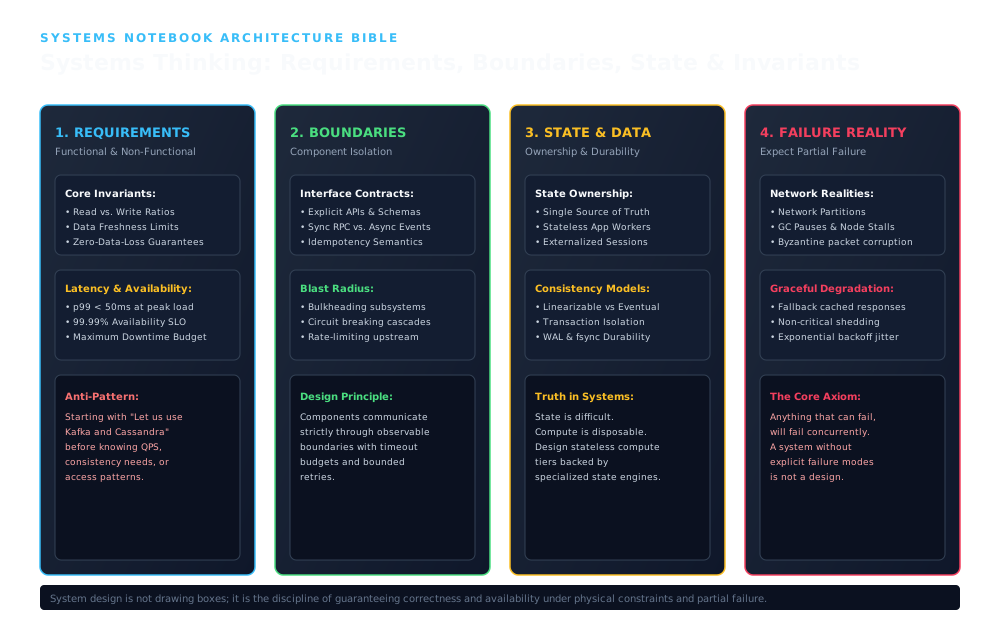
1. REQUIREMENTS & Core Invariants
Establishes the ingress and structural boundary across REQUIREMENTS & Core Invariants: Functional & Non-Functional; Read vs. Write Ratios; Data Freshness Limits.
2. BOUNDARIES & Interface Contracts
Coordinates core data-plane execution and state transitions through BOUNDARIES & Interface Contracts: Component Isolation; Explicit APIs & Schemas; Sync RPC vs. Async Events.
3. STATE & DATA & State Ownership
Enforces durability, state convergence, and output verification across STATE & DATA & State Ownership: Ownership & Durability; Single Source of Truth; Stateless App Workers.
4. FAILURE REALITY & Network Realities
Maintains fault isolation and operational recovery bounds across FAILURE REALITY & Network Realities: Expect Partial Failure; Network Partitions; GC Pauses & Node Stalls.
2. A useful mental model
Think of a software system like a commercial aircraft’s hydraulic and electrical architecture rather than a static floor plan. Every subsystem transforms inputs into outcomes while preserving safety invariants (conditions that must hold true even when components degrade or fail, such as “a seat is never sold to two buyers” or “a ledger debit always matches a credit”).
For every component you place in a design, interrogate five properties:
- Responsibility boundary: What single domain invariant or transformation does it own?
- State & durability: What mutable state does it hold, where does authoritative truth live, and what happens to in-flight state if power vanishes?
- Dependencies: Which downstream services, clocks, networks, or disks must respond for it to succeed?
- Contract to callers: What latency, throughput, ordering, and idempotency guarantees does it promise?
- Degradation mode: What happens when it is slower, unreachable, or returning stale data?
Foundational Bridge: The 5-Phase System Design Blueprint Walkthrough (Capacity → API → Data → Partitioning → Failure Defense)
When approaching any end-to-end architecture challenge in the System Design Studio (Part 4) or production RFC review, execute a disciplined 5-phase progression before selecting vendor technologies:
- Phase 1 — Quantitative Envelope & Workload Classification: Convert daily active volume into average and peak QPS (), read-to-write ratio (), payload bandwidth, and 5-year storage retention, then map the dominant bottleneck to one of the 16 canonical workload families.
- Phase 2 — API Contract & Idempotency Boundary: Define explicit REST/gRPC schemas, cursor-based pagination tokens (never large
OFFSETscans),Idempotency-Keyheaders for mutating operations, and admission-control rate limits. - Phase 3 — Storage Engine & Schema Selection: Match access patterns to storage internals—B+Trees (
PostgreSQL/MySQL) for ACID point reads and range scans, LSM-Trees (RocksDB/ScyllaDB) for high-ingestion append workloads, or inverted/vector indexes (Lucene/HNSW) for search. - Phase 4 — Partitioning, Replication & Caching Topology: Choose a shard key with high cardinality and uniform hash distribution, prevent hot-key skew via salting or request coalescing (
Singleflight), and set quorum parameters ( or Raft majority). - Phase 5 — Failure Mode & Blast-Radius Defense: Trace what happens when a shard leader crashes, a downstream dependency stalls by , or a network partition isolates an availability zone—enforcing bounded timeouts, jittered backoff, circuit breakers, and bulkheads.
3. Start with requirements and invariants
Before drawing boxes, separate functional behaviour (what the system does) from non-functional constraints and invariants (the quantitative and correctness envelope within which it must operate):
- Correctness & consistency: Can a user briefly see a stale follower count (eventual consistency), or must an account balance check forbid overdrafts under concurrent withdrawals (serializable / linearizable isolation)?
- Latency distribution: Average latency hides user pain. Specify percentile targets—for example, and .
- Scale & workload shape: Read-to-write ratio, payload size, and traffic skew (e.g., a celebrity post creating a hot-key spike).
- Durability & availability: Is losing 5 seconds of clickstream telemetry acceptable, whereas losing a committed financial transaction is fatal?
For example, “design a notification system” is not yet an actionable specification. You must first clarify whether alerts are real-time transactional OTPs (, high availability) or scheduled marketing digests, whether duplicate delivery is tolerable (at-least-once vs. deduplicated delivery), and how long audit logs must be retained.
4. Quantitative sanity bounds: Bridging design and physics
Qualitative reasoning must always be anchored by back-of-the-envelope physics. Two foundational equations immediately tell you whether a simple single-node design works or whether horizontal partitioning is mandatory:
1. Throughput Conversion (Daily Volume to Peak QPS)
Since one day contains ( for rapid mental estimation):
where is daily request volume and (typically to , or for flash events) captures diurnal bursts.
2. Little’s Law (Concurrency and Resource Pool Sizing)
For any stable system processing requests at arrival rate (requests/sec) with mean residency time (seconds per request):
where is the average number of concurrent in-flight requests holding threads, sockets, or database connections.
Worked Sanity Check: Suppose your checkout API handles and normally completes in (). Average concurrency is active connections—trivial for one server. If a downstream dependency stalls and raises to , concurrency jumps to in-flight requests, immediately exhausting a 200-connection database pool unless protected by timeouts and bulkheads.
| Metric / Workload Dimension | Single-Node Commodity Envelope (2025–2026 Baseline) | Trigger for Distributed / Multi-Node Complexity |
|---|---|---|
| Relational Write QPS | (PCIe 4.0/5.0 NVMe, PostgreSQL 16+) | Sustained or multi-region low-latency writes |
| Working-Set Memory | DDR5 DRAM on a single VM | Hot working set exceeds single-host DRAM or requires zero-downtime failover |
| Durable Storage Volume | with sub-hour physical backup/restore | Multi- dozen TiB to PiB datasets where backup, vacuum, or schema rebuilds stall |
| Network Egress | sustained per cloud instance | Media streaming or massive fan-out exceeding single-NIC egress limits |
5. Architecture is a sequence of justified decisions
Always begin with the simplest architecture that satisfies your quantitative bounds and correctness invariants:
Client ──► Stateless Application Tier ──► Primary Relational Database (+ Standby Replica)Every extra box on an architecture diagram imposes an operational tax—new serialization boundaries, network hops, schema drift, and partial failure states. Introduce a cache, queue, read replica, or shard only when a measured bottleneck or requirement proves the baseline insufficient:
- Clarify functional scope, invariants, and scale assumptions.
- Quantify average/peak QPS, working-set RAM, bandwidth, and storage growth.
- Establish the simplest baseline topology that meets correctness rules.
- Stress-test the baseline against peak bottlenecks and single points of failure.
- Evolve targeted components (e.g., CDN for static egress, Redis for hot read skew, Kafka/queue for burst buffering) and record the trade-offs.
- Instrument SLIs, timeouts, idempotency keys, and recovery runbooks.
6. Design alternatives & architectural trade-offs
No architecture optimizes every dimension simultaneously. Choosing a topology means explicitly trading operational simplicity and transactional consistency against independent scalability and blast-radius isolation:
| Architecture Pattern | Transactional Consistency | Operational & Debugging Cost | Horizontal Scale & Team Autonomy | Best Fit / When to Use |
|---|---|---|---|---|
| Single Monolith + Single DB | Strong local ACID transactions (JOINs, foreign keys) | Lowest (1 artifact, 1 local stack trace, 0 network hops between modules) | Vertical ceiling; tightly coupled deployments | Early products, internal tools, , small teams ( engineers) |
| Modular Monolith + Primary/Read Replicas | Strong ACID on primary; explicit bounded contexts in code; optional bounded-staleness reads | Low-Moderate (single deployment pipeline, simple observability) | Scales reads to ; shared deployment cadence across teams | High-throughput SaaS & commerce (e.g., Shopify core) before domain write limits hit |
| Microservices + Event Mesh (Kafka / Sagas) | Eventual consistency across services; requires outbox pattern, sagas, and compensating actions | High (distributed tracing, version skew, network partitions, duplicate events) | Independent per-service scaling, polyglot storage, isolated fault domains | Large organizations ( engineers) or heterogeneous workloads (e.g., CPU-heavy video transcode vs. ACID billing) |
7. Implementation: Architectural Trade-off Evaluator in TypeScript
The simulation below models weighted multi-attribute decision analysis (MADA) across candidate architectures so trade-offs are scored quantitatively against explicit business constraints rather than hype.
export interface ArchitectureCandidate {
  name: string;
  description: string;
  scores: {
    simplicity: number;         // 1-10 (higher is simpler to operate & debug)
    scalability: number;        // 1-10 (higher scales horizontally under skew)
    faultIsolation: number;     // 1-10 (higher contains blast radius of partial faults)
    operationalCost: number;    // 1-10 (higher means lower monthly infra + SRE cost)
    consistencySupport: number; // 1-10 (higher provides stronger ACID invariants)
  };
  monthlyEstimateUSD: number;
}

export interface DecisionWeights {
  simplicity: number;
  scalability: number;
  faultIsolation: number;
  operationalCost: number;
  consistencySupport: number;
}

export class TradeoffDecisionEvaluator {
  private candidates: ArchitectureCandidate[] = [];
  private readonly weights: DecisionWeights;

  constructor(weights: DecisionWeights) {
    this.weights = weights;
  }

  public registerCandidate(candidate: ArchitectureCandidate): void {
    this.candidates.push(candidate);
  }

  public evaluate(): {
    candidate: string;
    weightedScore: number;
    monthlyEstimateUSD: number;
    ranking: number;
  }[] {
    const totalWeight =
      this.weights.simplicity +
      this.weights.scalability +
      this.weights.faultIsolation +
      this.weights.operationalCost +
      this.weights.consistencySupport;

    if (totalWeight <= 0) {
      throw new Error('Decision weights must sum to a positive value.');
    }

    const scored = this.candidates.map((c) => {
      const score =
        (c.scores.simplicity * this.weights.simplicity +
          c.scores.scalability * this.weights.scalability +
          c.scores.faultIsolation * this.weights.faultIsolation +
          c.scores.operationalCost * this.weights.operationalCost +
          c.scores.consistencySupport * this.weights.consistencySupport) /
        totalWeight;

      return {
        candidate: c.name,
        weightedScore: Math.round(score * 100) / 100,
        monthlyEstimateUSD: c.monthlyEstimateUSD,
      };
    });

    scored.sort((a, b) => b.weightedScore - a.weightedScore);
    return scored.map((item, idx) => ({ ...item, ranking: idx + 1 }));
  }
}

export function runDemo(): void {
  console.log('=== Systems Thinking: Architectural Trade-off Evaluation ===');
  // Scenario: Series-A fintech ledger handling 1,200 peak TPS with strict ACID invariants
  const weights: DecisionWeights = {
    simplicity: 0.30,
    operationalCost: 0.25,
    consistencySupport: 0.20,
    scalability: 0.15,
    faultIsolation: 0.10,
  };

  const evaluator = new TradeoffDecisionEvaluator(weights);

  evaluator.registerCandidate({
    name: 'Modular Monolith + PostgreSQL HA',
    description: 'Single deployable with strict module boundaries, standby failover, and read replicas',
    scores: {
      simplicity: 9,
      operationalCost: 9,
      consistencySupport: 9,
      scalability: 6,
      faultIsolation: 5,
    },
    monthlyEstimateUSD: 650,
  });

  evaluator.registerCandidate({
    name: 'Microservices + Apache Kafka Event Mesh',
    description: '12 independent services coordinating mutations via outbox events and distributed sagas',
    scores: {
      simplicity: 3,
      operationalCost: 4,
      consistencySupport: 5,
      scalability: 9,
      faultIsolation: 9,
    },
    monthlyEstimateUSD: 3400,
  });

  const results = evaluator.evaluate();
  for (const r of results) {
    console.log(
      `Rank ${r.ranking}: ${r.candidate} - Weighted Score: ${r.weightedScore.toFixed(2)}/10 (Est. $${r.monthlyEstimateUSD}/mo)`
    );
  }
  console.log(
    `Recommendation: "${results[0].candidate}" satisfies ACID and throughput bounds at lowest operational risk.`
  );
}

runDemo();
Simulation Execution Output & State Transitions
=== Systems Thinking: Architectural Trade-off Evaluation ===
Rank 1: Modular Monolith + PostgreSQL HA - Weighted Score: 8.15/10 (Est. $650/mo)
Rank 2: Microservices + Apache Kafka Event Mesh - Weighted Score: 5.15/10 (Est. $3400/mo)
Recommendation: "Modular Monolith + PostgreSQL HA" satisfies ACID and throughput bounds at lowest operational risk.
8. Failure modes, pitfalls & recovery patterns
Distributed systems fail partially: one availability zone drops packets, a garbage-collection pause freezes a node for 800 ms, or an external webhook stalls. Designing for recovery from day one prevents local glitches from escalating into total outages:
- Unbounded Retries & Retry Storms:
- Pitfall: Retrying failed RPCs immediately without backoff or idempotency keys multiplies load on a struggling server by and risks duplicate state mutations.
- Recovery Pattern: Require client-generated
Idempotency-Keyheaders for mutating operations, use exponential backoff with full jitter, and enforce per-client retry budgets (e.g., Envoy Proxy capping retries at of active requests).
- Shared Resource Pool Exhaustion (Missing Bulkheads):
- Pitfall: Allowing slow, non-critical dependencies (analytics, recommendations, avatar rendering) to share worker threads or DB connection pools with mission-critical paths (login, checkout).
- Recovery Pattern: Partition thread pools and connection quotas (bulkheading), attach aggressive deadlines (e.g., timeout), and degrade gracefully to cached or empty defaults when secondary services trip a circuit breaker.
- Ambiguous State Ownership (“Shared-Database Microservices”):
- Pitfall: Letting five services write directly to the same database tables creates hidden schema coupling and lock contention while losing monolithic deployment simplicity.
- Recovery Pattern: Enforce a single authoritative writer per domain entity and expose state transitions through versioned APIs or transactional outbox events.
- Treating Replication as Backup or Instant High Availability:
- Pitfall: Assuming a
DROP TABLEor corrupt application write is prevented by synchronous replicas—replication faithfully copies corruption in milliseconds. - Recovery Pattern: Pair multi-AZ failover replicas with immutable point-in-time recovery (PITR) snapshots stored in an isolated fault/credential domain, and rehearse automated restoration regularly.
- Pitfall: Assuming a
9. Knowledge check
Complete the interactive assessment quiz at the end of this lesson to test your ability to sequence requirements before technology choices, diagnose partial-failure retry hazards, and apply bulkheading.
10. Exercise
Select an application you use daily (such as food delivery, ride-hailing, or collaborative document editing):
- Trace one critical write request from client click to durable storage.
- Classify each component along the path as stateless compute or stateful storage, stating the core invariant each stateful component must preserve.
- Assuming daily writes with a evening peak and a database residency time, calculate peak write QPS () and minimum steady-state in-flight concurrency () using Little’s Law.
- Identify two partial failure modes (e.g., lost response after commit, slow third-party dependency) and specify the exact timeout, idempotency, or bulkhead mechanism that keeps invariants intact.
View Reference Architecture & Worked Solutions (CORE-M00-001)
1. Critical Write Path Trace (Example: Food-Delivery Order Placement)
[Mobile Client] ──(HTTPS POST /v1/orders + Idempotency-Key)──► [L7 API Gateway (Envoy)]
──► [Order Service (Stateless Worker)] ──► [PostgreSQL Primary + Sync Standby (Orders & Outbox)]- The mobile client generates a UUIDv4
Idempotency-Keybefore submitting the order payload. - The L7 API Gateway terminates TLS, authenticates the JWT, applies per-user token-bucket rate limiting, and routes to an Order Service instance.
- The Order Service executes a single local ACID transaction on PostgreSQL that inserts the
ordersrecord, records theidempotency_keysentry, and appends apayment_requestedevent to a transactionaloutboxtable before returning201 Created.
2. Stateless vs. Stateful Classification & Core Invariants
- L7 API Gateway & Order Service Workers (Stateless Compute): Hold only ephemeral in-flight request buffers and connection pools; any pod can be terminated or autoscaled horizontally without losing committed orders.
- PostgreSQL Primary + Synchronous Standby (Stateful Storage): Owns authoritative order and idempotency state.
- Core Invariant 1 (Uniqueness / No Double-Charge):
UNIQUE (client_id, idempotency_key)guarantees at-most-once state mutation across arbitrary network retries. - Core Invariant 2 (Atomicity & Durability): Every order creation and its outbound outbox event commit together (
synchronous_commit = onto the standby WAL) so an order is never persisted without triggering downstream payment/kitchen dispatch.
- Core Invariant 1 (Uniqueness / No Double-Charge):
3. Quantitative Capacity & Concurrency Derivation ( Daily Writes)
- Average Write QPS ():
- Evening Peak Write QPS ( at multiplier): (Sanity Check: is well below the single-node PostgreSQL NVMe envelope, confirming a single primary database requires no horizontal write sharding).
- Steady-State Peak In-Flight Concurrency () via Little’s Law (): (Provisioning a 50-connection pool across Order Service pods provides headroom for transient latency variance).
4. Partial Failure Modes & Concrete Mitigations
- Lost HTTP Acknowledgement After Database Commit:
- Failure Mode: PostgreSQL commits the transaction, but the mobile client’s cellular connection drops before receiving HTTP
201, causing the client to retryPOST /v1/orders. - Mechanism: The Order Service checks
SELECT response_payload FROM idempotency_keys WHERE key = $1inside the transaction; finding the committed key, it returns the stored201 Createdpayload without re-inserting the order or double-charging.
- Failure Mode: PostgreSQL commits the transaction, but the mobile client’s cellular connection drops before receiving HTTP
- Slow Third-Party Delivery-ETA / Coupon Enrichment Service:
- Failure Mode: A secondary ETA estimation service degrades from to , threatening to raise by ( blocked threads) and exhaust the worker pool.
- Mechanism: Isolate the ETA call behind a dedicated bulkhead (max 20 concurrent outbound calls) with a strict timeout and circuit breaker that falls back to a static distance-based heuristic so order placement remains below .
11. Summary & architectural decision guide
- Requirements precede tools: Define functional invariants, read/write workload rates, latency percentiles (), and durability rules before naming databases or brokers.
- Anchor qualitative choices in math: Convert daily traffic () to peak QPS and apply Little’s Law () to expose concurrency bottlenecks early.
- Earn every distributed boundary: Start with a clean modular monolith and single authoritative datastore when workload bounds fit on modern hardware; split services only when scaling, fault isolation, or organizational boundaries demand it.
- Design for partial failure: Assume timeouts, duplicate deliveries, and slow dependencies are routine operational states—enforce idempotency, bounded timeouts, jittered backoff, and bulkheads from the outset.
12. Authoritative References & Version Context
- Hardware & Runtime Baseline Context: Single-node capacity thresholds in this lesson reflect 2025–2026 commodity cloud instances (64–128 vCPU AMD EPYC / Intel Xeon processors, DDR5 DRAM up to , PCIe 4.0/5.0 NVMe SSDs, Linux kernel 6.x, PostgreSQL 16/17, and Envoy Proxy 1.30+ retry-budget defaults).
- Butler W. Lampson, “Hints for Computer System Design”, ACM SIGOPS Operating Systems Review 17(5), 1983 — foundational principles on keeping interfaces simple, separating normal vs. worst-case paths, and preserving end-to-end safety invariants.
- Jerome H. Saltzer, David P. Reed, and David D. Clark, “End-to-End Arguments in System Design”, ACM Transactions on Computer Systems (TOCS) 2(4), 1984 — explains why correctness guarantees (such as idempotent transaction commit) must be enforced end-to-end rather than assumed from lower network layers.
- David L. Parnas, “On the Criteria To Be Used in Decomposing Systems into Modules”, Communications of the ACM 15(12), 1972 — the primary source on information hiding and defining module boundaries around state secrets that change.
- Amazon Builders’ Library, “Timeouts, Retries, and Backoff with Jitter” — production analysis of retry storms, exponential backoff with jitter, and load shedding in distributed services.