1. The Problem & Why It Matters
Hyperscale object stores (Amazon S3, Google Cloud Storage, Ceph) manage hundreds of billions of objects totaling exabytes of storage. When engineering storage at this scale, the laws of physics and economics impose brutal constraints:
- The Cost of Replication: A simple fault-tolerance strategy replicates every object across 3 separate physical drives. To store 100 Petabytes of customer data, you must purchase and power 300 Petabytes of raw storage (a 200% storage overhead). At enterprise hardware costs of $15,000 per petabyte per year, that 200% overhead represents tens of millions of dollars in wasted capital.
- The Metadata Bottleneck (The Billion File Problem): Early distributed filesystems (like Hadoop HDFS) relied on a centralized master node (the NameNode) that held block locations in RAM. Tracking 1 billion small files (e.g. 20 KB user avatar images) exhausts 500 GB of server RAM and creates a single point of failure that halts the cluster during failovers.
- Silent Bit Rot & Drive Failure: In a cluster of 50,000 hard drives, drives fail every single day. The system must continuously rebuild lost data across the network without impacting user read/write latency.
Solving these challenges requires the mathematical elegance of Reed-Solomon Erasure Coding and the decentralized deterministic placement of the Ceph CRUSH algorithm.
2. Intuitive Mental Model
Imagine sending an important 4-page legal contract across an unreliable postal service:
- Replication: You print 3 full copies of the 4-page contract (12 pages total) and mail them in 3 separate envelopes. If 2 envelopes get lost, the recipient still has a copy. You wasted 8 pages of paper.
- Reed-Solomon Erasure Coding: You take the 4-page contract () and mathematically compute 2 “summary check-pages” (), mailing 6 envelopes total. If any 2 envelopes are lost in the mail, the recipient can take the 4 surviving pages (whether original pages or summary pages) and solve a simple algebraic system of equations to regenerate the missing pages perfectly! You only used 2 extra pages of paper (50% overhead instead of 200%).
- Ceph CRUSH: Instead of keeping a giant address book that lists which drawer holds which envelope, every clerk uses a mathematical formula: . Anyone can calculate the exact drawer in 2 microseconds without asking anyone for help.
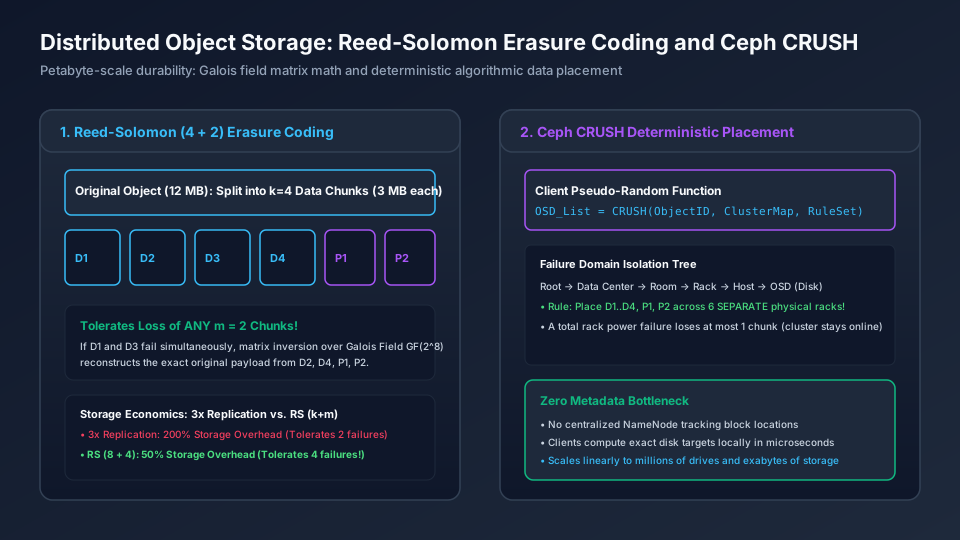
1. Client Pseudo-Random Function & Failure Domain Isolation Tree
Establishes the ingress and structural boundary across Client Pseudo-Random Function & Failure Domain Isolation Tree: OSD_List = CRUSH(ObjectID, ClusterMap, RuleSet); Root → Data Center → Room → Rack → Host → OSD (Disk); Rule: Place D1..D4, P1, P2 across 6 SEPARATE physical racks!.
2. D1 & D2
Coordinates core data-plane execution and state transitions through D1, D2, D3, D4 within the Distributed Object Storage: Reed-Solomon Erasure Coding and Ceph CRUSH architecture.
3. P1 & P2
Enforces durability, state convergence, and output verification across P1 & P2: If D1 and D3 fail simultaneously, matrix inversion over Galois Field GF(2^8) reconstructs the exact original payload from D2, D4, P1, P2; 3x Replication: 200% Storage Overhead (Tolerates 2 failures); RS (8 + 4): 50% Storage Overhead (Tolerates 4 failures!).
3. Architectural Mechanisms & Concrete Topologies
3.1 Reed-Solomon Encoding Architecture
An object of size is divided into equal data chunks: (each of size ). We generate parity chunks using matrix multiplication over a finite Galois Field (typically , representing byte arithmetic):
where is an Cauchy or Vandermonde Generator Matrix. The system writes all chunks to independent storage nodes across separate failure domains (racks or power zones).
Durability Guarantee: The system tolerates the catastrophic loss of any arbitrary chunks. As long as at least chunks survive, the original data can be reconstructed via matrix inversion.
Configuration       Data Chunks (k)   Parity Chunks (m)   Overhead (m/k)   Fault Tolerance
3x Replication      1                 2                   200%             2 disk failures
RS (4 + 2)          4                 2                   50%              2 disk failures
RS (8 + 4)          8                 4                   50%              4 disk failures
RS (16 + 4)         16                4                   25%              4 disk failures
3.2 The Ceph CRUSH Algorithm
Instead of storing a mapping of ObjectID -> NodeID in a database, Ceph clients compute the node location deterministically:
- Hierarchical Cluster Map: Encodes physical infrastructure as a tree:
RootData CenterRoomRackHostOSD (Physical Disk). - Rule Set: Specifies failure domain isolation constraints (e.g. “Select 6 OSDs such that no two OSDs reside in the same physical rack”).
- Deterministic Hash: Uses a multi-round variant of Jenkins hash. If a disk fails, CRUSH reshuffles only a minimal fraction () of data, avoiding full cluster rebalancing.
4. Formal Mathematical Derivations
4.1 Galois Field Arithmetic
In normal computer arithmetic, adding two 8-bit bytes can overflow (), and division by zero is undefined. To perform matrix inversion on digital bytes without overflow or precision loss, Reed-Solomon operates over a Galois Field of order , denoted :
- Addition & Subtraction: In , addition and subtraction are identical and equivalent to bitwise XOR ():
- Multiplication: Polynomial multiplication modulo an irreducible primitive polynomial (0x11D). In modern processors, multiplication is hardware-accelerated using Intel/AMD AVX-512 and ARM NEON SIMD vector instructions via the open-source ISA-L library.
4.2 Data Reconstruction via Matrix Inversion
Suppose and . Chunks and fail. We have 4 surviving chunks: . Let be the full encoding matrix containing the identity matrix on top and the generator matrix on the bottom:
We extract the sub-matrix corresponding to the 4 surviving chunk rows. Because was constructed using a Cauchy matrix, every square sub-matrix is guaranteed to be non-singular (invertible). The original data vector is recovered by computing the matrix inverse in :
5. Edge Cases, Failure Modes & Distributed Anomalies
5.1 The Degraded Read Network Tax
In normal operation, reading an object requires reading only the data chunks. However, if Node 1 hosting is slow or down, the storage engine must execute a Degraded Read:
- It must read all other data chunks () plus 1 parity chunk () across the network.
- It must pass all chunks through the CPU matrix inversion decoder to reconstruct . A single disk failure multiplies network read amplification by for that object!
5.2 Small Object Inode Starvation (The Haystack Problem)
When storing millions of 10 KB thumbnails on standard filesystems (ext4, XFS):
- An inode is allocated per file (typically 256 bytes on disk).
- Opening the file requires traversing directory dentries, reading the inode, and reading the data block ( IOPS amplification).
- The Solution (Bitcask / Haystack Needle Packing):
Instead of individual files, thousands of images are appended sequentially into a single 100 GB
packfile.data. An in-memory hash map holds: Fetching an image requires strictly 1 single disk seek directly to(Offset, Length).
6. Open-Source Architectural Studies
6.1 MinIO & Apache Ozone: Erasure Coded Object Storage
MinIO is an S3-compatible object store written in Go with assembly SIMD acceleration. It divides disk arrays into Erasure Sets (typically 16 drives). When an S3 PUT arrives, MinIO splits the stream into data and parity blocks, streaming them to drives in parallel. Object metadata (ETag, user metadata, chunk checksums) is stored inline in an adjacent part.1 metadata header.
6.2 Facebook Haystack & f4 Warm Storage
Facebook’s photo infrastructure separates hot photos from warm photos:
- Haystack (Hot): Stores newly uploaded photos using append-only needle packfiles and in-memory index structures to handle massive read throughput.
- f4 (Warm Storage): Once photos are older than 3 months and read frequency drops, Facebook moves them to the f4 warm storage cluster using Reed-Solomon and erasure coding across geographically distributed data centers, saving petabytes of disk hardware.
7. Production Incident Post-Mortem (War Stories)
The Ceph Recovery Network Meltdown
Context: A private cloud provider operated a 5-petabyte Ceph cluster using Reed-Solomon (8+4) erasure coding.
The Failure: A top-of-rack (ToR) network switch failed, temporarily isolating an entire rack containing 12 OSD storage nodes (10% of cluster storage capacity).
The Cascade: Ceph marked the 12 OSDs as DOWN and OUT. The CRUSH algorithm immediately initiated cluster-wide automatic backfilling and peering to rebuild the parity chunks across the remaining nodes.
The Storm: 1,200 drives began reading and transmitting hundreds of terabytes of data across the remaining network links at 100 Gbps. The recovery traffic saturated inter-switch links, starving user read/write RPCs. User API latency spiked from 15ms to 8,000ms, triggering timeout panics across client applications.
The Fix:
- Throttled recovery bandwidth using
osd_max_backfills = 1andosd_recovery_max_active = 2. - Configured quality-of-service (QoS) DSCP network tags to prioritize client traffic over internal replication and recovery traffic.
8. Production-Grade TypeScript Simulation: Reed-Solomon Parity & Bitcask Needle Storage
This simulation demonstrates two core object storage components:
- An XOR-based erasure coding parity generator and reconstruction engine (tolerating chunk loss).
- A Bitcask append-only needle packfile storage engine with an in-memory hash index.
/**
 * Production Object Storage Simulation: Erasure Coding & Bitcask Needle Store
 */

export class SimpleErasureCoder {
  /**
   * Encodes k data chunks into k data + 1 parity chunk using XOR parity over GF(2)
   */
  public static encode(dataChunks: Uint8Array[]): { data: Uint8Array[]; parity: Uint8Array } {
    const chunkSize = dataChunks[0].length;
    const parity = new Uint8Array(chunkSize);

    // Compute bitwise XOR parity across all data chunks
    for (const chunk of dataChunks) {
      if (chunk.length !== chunkSize) throw new Error("Chunks must be uniform size");
      for (let i = 0; i < chunkSize; i++) {
        parity[i] ^= chunk[i];
      }
    }

    return { data: dataChunks, parity };
  }

  /**
   * Reconstructs a single missing data chunk using the surviving chunks and the parity chunk
   */
  public static reconstruct(
    survivingChunks: (Uint8Array | null)[],
    parity: Uint8Array,
    missingIndex: number
  ): Uint8Array {
    const chunkSize = parity.length;
    const reconstructed = new Uint8Array(chunkSize);

    // Copy parity bits
    for (let i = 0; i < chunkSize; i++) {
      reconstructed[i] = parity[i];
    }

    // XOR against all surviving data chunks
    for (let idx = 0; idx < survivingChunks.length; idx++) {
      if (idx === missingIndex) continue;
      const chunk = survivingChunks[idx];
      if (!chunk) throw new Error(`Missing multiple chunks; cannot reconstruct`);
      for (let i = 0; i < chunkSize; i++) {
        reconstructed[i] ^= chunk[i];
      }
    }

    return reconstructed;
  }
}

export interface NeedleIndexEntry {
  offset: number;
  size: number;
}

export class BitcaskNeedleStore {
  private packfile: Uint8Array = new Uint8Array(0);
  private keydir = new Map<string, NeedleIndexEntry>();

  public write(key: string, data: Uint8Array): void {
    const offset = this.packfile.length;
    const size = data.length;

    // Append to immutable packfile
    const next = new Uint8Array(this.packfile.length + data.length);
    next.set(this.packfile, 0);
    next.set(data, this.packfile.length);
    this.packfile = next;

    // Update in-memory hash table
    this.keydir.set(key, { offset, size });
  }

  public read(key: string): Uint8Array | null {
    const entry = this.keydir.get(key);
    if (!entry) return null;

    // Direct single seek read: O(1) in-memory lookup + 1 disk slice
    return this.packfile.subarray(entry.offset, entry.offset + entry.size);
  }

  public getObjectCount(): number {
    return this.keydir.size;
  }
}

// Verification Routine
export function runObjectStorageSimulation() {
  console.log("=== 1. Erasure Coding Parity & Reconstruction Verification ===");

  // Create 3 data chunks
  const c1 = new Uint8Array([0x41, 0x42, 0x43]); // "ABC"
  const c2 = new Uint8Array([0x10, 0x20, 0x30]);
  const c3 = new Uint8Array([0x05, 0x05, 0x05]);

  const { data, parity } = SimpleErasureCoder.encode([c1, c2, c3]);
  console.log("Original C1:", Array.from(c1));
  console.log("Parity Chunk:", Array.from(parity));

  // Simulate loss of C1
  const surviving = [null, c2, c3];
  const recoveredC1 = SimpleErasureCoder.reconstruct(surviving, parity, 0);
  console.log("Reconstructed C1:", Array.from(recoveredC1));
  const isMatch = c1.length === recoveredC1.length && c1.every((v, i) => v === recoveredC1[i]); console.log("Match:", isMatch);

  console.log("\n=== 2. Bitcask Append-Only Needle Store Verification ===");
  const store = new BitcaskNeedleStore();
  store.write("user-avatar-1", new Uint8Array([1, 2, 3, 4]));
  store.write("user-avatar-2", new Uint8Array([9, 8, 7, 6, 5]));

  const fetched = store.read("user-avatar-1");
  console.log("Fetched Avatar 1:", Array.from(fetched!));
  console.log("Total Packfile Objects:", store.getObjectCount());
}

runObjectStorageSimulation();
9. Operational Checklist, Failure Runbooks & Capacity Planning
Erasure Coding Sizing Rules
- Choose Chunk Parameters Based on Node Count:
- Minimum nodes required = .
- For a 12-node cluster: Use RS (8 + 4). (50% overhead, tolerates 4 node failures).
- For an 8-node cluster: Use RS (6 + 2). (33% overhead, tolerates 2 node failures).
- Failure Domain Isolation:
- Ensure the Ceph CRUSH rule places each chunk on a separate failure domain (separate rack or power distribution unit).
10. Guided Applied System Design Exercises & Debugging Drills
Drill 1: Erasure Coding Infrastructure Economics
Your company must store 200 Petabytes of historical video files for 5 years. Enterprise storage servers cost $12,000 per petabyte of raw capacity.
- Calculate the raw storage hardware cost under standard replication.
- Calculate the raw storage hardware cost under Reed-Solomon erasure coding.
- Quantify the exact financial savings achieved by adopting erasure coding.
Drill 2: Small Object Needle Compaction Design
A Bitcask needle storage system appends deleted and updated user photos into packfiles. Over 6 months, 40% of all stored photos are updated or deleted, leaving dead bytes in the packfile.
- Design an asynchronous Merge & Compaction background routine that reclaims dead disk space without taking the storage node offline.
- How does the in-memory
keydirhash map maintain atomic consistency while old packfiles are swapped with compacted packfiles?
View Reference Architecture & Worked Solutions (INF-I07-001)
1. Worked Solution — Drill 1: Erasure Coding Infrastructure Economics
- 1. Raw Storage Cost under Replication ( Overhead):
- Raw capacity required: .
- Annual cost: $7,200,000/year.
- Total 5-year TCO: $36,000,000.
- 2. Raw Storage Cost under Reed-Solomon ( Overhead):
- Storage multiplier: .
- Raw capacity required: .
- Annual cost: $3,600,000/year.
- Total 5-year TCO: $18,000,000.
- 3. Net Financial & Durability Advantage:
- Adopting RS saves of raw hardware capacity, yielding $3,600,000/year and $18,000,000 over 5 years ( cost reduction) while simultaneously increasing fault tolerance from concurrent disk failures ( replication) to concurrent disk failures per stripe.
2. Worked Solution — Drill 2: Small Object Needle Compaction Design
- 1. Asynchronous Merge & Compaction Pipeline:
- Packfiles are rotated into immutable read-only data files (
packfile_001.data,packfile_002.data) once they reach a size threshold (e.g., ), while new writes append exclusively to the single active mutable packfile (packfile_active.data). - A background compaction thread scans immutable packfiles sequentially (
packfile_001.data). For each needle record(key, version, offset, size), it queries the in-memorykeydir:- If
keydir.get(key)points to a different(fileId, offset)(updated in a newer file) or is missing/marked deleted by a tombstone, the compactor skips the record (reclaiming dead bytes). - If
keydir.get(key)matches the current(fileId, offset), the needle is still live; the compactor appends it to a new compacted packfile (packfile_compacted_010.data) and writes a companion.hintindex file (key -> (newOffset, size)).
- If
- Packfiles are rotated into immutable read-only data files (
- 2. Atomic
keydirPointer Swap Without Reader Downtime:- For each copied live key, the compactor executes an atomic Compare-And-Swap (CAS) on the
keydirentry: - If a live client updated or deleted key while compaction was in flight,
keydir[K]will already point topackfile_active.data(), so the CAS safely no-ops without overwriting the newer client write! Once all live pointers are swapped and in-flightpread()file descriptors drain,packfile_001.datais unlinked to release disk blocks back to the OS.
- For each copied live key, the compactor executes an atomic Compare-And-Swap (CAS) on the
11. Authoritative References & Version Context
- Irving S. Reed and Gustave Solomon (1960), “Polynomial Codes over Certain Finite Fields”, Journal of the Society for Industrial and Applied Mathematics 8(2), pp. 300–304 — doi.org/10.1137/0108018
- Sage A. Weil et al. (2006), “Ceph: A Scalable, High-Performance Distributed File System”, USENIX OSDI ‘06 — usenix.org
- Justin Sheehy and David Smith (2010), “Bitcask: A Log-Structured Hash Table for Fast Key/Value Data”, Basho Whitepaper — riak.com
- Version Context: Object storage architectures reflect MinIO RELEASE.2024-01+, Ceph Reef (18.x) / Squid (19.x) BlueStore, and AWS S3 Multipart API.