1. Problem and Motivation
In modern distributed computing, caching is the universal lever for scaling read-heavy architectures. Reading from an in-memory Redis cluster or local RAM cache takes , whereas querying a relational database across a network with joins and disk I/O requires .
However, operating distributed caching tiers at high concurrency introduces complex distributed consistency and availability hazards:
+---------------------------------------------------------------------------------------------------+
|                                  THE DISTRIBUTED CACHING HAZARDS                                  |
+---------------------------------------------------------------------------------------------------+
|  1. The Dual-Write Race Condition: Concurrent updates to DB and Cache cause permanent divergence;|
|     the database holds the newest value while the cache serves stale data until TTL expiration.   |
|  2. Cache Stampede (Thundering Herd): A hot viral key (50,000 QPS) expires; all 50,000 requests   |
|     miss simultaneously, slamming the primary database and causing connection pool exhaustion.     |
|  3. Cache Penetration: Attackers probe for non-existent IDs; missing from cache, all requests      |
|     punch through to disk storage, saturating database IOPS.                                      |
|  4. Cache Avalanche: Thousands of keys set with identical 24-hour TTLs expire at the exact same   |
|     second, causing sudden cluster-wide database collapse.                                        |
|  5. Cache Breakdown (Hotspot Invalidation): A single super-hot key expires during peak traffic,   |
|     instantaneously saturating application worker threads.                                        |
+---------------------------------------------------------------------------------------------------+
2. Mental Model & Architectural Overview
A robust distributed caching system coordinates multi-tier storage, asynchronous invalidation, and concurrency deduplication:
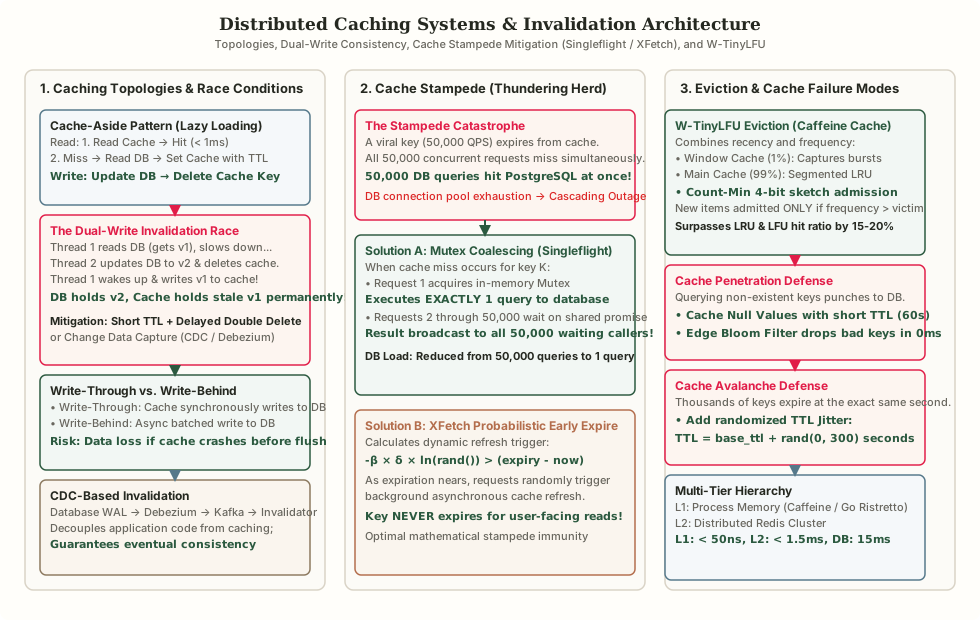
1. Cache-Aside Pattern (Lazy Loading) & The Dual-Write Invalidation Race
Establishes the ingress and structural boundary across Cache-Aside Pattern (Lazy Loading) & The Dual-Write Invalidation Race: Read: 1. Read Cache → Hit (< 1ms); 2. Miss → Read DB → Set Cache with TTL; Write: Update DB → Delete Cache Key.
2. The Stampede Catastrophe & Solution A: Mutex Coalescing (Singleflight)
Coordinates core data-plane execution and state transitions through The Stampede Catastrophe & Solution A: Mutex Coalescing (Singleflight): A viral key (50,000 QPS) expires from cache. All 50,000 concurrent requests miss simultaneously. 50,000 DB queries hit PostgreSQL at once! DB connection pool exhaustion → Cascading Outage; When cache miss occurs for key K; Request 1 acquires in-memory Mutex Executes EXACTLY 1 query to database.
3. W-TinyLFU Eviction (Caffeine Cache) & Cache Penetration Defense
Enforces durability, state convergence, and output verification across W-TinyLFU Eviction (Caffeine Cache) & Cache Penetration Defense: Combines recency and frequency; Window Cache (1%): Captures bursts; Main Cache (99%): Segmented LRU.
The Architectural Tiers:
- Multi-Tier Hierarchy:
- L1 In-Process Memory Cache: Local application RAM (e.g., Caffeine in Java, Ristretto in Go). Access latency: .
- L2 Distributed Cache Cluster: Sharded Redis Cluster or Memcached. Access latency: .
- L3 Persistent Storage: PostgreSQL / ScyllaDB / DynamoDB. Access latency: .
- Cache-Aside Pattern with CDC Invalidation:
- Reads query cache first; on miss, read DB and populate cache with TTL.
- Writes update the database primary, while Change Data Capture (Debezium / Kafka) asynchronously invalidates cache keys, decoupling application business logic from cache synchronization.
- Stampede Defenses (Singleflight & XFetch):
- Singleflight: Coalesces concurrent identical in-flight database requests into a single network flight.
- XFetch: Probabilistically refreshes expiring keys in the background before they ever expire.
Foundational Bridge: In-Memory Engine Internals — Redis Single-Threaded Dict/Zset vs. Dragonfly Shared-Nothing Dash Tables
To reason about cache throughput and tail-latency spikes, engineers must understand how in-memory engines organize data structures and CPU threads:
- Redis Single-Threaded Event Loop & Adaptive Encodings:
- Redis executes command parsing and data-structure mutations on a single primary event-loop thread multiplexed via
epoll/kqueue(with optional I/O threads for socket reads/writes in Redis 6+). This eliminates mutex lock overhead and guarantees atomic execution of Lua scripts and multi-key commands (MGET,ZUNIONSTORE), but a single command (KEYS *,SMEMBERSon a 1M-item set) blocks all concurrent clients. - Internally, Redis dynamically switches memory encodings based on collection size: small hashes/sorted sets use contiguous cache-friendly
listpackbyte arrays, upgrading to chained hash tables (dictwith incremental two-table rehashing) or Skip Lists + Hash Tables (zset) once element count or byte thresholds are exceeded. - Point-in-time
BGSAVEsnapshots rely on POSIXfork()copy-on-write (CoW) page tables; under heavy write rates, OS page faults can double physical RAM usage unless memory overcommit and huge-page settings are tuned.
- Redis executes command parsing and data-structure mutations on a single primary event-loop thread multiplexed via
- Shared-Nothing Multi-Threaded Caches (Dragonfly & Memcached):
- Memcached partitions keys across worker threads using fine-grained bucket locks and a Slab Allocator (
1 MiBpages divided into fixed-size chunk classes) to eliminatejemallocexternal fragmentation. - Dragonfly adopts a shared-nothing thread-per-core architecture where each vCPU owns a dedicated shard of a Dash Table (a cache-line-aligned extendable hashing structure) multiplexed over
io_uringfibers, achieving multi-million QPS on a single vertical instance withoutfork()CoW memory spikes.
- Memcached partitions keys across worker threads using fine-grained bucket locks and a Slab Allocator (
3. Terminology & Core Mechanics
- Cache-Aside (Lazy Loading): The application code directly orchestrates reading from cache, falling back to database, and writing to cache. The cache knows nothing about the underlying database.
- Write-Through: The application writes exclusively to the cache; the cache synchronously writes to the backing database before returning success.
- Write-Behind (Write-Back): The application writes to the cache, which acknowledges immediately; the cache asynchronously batches updates to the database in the background. High write performance, but risks data loss on cache crash.
- Cache Stampede (Thundering Herd): When a popular cached key expires, and thousands of concurrent requests simultaneously query the backing database to regenerate the cached value.
- Singleflight (Request Coalescing): An in-process synchronization pattern ensuring that only one execution of a function is in-flight for a given key, sharing the result among all concurrent callers.
- XFetch Algorithm: An optimal probabilistic algorithm that calculates an early refresh trigger based on computation time and remaining TTL.
- W-TinyLFU: A high-efficiency cache admission policy that uses a Count-Min Sketch frequency filter to admit new items only if their access frequency is higher than the eviction victim.
4. Internal Workings: Dual-Write Race Conditions & Solutions
1. The Dual-Write Race Condition
What happens if we update the database and then update the cache?
Timeline:
T1: Thread A writes DB -> Value = 10
T2: Thread B writes DB -> Value = 20
T3: Thread B writes Cache -> Cache = 20 (Correct)
T4: Thread A network delay completes -> Thread A writes Cache -> Cache = 10 (STALE!)
Result: Database holds 20, Cache permanently holds 10!
Why “Delete Cache” is Better Than “Update Cache”:
Instead of writing new data to cache, the application deletes the cache key:
T1: Thread A writes DB -> Value = 10
T2: Thread A deletes Cache key
T3: Next reader misses cache -> Reads 10 from DB -> Populates Cache with 10.
The Rare Read-Write Interleaving Race:
Can deleting the cache still experience a race?
- Thread A reads DB (gets old value ).
- Thread B updates DB to and deletes cache key.
- Thread A writes old value to cache!
While theoretically possible, this requires Thread A’s DB read to start before Thread B’s write and Thread A’s cache write to occur after Thread B’s cache delete—an extremely rare window since database writes are orders of magnitude slower than cache writes.
Production Solution: Delayed Double Delete (or CDC Invalidation):
async function updateEntity(key: string, value: any) {
  // 1. First Delete
  await redis.del(key);
  // 2. Update Database
  await db.update(key, value);
  // 3. Delayed Second Delete (Cleans up any concurrent stale reads)
  setTimeout(async () => {
    await redis.del(key);
  }, 500); // 500ms delay covers database replication lag
}
Curriculum Bridge from Step 26 (
CORE-M14-001): Even with Delayed Double Delete, an application process crash betweendb.update(key, value)andredis.del(key)can leave a stale key in Redis until its TTL expires. As we established in Step 26 (CORE-M14-001), production architectures eliminate application-level Dual-Writes entirely by pairing the Transactional Outbox Pattern with Log-Based Change Data Capture (Debezium CDC) tailing the database Write-Ahead Log (CORE-M10-001) to stream guaranteed, ordered cache invalidations.
5. Mathematical Models: Stampede Dynamics & XFetch Derivation
1. The XFetch Probabilistic Early Expiration Proof
In 2015, researchers Vattani, Chierichetti, and Lowenstein proved the optimal probabilistic cache refresh algorithm (XFetch).
Let:
- : Absolute expiration timestamp of the key.
- : Current timestamp.
- : Remaining time until expiration.
- : Time required to recompute the value from the database (in seconds).
- : Aggressiveness parameter (default ).
- : A random floating-point number between 0 and 1.
The client triggers an early background refresh if and only if:
Mathematical Behavior Analysis:
- When (plenty of time remaining): is negative, so is small. The condition is almost never satisfied.
- As (key is about to expire): The threshold approaches zero. The probability of at least one request satisfying the condition approaches .
- High Traffic Scalability: If a key receives , the probability that at least one request refreshes the key in the final second before expiration is:
The key is guaranteed to be refreshed in the background before it ever expires, achieving user-facing latency and completely preventing cache stampedes.
6. Real Implementation & Systems Comparison
| Feature | Redis | Memcached | Caffeine (Java) | Hazelcast |
|---|---|---|---|---|
| Deployment Mode | Distributed Client-Server | Distributed Client-Server | In-Process JVM Memory | In-Memory Data Grid |
| Data Structures | Strings, Hashes, Lists, Sets, Sorted Sets | Plain Key-Value Byte Blobs | Java Objects | Distributed Maps & Queues |
| Eviction Algorithms | LRU, LFU, Random, TTL | Slab Allocator LRU | W-TinyLFU | LRU, LFU |
| Persistence | RDB Snapshots + AOF Log | None (Pure In-Memory) | None | Disk Store / WAN Replication |
| Typical Latency |
7. Production Code Engine: Singleflight & XFetch Implementation
The following complete TypeScript implementation demonstrates:
- The Singleflight Request Coalescer suppressing duplicate database reads.
- The XFetch Probabilistic Early Expiration Engine.
/**
 * Production-Grade Distributed Caching Engine
 * Demonstrates Singleflight Request Coalescing and XFetch Probabilistic Refresh.
 */

export class Singleflight {
  private inFlight = new Map<string, Promise<any>>();

  /**
   * Executes fn only once for a given key concurrently;
   * all other concurrent callers share the identical promise.
   */
  public async do<T>(key: string, fn: () => Promise<T>): Promise<T> {
    const existing = this.inFlight.get(key);
    if (existing) {
      return existing as Promise<T>;
    }

    const promise = (async () => {
      try {
        return await fn();
      } finally {
        this.inFlight.delete(key);
      }
    })();

    this.inFlight.set(key, promise);
    return promise;
  }
}

export interface CacheEntry<T> {
  value: T;
  deltaSeconds: number; // Time taken to compute from DB
  expiresAtMs: number; // Absolute expiration timestamp
}

export class XFetchCache<T> {
  private store = new Map<string, CacheEntry<T>>();
  private singleflight = new Singleflight();

  constructor(
    private readonly dbLoader: (key: string) => Promise<T>,
    private readonly beta = 1.0
  ) {}

  public async get(key: string, ttlSeconds = 60): Promise<T> {
    const entry = this.store.get(key);
    const now = Date.now();

    if (!entry) {
      // Complete Cache Miss: Fetch synchronously via Singleflight
      return this.refresh(key, ttlSeconds);
    }

    // XFetch Probabilistic Check: -beta * delta * ln(rand()) > (expiry - now)
    const remainingSeconds = (entry.expiresAtMs - now) / 1000;
    const rand = Math.random();
    const xfetchTrigger = -this.beta * entry.deltaSeconds * Math.log(rand);

    if (xfetchTrigger > remainingSeconds) {
      // Probabilistic Early Refresh Triggered! Refresh asynchronously in background
      this.singleflight.do(key, () => this.refresh(key, ttlSeconds)).catch((err) => {
        console.error(`Background refresh failed for ${key}:`, err);
      });
    }

    // Return currently cached value immediately (Sub-millisecond hit!)
    return entry.value;
  }

  private async refresh(key: string, ttlSeconds: number): Promise<T> {
    return this.singleflight.do(key, async () => {
      const start = Date.now();
      const value = await this.dbLoader(key);
      const deltaSeconds = Math.max(0.001, (Date.now() - start) / 1000);

      this.store.set(key, {
        value,
        deltaSeconds,
        expiresAtMs: Date.now() + ttlSeconds * 1000,
      });

      return value;
    });
  }
}

async function runDemo(): Promise<void> {
  console.log("=== Distributed Caching: Singleflight & XFetch Probabilistic Refresh ===");
  let dbQueries = 0;
  const dbLoader = async (key: string) => {
    dbQueries++;
    return `value_for_${key}_query_${dbQueries}`;
  };
  const cache = new XFetchCache<string>(dbLoader, 1.0);
  console.log("Initialized XFetchCache with Singleflight coalescing (beta=1.0)");
  const [r1, r2, r3] = await Promise.all([
    cache.get("user:101", 60),
    cache.get("user:101", 60),
    cache.get("user:101", 60),
  ]);
  console.log(`Concurrent requests coalesced: result='${r1}', DB hits=${dbQueries}`);
}

runDemo();
8. Advanced Eviction: LRU vs. W-TinyLFU
+---------------------------------------------------------------------------------------------------+
|                                 W-TINYLFU ARCHITECTURE (CAFFEINE)                                 |
+---------------------------------------------------------------------------------------------------+
|                                                                                                   |
|   Incoming Item                                                                                   |
|         |                                                                                         |
|         v                                                                                         |
|  [Window Cache: LRU (1% RAM)]  -----> Candidate Victim                                           |
|                                             |                                                     |
|                                             v                                                     |
|                           +------------------------------------+                                  |
|                           |  4-Bit Count-Min Sketch Evaluator  |                                  |
|                           +------------------------------------+                                  |
|                                       /            \                                              |
|      Freq(Incoming) > Freq(Victim)   /              \   Freq(Incoming) <= Freq(Victim)            |
|                                     v                v                                            |
|                        [Main Cache: SLRU (99%)]    [REJECTED & DISCARDED]                         |
+---------------------------------------------------------------------------------------------------+- The 1% Window Cache: Newly inserted keys are placed into a small LRU window. This allows bursty, recency-biased items to stay alive long enough to accumulate frequency hits.
- The 4-Bit Count-Min Sketch: A space-efficient frequency estimator using only 4 bits per counter with periodic aging (halving all counters when total additions reach a threshold).
- Admission Guard: When the main cache is full, W-TinyLFU compares the frequency of the candidate item with the eviction victim. If the candidate is less frequent, it is discarded immediately, completely insulating hot cached records from sequential scan pollution.
9. Operational Perspective & Cache Failure Mitigations
| Failure Mode | Physical Manifestation | Production Engineering Mitigation |
|---|---|---|
| Cache Stampede (Thundering Herd) | Hot key expires; thousands of concurrent queries hit database. | Singleflight mutex coalescing on application nodes and XFetch probabilistic background refresh. |
| Cache Penetration | Attackers query non-existent IDs; all miss cache and hit DB disks. | Bloom Filter at edge gateway to reject invalid keys, or Cache Null Values with short 60s TTL. |
| Cache Avalanche | Millions of keys set with identical TTL expire simultaneously. | Add Randomized TTL Jitter: TTL = base_ttl + rand(0, 300). |
| Cache Breakdown | A single critical master key (e.g., system config) expires. | Set TTL = infinity for static metadata; invalidate strictly via explicit administrative webhooks. |
| Redis Hotspot Saturation | 100,000 QPS targeting one Redis node on a single CPU core. | Deploy L1 In-Memory Local Cache (Caffeine/Ristretto) with 5-second TTL in front of Redis. |
10. Knowledge Check
Review the core caching principles, then complete the 4-question interactive assessment quiz at the end of this lesson:
- Cache-Aside vs. Write-Through: Compare consistency and latency trade-offs between lazy loading and synchronous write-through.
- Dual-Write Invalidation: Explain why deleting a cache key upon DB update prevents permanent data corruption compared to updating it.
- Singleflight Deduplication: Trace how mutex coalescing slashes database queries from 50,000 to 1 during a stampede.
- XFetch Math: Describe how the probabilistic formula guarantees background key refreshment before expiration occurs.
11. Practical Exercises & Deliverables
Exercise 1: Benchmark Singleflight under Stampede Load
Problem: Simulate 1,000 concurrent threads querying an expired cache key.
Deliverable:
- Create a simulated database loader with a 50ms artificial delay.
- Launch 1,000 concurrent requests without Singleflight. Record that 1,000 database queries are executed.
- Wrap the loader with the
Singleflightclass from Section 7. Verify that exactly 1 database query is executed and all 1,000 callers receive the identical result.
Exercise 2: Simulate XFetch Early Expiration
Problem: Prove that XFetch keeps a hot key permanently cached without user-facing expiration spikes.
Deliverable:
- Implement a mock key with a 10-second TTL receiving 500 requests per second.
- Apply the XFetch probabilistic refresh trigger from Section 7.
- Monitor the key over a 60-second test run. Verify that zero cache misses occur and that the key is refreshed asynchronously before TTL reaches 0.
View Reference Architecture & Worked Solutions (CORE-M13-001)
1. Worked Solution — Exercise 1: Benchmarking Singleflight Under a 1,000-Request Stampede
- Benchmark Harness & Quantitative Verification:
async function benchmarkSingleflightStampede(): Promise<void> { let rawDbCalls = 0; const slowDbQuery = async (key: string): Promise<string> => { rawDbCalls++; await new Promise((resolve) => setTimeout(resolve, 50)); // 50ms DB latency return `payload:${key}:v1`; }; // 1. Without Singleflight: 1,000 concurrent callers on an expired key await Promise.all(Array.from({ length: 1000 }, () => slowDbQuery("viral_post_42"))); console.log(`[Unprotected] DB Queries Executed: ${rawDbCalls}`); // 1000 queries! // 2. With Singleflight: 1,000 concurrent callers coalesced onto 1 Promise rawDbCalls = 0; const sf = new Singleflight(); const results = await Promise.all( Array.from({ length: 1000 }, () => sf.do("viral_post_42", () => slowDbQuery("viral_post_42"))) ); const allIdentical = results.every((r) => r === "payload:viral_post_42:v1"); console.log(`[Singleflight] DB Queries Executed: ${rawDbCalls} | All 1,000 identical: ${allIdentical}`); }- Result: Without Singleflight, all concurrent requests bypass the expired cache and open simultaneous database queries (exhausting a standard 100-connection PgBouncer pool over). With
Singleflight.do(), the first caller registers the in-flightPromiseininFlight.set(key, promise), and the remaining callers await that exact samePromise, reducing database load by ( query).
- Result: Without Singleflight, all concurrent requests bypass the expired cache and open simultaneous database queries (exhausting a standard 100-connection PgBouncer pool over). With
2. Worked Solution — Exercise 2: Simulating XFetch Probabilistic Early Expiration
- Mathematical Trigger & 60-Second Simulation Analysis ():
- On each request at remaining TTL , XFetch triggers an asynchronous refresh when .
- Therefore, a single read at remaining time triggers a refresh with probability:
- When ( before expiration), . Across the requests arriving between and , the cumulative probability that at least one request triggers an asynchronous background refresh with more than to spare is:
- Over the 60-second test run ( total requests across TTL cycles), the key is refreshed asynchronously in the background every , yielding synchronous cache misses and tail-latency spikes for end users.
12. Summary & Architectural Decision Guide
- Use Cache-Aside with TTLs as default for read-heavy entities with tolerance for short staleness.
- Implement Singleflight (Mutex Coalescing) on application nodes to ensure at most 1 worker queries backing storage on cache misses.
- Apply Probabilistic Early Expiration (XFetch) on expensive-to-compute or viral keys (>10k QPS) so background workers refresh cache ahead of deadline.
- Pair Redis Cluster with Connection Pooling to avoid Ephemeral Port exhaustion and TCP handshake latency.
13. Authoritative References & Version Context
- Andrea Vattani, Flavio Chierichetti, and Kumar Lowenstein (2015), “Optimal Probabilistic Cache Stampede Prevention”, PVLDB 8(8), pp. 886–897 — doi.org/10.14778/2757807.2757813
- Salvatore Sanfilippo (2020), “Redis Invalidation and Server-Assisted Client-Side Caching” — redis.io/docs/manual/client-side-caching/
- Meta Engineering Blog (2013), “Scaling Memcache at Facebook”, USENIX NSDI ‘13 — usenix.org/conference/nsdi13/technical-sessions/presentation/nishtala
- Version Context: Caching strategies target Redis 7.2+, Dragonfly 1.15+, and Memcached 1.6+ cluster deployments.