1. The Problem & Why It Matters
In microservice architectures, business workflows span multiple services. When an order is placed in an e-commerce platform, inventory must be reserved, payment must be charged, shipping must be notified, and analytics must be updated.
A naive approach attempts direct synchronous RPC calls or uncoordinated Dual-Writes:
// THE DUAL-WRITE DISASTER
async function placeOrder(orderData) {
  // 1. Commit to PostgreSQL
  await db.query("INSERT INTO orders ...", [orderData]);

  // 2. Publish to Kafka
  // CRITICAL FAILURE POINT: What if the server crashes right HERE?
  await kafkaProducer.send({ topic: "orders", message: orderData });
}
If the service process crashes, loses power, or experiences a network partition after Step 1 but before Step 2:
- The customer’s order is committed in PostgreSQL and money is charged.
- The Kafka event is never published.
- Inventory is never reserved, the shipping warehouse never ships the product, and customer support receives angry phone calls.
- Reversing the order of operations (publishing to Kafka first, then writing to the database) is equally fatal: if the database write fails with a foreign key violation or disk-full error, an event has already been published to the broker for an order that does not exist in the database!
This is the classic Dual-Write Problem. Resolving it without heavyweight two-phase commit (2PC) requires the Transactional Outbox Pattern and Change Data Capture (CDC).
2. Intuitive Mental Model
Imagine ordering a passport at a government office:
- The Dual-Write Disaster: The clerk stamps your passport approval into the physical ledger book, and then promises to walk down the street to the post office to mail your passport. On the walk to the post office, the clerk gets into a bicycle accident. The ledger says your passport is approved, but the package is never mailed.
- The Transactional Outbox: The clerk stamps your passport approval in the ledger and simultaneously drops the envelope into an Outbox Tray on their desk. Both actions occur in one motion before you leave the window.
- Change Data Capture (CDC): A dedicated mail courier stops by the office every 10 seconds, picks up all envelopes from the Outbox Tray, delivers them to the postal logistics center, and marks the tray empty. Even if the clerk faints, the envelopes remain safely in the tray until delivered.
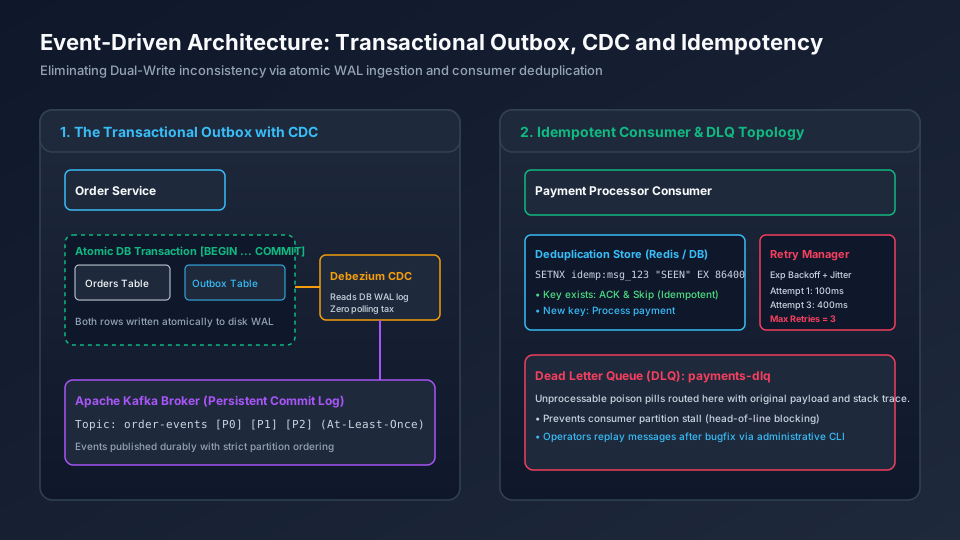
1. Order Service & Atomic DB Transaction [BEGIN ... COMMIT]
Establishes the ingress and structural boundary across Order Service & Atomic DB Transaction [BEGIN ... COMMIT]: Reads DB WAL log Zero polling tax; Topic: order-events [P0] [P1] [P2] (At-Least-Once); Events published durably with strict partition ordering.
2. Payment Processor Consumer & Deduplication Store (Redis / DB)
Coordinates core data-plane execution and state transitions through Payment Processor Consumer & Deduplication Store (Redis / DB): SETNX idemp:msg_123 "SEEN" EX 86400; Key exists: ACK & Skip (Idempotent); New key: Process payment.
3. Payment Processor Consumer & Deduplication Store (Redis / DB)
Enforces durability, state convergence, and output verification across Payment Processor Consumer & Deduplication Store (Redis / DB): SETNX idemp:msg_123 "SEEN" EX 86400; Key exists: ACK & Skip (Idempotent); New key: Process payment.
Foundational Bridge: Point-to-Point Work Queues (AMQP / SQS), Visibility Timeouts & Dead-Letter Queues
While append-only log brokers (Kafka, Pulsar) excel at ordered event replay, asynchronous background job execution relies on Point-to-Point Competing-Consumer Work Queues (Amazon SQS, RabbitMQ / AMQP):
- Competing Consumers & Per-Message Acknowledgment: Unlike Kafka (where parallelism is capped by partition count and offsets advance monotonically per partition), a work queue dispatches individual messages to any idle worker in a pool of consumers. Each message tracks an independent lifecycle state (
READYIN_FLIGHTACKED/DEAD_LETTERED). - Visibility Timeout & Lease Extension (Heartbeating):
- When Worker dequeues message , the broker hides from other workers for a Visibility Timeout (e.g., ).
- If Worker processes and sends
ACKwithin , the broker permanently deletes . - If Worker crashes before acknowledging, expires and automatically becomes visible again for another worker to retry (guaranteeing At-Least-Once delivery). Long-running tasks periodically send
ChangeMessageVisibilityheartbeats so active work is not prematurely redelivered.
- Exponential Backoff with Full Jitter & Dead-Letter Queues (DLQ):
- Immediate retries against a degraded downstream dependency trigger synchronized retry storms. Workers schedule retry attempt using Full Jitter:
- Poison-Pill Isolation (DLQ): A malformed message that causes a deterministic crash on every retry will loop infinitely unless bounded. The broker increments
ApproximateReceiveCounton each delivery; whenreceive_count > maxReceiveCount(e.g., ), the broker atomically moves the poison message to a Dead-Letter Queue (DLQ), triggers an alert, and preserves normal queue throughput.
3. Architectural Mechanisms & Concrete Topologies
3.1 The Transactional Outbox Architecture
To achieve atomic state and event creation:
- When an application service executes a business transaction, it inserts the domain entity into the business table (
orders) and inserts an event record into anoutboxtable within the exact same local ACID database transaction. - Because both inserts share a single database transaction, either both are committed to disk or both are rolled back. Inconsistency is impossible.
BEGIN;
  INSERT INTO orders (id, user_id, total_cents, status)
  VALUES ('ord_123', 'usr_456', 4999, 'CREATED');

  INSERT INTO outbox (id, aggregate_type, aggregate_id, event_type, payload, created_at)
  VALUES (
    'evt_789',
    'ORDER',
    'ord_123',
    'OrderCreated',
    '{"orderId":"ord_123","totalCents":4999}',
    NOW()
  );
COMMIT;
3.2 Change Data Capture (CDC) via Debezium
How do outbox rows move to Apache Kafka?
- Anti-Pattern (Polling): Running
SELECT * FROM outbox WHERE sent = false LIMIT 100every 500ms burns CPU, adds read locks, and leaves tombstones in index B+ trees. - Production Standard (Log-Based CDC): Debezium connects to PostgreSQL using the logical replication protocol (
pgoutputplugin). As the PostgreSQL database engine writes commit records to its sequential Write-Ahead Log (WAL), Debezium tails the WAL directly, extracts outbox inserts, and publishes them into Kafka topics in real time with sub-millisecond latency and zero SQL query load on the database.
4. Formal Mathematical Derivations
4.1 Exponential Backoff with Full Jitter Formula
When a consumer encounters a transient failure (e.g. downstream service 503), retrying immediately causes a thundering herd. Standard exponential backoff computes delay for retry attempt :
However, if 1,000 consumers fail simultaneously, standard exponential backoff causes all 1,000 consumers to retry at the exact same instant (). To distribute load uniformly across time, we implement AWS’s Full Jitter algorithm:
The expected delay is half the maximum backoff window:
This spreads the 1,000 retries across the entire interval, eliminating peak load spikes.
4.2 Idempotency Window Sizing
Let message arrival rate be messages/sec. Let the maximum expected clock skew between nodes be , and let the maximum consumer replay offset window be seconds. The required memory capacity for the deduplication key store (e.g. Redis) with key size is:
For , (24 hours), and : A single Redis instance with 64 GB of RAM comfortably protects against duplicates across a 24-hour replay window.
5. Edge Cases, Failure Modes & Distributed Anomalies
5.1 The Poison Pill Message
A corrupted message (e.g. malformed JSON or unhandled null pointer exception) arrives on a Kafka partition.
- The Failure: The consumer reads the message, throws an uncaught exception, and crashes before committing the offset.
- The Cascade: Kubernetes restarts the consumer. The consumer reads the same message again, crashes again, and enters an infinite crash-loop. The entire partition halts, blocking all subsequent valid messages from being processed!
- The Remediation (Dead Letter Queue - DLQ): Wrap consumer handlers in a try-catch block. If retries exceed (e.g. 3 attempts), route the poisoned message with its error stack trace to a dedicated
orders-dlqtopic, commit the partition offset, and continue processing valid messages.
5.2 Out-of-Order Message Processing Across Retries
If Message 1 (Create Order) fails and is scheduled for a retry in 5 seconds, but Message 2 (Cancel Order) arrives and is processed immediately, the cancellation may execute before creation!
To preserve domain consistency, Kafka partition keys must hash on the entity identifier (e.g. order_id), and retry queues must be partitioned per entity or use state-machine status guards (e.g. WHERE status = 'CREATED').
6. Open-Source Architectural Studies
6.1 Debezium: PostgreSQL Logical Decoding
Debezium leverages PostgreSQL’s native logical replication stream. When a transaction commits, the PostgreSQL write-ahead log records BEGIN, tuple data, and COMMIT. Debezium acts as an internal replication slot (pgoutput), streaming byte representations of row changes directly into Kafka. If Debezium crashes, PostgreSQL holds the replication slot position in WAL, ensuring zero event loss upon restart.
6.2 Temporal & Uber Cadence: Durable Execution Outboxes
Workflow orchestration platforms like Temporal maintain durability by treating event history as an append-only outbox. Instead of relying on volatile message brokers, every step in a Temporal workflow is recorded into Cassandra or PostgreSQL before dispatching activity tasks, ensuring workflows resume from their exact execution step after node crashes.
7. Production Incident Post-Mortem (War Stories)
The Duplicate Charge Catastrophe
Context: A fintech payment platform processed credit card payments via an asynchronous messaging queue.
The Incident: A network switch reboot caused an 8-second network partition between Kafka brokers and payment consumer workers.
The Bug: Kafka’s consumer group rebalance kicked in because heartbeats timed out. Ten consumer workers that were halfway through charging user cards had their partitions revoked. When the partition was reassigned to new workers, they re-read the uncommitted messages and charged the cards a second time. Over 14,000 users were double-charged, totaling $2.3 million in duplicate authorizations.
The Fix: Implemented a two-state Idempotency State Machine (PROCESSING COMPLETED) paired with gateway-level idempotency keys:
- Every payment message carries a deterministic
idempotency_key = sha256(order_id + user_id). - Before calling the payment gateway, the consumer atomically claims an in-flight lease in Redis (
SET payment:key:<id> "PROCESSING" NX EX 60) and passesIdempotency-Key: <id>to the payment gateway API, marking the Redis key"COMPLETED"(with a 24h TTL) once the gateway responds. - If a duplicate message arrives and observes
"COMPLETED", the consumer immediately acknowledges and skips it. If it observes"PROCESSING"(meaning another worker is currently mid-flight or crashed before completing), the consumer never blindly discards the message (which would drop the payment if the first worker crashed); instead, it withholds ACK / backs off until the lease transitions to"COMPLETED"or expires, or queries the payment provider usingidempotency_keyto reconcile the authoritative charge status.
8. Production-Grade TypeScript Simulation: Transactional Outbox, CDC Dispatcher & Idempotent Consumer
This simulation models the entire end-to-end event pipeline: atomic database transaction with Outbox, an asynchronous CDC log reader, a message broker with network retries, and an Idempotent Consumer with Dead Letter Queue routing.
/**
 * Production Event Streaming Simulation: Outbox, CDC, Idempotency & DLQ
 */

export interface OutboxRecord {
  id: string;
  aggregateId: string;
  eventType: string;
  payload: string;
  createdAt: number;
}

export class MockDatabase {
  public ordersTable = new Map<string, any>();
  public outboxTable: OutboxRecord[] = [];
  public walLog: OutboxRecord[] = [];

  public beginTransaction(): {
    insertOrder: (order: any) => void;
    insertOutbox: (record: OutboxRecord) => void;
    commit: () => void;
  } {
    const stagedOrders: any[] = [];
    const stagedOutbox: OutboxRecord[] = [];

    return {
      insertOrder: (order) => stagedOrders.push(order),
      insertOutbox: (record) => stagedOutbox.push(record),
      commit: () => {
        // Atomic commit
        for (const o of stagedOrders) this.ordersTable.set(o.id, o);
        for (const ob of stagedOutbox) {
          this.outboxTable.push(ob);
          this.walLog.push(ob); // Append to WAL
        }
      },
    };
  }
}

export class CDCDispatcher {
  private walOffset = 0;
  private readonly db: MockDatabase;
  private readonly broker: MessageBroker;

  constructor(db: MockDatabase, broker: MessageBroker) {
    this.db = db;
    this.broker = broker;
  }

  public pollWAL(): void {
    while (this.walOffset < this.db.walLog.length) {
      const record = this.db.walLog[this.walOffset];
      this.broker.publish("order-events", record);
      this.walOffset++;
    }
  }
}

export class MessageBroker {
  public topics = new Map<string, OutboxRecord[]>();
  public dlq: { record: OutboxRecord; error: string }[] = [];

  constructor() {
    this.topics.set("order-events", []);
  }

  public publish(topic: string, record: OutboxRecord): void {
    const list = this.topics.get(topic) ?? [];
    list.push(record);
    this.topics.set(topic, list);
  }

  public routeToDLQ(record: OutboxRecord, error: string): void {
    this.dlq.push({ record, error });
  }
}

export class IdempotentConsumer {
  private readonly processedIds = new Set<string>();
  private readonly broker: MessageBroker;
  public successfulDeliveries = 0;
  public duplicatesFiltered = 0;
  public poisonPillsTriaged = 0;

  constructor(broker: MessageBroker) {
    this.broker = broker;
  }

  public consumeMessage(record: OutboxRecord): void {
    // 1. Idempotency Check
    if (this.processedIds.has(record.id)) {
      this.duplicatesFiltered++;
      return; // Discard duplicate safely
    }

    // 2. Business Execution with Poison Pill Guard
    try {
      const data = JSON.parse(record.payload);
      if (data.corrupted) {
        throw new Error("MALFORMED_PAYLOAD: unrecoverable schema poison pill");
      }

      // Simulate successful business side-effect
      this.successfulDeliveries++;
      this.processedIds.add(record.id); // Commit idempotency lock
    } catch (err: any) {
      // 3. Poison pill routed to Dead Letter Queue
      this.poisonPillsTriaged++;
      this.broker.routeToDLQ(record, err.message);
      this.processedIds.add(record.id); // Mark handled so partition is not blocked
    }
  }
}

// Verification Routine
export function runEventStreamingExperiment() {
  console.log("=== Transactional Outbox, CDC & Idempotent Consumer Pipeline ===");

  const db = new MockDatabase();
  const broker = new MessageBroker();
  const cdc = new CDCDispatcher(db, broker);
  const consumer = new IdempotentConsumer(broker);

  // 1. Service writes order + outbox atomically
  const tx = db.beginTransaction();
  tx.insertOrder({ id: "ord_101", totalCents: 9900 });
  tx.insertOutbox({
    id: "evt_001",
    aggregateId: "ord_101",
    eventType: "OrderCreated",
    payload: JSON.stringify({ orderId: "ord_101", totalCents: 9900 }),
    createdAt: Date.now(),
  });
  // Simulate a poison pill message
  tx.insertOutbox({
    id: "evt_002",
    aggregateId: "ord_102",
    eventType: "OrderCreated",
    payload: "{ corrupted: true }", // Invalid JSON / bad payload
    createdAt: Date.now(),
  });
  tx.commit();

  // 2. CDC tails the WAL log and streams to Kafka
  cdc.pollWAL();

  // 3. Consumer processes messages from Kafka
  const messages = broker.topics.get("order-events") ?? [];
  for (const msg of messages) {
    consumer.consumeMessage(msg);
  }

  // 4. Simulate duplicate delivery (At-Least-Once retry)
  consumer.consumeMessage(messages[0]); // Duplicate of evt_001

  console.log(`Success Count: ${consumer.successfulDeliveries}`);
  console.log(`Duplicates Filtered: ${consumer.duplicatesFiltered}`);
  console.log(`Poison Pills Triaged to DLQ: ${consumer.poisonPillsTriaged}`);
  console.log(`DLQ Items: ${broker.dlq.length} (Reason: ${broker.dlq[0]?.error})`);
}

function runDemo(): void {
  console.log("=== Event Streaming: Transactional Outbox & CDC Dispatcher ===");
  runEventStreamingExperiment();
}

runDemo();
9. Operational Checklist, Failure Runbooks & CDC Tuning
Production Debezium & PostgreSQL Configuration
To configure PostgreSQL for log-based CDC without dropping events:
# /etc/postgresql/postgresql.conf
wal_level = logical
max_replication_slots = 10
max_wal_senders = 10
wal_keep_size = 4096MB
Runbook: Triaging the Dead Letter Queue
When the DLQ alert fires (messages_in_dlq > 0):
- Inspect Payload: Fetch sample message using Kafka console consumer:
kafka-console-consumer --bootstrap-server localhost:9092 --topic payments-dlq --max-messages 1 - Determine Failure Class:
- Transient external API error: Re-inject message back into main topic via Kafka Connect Replay.
- Permanent schema bug: Deploy application patch, then run replay CLI script.
10. Guided Applied System Design Exercises & Debugging Drills
Drill 1: The Outbox Polling Meltdown
An application uses table polling (SELECT * FROM outbox WHERE processed = false LIMIT 100 FOR UPDATE) running every 200 milliseconds across 10 service instances. Under 2,000 write TPS, database CPU reaches 100% and transaction deadlocks occur.
- Identify the three database storage mechanisms causing the lock contention.
- Outline how switching to Debezium and PostgreSQL logical replication eliminates table polling completely.
Drill 2: Idempotent Payment Webhook Design
Stripe transmits payment confirmation webhooks to your subscription billing system. Under network retries, Stripe guarantees At-Least-Once delivery, frequently delivering the exact same webhook payload 3 times within 10 seconds.
- Design an atomic Redis + PostgreSQL deduplication pipeline that guarantees a user’s subscription is only extended once.
- What HTTP status code should your webhook endpoint return when a duplicate event is detected? Justify your choice.
View Reference Architecture & Worked Solutions (CORE-M14-001)
1. Worked Solution — Drill 1: Diagnosing & Resolving the Outbox Polling Meltdown
-
The Three Database Storage Mechanisms Causing CPU Saturation & Deadlocks:
- Row-Level Lock Contention on the Head of the Queue (
FOR UPDATE): When 10 worker instances executeSELECT * FROM outbox WHERE processed = false ORDER BY id LIMIT 100 FOR UPDATEevery (), all 10 instances contend for exclusive row locks on the exact same oldest 100 unprocessed rows, serializing 9 out of 10 workers behind lock waits (FOR UPDATE SKIP LOCKEDmitigates blocking between pollers, but still burns index scans). - MVCC Dead-Tuple & Secondary Index Bloat: At ,
UPDATE outbox SET processed = truegenerates () in PostgreSQL. Even with a partial indexCREATE INDEX ON outbox (id) WHERE processed = false, scanning through newly dead MVCC versions beforeautovacuumcan clean them degrades index seeks into multi-page scans. - B+ Tree Page Latch Contention & Lock-Order Deadlocks: Concurrent foreground transactions inserting into
outboxwhile background pollers lock and update adjacent rows on the same 8 KB slotted heap/index pages trigger buffer-pool page latch contention and lock-upgrade deadlocks when batchUPDATE WHERE id IN (...)statements lock IDs out of ascending order.
- Row-Level Lock Contention on the Head of the Queue (
-
How Debezium Log-Based CDC (
pgoutput) Eliminates Polling:- Instead of querying the
outboxtable via SQL, PostgreSQL is configured withwal_level = logicaland a logical replication slot. - As foreground transactions commit
INSERT INTO outbox, PostgreSQL streams the committed WAL records directly from memory/OS page cache over the replication protocol (pgoutput) to Debezium. - Zero Update/Vacuum Tax: Because Debezium only triggers on
INSERTWAL records, the application never needs to updateprocessed = true, or can insert directly into an unindexed/append-only table (or usepg_logical_emit_message()in PostgreSQL 14+ to write outbox events directly into the WAL without touching a heap table at all!).
- Instead of querying the
2. Worked Solution — Drill 2: Idempotent Payment Webhook Pipeline (Redis + PostgreSQL)
-
Atomic Deduplication & Subscription Extension Pipeline:
- Use a two-layer defense: a fast Redis in-flight lease (
SET NX EX) at the HTTP edge to coalesce simultaneous webhook retries, backed by a PostgreSQLUNIQUEconstraint inside the same local ACID transaction that extends the user’s subscription (guaranteeing correctness even if Redis restarts or a lease expires):
-- Single atomic PostgreSQL transaction: BEGIN; -- 1. Attempt to insert Stripe event_id; conflicts abort or return 0 rows INSERT INTO processed_webhooks (event_id, provider, processed_at) VALUES ($1, 'stripe', NOW()) ON CONFLICT (event_id) DO NOTHING RETURNING event_id; -- 2. Only if Step 1 returned a row (first time seen), extend subscription: UPDATE subscriptions SET current_period_end = GREATEST(current_period_end, NOW()) + INTERVAL '30 days', updated_at = NOW() WHERE user_id = $2; COMMIT;- At the HTTP handler layer before opening a DB transaction:
- Check
GET webhook:evt:<event_id>in Redis: if"COMPLETED", return200 OKimmediately. - Claim lease
SET webhook:evt:<event_id> "PROCESSING" NX EX 30. IfNXfails ("PROCESSING"already held by a concurrent retry), return409 Conflict/429 Too Many Requests(or wait briefly on a Singleflight channel) so a crash of Worker 1 never silently drops the webhook. Once the PostgreSQL transaction commits, setSET webhook:evt:<event_id> "COMPLETED" EX 86400.
- Check
- Use a two-layer defense: a fast Redis in-flight lease (
-
HTTP Status Code for Confirmed Duplicates (
200 OKvs.4xx/5xx):- When a webhook
event_idis confirmed as already processed ("COMPLETED"in Redis orON CONFLICT DO NOTHINGin PostgreSQL), the endpoint MUST return200 OK(or204 No Content). - Justification: Webhook providers (Stripe, Adyen, GitHub) treat any
4xxor5xxstatus code as a delivery failure and continue retrying exponentially for up to 72 hours, wasting bandwidth and triggering false-positive webhook failure alerts. Returning200 OKacknowledges receipt and halts further retries safely.
- When a webhook
11. Design Alternatives & Outbox Trade-Off Matrix
| Event Publishing Pattern | Atomicity Guarantee | Latency Overhead | Database Load | Best Architectural Fit |
|---|---|---|---|---|
| Naive Dual-Write (DB + Broker) | None (Split-brain hazard) | Low | Low | Toy systems; strictly unacceptable in financial/distributed systems |
| Transactional Outbox + Poller | Strong ACID in DB | 500 ms - 2 s polling delay | Moderate (Repeated SQL queries) | Simple low-scale microservices without CDC connector infrastructure |
| Transactional Outbox + Log CDC (Debezium) | Strong ACID in DB | 10 - 50 ms (WAL streaming) | Minimal (Direct WAL stream) | Enterprise microservices, mission-critical event-driven architectures |
| Two-Phase Commit (XA Transactions) | Distributed ACID | Extreme (Blocking locks) | Severe connection holding | Monolithic legacy databases; avoid in cloud distributed architectures |
12. Authoritative References & Version Context
- Chris Richardson (2018), “Microservices Patterns: With examples in Java”, Manning Publications (Chapter 3: Inter-process communication & Outbox Pattern) — manning.com
- Debezium Project Documentation (v2.5+) — Architecture and PostgreSQL WAL2JSON / pgoutput Connectors — debezium.io/documentation/reference/stable/architecture.html
- Jay Kreps, Neha Narkhede, and Jun Rao (2011), “Kafka: A Distributed Messaging System for Log Processing”, NetDB ‘11 — semanticscholar.org
- Version Context: Outbox patterns reflect PostgreSQL 15/16 pgoutput CDC, Debezium 2.5+, Apache Kafka 3.7+ (KRaft), and Redis 7.2 deduplication locks.