The fundamental challenge of distributed systems is time. In a single server, the operating system kernel and CPU registers provide a monotonically increasing hardware clock that orders instructions deterministically. In a distributed cluster spanning data centers in North America, Europe, and Asia, there is no shared global clock.
Every server’s crystal quartz oscillator drifts due to temperature fluctuations, voltage variations, and hardware aging. Standard Network Time Protocol (NTP) synchronization leaves clock uncertainties of across regions. If Transaction commits in New York, and milliseconds later Transaction begins in Tokyo, standard NTP cannot prove which transaction occurred first.
To deliver Planetary-Scale Linearizable Consistency (External Consistency / Strict Serializability), distributed database architectures employ three profound paradigms:
- Google Spanner TrueTime: Bounding physical uncertainty () using atomic rubidium clocks and GPS receivers, paired with the Commit-Wait Rule.
- CockroachDB Hybrid Logical Clocks (HLC): Combining physical wall time with logical event counters on commodity hardware with Read-Restart uncertainty handling.
- Calvin Deterministic Scheduling: Bypassing physical clocks and Two-Phase Commit entirely by pre-sequencing transactions via consensus.
1. Context & Architecture Setting
Project Identity, Version & License Baseline
| Project Component | Canonical Repository | Pinned Release | Governance / License | Edition Boundary |
|---|---|---|---|---|
| Google Cloud Spanner | Proprietary Managed | API 2024 | Google LLC (Proprietary Cloud) | Managed cloud only |
| CockroachDB | cockroachdb/cockroach | v23.2 | Cockroach Labs (BSL 1.1 / CCL) | Source-available / Commercial |
Licensing & Deployment Models: While Google Cloud Spanner is a proprietary managed cloud service, CockroachDB is a source-available database governed by Cockroach Labs (licensed under BSL 1.1 / CCL), requiring an enterprise license for commercial deployments by large organizations. Neither project is OSI open source.
+-------------------------------------------------------------------------------+
|                      GLOBAL CONSISTENCY COMPARISON MATRIX                     |
+-------------------------------------------------------------------------------+
| Dimension               | Google Spanner (TrueTime) | CockroachDB (HLC)       |
+-------------------------+---------------------------+-------------------------+
| Hardware Requirement    | Custom GPS + Atomic Clocks| Commodity Hardware (NTP)|
| Clock Representation    | Interval [t.early, t.late]| Tuple (l.e, c.e)        |
| Uncertainty Window      | Bounded epsilon (1-7 ms)  | max_offset (e.g. 500 ms)|
| Write Latency Penalty   | Commit-Wait (2 * epsilon) | Zero wait on writes     |
| Read Penalty            | ZERO wait, lock-free point| Read-restart on skew    |
| Failure Mode            | epsilon grows if GPS drops| Node PANIC if > max_off |
| Consistency Guarantee   | Strict Serializability    | Strict Serializability  |
+-------------------------+---------------------------+-------------------------+
2. Google Spanner TrueTime: Physics and the Commit-Wait Rule
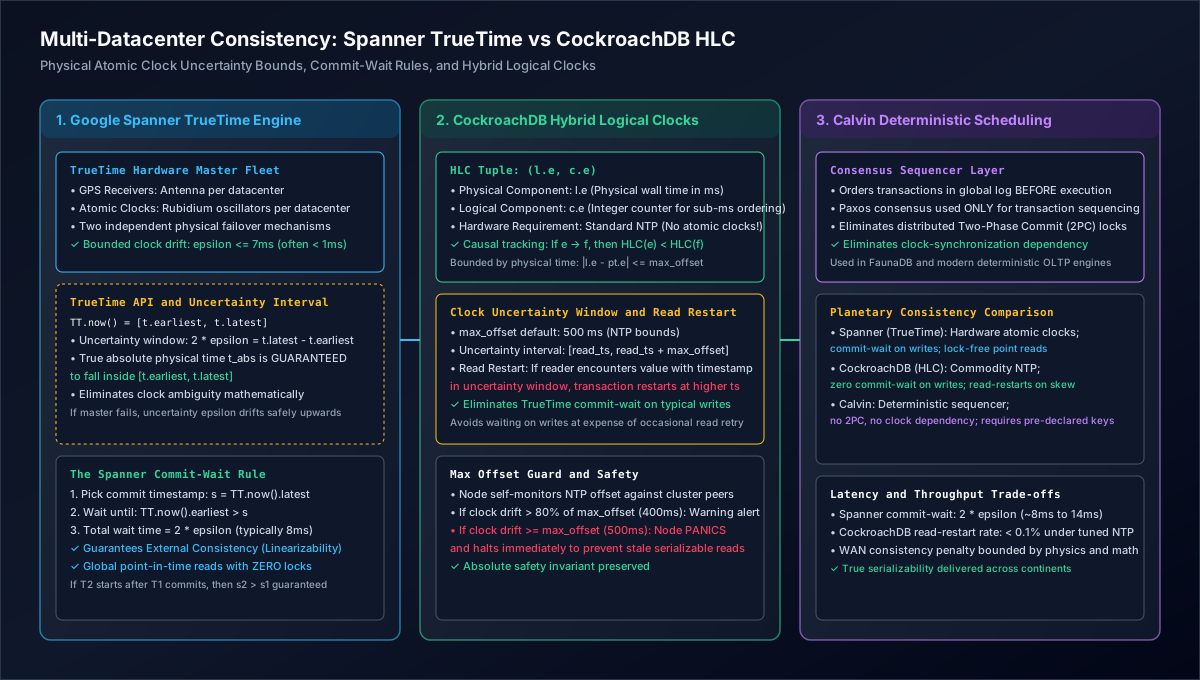
1. Google Spanner TrueTime Engine & TrueTime Hardware Master Fleet
Establishes the ingress and structural boundary across Google Spanner TrueTime Engine & TrueTime Hardware Master Fleet: GPS Receivers: Antenna per datacenter; Atomic Clocks: Rubidium oscillators per datacenter; Two independent physical failover mechanisms.
2. CockroachDB Hybrid Logical Clocks & HLC Tuple: (l.e, c.e)
Coordinates core data-plane execution and state transitions through CockroachDB Hybrid Logical Clocks & HLC Tuple: (l.e, c.e): Physical Component: l.e (Physical wall time in ms); Logical Component: c.e (Integer counter for sub-ms ordering); Hardware Requirement: Standard NTP (No atomic clocks!).
3. Calvin Deterministic Scheduling & Consensus Sequencer Layer
Enforces durability, state convergence, and output verification across Calvin Deterministic Scheduling & Consensus Sequencer Layer: Orders transactions in global log BEFORE execution; Paxos consensus used ONLY for transaction sequencing; Eliminates distributed Two-Phase Commit (2PC) locks.
Google Spanner is the world’s first globally distributed database to provide External Consistency (Linearizability): This guarantee enables global read-only transactions to read point-in-time snapshots across continents without taking any locks.
The TrueTime API: Representing Uncertainty
Instead of returning a single discrete integer timestamp, Spanner’s TrueTime API explicitly returns an uncertainty interval:
Where:
The true, absolute physical time is guaranteed to fall inside this interval:
In Google data centers, each facility hosts redundant Time Master daemons equipped with:
- GPS receivers with dedicated antennas on roofs.
- Rubidium atomic clocks that drift by less than if GPS signals are lost or jammed. Under normal operations, remains bounded between and .
                      Absolute Time t_abs
                              |
                     +--------+--------+
                     |                 |
       [---------------------*---------------------]
       t.earliest                                 t.latest
       <----------------- 2 * epsilon ------------>
The Spanner Commit-Wait Rule
To guarantee that transaction timestamps strictly mirror causal and physical reality:
- Assign Timestamp: When transaction prepares to commit, the coordinator acquires TrueTime:
- Commit-Wait: The coordinator refuses to release locks or acknowledge the client until TrueTime guarantees that the absolute time has passed :
- The Guarantee: By the time ‘s client receives confirmation that committed, physical time is strictly greater than .
- Therefore, any subsequent transaction that begins anywhere on Earth will observe: External consistency is mathematically proven.
The write latency cost is . In exchange, every read transaction in the world executes with zero distributed lock overhead.
3. CockroachDB Hybrid Logical Clocks (HLC)
Most organizations cannot install roof-mounted atomic clocks and GPS antennas in cloud environments (AWS, Azure, GCP). CockroachDB solves this by implementing Hybrid Logical Clocks (HLC) (Kulkarni et al., 2014) on standard Network Time Protocol (NTP).
The HLC State Tuple
An HLC timestamp consists of two components:
- : Physical component (reflecting physical wall time).
- : Logical counter component (capturing sub-millisecond causal events occurring within the same physical millisecond tick).
The HLC Update Protocol
When an event occurs locally on node , or when node receives a message from node with timestamp :
- Capture physical wall-clock time .
- Compute new physical component:
- Compute new logical component:
- If equals previous physical timestamps, increment counter: .
- If moved forward in physical time, reset counter: .
The Clock Uncertainty Window & Read-Restart
In CockroachDB, servers synchronize via NTP with a defined maximum allowable drift:
When a transaction executes a read at timestamp , it defines an uncertainty window:
If the reader encounters a value written with timestamp within this uncertainty window:
- The database cannot prove whether occurred before or after in physical reality.
- Rather than waiting out a commit-wait window on writes, CockroachDB executes a Read-Restart: the reading transaction restarts with its read timestamp bumped to , ensuring serializable safety.
4. Calvin: Deterministic Transaction Scheduling
An alternative planetary consistency architecture is Calvin (Thomson et al., Yale University):
- Instead of using physical or hybrid clocks with 2-Phase Commit locks, Calvin uses an independent consensus layer (Paxos / Raft) as an Active Sequencer.
- Transactions declare their read/write keys in advance.
- The sequencer packages transactions into global epoch batches and assigns a strict, deterministic sequence order across all nodes.
- Storage nodes execute transactions in lockstep based strictly on this pre-determined sequence.
- Result: Zero distributed 2PC commit locks; zero dependency on physical clock synchrony.
5. Mathematical Analysis: Commit-Wait vs. WAN Network Latency
In global databases, transaction latency is governed by two physical components:
For Google Spanner:
- = Intra-region Paxos round trip ().
- = Commit-wait duration ().
For CockroachDB:
- = Intra-region Raft round trip ().
- = Zero wait on write path (). (Reads occasionally pay a read-restart retry penalty if clock skew exceeds zero under high contention).
6. Practical Engineering Simulation: TrueTime Engine & CockroachDB HLC
This self-contained TypeScript simulation implements both the TrueTime commit-wait engine and the CockroachDB Hybrid Logical Clock with read-restart detection.
/**
 * Systems Notebook - TrueTime & CockroachDB HLC Simulation
 */

// -------------------------------------------------------------
// Part 1: Google Spanner TrueTime Simulator
// -------------------------------------------------------------
interface TrueTimeInterval {
  earliest: number;
  latest: number;
}

class SpannerTrueTimeEngine {
  constructor(private readonly epsilonMs: number = 4) {}

  public now(currentWallTimeMs: number): TrueTimeInterval {
    return {
      earliest: currentWallTimeMs - this.epsilonMs,
      latest: currentWallTimeMs + this.epsilonMs
    };
  }

  /**
   * Spanner Commit-Wait Rule:
   * 1. Pick commit timestamp s = TT.now().latest
   * 2. Wait until TT.now().earliest > s
   */
  public executeCommitWait(simulatedWallTimeMs: number): {
    commitTimestamp: number;
    requiredWaitMs: number;
    completedAtWallTimeMs: number;
  } {
    const t = this.now(simulatedWallTimeMs);
    const commitTimestamp = t.latest;

    // We must wait until earliest > commitTimestamp:
    // simulatedTime + wait - epsilon > commitTimestamp
    // wait > commitTimestamp - simulatedTime + epsilon = (simulatedTime + epsilon) - simulatedTime + epsilon = 2 * epsilon
    const requiredWaitMs = 2 * this.epsilonMs + 1;
    const completedAtWallTimeMs = simulatedWallTimeMs + requiredWaitMs;

    return {
      commitTimestamp,
      requiredWaitMs,
      completedAtWallTimeMs
    };
  }
}

// -------------------------------------------------------------
// Part 2: CockroachDB Hybrid Logical Clock (HLC)
// -------------------------------------------------------------
interface HLCTimestamp {
  physical: number; // l.e
  logical: number;  // c.e
}

class HybridLogicalClock {
  private l: number = 0; // Highest physical time seen
  private c: number = 0; // Logical counter
  public readonly maxOffsetMs: number;

  constructor(maxOffsetMs: number = 500) {
    this.maxOffsetMs = maxOffsetMs;
  }

  /**
   * Local Event Update
   */
  public tick(physicalWallTimeMs: number): HLCTimestamp {
    const prevL = this.l;
    this.l = Math.max(prevL, physicalWallTimeMs);

    if (this.l === prevL) {
      this.c++;
    } else {
      this.c = 0;
    }

    if (Math.abs(this.l - physicalWallTimeMs) > this.maxOffsetMs) {
      throw new Error(`FATAL: Clock offset ${Math.abs(this.l - physicalWallTimeMs)}ms exceeds max_offset ${this.maxOffsetMs}ms! Halting node.`);
    }

    return { physical: this.l, logical: this.c };
  }

  /**
   * Remote Message Receive Update (Kulkarni et al. HLC Algorithm):
   * l' = max(l, remoteL, pt)
   */
  public update(remoteL: number, remoteC: number, physicalWallTimeMs: number): HLCTimestamp {
    const prevL = this.l;
    this.l = Math.max(prevL, remoteL, physicalWallTimeMs);

    if (this.l === prevL && this.l === remoteL) {
      this.c = Math.max(this.c, remoteC) + 1;
    } else if (this.l === prevL) {
      this.c = this.c + 1;
    } else if (this.l === remoteL) {
      this.c = remoteC + 1;
    } else {
      this.c = 0;
    }

    if (Math.abs(this.l - physicalWallTimeMs) > this.maxOffsetMs) {
      throw new Error(`FATAL: Clock offset ${Math.abs(this.l - physicalWallTimeMs)}ms exceeds max_offset ${this.maxOffsetMs}ms! Halting node.`);
    }

    return { physical: this.l, logical: this.c };
  }

  /**
   * Check for Read-Restart Condition
   */
  public checkReadRestart(readTs: HLCTimestamp, writeTs: HLCTimestamp): boolean {
    // If write occurred at higher physical time within max_offset window
    if (writeTs.physical > readTs.physical && writeTs.physical <= readTs.physical + this.maxOffsetMs) {
      return true; // Uncertainty window collision: Must restart read!
    }
    return false;
  }
}

// -------------------------------------------------------------
// Verification Execution
// -------------------------------------------------------------
function runConsistencyDemo(): void {
  console.log('=== Step 1: Spanner TrueTime Commit-Wait Rule ===');
  const spanner = new SpannerTrueTimeEngine(4); // 4ms epsilon (8ms window)
  const virtualWallTime = 1700000000000;

  const result = spanner.executeCommitWait(virtualWallTime);
  console.log(`T1 Commit Timestamp Assigned: s = ${result.commitTimestamp}`);
  console.log(`Commit-Wait Duration: ${result.requiredWaitMs}ms`);
  console.log(`Locks released at: t = ${result.completedAtWallTimeMs}`);
  console.log('External consistency proven: Any future T2 starts strictly after s!');

  console.log('\n=== Step 2: CockroachDB Hybrid Logical Clock (HLC) ===');
  const hlc = new HybridLogicalClock(500); // 500ms max offset

  const e1 = hlc.tick(1700000000000);
  console.log('HLC Event 1:', e1);

  // Sub-millisecond consecutive event on same millisecond
  const e2 = hlc.tick(1700000000000);
  console.log('HLC Event 2 (Logical Counter Incremented):', e2);

  // Receive message from remote peer whose physical clock is 5ms ahead
  const e3 = hlc.update(1700000000005, 2, 1700000000000);
  console.log('HLC Event 3 (After Remote Message Receive):', e3);

  console.log('\n=== Step 3: HLC Read-Restart Detection ===');
  const readTimestamp: HLCTimestamp = { physical: 1700000000000, logical: 0 };
  const conflictingWrite: HLCTimestamp = { physical: 1700000000150, logical: 0 }; // 150ms ahead (within 500ms window)

  const mustRestart = hlc.checkReadRestart(readTimestamp, conflictingWrite);
  console.log(`Write timestamp in uncertainty window? [${mustRestart}]. Read-Restart triggered to prevent stale read!`);
}

runConsistencyDemo();
7. Observability & SRE Metrics
+-------------------------------------------------------------------------------+
|                       PLANETARY CONSISTENCY TELEMETRY                         |
+-------------------------------------------------------------------------------+
| Metric Indicator       | Metric Name / Source    | Alert Threshold & Action   |
+------------------------+-------------------------+----------------------------+
| TrueTime Uncertainty   | truetime_epsilon_ms     | Alert if epsilon > 7ms;    |
| (Spanner)              |                         | GPS antenna loss detected  |
| Commit-Wait Duration   | spanner_commit_wait_ms  | Alert if wait > 15ms;      |
|                        |                         | write latency degradation  |
| HLC Clock Drift Offset | clock_offset_nanos      | Alert if offset > 400ms;   |
| (CockroachDB)          |                         | panic threshold at 500ms!  |
| Read-Restart Rate      | txn_restart_count       | Alert if restart rate > 1%;|
|                        |                         | high clock skew contention |
+------------------------+-------------------------+----------------------------+
8. Comprehensive Architectural Summary
Planetary-scale data consistency is an engineering triumph over physical relativity and asynchronous networks:
- Google Spanner harnesses specialized atomic rubidium clocks and GPS receivers through the TrueTime API, executing the Commit-Wait rule () to provide globally linearizable transactions and lock-free snapshot reads.
- CockroachDB delivers serializable consistency on commodity hardware via Hybrid Logical Clocks (HLC), replacing physical wait intervals with logical event counters and safe read-restarts.
- Calvin represents the deterministic alternative, using consensus sequencers to pre-order transactions and eliminating both distributed 2PC locks and clock synchronization dependencies.
9. Design Alternatives & Global Clock Trade-Off Matrix
| Distributed Clock Mechanism | Hardware Dependency | Maximum Uncertainty () | Commit-Wait Penalty | Best Architectural Fit |
|---|---|---|---|---|
| TrueTime (Google Spanner) | GPS receivers + Atomic Rubidium clocks | Delays commit release by | Global enterprise databases with private datacenter hardware | |
| Hybrid Logical Clock (HLC) | Standard NTP on commodity servers | max offset | Read restart on uncertainty window | Multi-cloud and commodity hardware (CockroachDB, YugabyteDB) |
| Centralized Timestamp Oracle (TSO) | None (Single leader raft group) | Zero uncertainty (Monotonic integer) | 1 RTT to TSO leader on every txn start | Single-datacenter or low-latency WAN (TiDB / TiKV) |
| Vector Clocks | None | Variable per node | Zero wait, but array grows with cluster size | Partition-tolerant eventual consistency stores (Dynamo, Riak) |
10. Failure Modes, Clock Desynchronization & Recovery
- TrueTime GPS Antenna Failure: Spanner nodes fall back to local rubidium atomic clocks; drifts slowly up to dozens of milliseconds. Spanner transactions continue correctly but incur higher commit-wait latencies.
- NTP Asymmetric Routing Spike: If NTP network delay shifts suddenly, an HLC node may experience physical clock offset exceeding
max_offset(typically 500 ms). CockroachDB nodes detect this during inter-node heartbeats and voluntarily crash/evict themselves to prevent consistency anomalies. - Leap Second Insertion: Modern distributed systems use clock smearing (gradually stretching seconds over 24 hours) to prevent time-travel backward jumps that break monotonic assumptions.
11. Guided Design Exercises
Exercise 1 (Foundational — Spanner TrueTime Commit-Wait Overlap & GPS Holdover Drift)
- In Google Spanner, a single-shard write transaction acquires locks at real time on a Paxos leader whose TrueTime uncertainty is (and whose local clock happens to read , so ). If Paxos replication across the 3-AZ quorum takes , calculate ‘s assigned commit timestamp , how much of the commit-wait overlaps with Paxos replication, and the exact additional sleep delay before can release locks.
- Suppose a rooftop GPS antenna failure forces the datacenter onto Rubidium holdover oscillator drift of while time-master polling occurs every from a base . Compute the peak and resulting commit-wait before each poll.
Exercise 2 (Intermediate — CockroachDB HLC State Transitions & Read-Restart Window)
Node A and Node B run CockroachDB with max_offset = 250 ms.
- Trace the exact HLC tuples across the following sequence:
- Node A (wall clock ) executes a local write starting from HLC .
- Node A immediately executes a second local event at the same and sends an RPC carrying its HLC to Node B.
- Node B receives the RPC when Node B’s local NTP wall clock is lagging at (and Node B’s prior HLC was ).
- A read transaction starts on Node B at with uncertainty bound
max_offset = 250 msand scans a key on Node C that holds a committed value at and another key at . Explain how handles both keys!
Exercise 3 (Staff-Level — Global Read-Heavy vs. Write-Heavy Workload Architecture Selection)
A global fintech ledger executes multi-key snapshot reads and writes across 3 US regions (us-east, us-central, us-west, inter-region ). Compare total read and write latency under (a) Google Spanner TrueTime (), (b) CockroachDB HLC (max_offset = 250 ms, with of reads hitting a contended uncertainty restart), and (c) TiDB Centralized Timestamp Oracle (TSO) hosted in us-central.
View Reference Architecture & Worked Solutions (CORE-M24-002)
1. Worked Solution — Exercise 1 (Spanner TrueTime Commit-Wait Overlap & Drift Math)
- Part 1 — Overlapping Commit-Wait with Paxos Consensus:
- Timestamp Assignment: At (), the leader calls and assigns commit timestamp:
- Overlapped Paxos Replication: Instead of waiting first and replicating second, Spanner starts the commit-wait in parallel with the Paxos
Acceptbroadcast! - Remaining Wait After Paxos Commit: When Paxos replication completes later (), the leader checks . Since , the leader only needs to sleep for an additional (until ), making total commit latency rather than !
- Part 2 — Sawtooth Under Holdover Drift:
- Between time-master synchronizations every at drift rate :
- Consequently, the worst-case commit-wait window just before resynchronization is , and the time-averaged uncertainty across the sawtooth cycle is ().
2. Worked Solution — Exercise 2 (CockroachDB HLC Tuple Evolution & Read-Restart)
- Part 1 — Step-by-Step HLC Tuple Trace:
- Node A Local Event 1 (, prior ):
- . Because , logical counter resets to .
- Node A Local Event 2 (, prior ):
- . Because , logical counter increments to . Node A attaches to its outbound RPC.
- Node B Receives RPC (, prior , remote ):
- .
- Because , Node B adopts , pulling Node B’s HLC forward to causal parity with Node A despite Node B’s lagging physical clock! (Offset , so Node B stays healthy).
- Node A Local Event 1 (, prior ):
- Part 2 — Read-Restart Evaluation for with :
- The reader’s uncertainty interval is .
- Key 1 (): Lies inside the uncertainty window! Node C might simply have had a fast clock when committed before started in real time. To preserve linearizability, triggers a Read-Restart, bumping its read timestamp to and including Key 1 in its snapshot.
- Key 2 (): Lies strictly above . Even under maximum possible clock skew, Key 2 is guaranteed to have been written after started in real physical time, so safely ignores Key 2 (reads the prior MVCC version ) without restarting!
3. Worked Solution — Exercise 3 (Spanner vs. CockroachDB HLC vs. TiDB TSO Comparison)
- Google Spanner TrueTime ():
- Writes: (commit-wait is completely hidden inside the cross-region Paxos RTT!).
- Reads (95% of workload): Lock-free snapshot read at in locally (or to closest replica) with zero read-restarts.
- CockroachDB HLC (
max_offset = 250 ms, contended restarts):- Writes: (zero commit-wait).
- Reads: complete in 1 pass, while hit an uncertainty restart requiring an extra cross-region round trip (), increasing tail read latency to unless Closed Timestamps / Follower Reads are used.
- TiDB Centralized TSO (in
us-central):- Every transaction in
us-eastorus-westmust pay an extra WAN RTT to fetch a start timestamp fromus-centralbefore reading, plus another WAN RTT to fetch a commit timestamp during 2PC—making centralized TSO ideal inside a single low-latency region ( RTT) but expensive across multi-region WANs.
- Every transaction in
12. Authoritative References & Version Context
- James C. Corbett et al. (2012), “Spanner: Google’s Globally-Distributed Database”, ACM TOCS / OSDI ‘12 — usenix.org/conference/osdi12/technical-sessions/presentation/corbett
- Sandeep Kulkarni et al. (2014), “Logical Physical Clocks and Consistent Snapshots in Globally Distributed Databases”, Tech Report (Hybrid Logical Clock foundation) — cse.buffalo.edu/tech-reports/2014-04.pdf
- Cockroach Labs (2020), “Living Without Atomic Clocks: How CockroachDB Manages Time” — cockroachlabs.com/blog/living-without-atomic-clocks/
- Version Context: Clock synchronization mechanisms reflect Google Cloud Spanner current TrueTime specs and CockroachDB 23.x HLC implementation.