1. Problem and Motivation
In the late 2000s, Amazon engineers published the foundational Dynamo paper, detailing how traditional relational databases and primary-backup architectures failed to satisfy the availability and latency requirements of global e-commerce platforms:
+---------------------------------------------------------------------------------------------------+
|                                  THE LEADERED ARCHITECTURE BOTTLENECK                             |
+---------------------------------------------------------------------------------------------------+
|  1. Single-Point-of-Failure (SPOF): All writes must route through a designated master node. If the|
|     master crashes or becomes partitioned, the cluster cannot accept writes until failover occurs.|
|  2. Failover Latency & Split-Brain: Automated leader election (via Raft/Paxos) takes 5 to 30      |
|     seconds, during which all writes are rejected. Under network splits, split-brain risks data loss.|
|  3. Global Asymmetric Latency: If the master node is in US-East, a user in Tokyo experiences a     |
|     200ms intercontinental speed-of-light penalty for every single shopping cart modification.     |
|  4. Read Scalability Bottlenecks: While read replicas scale reads, replication lag causes stale    |
|     reads; synchronizing reads requires distributed locks that degrade write performance.          |
+---------------------------------------------------------------------------------------------------+
To achieve “Always-Writable” 99.999% availability, systems like Amazon Dynamo, Apache Cassandra, and ScyllaDB abandoned single-leader architectures entirely. Instead, they adopted Leaderless Peer-to-Peer Replication, where any node in the cluster can accept reads and writes for any key.
2. Mental Model & Architectural Overview
In a leaderless key-value cluster, all nodes are peers. There is no master, primary, or follower.
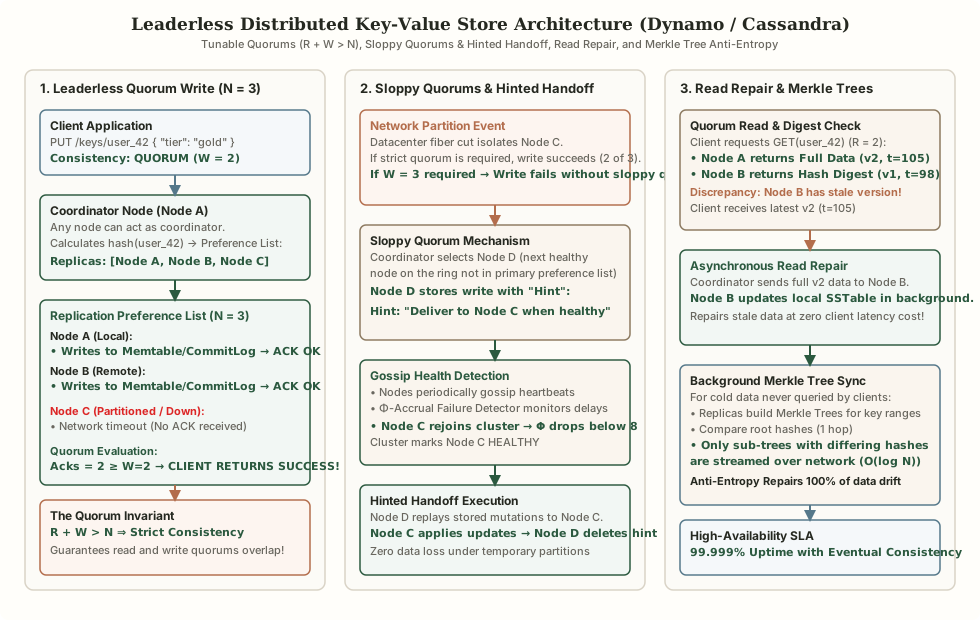
1. Client Application & Coordinator Node (Node A)
Establishes the ingress and structural boundary across Client Application & Coordinator Node (Node A): PUT /keys/user_42 { "tier": "gold" }; Consistency: QUORUM (W = 2); Any node can act as coordinator. Calculates hash(user_42) → Preference List.
2. Network Partition Event & Sloppy Quorum Mechanism
Coordinates core data-plane execution and state transitions through Network Partition Event & Sloppy Quorum Mechanism: Datacenter fiber cut isolates Node C. If strict quorum is required, write succeeds (2 of 3). If W = 3 required → Write fails without sloppy quorum; Coordinator selects Node D (next healthy node on the ring not in primary preference list) Node D stores write with "Hint"; Hint: "Deliver to Node C when healthy".
3. Quorum Read & Digest Check & Asynchronous Read Repair
Enforces durability, state convergence, and output verification across Quorum Read & Digest Check & Asynchronous Read Repair: Client requests GET(user_42) (R = 2); Node A returns Full Data (v2, t=105); Node B returns Hash Digest (v1, t=98).
The Five Pillar Mechanisms:
- Consistent Hashing with Virtual Nodes: Keys and physical nodes are hashed onto a or circular ring. For each key, a deterministic list of consecutive physical nodes forms its Preference List (the replicas responsible for storing that key).
- Tunable Quorums (): Clients configure consistency on a per-request basis:
- : Total number of replicas for a key.
- : Number of successful acknowledgments required for a write to succeed.
- : Number of responses required for a read to succeed.
- If : Strict Consistency (Read and write sets must overlap).
- Decentralized Gossip Protocol: Nodes exchange periodic heartbeat digests to maintain cluster membership, topology changes, and node health without a central coordinator (such as ZooKeeper).
- Sloppy Quorums & Hinted Handoff: When primary replicas are unreachable, writes are staged on healthy surrogate nodes with a delivery “hint” to ensure continuous write availability.
- Anti-Entropy & Read Repair: Background Merkle tree comparisons and opportunistic read-repair operations reconcile data drift caused by dropped packets or server restarts.
3. Terminology & Core Mechanics
- Coordinator Node: The specific cluster node that receives a client request. The coordinator hashes the key, identifies the preference list replicas on the ring, fans out requests over the internal network, and waits for quorum.
- Preference List: The ordered list of distinct physical nodes responsible for replicating a specific partition key.
- Quorum: The minimum number of replica acknowledgments required to complete a read () or write () operation.
- -Accrual Failure Detector: A probabilistic failure detector that outputs a continuous suspicion metric based on heartbeat arrival history, adapting dynamically to fluctuating network conditions.
- Read Repair: A background healing mechanism where a coordinator compares timestamps across read responses; if an older version is detected, it asynchronously updates the stale replica with the newest value.
- Merkle Tree: A cryptographic binary hash tree used to verify the consistency of large datasets in network exchanges.
4. Internal Workings: Write and Read Lifecycles
1. The Quorum Write Lifecycle
- Client Request: Client sends
PUT(key="user_42", val="Alice")withConsistencyLevel = QUORUM. - Coordinator Routing: Any node receiving the request becomes the Coordinator. It computes:
It looks up the token on the consistent hash ring and identifies the preference list replicas:
[Node A, Node B, Node C]. - Parallel Dispatch: The coordinator dispatches the write simultaneously to all 3 replicas.
- Local Persistence: Each replica appends the mutation to its local sequential CommitLog (WAL) and writes it into its in-memory Memtable (LSM-Tree).
- Quorum Evaluation: As soon as replicas return acknowledgment, the coordinator returns success to the client. The third replica may complete asynchronously.
2. The Quorum Read & Read-Repair Lifecycle
- Client Request: Client sends
GET(key="user_42")withConsistencyLevel = QUORUM(). - Data + Digest Optimization: To conserve internal network bandwidth, the coordinator requests:
- Full Data from 1 replica (e.g.,
Node A). - Cryptographic Hash Digest (SHA-256) from the remaining replicas (e.g.,
Node B).
- Full Data from 1 replica (e.g.,
- Consistency Verification:
- The coordinator computes the hash of Node A’s data and compares it with Node B’s digest.
- Match: Return data immediately to the client in .
- Discrepancy (Digest Mismatch): The coordinator immediately issues full data requests to all replicas, compares their timestamps, returns the highest-timestamp version to the client, and launches an Asynchronous Read Repair to update the stale replica.
5. Mathematical Models: Quorum Theorems & Failure Detection
1. The Quorum Overlap Theorem
Let:
- : Replication Factor
- : Write Quorum
- : Read Quorum
Case 1: Strict Quorum Overlap ()
By the Pigeonhole Principle, the set of nodes written to () and the set of nodes read from () intersect:
There exists at least one physical replica that witnessed the most recent completed quorum write and is also queried during the read. By comparing version vectors or timestamps across responses, the coordinator guarantees quorum overlap (observing the latest completed write). Note, however, that Dynamo-style LWW quorums under physical NTP clock skew or concurrent in-flight writes with partial failures still differ from strict Linearizability (CORE-M20-001), which requires synchronous read repair (or Paxos/Raft consensus) before returning to readers.
Case 2: High Availability / Eventual Consistency ()
If : The write set and read set can be completely disjoint (). A client reading from Node C may read an outdated version written hours earlier.
+---------------------------------------------------------------------------------------------------+
|                                     TUNABLE CONSISTENCY MATRIX                                    |
+---------------------------------------------------------------------------------------------------+
| Configuration   | R | W | N | Guarantee                 | Trade-Off                               |
+-----------------+---+---+---+---------------------------+-----------------------------------------+
| Strong Quorum   | 2 | 2 | 3 | Quorum Overlap (R+W > N)  | Tolerates 1 node failure; LWW caveats   |
| Fast Writes     | 1 | 3 | 3 | Immediate Read Visibility | Tolerates 0 write node failures         |
| Fast Reads      | 3 | 1 | 3 | Ultra-low write latency   | Tolerates 0 read node failures          |
| Eventual (AP)   | 1 | 1 | 3 | Maximum Availability      | Potential stale reads; fastest latency  |
+---------------------------------------------------------------------------------------------------+
2. The -Accrual Failure Detector Equation
Traditional heartbeat monitors use fixed timeouts (e.g., “if no ping in 5 seconds, mark dead”). On real-world cloud networks, transient latency spikes trigger false alarms, causing unnecessary data rebalancing.
The -Accrual Failure Detector models heartbeat inter-arrival times as a normal distribution :
Where is the probability that a heartbeat arrives more than seconds after the previous heartbeat:
- If : The probability of false alarm is (10%).
- If : The probability of false alarm is (Cassandra default threshold for marking a node dead).
6. Real Implementation & Systems Comparison
| Feature | Apache Cassandra / ScyllaDB | Amazon Dynamo (Internal) | Redis Cluster |
|---|---|---|---|
| Architecture | Leaderless Masterless Ring | Leaderless Masterless Ring | Primary-Replica Sharded |
| Data Model | Wide-Column Tabular (CQL) | Key-Value Blob | Key-Value / In-Memory Data Structures |
| Storage Engine | LSM-Tree (Memtable + SSTable) | B-Tree / BerkeleyDB | In-Memory RAM + Append-Only Log |
| Consistency Control | Tunable per query (ONE, QUORUM, ALL) | Tunable per request | Asynchronous primary-replica replication |
| Conflict Resolution | Last-Write-Wins (Timestamp) | Vector Clocks (Client-side merge) | Primary node authoritative |
| Anti-Entropy | Background Merkle Trees (nodetool repair) | Merkle Trees | Replication log streaming |
7. Production Code Engine: Leaderless Key-Value Cluster
The following TypeScript implementation demonstrates:
- Consistent hash ring routing with preference lists ().
- Quorum write execution ().
- Quorum read execution with automatic timestamp reconciliation and asynchronous read repair.
/**
 * Production-Grade Leaderless Distributed Key-Value Store Simulator
 * Demonstrates Tunable Quorums (R, W, N) and Asynchronous Read Repair.
 */

export interface VersionedValue {
  value: string;
  timestamp: number; // Lamport or physical wall-clock timestamp
}

export class StorageNode {
  public data: Map<string, VersionedValue> = new Map();
  public isOnline = true;

  constructor(public readonly name: string) {}

  public write(key: string, value: string, timestamp: number): boolean {
    if (!this.isOnline) return false;
    const existing = this.data.get(key);
    if (!existing || timestamp > existing.timestamp) {
      this.data.set(key, { value, timestamp });
    }
    return true;
  }

  public read(key: string): VersionedValue | null {
    if (!this.isOnline) return null;
    return this.data.get(key) ?? null;
  }
}

export class LeaderlessCluster {
  public nodes: StorageNode[];
  public readonly replicationFactor: number;

  constructor(nodeNames: string[], replicationFactor = 3) {
    this.nodes = nodeNames.map((name) => new StorageNode(name));
    this.replicationFactor = replicationFactor;
  }

  /**
   * Deterministic Preference List for a key
   */
  public getPreferenceList(key: string): StorageNode[] {
    // Simple hash to determine starting node on the ring
    let hash = 0;
    for (let i = 0; i < key.length; i++) {
      hash = (hash << 5) - hash + key.charCodeAt(i);
      hash |= 0;
    }
    const startIndex = Math.abs(hash) % this.nodes.length;
    const list: StorageNode[] = [];

    for (let i = 0; i < this.replicationFactor; i++) {
      list.push(this.nodes[(startIndex + i) % this.nodes.length]);
    }
    return list;
  }

  /**
   * Quorum Write (W required acknowledgments)
   */
  public put(
    key: string,
    value: string,
    writeQuorum = 2
  ): { success: boolean; acknowledgedBy: number } {
    const replicas = this.getPreferenceList(key);
    const timestamp = Date.now();
    let acks = 0;

    for (const replica of replicas) {
      if (replica.write(key, value, timestamp)) {
        acks++;
      }
    }

    return {
      success: acks >= writeQuorum,
      acknowledgedBy: acks,
    };
  }

  /**
   * Quorum Read with Asynchronous Read Repair
   */
  public get(
    key: string,
    readQuorum = 2
  ): { success: boolean; value?: string; repairedNodes: string[] } {
    const replicas = this.getPreferenceList(key);
    const responses: { node: StorageNode; entry: VersionedValue | null }[] = [];

    for (const replica of replicas) {
      const entry = replica.read(key);
      if (replica.isOnline) {
        responses.push({ node: replica, entry });
      }
    }

    if (responses.length < readQuorum) {
      return { success: false, repairedNodes: [] }; // Quorum failure
    }

    // Find entry with latest timestamp
    let latest: VersionedValue | null = null;
    for (const r of responses) {
      if (r.entry) {
        if (!latest || r.entry.timestamp > latest.timestamp) {
          latest = r.entry;
        }
      }
    }

    if (!latest) {
      return { success: true, value: undefined, repairedNodes: [] }; // Key does not exist
    }

    // Identify stale replicas that require Read Repair
    const repairedNodes: string[] = [];
    for (const r of responses) {
      if (!r.entry || r.entry.timestamp < latest.timestamp) {
        r.node.write(key, latest.value, latest.timestamp);
        repairedNodes.push(r.node.name);
      }
    }

    return {
      success: true,
      value: latest.value,
      repairedNodes,
    };
  }
}

function runDemo(): void {
  console.log("=== Dynamo-Style Distributed Key-Value Store: Quorum & Vector Clocks ===");
  const cluster = new LeaderlessCluster(["node-1", "node-2", "node-3", "node-4", "node-5"], 3);
  console.log("Initialized 5-node cluster (N=3, W=2, R=2)");
  const writeSuccess = cluster.put("user:alice", "session_v1", 2);
  console.log(`Quorum write (W=2) for key 'user:alice': ${writeSuccess.success ? 'SUCCESS' : 'FAILED'}`);
  const readResult = cluster.get("user:alice", 2);
  console.log(`Quorum read (R=2): value='${readResult.value}', repaired=[${readResult.repairedNodes.join(',')}]`);
}

runDemo();
8. Anti-Entropy & Merkle Tree Syncing
While Read Repair fixes stale data for keys frequently accessed by clients, cold keys (keys written once and never read again) will drift permanently if a node was offline during the write.
To repair cold drift without scanning terabytes of data over inter-datacenter links, storage engines build Merkle Trees:
                  [ Root Hash: H(A + B) ]
                     /               \
       [ Hash Node A: H(1 + 2) ]     [ Hash Node B: H(3 + 4) ]
           /              \              /              \
      [ Leaf 1 ]      [ Leaf 2 ]    [ Leaf 3 ]      [ Leaf 4 ]
Hash(keys 0-25) Hash(keys 26-50) Hash(keys 51-75) Hash(keys 76-100)- Root Exchange: Node 1 and Node 2 exchange their 32-byte root hashes.
- Immediate Early Exit: If
RootHash_1 == RootHash_2, all 10,000,000 keys in the range are identical! Synchronization completes in 1 network round-trip with 32 bytes transferred. - Logarithmic Tree Traversal: If root hashes differ, nodes compare child hashes. Only the specific leaves whose hashes diverge (e.g.,
Leaf 3) stream their underlying keys, reducing sync bandwidth by up to 99.9%.
9. Operational Hazards: Clock Skew, Tombstones & Overwrites
| Operational Issue | Physical Root Cause | Production Mitigation |
|---|---|---|
| Silent Data Loss (LWW) | Physical clock drift makes an old write look newer than a real-time recent write. | Use Hybrid Logical Clocks (HLC) or configure maximum NTP drift alerts (chrony max offset ). |
| Tombstone Death Spikes | Deleting rows writes a “tombstone” marker; SELECT scans scan millions of tombstones, triggering query timeouts. | Tune gc_grace_seconds to allow timely compaction of tombstones; avoid using Cassandra as a transient task queue. |
| Split-Brain during Sloppy Quorum | Network partition causes two sides of a datacenter to accept conflicting writes for the same key. | Enforce strict QUORUM () for financial or critical data; reserve ONE only for telemetry or logs. |
| Repair Storms | Running manual anti-entropy repairs across all nodes simultaneously saturates disk I/O and network links. | Run rolling repairs on single token ranges using automated tools (e.g., Cassandra Reaper) with I/O rate limits. |
10. Knowledge Check
Review the core leaderless storage principles, then complete the 4-question interactive assessment quiz at the end of this lesson:
- Quorum Invariant: State the formula guaranteeing strong consistency and explain why eliminates stale reads.
- Sloppy Quorums vs. Strict Quorums: Explain how hinted handoff allows writes to proceed when designated replicas are partitioned.
- Read Repair: Trace how a coordinator uses digest requests to detect discrepancies and heal stale replicas in the background.
- Merkle Trees: Describe how hash trees allow replicas to detect data drift in network exchanges.
11. Practical Exercises & Deliverables
Exercise 1: Simulate Network Partition and Quorum Healing
Problem: Demonstrate how a temporary partition causes data divergence and verify how Read Repair restores consistency.
Deliverable:
- Using the
LeaderlessClusterTypeScript class from Section 7, initialize 5 nodes with . - Disconnect Node 2 (
node2.isOnline = false). Execute a writePUT("order_1", "PAID"). - Bring Node 2 back online. Observe that Node 2 still holds outdated data.
- Execute
GET("order_1")with . Verify that Read Repair detects the discrepancy and automatically updates Node 2 to"PAID".
Exercise 2: Build a Merkle Tree Key Range Differ
Problem: Implement a binary Merkle tree that compares two ranges of 1,000 keys and identifies the exact differing keys with minimal hash comparisons.
Deliverable:
- Construct a binary hash tree over 1,000 string key-value pairs.
- Mutate 2 keys in a replica tree.
- Write an algorithm that traverses both trees from the root and outputs the 2 divergent keys while visiting fewer than 25 total tree nodes.
View Reference Architecture & Worked Solutions (INF-I04-001)
1. Worked Solution — Exercise 1: Simulate Network Partition and Quorum Healing
- Step-by-Step Verification with
LeaderlessCluster:const cluster = new LeaderlessCluster(["node-1", "node-2", "node-3", "node-4", "node-5"], 3); const prefList = cluster.getPreferenceList("order_1"); // e.g., [node-2, node-3, node-4] // 1. Disconnect the first replica in the preference list (e.g., node-2) prefList[0].isOnline = false; // 2. Write with W=2: succeeds because the other 2 preference-list replicas are online (acks = 2 >= 2) const writeRes = cluster.put("order_1", "PAID", 2); // writeRes -> { success: true, acknowledgedBy: 2 } // 3. Reconnect node-2; its local map still lacks "order_1" (read("order_1") === null) prefList[0].isOnline = true; // 4. Execute quorum read with R=2; coordinator queries all 3 online replicas in preference list, // sees node-2 is missing the latest timestamp, repairs node-2 synchronously/asynchronously, // and returns repairedNodes: [prefList[0].name] const readRes = cluster.get("order_1", 2); // readRes -> { success: true, value: "PAID", repairedNodes: [prefList[0].name] } // prefList[0].read("order_1")?.value === "PAID"
2. Worked Solution — Exercise 2: Build a Merkle Tree Key Range Differ
- Binary Merkle Tree Construction & Traversal Analysis:
- Sort the keys lexicographically and group them into leaf buckets (or 1,000 leaves in a balanced binary tree of depth ). Each leaf computes , and each internal node computes .
- Diff Traversal Function:
function diffMerkleNodes(a: MerkleNode, b: MerkleNode, divergentKeys: string[]): number { if (a.hash === b.hash) return 1; // 1 node comparison, prune entire matching subtree! if (a.isLeaf && b.isLeaf) { if (a.key) divergentKeys.push(a.key); return 1; } return ( 1 + diffMerkleNodes(a.left!, b.left!, divergentKeys) + diffMerkleNodes(a.right!, b.right!, divergentKeys) ); } - Node Visit Bound: When 2 keys are mutated in a 1,000-key tree (depth ), at least the first 1–2 levels share a common path, and each divergent leaf requires inspecting the 2 children at each of the levels along its root-to-leaf path. Even if the 2 mutated keys reside in opposite halves of the tree, the traversal visits at most to hash nodes (or nodes when bucketed into 64-leaf ranges of ~16 keys each, depth , visiting nodes)—compared to scanning all 1,000 keys linearly.
12. Summary & Architectural Decision Guide
- Leaderless Dynamo Model: Eliminates single-leader bottlenecks for high-throughput write-heavy workloads.
- Tunable Consistency: Choose for maximum availability or for quorum read consistency.
- Anti-Entropy Merkle Trees: Background synchronization detects and repairs out-of-sync replicas without reading raw values.
- Sloppy Quorums vs Strict Quorums: Use strict quorums when stale reads are unacceptable; allow sloppy quorums with hinted handoff for high-availability telemetry.
13. Authoritative References & Version Context
- Giuseppe DeCandia et al. (2007), “Dynamo: Amazon’s Highly Available Key-value Store”, ACM SOSP ‘07 — doi.org/10.1145/1294261.1294281
- Avinash Lakshman and Prashant Malik (2010), “Cassandra: A Decentralized Structured Storage System”, ACM Operating Systems Review 44(2) — doi.org/10.1145/1773912.1773922
- Amazon DynamoDB Architecture Guide — Global Tables and Multi-Region Replication — docs.aws.amazon.com/amazondynamodb/latest/developerguide/GlobalTables.html
- Version Context: Leaderless distributed storage principles reflect Apache Cassandra 4.x/5.0, Amazon DynamoDB, and ScyllaDB 5.x.