1. The Problem & Why It Matters
As software systems grow from small prototypes into enterprise platforms, they encounter predictable architectural decay:
- The Big Ball of Mud: Code that started with neat folders slowly entangles. The payment module directly queries shipping tables, user entities import database connection pools, and changing a column type in an SQL migration breaks unrelated background reporting scripts.
- Global Blast Radiuses: In a unified global microservice cluster, a single bad deployment or poison-pill query saturates the primary database, taking down 100% of customers across the globe simultaneously.
- Write/Read Contention: Highly transactional database models optimized for ACID updates become unusable for complex search dashboards, causing read queries to lock out write transactions.
Establishing resilient systems requires disciplined Architectural Styles: isolating domain rules with Hexagonal Architecture, decoupling read and write paths with CQRS, and bounding failure blast radiuses with Cell-Based Architectures.
2. Intuitive Mental Model
The Electrical Adapter Mental Model (Hexagonal Architecture)
Imagine your laptop power charger:
- The laptop (the Domain) requires 20V DC power. It does not care whether the electricity came from a coal plant, a solar farm, or a nuclear reactor.
- When traveling to the UK, you do not rewrite your laptop’s motherboard. You simply plug a UK physical plug adapter (the Driven Adapter) into the wall socket (the Port).
- Hexagonal architecture designs software like your laptop: core business rules remain untouched whether data comes from an HTTP REST call, a CLI command, or an automated test mock.
The Submarine Compartment Model (Cell-Based Architecture)
A submarine does not have one giant open room inside its hull. It is divided into watertight compartments separated by steel bulkheads. If a torpedo punctures compartment 3, doors seal automatically. Compartment 3 floods, but the submarine does not sink.
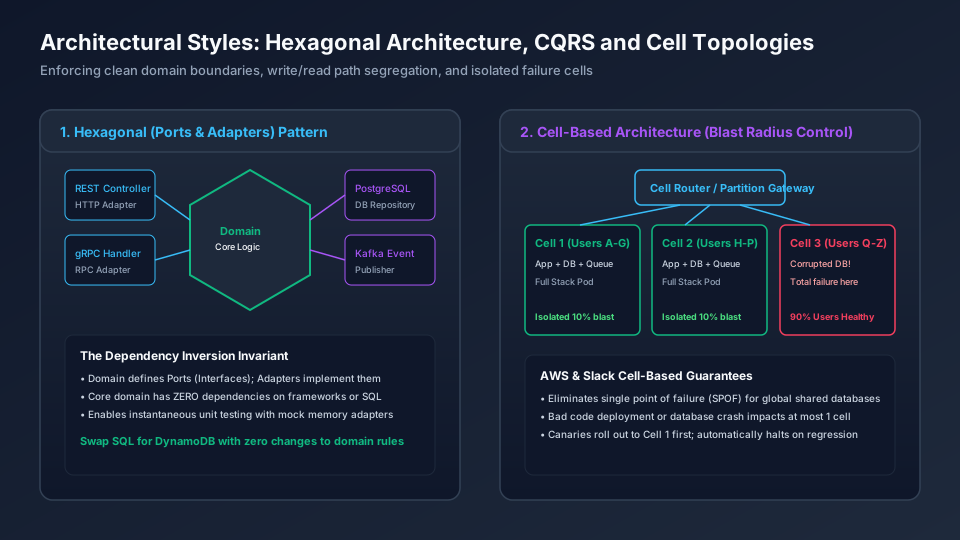
1. REST Controller & gRPC Handler
Establishes the ingress and structural boundary across REST Controller & gRPC Handler: HTTP Adapter; RPC Adapter; DB Repository.
2. Cell Router / Partition Gateway & Cell 1 (Users A-G)
Coordinates core data-plane execution and state transitions through Cell Router / Partition Gateway & Cell 1 (Users A-G): App + DB + Queue Full Stack Pod Isolated 10% blast; Corrupted DB! Total failure here 90% Users Healthy.
3. AWS & Slack Cell-Based Guarantees
Enforces durability, state convergence, and output verification across AWS & Slack Cell-Based Guarantees: Eliminates single point of failure (SPOF) for global shared databases; Bad code deployment or database crash impacts at most 1 cell; Canaries roll out to Cell 1 first; automatically halts on regression.
3. Architectural Mechanisms & Concrete Topologies
3.1 Domain-Driven Design (DDD) Bounded Contexts
In DDD Strategic Design, a large business domain is segmented into distinct Bounded Contexts:
- In the Sales Context, an
Accountrepresents a prospective lead with sales funnel stages and pipeline revenue. - In the Billing Context, an
Accountrepresents a credit card token, invoicing address, and net-30 payment terms. - In the Support Context, an
Accountrepresents open Zendesk tickets and SLA priority. Attempting to force these three disparate concepts into a single sharedaccountsdatabase table creates unmaintainable schema bloat. Each bounded context maintains its own private data models and communicates across explicit anti-corruption layers.
3.2 Cell-Based Architecture Topology
Instead of scaling one monolithic cluster to 100 million users:
- The user base is partitioned into independent Cells (e.g. 20 cells, each hosting 5% of users).
- Each cell contains an autonomous, complete deployment of all services, databases, and message brokers.
- A lightweight, stateless Cell Router at the edge inspects the user token or organization ID and proxies the request to the user’s assigned cell.
                    [ Edge Cell Router / DNS ]
                     /          |          \
                    /           |           \
           [ Cell 1 ]      [ Cell 2 ]     [ Cell 3 ]
         (Users A-G)      (Users H-P)    (Users Q-Z)
         +---------+      +---------+    +---------+
         | App Pod |      | App Pod |    | App Pod |
         | Relational DB  | Relational DB| Relational DB
         | Message Queue  | Message Queue| Message Queue
         +---------+      +---------+    +---------+
4. Formal Mathematical Derivations
4.1 Cell Blast Radius & Availability Formula
Let a system suffer a critical defect with catastrophic failure probability . Let the system be partitioned into independent, decoupled cells. Let total user population be .
-
Impacted Population per Failure: For cells, a catastrophic failure impacts strictly 5% of users.
-
System Availability Multiplier: In a single global cluster (), an outage drops global availability to 0%. In a cell architecture, assuming failures are independent and cell routers remain available: If Cell 4 is down for 1 hour, the platform still delivers 95% effective global uptime during that hour!
5. Edge Cases, Failure Modes & Distributed Anomalies
5.1 The Cross-Cell Entity Dilemma
What happens in a cell-based social network if User Alice (in Cell 1) sends a message to User Bob (in Cell 14)? If Cell 1 directly opens a TCP connection to Cell 14’s database, the failure isolation invariant is shattered: a database lock in Cell 14 can cascade backward into Cell 1! The Invariant: Cells never talk directly to other cell databases. Cross-cell interactions must pass through an asynchronous global event backbone (e.g. Kafka or SQS) via the Transactional Outbox pattern.
5.2 Eventual Consistency Drift in CQRS Read Models
In CQRS, the write model commits to an SQL database, which asynchronously emits events to update Elasticsearch or Redis read projections.
If a user submits an update (POST /profile) and immediately reloads the page (GET /profile), the read projection may lag by 50ms, showing stale old data.
Remediation: Implement Read-Your-Own-Writes consistency: clients pass the latest written monotonic version or read directly from the write primary for 5 seconds after a mutation.
6. Open-Source Architectural Studies
6.1 AWS: Cellular Architecture in Route 53 & S3
Amazon Web Services constructs critical infrastructure using cell architecture. Route 53 DNS is divided into independent cellular data planes. An internal control-plane bug or deployment issue can at most impact a single cell, ensuring AWS never suffers a simultaneous global multi-region blackout.
6.2 Slack: Cell-Based Migration
As Slack expanded, single MySQL database clusters hosting multiple large enterprise workspaces began hitting replication limits. Slack re-architected its infrastructure into Cells: each enterprise customer is assigned to an isolated cell containing web servers, job runners, and database shards. A runaway bot script in one enterprise cannot impact any other company.
7. Production Incident Post-Mortem (War Stories)
The Global Schema Migration Lockout
Context: A multi-tenant SaaS provider operated a single global PostgreSQL database for 40,000 corporate clients.
The Incident: A developer ran an ALTER TABLE organizations ADD COLUMN status VARCHAR DEFAULT 'ACTIVE'; migration without CONCURRENTLY.
The Disaster: PostgreSQL acquired an exclusive ACCESS EXCLUSIVE table lock on the organizations table. All 40,000 companies were locked out. Ingress HTTP requests backed up, connection pools on 250 microservices saturated, and the entire global platform collapsed for 42 minutes.
The Architectural Remediation: Migrated the platform into a Cell-Based Architecture with 10 cells. Future schema migrations are run on Cell 1 first as an automated canary; even a locking failure is quarantined to 10% of customers, and canaries are automatically aborted.
8. Production-Grade TypeScript Simulation: Hexagonal Domain & Cell Router
/**
 * Production Architecture Simulation: Hexagonal Architecture & Cell Router
 */

// --- 1. HEXAGONAL ARCHITECTURE (Ports & Domain) ---

export interface Order {
  id: string;
  userId: string;
  amountCents: number;
}

// DRIVEN PORT: Pure interface defined by the domain
export interface OrderRepositoryPort {
  save(order: Order): Promise<void>;
  findById(id: string): Promise<Order | null>;
}

// CORE DOMAIN SERVICE: Zero dependencies on frameworks or SQL!
export class OrderDomainService {
  private readonly repo: OrderRepositoryPort;

  constructor(repo: OrderRepositoryPort) {
    this.repo = repo;
  }

  public async createOrder(orderId: string, userId: string, amountCents: number): Promise<Order> {
    if (amountCents <= 0) {
      throw new Error("ORDER_VALIDATION_ERROR: Order amount must be positive");
    }
    const order: Order = { id: orderId, userId, amountCents };
    await this.repo.save(order);
    return order;
  }
}

// IN-MEMORY ADAPTER: Implements Port for instant unit testing
export class InMemoryOrderAdapter implements OrderRepositoryPort {
  private store = new Map<string, Order>();

  public async save(order: Order): Promise<void> {
    this.store.set(order.id, { ...order });
  }

  public async findById(id: string): Promise<Order | null> {
    return this.store.get(id) ?? null;
  }
}

// --- 2. CELL-BASED ARCHITECTURE ROUTER ---

export interface CellInstance {
  cellId: number;
  isHealthy: boolean;
  orderService: OrderDomainService;
}

export class CellRouter {
  private cells: CellInstance[] = [];

  constructor(cellCount: number) {
    for (let i = 0; i < cellCount; i++) {
      this.cells.push({
        cellId: i,
        isHealthy: true,
        orderService: new OrderDomainService(new InMemoryOrderAdapter()),
      });
    }
  }

  public routeUserToCell(userId: string): CellInstance {
    // Deterministic hash to cell
    let hash = 0;
    for (let i = 0; i < userId.length; i++) {
      hash = (hash * 31 + userId.charCodeAt(i)) >>> 0;
    }
    const cellIndex = hash % this.cells.length;
    return this.cells[cellIndex];
  }

  public simulateCellFailure(cellId: number): void {
    this.cells[cellId].isHealthy = false;
  }

  public getClusterHealth(): { totalCells: number; healthyCells: number } {
    return {
      totalCells: this.cells.length,
      healthyCells: this.cells.filter((c) => c.isHealthy).length,
    };
  }
}

// Verification Routine
export async function runArchitectureSimulation() {
  console.log("=== 1. Hexagonal Domain Invariant Verification ===");
  const memoryAdapter = new InMemoryOrderAdapter();
  const domain = new OrderDomainService(memoryAdapter);

  const order = await domain.createOrder("ord-101", "user-42", 7500);
  console.log("Domain created order with pure in-memory port:", order);

  console.log("\n=== 2. Cell-Based Architecture Blast Radius Verification ===");
  const router = new CellRouter(10); // 10 cells -> 10% blast radius per cell

  // Simulate Cell 3 crashing
  router.simulateCellFailure(3);

  const testUsers = ["user-alpha", "user-beta", "user-gamma", "user-delta", "user-epsilon"];
  let impactedCount = 0;

  for (const u of testUsers) {
    const cell = router.routeUserToCell(u);
    if (!cell.isHealthy) {
      impactedCount++;
      console.log(`User ${u} routed to Cell ${cell.cellId} -> IMPACTED by isolated outage`);
    } else {
      console.log(`User ${u} routed to Cell ${cell.cellId} -> HEALTHY (Serving normal traffic)`);
    }
  }

  const health = router.getClusterHealth();
  console.log(`Cluster Health: ${health.healthyCells}/${health.totalCells} cells online (90% availability)`);
}

runArchitectureSimulation();
9. Operational Checklist, Failure Runbooks & Architectural Rules
Hexagonal Architecture Design Rules
- The Inversion Test: The domain folder must contain zero imports from external packages (no Express, no Prisma, no Kafka, no AWS SDK).
- Ports as Pure Interfaces: Always define ports using pure TypeScript interfaces or abstract classes.
10. Guided Applied System Design Exercises & Debugging Drills
Drill 1: Strangler Fig Gateway Migration
A 15-year-old monolithic application handles customer orders, billing, and shipping in a single 2-million-line PHP application.
- Design an Envoy proxy ingress topology to execute the Strangler Fig pattern.
- Outline how you route 5% of order creation calls to a new Go microservice while maintaining shared session authentication.
Drill 2: Cell Partition Key Selection
You are designing a cell-based architecture for a collaborative document editor like Google Docs or Figma.
- Evaluate whether to partition cells by
user_id,organization_id, ordocument_id. - Analyze the cross-cell collaboration penalty for each choice.
View Reference Architecture & Worked Solutions (CORE-M16-001)
1. Worked Solution — Drill 1: Strangler Fig Gateway Migration (PHP Monolith Go Order Service)
-
Envoy Ingress Proxy Topology & Weighted Canary Routing ():
- Place an Envoy API Gateway at the ingress edge so all client traffic (
https://api.example.com/*) terminates at Envoy before reaching either the PHP monolith or extracted microservices. - Configure a route matcher for
POST /v1/ordersusing Envoy’sweighted_clusterswhile routing/v1/billing/*and/v1/shipping/*tophp_monolith_cluster:
routes: - match: { prefix: "/v1/orders", headers: [{ name: ":method", exact_match: "POST" }] } route: weighted_clusters: clusters: - { name: php_monolith_cluster, weight: 95 } - { name: go_orders_service, weight: 5 } - match: { prefix: "/" } route: { cluster: php_monolith_cluster }- Data Synchronization Anti-Corruption Layer: While both the PHP monolith () and Go microservice () handle writes during the canary window, synchronize orders back to the monolith’s read tables via a Debezium CDC / Transactional Outbox bridge (
CORE-M14-001) so downstream PHP billing/shipping screens observe orders created by the Go service without dual-write race conditions.
- Place an Envoy API Gateway at the ingress edge so all client traffic (
-
Shared Session Authentication Across PHP and Go:
- Legacy PHP apps typically store stateful session blobs (
PHPSESSID) on local disk or in Redis. To avoid coupling the Go microservice to PHP’s internal session serialization format:- Move PHP’s session handler to a shared Redis cluster (
session.save_handler = redis) or deploy an Edge Auth Filter (ext_authz) inside Envoy. - On every incoming request carrying a
PHPSESSIDcookie, Envoy’sext_authzfilter validates the session once against Redis and injects a short-lived, cryptographically signed internal JWT header (X-Internal-Identity-JWT) containing{ sub: user_id, org_id, roles }. - Both the Go microservice and the PHP monolith trust the mTLS-authenticated
X-Internal-Identity-JWT, enabling stateless authentication across every extracted service.
- Move PHP’s session handler to a shared Redis cluster (
- Legacy PHP apps typically store stateful session blobs (
2. Worked Solution — Drill 2: Cell Partition Key Selection for Collaborative Document Editing
- Comparative Evaluation of Partition Keys (
user_idvs.organization_idvs.document_id):- Option A — Partition by
user_id(Poor Fit):- If Alice (
Cell 1) and Bob (Cell 14) co-edit the same real-time document simultaneously, their WebSocket Operational Transformation (OT) / CRDT streams terminate in two different cells! Synchronizing keystrokes across cells every reintroduces cross-cell synchronous coupling and shatters cell fault isolation.
- If Alice (
- Option B — Partition by
document_id(Strong for Consumer Docs, Weak for Enterprise Dashboards):- Every collaborator opening
doc_882is routed by the Edge Cell Router to the exact cell owningdoc_882(e.g.,Cell 7). Real-time CRDT/OT state lives 100% insideCell 7with zero cross-cell synchronization! - Trade-off: Listing all documents belonging to an enterprise workspace (
SELECT * FROM docs WHERE org_id = 'acme') requires either a scatter-gather query across all cells or an asynchronous CQRS metadata index.
- Every collaborator opening
- Option C — Partition by
organization_id/workspace_id(Optimal for B2B Enterprise SaaS like Slack / Notion / Figma):- Over of real-time collaboration occurs among users within the same organization/workspace. Assigning the entire tenant
org_idto a single cell guarantees that workspace listings, permissions, and real-time document co-editing all execute 100% cell-locally. - For the rare external guest collaborator from another organization, the Edge Cell Router routes the guest’s session to the host document’s
organization_idcell (using a lightweight global lookup tabledoc_id -> host_org_idcached at the edge withCORE-M13-001Read-Aside TTLs), keeping real-time document state strictly within one cell!
- Over of real-time collaboration occurs among users within the same organization/workspace. Assigning the entire tenant
- Option A — Partition by
11. Design Alternatives & Architectural Topology Trade-Off Matrix
| Architectural Style | Blast Radius Isolation | Operational Complexity | Data Consistency Model | Best Architectural Fit |
|---|---|---|---|---|
| Modular Monolith | Low (Single deployment failure domain) | Low | Local ACID transactions | Early-stage products, small teams, bounded domain complexity |
| Microservices (Independent DBs) | Moderate (Per-service boundary) | High (Distributed network tracing, CI/CD) | Eventual consistency via Sagas / Outbox | Multi-team engineering organizations with autonomous release cycles |
| Event-Sourced CQRS | Moderate | Very High (Event schema evolution, projection rebuilds) | Eventual consistency across read projections | Audit-heavy domains (finance, banking, supply chain tracking) |
| Cell-Based Architecture | Minimal (Bounded strictly to 1 cell) | High (Cell routing layer and canary cells) | Cell-local consistency, global router | Planetary-scale SaaS (Slack, AWS, Stripe) targeting five-nines availability |
12. Authoritative References & Version Context
- Alistair Cockburn (2005), “Hexagonal Architecture (Ports and Adapters)” — alistair.cockburn.us/hexagonal-architecture/
- Martin Fowler (2011), “CQRS (Command Query Responsibility Segregation)” — martinfowler.com/bliki/CQRS.html
- AWS Well-Architected Framework (2023), “Reliability Pillar: Fault Isolation with Cell-Based Architecture” — docs.aws.amazon.com/wellarchitected/latest/reliability-pillar/fault-isolation.html
- Version Context: Modern application decomposition patterns align with Domain-Driven Design (DDD), Kubernetes multi-cell namespace routing, and Envoy service mesh ingress.