The foundational business model of Software-as-a-Service (SaaS) relies on the economics of shared infrastructure. By multiplexing thousands of corporate customers across shared computing, database, and networking resources, SaaS providers achieve operational leverage, rapid deployment cycles, and high gross margins.
However, sharing infrastructure introduces critical engineering hazards:
- Data Leakage: A bug in an application query or ORM filter could expose financial records, patient data, or proprietary IP across competing corporations.
- Noisy Neighbors: A single customer running an intensive analytics query or batch export can exhaust CPU cores, database connection pools, or worker threads, degrading service for all other tenants.
- Compliance & Sovereignty: Enterprise customers in banking, healthcare, and government require compliance with strict regulatory regimes (SOC2, HIPAA, FedRAMP, GDPR) that dictate cryptographic isolation and customer-managed encryption keys.
This lesson explores the architectural patterns required to build multi-tenant SaaS platforms that are both cost-efficient and enterprise-secure.
1. Context & Architecture Setting
+-------------------------------------------------------------------------------+
|                       MULTI-TENANCY SPECTRUM COMPARISON                       |
+-------------------------------------------------------------------------------+
| Dimension               | Silo Model                | Pool Model (RLS)        |
+-------------------------+---------------------------+-------------------------+
| Compute Layer           | Dedicated Pods / VMs      | Shared Microservice Pods|
| Storage Layer           | Dedicated Database        | Shared DB + RLS Key     |
| Tenant Isolation        | Physical / Infrastructure | Logical / Cryptographic |
| Cost per Tenant         | High                      | Near-Zero               |
| Noisy-Neighbor Risk     | Zero                      | High (Needs Throttling) |
| Schema Migration Effort | O(N) database DDL deploys | O(1) single DDL deploy  |
| Target Customers        | Fortune 500 Enterprises   | Free, SMB, Pro Tiers    |
+-------------------------+---------------------------+-------------------------+
2. Architectural Mental Model: Storage Isolation Models
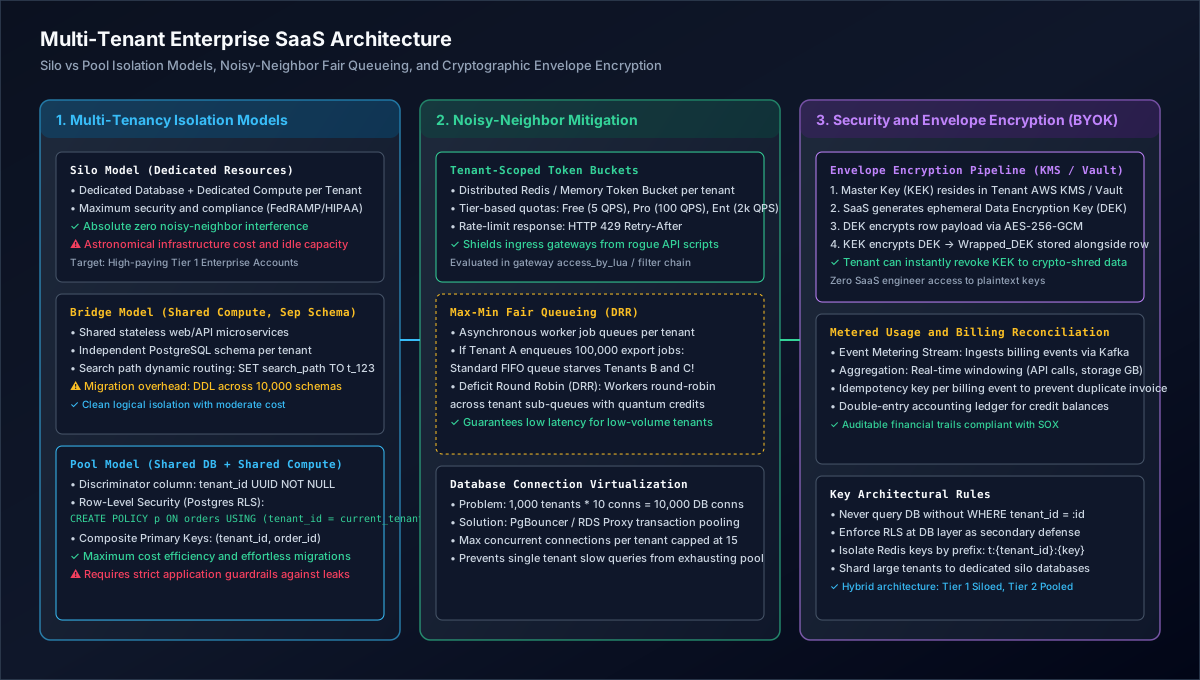
1. Multi-Tenancy Isolation Models & Silo Model (Dedicated Resources)
Establishes the ingress and structural boundary across Multi-Tenancy Isolation Models & Silo Model (Dedicated Resources): Dedicated Database + Dedicated Compute per Tenant; Maximum security and compliance (FedRAMP/HIPAA); Absolute zero noisy-neighbor interference ⚠ Astronomical infrastructure cost and idle capacity.
2. Noisy-Neighbor Mitigation & Tenant-Scoped Token Buckets
Coordinates core data-plane execution and state transitions through Noisy-Neighbor Mitigation & Tenant-Scoped Token Buckets: Distributed Redis / Memory Token Bucket per tenant; Tier-based quotas: Free (5 QPS), Pro (100 QPS), Ent (2k QPS); Rate-limit response: HTTP 429 Retry-After.
3. Security and Envelope Encryption (BYOK) & Envelope Encryption Pipeline (KMS / Vault)
Enforces durability, state convergence, and output verification across Security and Envelope Encryption (BYOK) & Envelope Encryption Pipeline (KMS / Vault): 1. Master Key (KEK) resides in Tenant AWS KMS / Vault; 2. SaaS generates ephemeral Data Encryption Key (DEK); 3. DEK encrypts row payload via AES-256-GCM.
1. The Silo Model (Dedicated Infrastructure)
Each tenant receives an isolated compute cluster and dedicated database instance.
- Pros: Total physical isolation; zero chance of cross-tenant noisy-neighbor starvation; simple compliance certification.
- Cons: Massive resource under-utilization; operational overhead of running database instances; complex cross-tenant fleet analytics.
2. The Bridge Model (Schema-Per-Tenant)
Stateless application servers are shared, but each customer receives their own distinct schema inside a shared relational database (e.g., PostgreSQL CREATE SCHEMA tenant_482).
- Pros: Logical namespace isolation; easy per-tenant backups via
pg_dump -n tenant_482. - Cons: Severe catalog bloat. In PostgreSQL, schemas with tables each create tables, exhausting shared buffer caches and causing DDL migration scripts to stall for hours.
3. The Pool Model (Shared Tables with Discriminator & RLS)
All tenants share the same physical database and database tables. Every table includes a discriminator column:
tenant_id UUID NOT NULL REFERENCES tenants(id).
To eliminate reliance on application developers remembering WHERE tenant_id = ..., PostgreSQL Row-Level Security (RLS) is enforced at the database kernel level:
-- Enable Row-Level Security on orders table (and enforce even for table owners)
ALTER TABLE orders ENABLE ROW LEVEL SECURITY;
ALTER TABLE orders FORCE ROW LEVEL SECURITY;

-- Define default PERMISSIVE tenant isolation policy based on session variable
-- (Note: In PostgreSQL, an AS RESTRICTIVE policy only narrows access granted by at least
--  one PERMISSIVE policy; defining a RESTRICTIVE policy alone denies all rows!)
CREATE POLICY tenant_isolation_policy ON orders
  AS PERMISSIVE
  FOR ALL
  USING (tenant_id = current_setting('app.current_tenant_id', true)::uuid)
  WITH CHECK (tenant_id = current_setting('app.current_tenant_id', true)::uuid);
When an application connection is checked out from the pool, the middleware sets the session context:
SET LOCAL app.current_tenant_id = 'a1b2c3d4-...';
Any query executed during this transaction—even SELECT * FROM orders—is automatically restricted by the database engine to only the active tenant’s records.
3. Noisy-Neighbor Mitigation: Fair Queueing & Virtualized Connection Pools
Deficit Round Robin (DRR) Fair Queueing
When tenants share asynchronous background workers (e.g., PDF generation, data synchronization, ML inference), a single tenant enqueuing tasks will completely starve other tenants if a naive First-In-First-Out (FIFO) queue is used.
Deficit Round Robin provides fair scheduling across dynamic tenant queues:
- Each tenant maintains a dedicated sub-queue and an accumulated
deficit_counter. - At each round, the scheduler adds a fixed credit
quantumto each tenant’s deficit counter. - If the job at the head of the tenant’s queue requires fewer bytes/cost than
deficit_counter, it is dispatched, and its cost is subtracted fromdeficit_counter. - If a tenant has no jobs, its deficit is reset to 0 to prevent hoarding credits.
       [Tenant A Queue: 100,000 jobs] ----+
                                          |
       [Tenant B Queue: 2 jobs] ----------+--> [DRR Fair Scheduler] ---> [Worker Pool]
                                          |    (Dispatches fairly)
       [Tenant C Queue: 1 job] -----------+
Database Connection Pool Virtualization
A classic failure mode in multi-tenant systems is connection pool exhaustion: Tenant A runs an un-indexed query that holds 50 database connections for 10 seconds. All subsequent queries from Tenants B and C fail with Connection pool timeout.
To solve this, SaaS platforms use a virtualized connection manager (such as PgBouncer in transaction pooling mode, or client-side Semaphore pools) that caps maximum concurrent active queries per tenant: Even if Tenant A attempts to execute 1,000 concurrent queries, 990 are queued client-side, leaving 90% of the database connection pool available for other tenants.
4. Cryptographic Isolation: Bring Your Own Key (BYOK) & Envelope Encryption
Enterprise compliance standards require that the cloud provider or SaaS vendor cannot inspect raw customer data. This is achieved via Envelope Encryption:
+-------------------------------------------------------------------------------+
|                       BYOK ENVELOPE ENCRYPTION WORKFLOW                       |
+-------------------------------------------------------------------------------+
| Enterprise Customer AWS KMS Account                                           |
| [Customer Master Key (KEK)]                                                   |
|          |                                                                    |
|          | (1. kms:GenerateDataKey via IAM Role)                              |
|          v                                                                    |
| SaaS Application Pod                                                          |
| [Plaintext DEK (256-bit)] ---------------------> [Encrypted DEK (Wrapped)]    |
|          |                                                |                   |
|          | (2. Encrypts customer sensitive row)           | (Stored alongside)|
|          v                                                v                   |
| [Ciphertext Payload (AES-256-GCM)] ---------> [Database Persistent Row]       |
|                                                                               |
| Crypto-Shredding: If Customer revokes KEK in KMS, SaaS can NEVER decrypt DEK!|
+-------------------------------------------------------------------------------+
5. Mathematical Sizing: Max-Min Fairness Model
In a multi-tenant platform with tenants sharing a total compute capacity :
Let tenant resource demands be . Max-Min Fairness maximizes the allocation given to the tenant with the minimum demand:
- Divide capacity equally: .
- If a tenant demands less than its equal share (), allocate and redistribute the remaining capacity equally among tenants whose demands were not yet satisfied.
- Repeat until all capacity is allocated.
Example:
- 4 Tenants share ().
- Demands: , , , .
- Round 1: Tenant 1 needs 10 (satisfied, leaves 15 unused). Tenant 2 needs 20 (satisfied, leaves 5 unused). Total surplus = .
- Round 2: Remaining capacity for Tenants 3 and 4 is . Split equally: each.
- Final Allocation: , , , . Total = . Low-volume tenants are 100% satisfied with zero latency impact, while high-volume tenants are fairly throttled to their max-min cap.
6. Practical Engineering Simulation: Multi-Tenant Router with Fair Queueing & RLS
This self-contained TypeScript simulation models a multi-tenant request router enforcing Row-Level Security contexts and a Deficit Round Robin fair job queue.
/**
 * Systems Notebook - Multi-Tenant Router & Deficit Round Robin Fair Queue
 */

interface TenantContext {
  tenantId: string;
  tier: 'FREE' | 'PRO' | 'ENTERPRISE';
  rateLimitQps: number;
  maxConcurrentDbConnections: number;
}

interface TenantJob {
  jobId: string;
  tenantId: string;
  costBytes: number;
  description: string;
}

class DeficitRoundRobinScheduler {
  private queues: Map<string, TenantJob[]> = new Map();
  private deficits: Map<string, number> = new Map();
  private readonly quantum: number;

  constructor(quantumBytes: number = 1000) {
    this.quantum = quantumBytes;
  }

  public enqueueJob(job: TenantJob): void {
    if (!this.queues.has(job.tenantId)) {
      this.queues.set(job.tenantId, []);
      this.deficits.set(job.tenantId, 0);
    }
    this.queues.get(job.tenantId)!.push(job);
  }

  /**
   * Dispatches next batch of jobs according to Deficit Round Robin
   */
  public dispatchBatch(maxJobsToDispatch: number): TenantJob[] {
    const dispatched: TenantJob[] = [];
    const tenantIds = Array.from(this.queues.keys());

    let dispatchedInThisRound = true;

    while (dispatched.length < maxJobsToDispatch && dispatchedInThisRound) {
      dispatchedInThisRound = false;

      for (const tenantId of tenantIds) {
        if (dispatched.length >= maxJobsToDispatch) {
          break;
        }

        const queue = this.queues.get(tenantId)!;
        if (queue.length === 0) {
          this.deficits.set(tenantId, 0); // Reset deficit if queue empty
          continue;
        }

        // Add quantum credit to tenant's deficit
        let deficit = (this.deficits.get(tenantId) ?? 0) + this.quantum;

        // Dispatch jobs while tenant has sufficient deficit credit
        while (queue.length > 0 && queue[0].costBytes <= deficit && dispatched.length < maxJobsToDispatch) {
          const job = queue.shift()!;
          deficit -= job.costBytes;
          dispatched.push(job);
          dispatchedInThisRound = true;
        }

        // Reset deficit to 0 if queue drained so idle tenants cannot hoard credits
        this.deficits.set(tenantId, queue.length === 0 ? 0 : deficit);
      }
    }

    return dispatched;
  }
}

class MultiTenantDatabaseSimulator {
  private records: Array<{ tenantId: string; data: string }> = [
    { tenantId: 'tenant-alpha', data: 'Confidential Financials Alpha' },
    { tenantId: 'tenant-beta',  data: 'Proprietary Trade Secrets Beta' },
    { tenantId: 'tenant-gamma', data: 'Medical Telemetry Gamma' }
  ];

  /**
   * Simulates PostgreSQL Row-Level Security
   */
  public executeQuery(activeTenantId: string): Array<{ data: string }> {
    // Database kernel automatically applies session filter
    return this.records
      .filter((r) => r.tenantId === activeTenantId)
      .map((r) => ({ data: r.data }));
  }
}

// -------------------------------------------------------------
// Verification Execution
// -------------------------------------------------------------
function runMultiTenantDemo(): void {
  console.log('=== Step 1: Row-Level Security (RLS) Query Execution ===');
  const db = new MultiTenantDatabaseSimulator();

  const alphaResults = db.executeQuery('tenant-alpha');
  console.log('Query as tenant-alpha:', alphaResults);

  const betaResults = db.executeQuery('tenant-beta');
  console.log('Query as tenant-beta:', betaResults);

  console.log('\n=== Step 2: Deficit Round Robin Fair Queueing ===');
  const scheduler = new DeficitRoundRobinScheduler(1000); // 1000 byte quantum

  // Tenant A floods queue with 5 heavy jobs (800 bytes each)
  for (let i = 1; i <= 5; i++) {
    scheduler.enqueueJob({
      jobId: `job-A-${i}`,
      tenantId: 'tenant-A',
      costBytes: 800,
      description: `Tenant A Large Report #${i}`
    });
  }

  // Tenant B submits 1 urgent light job (200 bytes)
  scheduler.enqueueJob({
    jobId: 'job-B-1',
    tenantId: 'tenant-B',
    costBytes: 200,
    description: 'Tenant B Quick Invoice'
  });

  // Tenant C submits 1 urgent light job (300 bytes)
  scheduler.enqueueJob({
    jobId: 'job-C-1',
    tenantId: 'tenant-C',
    costBytes: 300,
    description: 'Tenant C Password Reset'
  });

  console.log('Dispatching first batch of 3 jobs...');
  const batch1 = scheduler.dispatchBatch(3);
  batch1.forEach((job, idx) => {
    console.log(`Dispatched ${idx + 1}: [${job.tenantId}] ${job.description} (${job.costBytes} bytes)`);
  });

  console.log('\nDispatching second batch of 3 jobs...');
  const batch2 = scheduler.dispatchBatch(3);
  batch2.forEach((job, idx) => {
    console.log(`Dispatched ${idx + 1}: [${job.tenantId}] ${job.description} (${job.costBytes} bytes)`);
  });
}

runMultiTenantDemo();
7. Observability & SRE Metrics
+-------------------------------------------------------------------------------+
|                       MULTI-TENANT SAAS SRE TELEMETRY                         |
+-------------------------------------------------------------------------------+
| Metric Indicator       | Metric Name / Source    | Alert Threshold & Action   |
+------------------------+-------------------------+----------------------------+
| Per-Tenant QPS         | rate(http_requests_     | Alert if single tenant     |
|                        | total{tenant_id}[1m])   | exceeds 40% of cluster QPS |
| Active DB Connections  | pgbouncer_pools_active_ | Alert if single tenant     |
| per Tenant             | connections{tenant}     | hits max per-tenant cap    |
| Fair Queue Wait Time   | queue_wait_seconds_     | Alert if P90 wait time     |
|                        | bucket{tenant_tier}     | diverges > 3x across tiers |
| BYOK KMS Call Failures | kms_decrypt_error_count | Alert if > 0; client KEK   |
|                        |                         | revoked or IAM misconfig   |
+------------------------+-------------------------+----------------------------+
8. Comprehensive Architectural Summary
Enterprise multi-tenant SaaS architecture is defined by disciplined layered isolation:
- Storage Isolation: Row-Level Security (RLS) guarantees logical data partition at the database kernel level, eliminating human application filtering errors.
- Noisy-Neighbor Mitigation: Deficit Round Robin (DRR) fair scheduling and connection pool virtualization ensure that rogue high-volume tenants cannot degrade service for low-volume accounts.
- Cryptographic Independence: Envelope encryption with BYOK empowers enterprise customers to maintain cryptographic ownership and execute instant crypto-shredding by revoking their master KMS keys.
9. Multi-Tenancy Architecture Trade-Offs & Alternatives
| Multi-Tenancy Isolation Model | Cost Efficiency | Data Isolation Guarantee | Blast Radius Risk | Operational Complexity |
|---|---|---|---|---|
| Silo (Database-per-tenant) | Low (High baseline idle infra) | Maximum (Physical separation) | Minimal (Strictly single tenant) | High (Database migrations across thousands of DBs) |
| Bridge (Schema-per-tenant) | Moderate | High (Separate schema permissions) | Moderate (Shared DB engine resources) | Moderate (Schema proliferation limits per DB) |
| Pool (Shared-DB with RLS) | Highest (Maximum resource density) | High (Cryptographic & SQL RLS) | High (Noisy neighbor risks) | Low (Single migration script updates all tenants) |
| Hybrid Tiering | High (Pool SMBs, Silo Enterprises) | Enterprise-grade | Controlled | Moderate (Automated provisioning tier router) |
10. Failure Modes, Noisy Neighbor Incidents & Mitigation
| Incident Type | Failure Mechanism | Observed Symptom | Automated Mitigation Strategy |
|---|---|---|---|
| Connection Pool Exhaustion | Rogue tenant fires 1,000 concurrent queries | All tenants receive HTTP 504 | Enforce per-tenant PgBouncer connection quotas |
| Fair-Queue Starvation | Batch export script fills shared Kafka topic | Low-latency alerts delayed by hours | Deficit Round Robin (DRR) tenant sub-queuing |
| Cross-Tenant Data Leakage | Missing tenant_id filter in ad-hoc query | Privacy violation / Compliance breach | Postgres Row-Level Security (RLS) forced on session variables |
| KMS API Throttling | Millions of cache misses flood AWS KMS | Rate limit HTTP 429 on decrypt | In-memory local DEK caching with tight 5-minute TTL |
11. Guided Design Exercises
Exercise 1: Max-Min Fairness & Deficit Round Robin (DRR) Scheduling
Scenario: Five enterprise tenants share a multi-tenant analytics worker cluster with an aggregate throughput capacity of . During a peak reporting hour, their instantaneous job arrival rates are:
- Compute the exact steady-state throughput allocation granted to each tenant under Max-Min Fairness and determine which tenants experience queueing backpressure.
- In the
DeficitRoundRobinSchedulerwithquantum = 1000bytes, trace the exact deficit balances and dispatch order when Tenant A has five jobs, Tenant B has one job, and Tenant C has two jobs.
Exercise 2: PostgreSQL RLS Context Safety & PgBouncer Transaction Pooling
Scenario: A pooled SaaS database serves SMB tenants over a PostgreSQL primary configured with max_connections = 200 fronted by PgBouncer in pool_mode = transaction.
- Explain why executing
SET app.current_tenant_id = '...'(session-scoped) instead ofSET LOCAL app.current_tenant_id = '...'(transaction-scoped) causes catastrophic cross-tenant data leakage when using PgBouncer transaction pooling. - Design the composite primary/secondary B+ Tree index layout
(tenant_id, ...)and per-tenant semaphore admission limit so a single noisy tenant running slow analytical scans cannot exhaust all backend PostgreSQL connections.
Exercise 3: BYOK Envelope Encryption & KMS Rate-Limit Mitigation
Scenario: An enterprise tenant encrypts every sensitive database row using envelope encryption backed by their own AWS KMS Customer Managed Key (KEK). During a peak traffic burst of , the application pods call kms:Decrypt on every row fetch and immediately fail with AWS KMS ThrottlingException (default KMS quota: per region).
- Architect a Hierarchical Data Encryption Key (DEK) Caching & Key-Rotation protocol that slashes AWS KMS API calls by while preserving a bounded 5-minute crypto-shredding revocation SLA if the customer revokes their KEK.
View Reference Architecture & Worked Solutions (APP-A11-001)
1. Reference Solution — Exercise 1: Max-Min Fairness & Deficit Round Robin (DRR) Scheduling
- Step 1 (Max-Min Fairness Water-Filling Derivation for , ):
- Round 1: Equal share is .
- Tenant 1 demands (surplus ).
- Tenant 2 demands (surplus ).
- Tenant 3 demands (surplus ).
- Round 2: Remaining capacity is split equally between the unsatisfied tenants ():
- Final Allocation: (). Tenants 1, 2, and 3 experience zero queueing delay; only noisy neighbors and are throttled.
- Round 1: Equal share is .
- Step 2 (DRR Round-by-Round Trace with
quantum = 1000):- Round 1:
- Tenant A:
deficit = 0 + 1000 = 1000. Dispatchesjob-A-1();deficitbecomes ( next job). - Tenant B:
deficit = 0 + 1000 = 1000. Head jobjob-B-1costs , so B waits and retainsdeficit = 1000. - Tenant C:
deficit = 0 + 1000 = 1000. Dispatches bothjob-C-1() andjob-C-2(); queue is now empty so C’s remaining deficit is reset to0.
- Tenant A:
- Round 2:
- Tenant A:
deficit = 200 + 1000 = 1200. Dispatchesjob-A-2();deficitbecomes . - Tenant B:
deficit = 1000 + 1000 = 2000. Dispatchesjob-B-1(); queue is now empty so B’s remaining deficit is reset to0.
- Tenant A:
- Round 1:
2. Reference Solution — Exercise 2: PostgreSQL RLS Context Safety & PgBouncer Transaction Pooling
- Step 1 (
SETvs.SET LOCALunder Transaction Pooling):- In PgBouncer
pool_mode = transaction, a physical PostgreSQL backend connection is returned to the shared pool the instantCOMMITcompletes, without resetting session-level state. If Request 1 runs session-scopedSET app.current_tenant_id = 'tenant-A'and commits, and Request 2 checks out that same physical connection without setting the variable, Request 2 inherits'tenant-A'! - Executing
BEGIN; SET LOCAL app.current_tenant_id = 'tenant-A'; ... COMMIT;scopes the GUC strictly to the current transaction block: PostgreSQL automatically clearsapp.current_tenant_idonCOMMITorROLLBACK. Pair this withNULLIF(current_setting('app.current_tenant_id', true), '')::uuidin the RLS policy so any query missingSET LOCALevaluates toNULLand returns zero rows.
- In PgBouncer
- Step 2 (Composite Index & Per-Tenant Connection Bulkhead):
- Every multi-tenant table must place
tenant_idas the leading column of its B+ Tree indexes—e.g.,CREATE INDEX idx_orders_tenant_created ON orders (tenant_id, created_at DESC)—so RLS predicate pruning performs a narrow single-tenant index range scan instead of scanning other tenants’ heap pages. - Enforce a per-tenant semaphore in the data-access layer capping any single tenant to ( of the pool), shedding excess requests from that tenant with
HTTP 429 Too Many Requestsbefore PgBouncer queues saturate.
- Every multi-tenant table must place
3. Reference Solution — Exercise 3: BYOK Envelope Encryption & KMS Rate-Limit Mitigation
- Time-Bucketed DEK Hierarchy & Local Memory Cache:
- Instead of calling
kms:GenerateDataKeyper row, generate one Tenant Epoch DEK per(tenant_id, 5_minute_bucket)via AWS KMS, store the KMS-wrapped ciphertextencrypted_dekin the tenant key table, and encrypt all rows written during that window locally usingAES-256-GCMwith unique 96-bit nonces. - Application pods cache decrypted plaintext DEKs in an in-memory LRU map (
Map<dek_id, { key: CryptoKey, expiresAt: number }>) with a hard 300-second (5-minute) TTL and zero disk persistence. - KMS Offload & Crypto-Shredding Proof: For across active enterprise tenants on application pods, each pod calls
kms:Decryptonly once per active tenant every : - If a customer revokes their KEK in AWS KMS, cached DEKs expire within at most (or immediately via a control-plane cache-eviction broadcast), after which all
kms:Decryptrefreshes fail withKMSDisabledExceptionand render the tenant’s ciphertext permanently unreadable.
- Instead of calling
12. Authoritative References & Production Standards
- Amazon Web Services (2023), “SaaS Multi-Tenant Architecture Patterns & Best Practices” — docs.aws.amazon.com/wellarchitected/latest/saas-lens/
- PostgreSQL Global Development Group (2024), “Row Security Policies (RLS) Documentation” — postgresql.org/docs/current/ddl-rowsecurity.html
- NIST Special Publication 800-57 Part 1 Rev. 5, “Recommendation for Key Management” — doi.org/10.6028/NIST.SP.800-57pt1r5
- Version Context: Architectures reflect PostgreSQL 16+ RLS, AWS KMS envelope encryption, and Redis 7.2+ token bucket rate limiters.