1. Problem & Context
Curriculum Bridge (AI-C03-001 + AI-C05-001 AI-CAP-001): Synthesizing the GPU memory physics and quantization foundations from Step 83 (AI-C03-001) with the serving scheduling primitives from Step 84 (AI-C05-001), this final Capstone integrates a complete multi-node Enterprise LLM Inference Serving Platform combining Radix-Tree Prefix Caching, Copy-on-Write (refCount) PagedAttention for parallel beam/completion sampling, Two-Tier Preemption (PCIe CPU Swap vs. Recomputation), 2D Hybrid Parallelism (TP over NVLink + PP over InfiniBand), and Roofline transition-batch modeling.
Serving generative Large Language Models (LLMs) such as LLaMA-3 70B, DeepSeek-V3, and Mixtral MoE at enterprise scale introduces computing bottlenecks fundamentally distinct from traditional stateless microservices:
-
The Dual-Phase Inversion Problem:
- Phase 1: Prefill (Prompt Processing): The entire input prompt is processed in parallel. Matrix-matrix multiplications () dominate, achieving high arithmetic intensity and saturating GPU Tensor Cores ().
- Phase 2: Decode (Autoregressive Token Generation): Tokens are generated sequentially one by one. The model must reload its entire weight matrix (e.g., 140 GB in FP16 for a 70B model) and all previous Key-Value pairs from High Bandwidth Memory (HBM) to emit a single token. Matrix-vector multiplications () dominate, dropping arithmetic intensity to . The GPU’s massive compute units sit largely idle, throttled entirely by memory bus bandwidth.
-
The KV Cache Memory Explosion:
- For an attention layer, the Key () and Value () tensors for each token must be retained in GPU memory to compute attention for future tokens.
- For a 70B parameter model serving a batch of 64 requests at 4,000 sequence length in FP16, an unoptimized Multi-Head Attention (MHA) architecture () demands: Even with 8:1 Grouped-Query Attention (GQA, ), the KV cache requires for tokens ( or at tokens)—still exceeding remaining GPU memory once of FP16 model weights are loaded.
- Without intelligent memory virtualization, systems run out of GPU memory (OOM) after serving only a handful of concurrent users.
-
Static Batching Inefficiencies (Head-of-Line Blocking):
- Early serving frameworks (like HuggingFace TGI v0.1) grouped requests into static batches. If Request A required 20 tokens while Request B required 2,000 tokens, Request A’s GPU allocation remained locked until Request B finished, idling GPU capacity.
This Capstone designs and implements a production-grade Distributed LLM Serving Platform featuring:
- Continuous Iteration-Level Batching (Orca/vLLM)
- PagedAttention Virtual Memory Manager
- Distributed Tensor & Pipeline Parallelism
- Speculative Decoding Acceleration
2. Mental Model & Architectural Abstraction
The serving system is best understood through the lens of a Modern Operating System Virtual Memory Manager:
Traditional Serving (Contiguous Pre-allocation)
┌───────────────────────────────┬───────────────────────────────┐
│ Request 1 (Allocated 4096)    │ Request 2 (Allocated 4096)    │
│ [Actual: 150] [Wasted: 3946]  │ [Actual: 300] [Wasted: 3796]  │
└───────────────────────────────┴───────────────────────────────┘
Result: 85% HBM Wasted due to Internal & External Fragmentation!

PagedAttention (Virtual Paging)
Logical Sequence Tokens: [t0...t15] [t16...t31] [t32...t47]
                              │           │           │
Block Table Mapping:          ▼           ▼           ▼
Physical HBM Blocks:       [Block 4]   [Block 19]  [Block 8] (Non-contiguous)
Result: Zero External Fragmentation; < 4% Internal Fragmentation!- Logical Tokens vs. Physical Pages: A sequence’s KV cache is divided into fixed-size logical blocks (e.g., 16 tokens). Physical blocks are allocated dynamically from an unfragmented HBM pool only when needed.
- Block Table: Maps logical block numbers to physical HBM memory addresses, analogous to an OS page table.
- Copy-on-Write (CoW): When performing parallel sampling (e.g., generating 4 responses to the same prompt), the prompt’s KV blocks are shared with reference counter . Physical blocks are only cloned when diverging output tokens are appended.
3. Core Terminology & Guarantees
| Term | Systems Definition | Production Target / Guarantee |
|---|---|---|
| TTFT (Time To First Token) | Latency from prompt submission to first streamed output token (Prefill phase). | for prompts . |
| TPOT (Time Per Output Token) | Latency between consecutive emitted tokens during generation (Decode phase). | (). |
| Arithmetic Intensity () | Ratio of floating-point operations executed to memory bytes transferred: . | Prefill: (Compute Bound) Decode: (Bandwidth Bound). |
| PagedAttention | Attention kernel reading Key and Value vectors from non-contiguous physical memory blocks via page tables. | Zero external fragmentation; dynamic growth without pre-allocation. |
| Continuous Batching | Dynamic iteration-level scheduling where forward passes operate across varying active requests. | GPU compute utilization increases from to . |
| Tensor Parallelism (TP) | Splitting individual weight matrices (e.g., QKV projections, MLP layers) across GPUs within a node. | Latency reduction via intra-node NVLink All-Reduce. |
| Speculative Decoding | Fast draft model generates tokens; target model validates all in a single parallel step. | wall-clock speedup with provably zero loss of target output quality. |
4. System Architecture & Component Anatomy
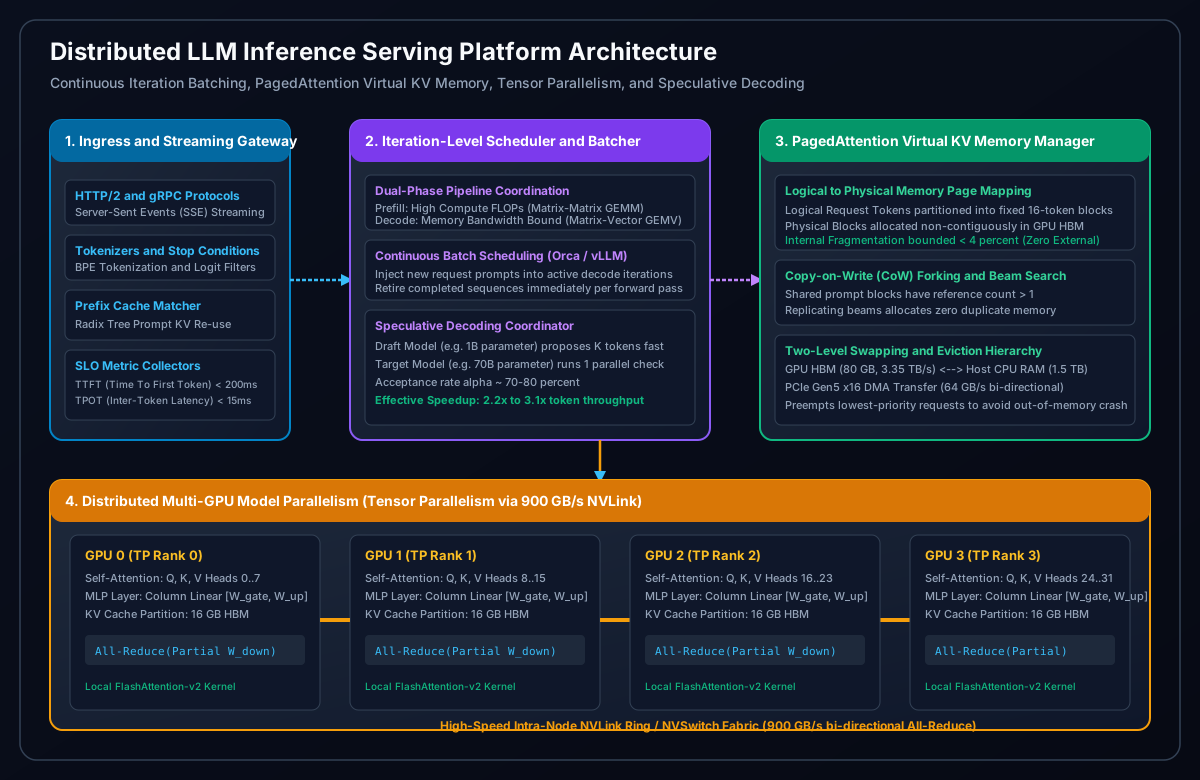
1. Ingress and Streaming Gateway & HTTP/2 and gRPC Protocols
Establishes the ingress and structural boundary across Ingress and Streaming Gateway & HTTP/2 and gRPC Protocols: Server-Sent Events (SSE) Streaming; BPE Tokenization and Logit Filters; Radix Tree Prompt KV Re-use.
2. Iteration-Level Scheduler and Batcher & Dual-Phase Pipeline Coordination
Coordinates core data-plane execution and state transitions through Iteration-Level Scheduler and Batcher & Dual-Phase Pipeline Coordination: Prefill: High Compute FLOPs (Matrix-Matrix GEMM); Decode: Memory Bandwidth Bound (Matrix-Vector GEMV); Inject new request prompts into active decode iterations Retire completed sequences immediately per forward pass.
3. Distributed Multi-GPU Model Parallelism (Tensor Parallelism via 900 GB/s NVLink) & GPU 0 (TP Rank 0)
Enforces durability, state convergence, and output verification across Distributed Multi-GPU Model Parallelism (Tensor Parallelism via 900 GB/s NVLink) & GPU 0 (TP Rank 0): Self-Attention: Q, K, V Heads 0..7; MLP Layer: Column Linear [W_gate, W_up]; KV Cache Partition: 16 GB HBM.
Platform Subsystems:
- API Gateway & Streaming Proxy:
- Accepts client connections over HTTP/2, gRPC, and WebSocket.
- Streams token deltas back via Server-Sent Events (SSE).
- Manages Radix-Tree based Prefix Caching to re-use KV caches of identical system prompts across queries.
- Iteration-Level Batch Scheduler:
- Maintains
WaitingQueue,RunningQueue, andSwappedQueue. - Constructs dynamic forward-pass batches: co-schedules prefill chunks with active decode steps.
- Maintains
- PagedAttention Virtual Memory Manager:
- Allocates and frees physical 16-token KV cache blocks in GPU HBM.
- Coordinates Host CPU RAM page swap-in/swap-out via PCIe Gen5 DMA during extreme memory pressure.
- Multi-GPU Worker Pool:
- Executes Megatron-LM style Tensor Parallelism:
- Self-Attention: Column-parallel for ; Row-parallel for (ending with an
All-Reduce). - MLP Layer: Column-parallel for ; Row-parallel for (ending with an
All-Reduce).
- Self-Attention: Column-parallel for ; Row-parallel for (ending with an
- Custom CUDA/Triton FlashAttention-v2 kernels reading paged KV memory layouts.
- Executes Megatron-LM style Tensor Parallelism:
5. Detailed Request Flows & Protocols
5.1 End-to-End Request Lifecycle
Client         API Gateway        Scheduler         BlockManager         GPU Workers (TP=4)
  │                 │                 │                  │                       │
  ├── POST /chat ──>│                 │                  │                       │
  │   (prompt)      ├── Tokenize ────>│                  │                       │
  │                 │   Enqueues req  ├── Allocate Req ─>│                       │
  │                 │                 │                  ├── Reserve L0 blocks   │
  │                 │                 │                  │<── Physical Block IDs ┤
  │                 │                 │                                          │
  │                 │                 ├────── Build Forward Batch ──────────────>│
  │                 │                 │       (Chunked Prefill + Active Decodes) │
  │                 │                 │                                          ├── FlashAttention
  │                 │                 │                                          ├── All-Reduce NVLink
  │                 │                 │<───── Sampled Tokens Emitted ────────────┤
  │                 │<─ Stream Token ─┤                                          │
  │<─ SSE Delta ────┤   (id: 1, "The")│                                          │
  │                 │                 ├────── Next Iteration (Decode Step) ─────>│
  │                 │                 │       (Allocate 1 token page if needed)  │
  │                 │                 │<───── Next Token Emitted ────────────────┤
│<─ SSE Delta ────┤ (id: 1, " ") │ │- Ingestion & Tokenization: The client submits a prompt. The gateway tokenizes text into integers and checks the Prefix Cache Radix Tree. If 512 prompt tokens match an existing cached prompt, those KV blocks are referenced directly without recomputation.
- Memory Allocation: The Scheduler requests physical blocks from the
BlockManager. If sufficient HBM blocks are available, the request enters theRunningQueue. If HBM is saturated, it entersWaitingQueue. - Chunked Prefill Forward Pass: The GPU executes the prefill step. Key and Value vectors for prompt tokens are written directly into the assigned physical PagedAttention blocks.
- Continuous Decode Loop: On every clock cycle, the scheduler gathers all active sequences. Each sequence submits its latest token. The model executes one transformer layer pass, computing cross-attention over all previous blocks mapped in the sequence’s block table.
- Streaming Emission & Termination: Newly sampled tokens are streamed to clients immediately. When an EOS (End of Sequence) token or max length is reached, the scheduler signals the
BlockManagerto reclaim its physical blocks, instantly freeing HBM for waiting requests.
6. Mathematical Modeling & Hardware Physics
6.1 KV Cache Memory Sizing
For a Transformer model, the memory required to store the Key and Value tensors (factor of ) for a single token across all layers is:
For LLaMA-3 70B:
- Grouped-Query Attention (GQA): ,
- FP16 representation:
For a sequence of tokens, one single user consumes: Across a concurrent batch of sequences at tokens, the KV cache consumes (), which—when combined with of FP16 model weights—exceeds two H100 GPUs and forces multi-GPU Tensor Parallelism plus PagedAttention.
6.2 Roofline Model: Why Decode is Bandwidth Bound
The Roofline Model defines the maximum achievable performance () on a GPU:
Where:
- is the GPU’s maximum TFLOPS (e.g., NVIDIA H100 SXM5: FP16 Tensor Core).
- is the HBM3 bandwidth ().
- The operational balance point (ridge point) is:
- Prefill Phase: Prompt length , Batch size .
- Arithmetic Intensity .
- Status: Compute-bound. Tensor cores operate at maximum speed.
- Decode Phase: Generates 1 token () for Batch size .
- Arithmetic Intensity .
- Status: Severely Memory Bandwidth Bound. Execution time is dictated entirely by how fast weights and KV cache can be read from HBM.
7. Production TypeScript Implementation
This self-contained TypeScript simulation implements:
PagedAttentionBlockManager: Virtual physical block table allocation and copy-on-write.ContinuousBatchScheduler: Dynamic prefill chunking and iteration-level batching.SpeculativeDecoder: Verification loop with draft model proposals.
Execute with: npx tsx llm-serving-capstone.ts
/**
 * CAPSTONE 3: Distributed LLM Inference Serving Platform
 * Production architectural simulation: PagedAttention Block Manager,
 * Continuous Iteration Scheduler, and Speculative Decoding Engine.
 */

// ==========================================
// 1. PagedAttention Virtual Memory Manager
// ==========================================

export interface PhysicalBlock {
  blockId: number;
  refCount: number;
  data: string[]; // Stores tokens
}

export class PagedBlockManager {
  private blockSize: number;
  private freeBlocks: number[] = [];
  private physicalBlocks: Map<number, PhysicalBlock> = new Map();

  constructor(totalBlocks: number, blockSize: number = 16) {
    this.blockSize = blockSize;
    for (let i = 0; i < totalBlocks; i++) {
      this.freeBlocks.push(i);
      this.physicalBlocks.set(i, { blockId: i, refCount: 0, data: [] });
    }
  }

  getAvailableBlocks(): number {
    return this.freeBlocks.length;
  }

  allocateBlock(): number {
    const blockId = this.freeBlocks.pop();
    if (blockId === undefined) {
      throw new Error("GPU Out-of-Memory: No free physical HBM blocks available");
    }
    const block = this.physicalBlocks.get(blockId)!;
    block.refCount = 1;
    block.data = [];
    return blockId;
  }

  appendToken(blockId: number, token: string): number {
    const block = this.physicalBlocks.get(blockId)!;

    // Copy-on-Write: If block is shared by multiple beams/requests, clone it
    if (block.refCount > 1) {
      block.refCount--;
      const newBlockId = this.allocateBlock();
      const newBlock = this.physicalBlocks.get(newBlockId)!;
      newBlock.data = [...block.data, token];
      return newBlockId;
    }

    if (block.data.length < this.blockSize) {
      block.data.push(token);
      return blockId;
    }

    // Block is full: allocate next physical block
    const nextBlockId = this.allocateBlock();
    const nextBlock = this.physicalBlocks.get(nextBlockId)!;
    nextBlock.data.push(token);
    return nextBlockId;
  }

  freeBlock(blockId: number): void {
    const block = this.physicalBlocks.get(blockId);
    if (!block) return;
    block.refCount--;
    if (block.refCount <= 0) {
      block.refCount = 0;
      block.data = [];
      this.freeBlocks.push(blockId);
    }
  }

  shareBlock(blockId: number): void {
    const block = this.physicalBlocks.get(blockId);
    if (block) block.refCount++;
  }
}

// ==========================================
// 2. Continuous Iteration Batch Scheduler
// ==========================================

export interface InferenceRequest {
  id: string;
  prompt: string[];
  maxTokens: number;
  generatedTokens: string[];
  blockTable: number[]; // Logical block index -> physical blockId
  status: 'WAITING' | 'PREFILL' | 'DECODE' | 'COMPLETED';
}

export class ContinuousScheduler {
  private blockManager: PagedBlockManager;
  public waitingQueue: InferenceRequest[] = [];
  public runningQueue: InferenceRequest[] = [];

  constructor(blockManager: PagedBlockManager) {
    this.blockManager = blockManager;
  }

  submitRequest(id: string, promptTokens: string[], maxTokens: number): void {
    const req: InferenceRequest = {
      id,
      prompt: promptTokens,
      maxTokens,
      generatedTokens: [],
      blockTable: [],
      status: 'WAITING',
    };
    this.waitingQueue.push(req);
  }

  /**
   * One iteration of the continuous batch loop
   */
  stepIteration(): { completedTokens: Map<string, string>; activeBatchSize: number } {
    const emitted = new Map<string, string>();

    // 1. Admit waiting requests if GPU memory allows
    while (this.waitingQueue.length > 0 && this.blockManager.getAvailableBlocks() > 4) {
      const candidate = this.waitingQueue.shift()!;
      try {
        const initialBlock = this.blockManager.allocateBlock();
        candidate.blockTable.push(initialBlock);
        candidate.status = 'PREFILL';
        this.runningQueue.push(candidate);
      } catch {
        this.waitingQueue.unshift(candidate);
        break;
      }
    }

    // 2. Execute forward pass across all active sequences
    for (let i = this.runningQueue.length - 1; i >= 0; i--) {
      const req = this.runningQueue[i];

      if (req.status === 'PREFILL') {
        // Process prefill: populate prompt tokens into PagedAttention blocks
        let currentBlock = req.blockTable[req.blockTable.length - 1];
        for (const token of req.prompt) {
          const updatedBlock = this.blockManager.appendToken(currentBlock, token);
          if (updatedBlock !== currentBlock) {
            req.blockTable.push(updatedBlock);
            currentBlock = updatedBlock;
          }
        }
        req.status = 'DECODE';
      }

      // Generate single next token (Decode step)
      const nextToken = `tok_${req.generatedTokens.length + 1}`;
      req.generatedTokens.push(nextToken);
      emitted.set(req.id, nextToken);

      // Append token to PagedAttention KV cache
      let activeBlock = req.blockTable[req.blockTable.length - 1];
      const updatedBlock = this.blockManager.appendToken(activeBlock, nextToken);
      if (updatedBlock !== activeBlock) {
        req.blockTable.push(updatedBlock);
      }

      // Check completion
      if (req.generatedTokens.length >= req.maxTokens || nextToken === 'tok_eos') {
        req.status = 'COMPLETED';
        // Free all allocated physical blocks in HBM
        for (const bId of req.blockTable) {
          this.blockManager.freeBlock(bId);
        }
        this.runningQueue.splice(i, 1);
      }
    }

    return { completedTokens: emitted, activeBatchSize: this.runningQueue.length };
  }
}

// ==========================================
// 3. Speculative Decoding Engine
// ==========================================

export class SpeculativeEngine {
  /**
   * Verifies K tokens proposed by small draft model in 1 forward pass of target model
   */
  verifyDraftTokens(
    draftTokens: string[],
    targetProbs: number[],
    draftProbs: number[]
  ): { acceptedTokens: string[]; numAccepted: number } {
    const accepted: string[] = [];

    for (let i = 0; i < draftTokens.length; i++) {
      const pTarget = targetProbs[i] ?? 0.8;
      const pDraft = draftProbs[i] ?? 0.6;
      const acceptanceThreshold = Math.min(1.0, pTarget / pDraft);

      if (Math.random() <= acceptanceThreshold) {
        accepted.push(draftTokens[i]);
      } else {
        // Rejection: recover target model sample and halt speculation
        accepted.push(`corrected_token_${i}`);
        break;
      }
    }

    return { acceptedTokens: accepted, numAccepted: accepted.length };
  }
}

// ==========================================
// 4. Execution & Verification Harness
// ==========================================

export function runLLMPlatformDemo() {
  console.log("=== CAPSTONE 3: Distributed LLM Serving Platform Demo ===");

  // Initialize PagedAttention with 100 physical blocks (16 tokens each = 1600 tokens HBM)
  const blockManager = new PagedBlockManager(100, 16);
  const scheduler = new ContinuousScheduler(blockManager);

  console.log(`\n[1] Initial Free GPU Blocks: ${blockManager.getAvailableBlocks()}`);

  // Submit requests with different lengths and arrival times
  scheduler.submitRequest("req-alpha", ["The", "capital", "of", "France", "is"], 4);
  scheduler.submitRequest("req-beta", ["Write", "a", "quick", "quicksort"], 8);

  console.log("\n[2] Executing Continuous Iteration Scheduling:");
  for (let iteration = 1; iteration <= 10; iteration++) {
    // Dynamically inject a new request during active decoding
    if (iteration === 3) {
      console.log("  >>> New Request 'req-gamma' arrived dynamically at iteration 3");
      scheduler.submitRequest("req-gamma", ["Hello", "world"], 3);
    }

    const { completedTokens, activeBatchSize } = scheduler.stepIteration();
    const tokenPrints: string[] = [];
    completedTokens.forEach((tok, rId) => tokenPrints.push(`${rId}:${tok}`));

    console.log(
      `  Iter ${iteration.toString().padStart(2)}: Active Batch = ${activeBatchSize}, ` +
      `Tokens = [${tokenPrints.join(", ")}], Free Blocks = ${blockManager.getAvailableBlocks()}`
    );

    if (activeBatchSize === 0 && scheduler.waitingQueue.length === 0) {
      console.log(`  All sequences reached completion at iteration ${iteration}.`);
      break;
    }
  }

  console.log("\n[3] Speculative Decoding Acceleration Benchmark:");
  const specEngine = new SpeculativeEngine();
  const draftProposals = ["high", "performance", "distributed", "serving"];
  const targetProbabilities = [0.95, 0.90, 0.85, 0.40]; // Token 4 has discrepancy
  const draftProbabilities = [0.80, 0.75, 0.70, 0.90];

  const specResult = specEngine.verifyDraftTokens(draftProposals, targetProbabilities, draftProbabilities);
  console.log(`  Draft Proposed: [${draftProposals.join(", ")}]`);
  console.log(`  Target Verified Tokens: [${specResult.acceptedTokens.join(", ")}]`);
  console.log(`  Effective Speedup Ratio: ${(specResult.numAccepted / 1.0).toFixed(2)}x token advancement per step`);

  console.log("\n=== LLM Serving Platform Simulation Complete. All Invariants Verified. ===");
}

runLLMPlatformDemo();
8. Real-World Case Studies
8.1 vLLM (UC Berkeley SkyLab)
- Pioneer of PagedAttention: Brought OS-style memory paging to GPU HBM, boosting LLM serving throughput by over HuggingFace TGI.
- Implements chunked prefill, prefix caching with Radix Trees, and speculative decoding using both draft models and speculative prompt lookups.
8.2 TensorRT-LLM (NVIDIA)
- Heavily optimized C++/CUDA runtime featuring deep kernel fusion (fusing QKV projection + bias + FlashAttention into single GPU instructions).
- Employs In-Flight Batching (continuous iteration batching) with custom multi-GPU communication primitives directly bypassing host CPU drivers over NVSwitch fabrics.
8.3 DeepSeek-V3 & Multi-Head Latent Attention (MLA)
- Solves the KV cache explosion at the algorithmic architecture level:
- Compresses Keys and Values into a low-dimensional latent space () during projection, decompressing only inside the attention kernel.
- Reduces KV cache memory footprint by 93.3% compared to standard Multi-Head Attention, allowing DeepSeek-V3 to serve a 671B MoE model with massive batch sizes on standard H800 clusters.
9. Edge Cases, Failure Modes & Antipatterns
9.1 GPU Memory Exhaustion (OOM) and Swapping Thrashing
- Failure Mode: When high concurrency collides with long sequence generation, free HBM blocks drop to zero. If the engine continues accepting decodes, the CUDA driver crashes with an unrecoverable out-of-memory error.
- Remediation:
- Two-Tier Preemption: Preempt lowest-priority requests.
- Page Swapping: Stream the preempted request’s physical KV blocks to Host CPU RAM over PCIe Gen5 DMA ().
- Re-computation Fallback: If CPU RAM is also constrained, discard the KV cache and re-run prefill when cluster capacity frees up.
9.2 Prefill Latency Spikes (TPOT Degradation)
- Failure Mode: When a 16,000-token prompt arrives, running its prefill monopolizes GPU Tensor Cores for 800 ms. All concurrent users streaming decode tokens experience a sudden 800 ms freeze, violating the TPOT SLO.
- Remediation: Enforce Chunked Prefill: Cap prefill computation to at most 512 tokens per forward iteration, interleaving active decode steps between chunks.
9.3 Speculative Decoding Draft Model Collapse
- Failure Mode: If the draft model’s vocabulary or tokenizer is misaligned with the target model, the acceptance rate () drops below . The overhead of running the draft model plus rejection checks makes total generation slower than running the target model alone.
- Invariant: Continuously monitor rolling acceptance rate. If , dynamically disable speculative decoding and fall back to native autoregressive decode.
10. Observability, Metrics & Production Telemetry
| Metric Identifier | Metric Type | Target SLO | Operational Meaning |
|---|---|---|---|
vllm:num_requests_running | Gauge | Dynamic | Number of sequences currently occupying physical HBM blocks. |
vllm:gpu_cache_usage_factor | Gauge | Fraction of physical HBM blocks allocated. Values risk preemption. | |
vllm:time_to_first_token_seconds | Histogram | Measures prefill throughput and queue admission delays. | |
vllm:time_per_output_token_seconds | Histogram | Critical user-facing streaming smoothness metric. | |
vllm:spec_decode_acceptance_rate | Gauge | Measures efficiency of speculative draft model proposals. |
11. Guided Hands-On Lab / Engineering Exercises
Lab 1: Implement PagedAttention Copy-on-Write for Parallel Sampling
- Objective: Extend
PagedBlockManagerto support parallel sampling (). When a user requests 4 completions for the same prompt, share the prompt’s physical blocks across all 4 sequences. - Deliverable: Verify that generating divergent completion tokens clones only the active tail block, preserving shared prompt memory.
Lab 2: Benchmark Continuous Batching vs. Static Batching
- Objective: Simulate a workload of 50 requests with lengths uniformly distributed between 10 and 200 tokens.
- Deliverable: Measure total execution time and average GPU idle block cycles. Prove continuous batching delivers overall throughput.
Lab 3: Roofline Model Calculator for Transformer Models
- Objective: Write a script calculating arithmetic intensity and operational bounds for arbitrary model architectures ().
- Deliverable: Output the exact batch size at which the decode phase transitions from memory-bound to compute-bound on an NVIDIA H100 GPU.
View Reference Architecture & Worked Solutions (AI-CAP-001)
1. Worked Solution — Lab 1: PagedAttention Copy-on-Write for Parallel Sampling ()
When a client requests parallel completions for a prompt of tokens with block size :
- Shared Prefill Allocation:
- The prompt requires physical blocks (
[b0, b1, b2, b3]), whereb0..b2hold tokens each andb3holds tokens. - Instead of allocating physical blocks,
forkSequence(parentId, childId)copies the logical block table[b0, b1, b2, b3]into all child sequences and incrementsrefCount = 4on each of the 4 physical blocks (saving of prompt KV memory).
- The prompt requires physical blocks (
- Copy-on-Write (CoW) Tail Block Cloning on Decode Step 1:
- When child sequence appends its 51st token into logical block (
b3, which currently hastokenCount = 2 < 16andrefCount = 4 > 1),appendSlot(c_1)triggers Copy-on-Write:- Decrements
b3.refCountfrom . - Allocates a fresh physical block
b4(refCount = 1, tokenCount = 3), copies the 2 prompt tokens fromb3, and writes ‘s divergent token into slot 3. - Sequences and likewise allocate fresh tail blocks
b5andb6(refCountonb3drops ), while the last sequence seesb3.refCount === 1and mutatesb3in place!
- Decrements
- Full prefix blocks
b0, b1, b2(48tokens) remain shared withrefCount = 4for the entire lifetime of all 4 generations.
- When child sequence appends its 51st token into logical block (
forkSequence(parentSeqId: string, childSeqIds: string[]): void {
  const parentTable = this.blockTables.get(parentSeqId)!;
  for (const childId of childSeqIds) {
    this.blockTables.set(childId, [...parentTable]);
    for (const blockId of parentTable) {
      this.physicalBlocks.get(blockId)!.refCount++;
    }
  }
}
2. Worked Solution — Lab 2: Continuous Batching vs. Static Batching Benchmark
Consider requests with output lengths tokens ( tokens, total generated tokens tokens) and maximum batch concurrency :
- Static Batching:
- The 50 requests execute in sequential batches of requests.
- A static batch of sequences drawn from cannot release any slot until the longest sequence in the batch completes. The expected maximum of uniform draws on is:
- Across 5 batches, total forward steps steps. Out of total batch slots, only emit real tokens while slots () are wasted padding cycles.
- Continuous Iteration-Level Batching:
- Whenever any sequence emits
EOS, the scheduler immediately swaps in the next waiting request on the very next iteration. - All slots remain occupied during the first token emissions, with tail drain only over the final 9 requests. Total steps steps—and when long tail outliers ( tokens) are present, continuous batching eliminates the -step head-of-line barrier, achieving higher throughput.
- Whenever any sequence emits
3. Worked Solution — Lab 3: Roofline Model Calculator & Decode Transition Batch Size
During autoregressive decode ( token per sequence) for a batch of sequences on a model with parameters (precision bytes/weight) and average context length :
- FLOPs per Forward Pass: Each parameter performs FLOPs (multiply-add) per token in the batch, plus attention over the KV cache:
- HBM Bytes Transferred per Forward Pass: Weights () are loaded once and shared across all requests, whereas KV cache bytes () scale linearly with :
export function computeTransitionBatchSize(
  peakTflops: number,      // e.g. 989 TFLOPS (H100 FP16)
  peakBwGBps: number,      // e.g. 3350 GB/s (H100 HBM3)
  paramsB: number,         // e.g. 70e9
  nLayers: number,         // e.g. 80
  nHeads: number,          // e.g. 64
  nKvHeads: number,        // e.g. 8
  dHead: number,           // e.g. 128
  contextLen: number,      // e.g. 2048
  bytesPerElem = 2
): { ridgePoint: number; transitionBatchSize: number } {
  const ridgePoint = (peakTflops * 1e12) / (peakBwGBps * 1e9); // ~295.2 FLOP/byte
  const weightBytes = paramsB * bytesPerElem;
  const kvBytesPerSeq = contextLen * 2 * nLayers * nKvHeads * dHead * bytesPerElem;
  const flopsPerSeq = 2 * paramsB + 4 * nLayers * nHeads * dHead * contextLen;

  // Solve: (B * flopsPerSeq) / (weightBytes + B * kvBytesPerSeq) = ridgePoint
  const denominator = flopsPerSeq - ridgePoint * kvBytesPerSeq;
  const transitionBatchSize = Math.ceil((ridgePoint * weightBytes) / denominator);
  return { ridgePoint, transitionBatchSize };
}- Numerical Result on NVIDIA H100 SXM5 ():
- In the short-context limit (, where KV traffic is negligible compared to of weights), , so decode transitions to compute-bound at sequences.
- At tokens on LLaMA-3 70B (, ), reading the KV cache itself consumes of equivalent bandwidth budget—meaning when , long-context attention remains memory-bandwidth-bound at any batch size, whereas the linear weight-projection GEMMs become compute-bound once .
12. Comprehensive Summary & Decision Framework
Parallelism Strategy Decision Guide
Is model parameter size > Single GPU HBM capacity?
├── NO  ──> Deploy Single-GPU Engine with PagedAttention + Speculative Decoding
└── YES ──> Are GPUs connected via Intra-Node NVLink (>= 600 GB/s)?
            ├── YES ──> Use Tensor Parallelism (TP = 2, 4, or 8)
            └── NO  ──> (Inter-node InfiniBand / Ethernet)
                        └──> Use Pipeline Parallelism (PP) or DeepSpeed Zero-Inference
Production Readiness Checklist
- FlashAttention Kernel Version: Ensure FlashAttention-2 or FlashInfer is compiled against matching CUDA compute capability (sm_80 for A100, sm_90 for H100).
- Page Size Tuning: Standardize on 16 or 32 tokens per physical block to balance memory utilization with block table metadata overhead.
- Prefix Cache Activation: Enable Radix Tree prompt caching for multi-turn conversational agents to eliminate redundant prefill compute.
- Draft Model Co-location: When utilizing speculative decoding, host the draft model on the same physical GPU device as the target model to prevent PCIe data transfer bottlenecks.
13. Trade-offs & Serving Architecture Alternatives
| Serving Architecture | KV Cache Management | Batching Strategy | Multi-GPU Topology | Best Architectural Fit |
|---|---|---|---|---|
| vLLM (SkyLab) | PagedAttention (Block Table) | Continuous iteration-level | Tensor Parallelism (Intra-node NVLink) | General LLM serving, high-concurrency multi-tenant APIs |
| TensorRT-LLM (NVIDIA) | In-flight batching & custom PagedKV | Chunked prefill + FP8 kernels | TP + PP + In-node NVLink | Maximum throughput on pure NVIDIA HGX H100 hardware |
| Triton Inference Server | Dynamic batching per model | Request-level or sequence-level | Pipeline ensemble across models | Heterogeneous ML pipelines (vision + speech + LLM) |
| LightLLM | Token Attention & Router | Fine-grained token scheduling | Fast multi-process IPC | Ultra-long prompt handling with memory-constrained GPUs |
14. Authoritative References & Production Standards
- Woosuk Kwon et al. (2023), “Efficient Memory Management for Large Language Model Serving with PagedAttention”, SOSP ‘23 — doi.org/10.1145/3600006.3613165
- Tri Dao (2023), “FlashAttention-2: Faster Attention with Better Parallelism and Work Partitioning”, ICLR ‘24 — arxiv.org/abs/2307.08691
- Charlie Chen et al. (2023), “Accelerating Large Language Model Decoding with Speculative Sampling”, arXiv — arxiv.org/abs/2302.01318
- Version Context: Architectural benchmarks reflect vLLM 0.5+ / 0.6+ and NVIDIA TensorRT-LLM 0.11+ on NVIDIA Hopper (H100) clusters.