1. The Problem & Why It Matters
The frontier of production AI systems has fundamentally transitioned from single-turn, stateless chat completions to Autonomous Agentic Systems and Ultra-Long-Context Multimodal Platforms:
- The Context Memory Wall: Modern enterprise applications require processing whole codebases, 500-page financial audits, or hours of video recordings ( tokens). For a model like Llama 3 70B ( layers, KV heads, , in BF16/FP16), a 1-million-token prompt generates a KV cache of () in BF16/FP16 (or in FP8), far overflowing the HBM3 memory of a single NVIDIA H100 GPU.
- The Fragility of Long-Running Agent Loops: An autonomous software engineering agent operates in a continuous loop: A complex task may require 40 consecutive tool invocations over 30 minutes. If the host pod is preempted by Kubernetes or encounters an unhandled socket drop on Step 38, restarting the agent from scratch burns $15 in LLM API fees and risks duplicating irreversible external side-effects (e.g. creating duplicate GitHub PRs).
- Multimodal Synchronization: Processing streaming audio and video in real time requires continuous chunking, cross-modal attention fusion, and sub-200ms end-to-end response times to support natural voice interruption.
Solving these challenges requires Context Parallelism (RingAttention) to shard sequence dimensions across GPUs and Durable Execution Engines to orchestrate resilient tool-calling DAGs.
2. Intuitive Mental Model
Imagine a team of 4 detectives investigating a 1,000-page criminal conspiracy:
- Stateless LLM (The Solo Detective): One detective attempts to read all 1,000 pages at once. Their desk is too small (GPU memory limit), so the papers fall onto the floor, and the detective passes out from exhaustion after reading 200 pages.
- RingAttention (The Circular Reading Ring): The 1,000 pages are split into 4 equal stacks of 250 pages. Four detectives sit around a circular table. Each detective holds their 250 questions stationary, reads their own stack, and then slides the 250-page stack to the detective on their right. Over 3 circular passes, every detective has compared their questions against all 1,000 pages without anyone ever holding more than 250 pages at their desk!
- Durable Agent Execution: Detective 1 interviews a witness, writes the testimony into an immutable evidence ledger, and files an arrest warrant. If Detective 1 gets food poisoning, Detective 2 opens the ledger, sees that the witness was already interviewed, and immediately proceeds to execute the warrant without re-interviewing the witness.
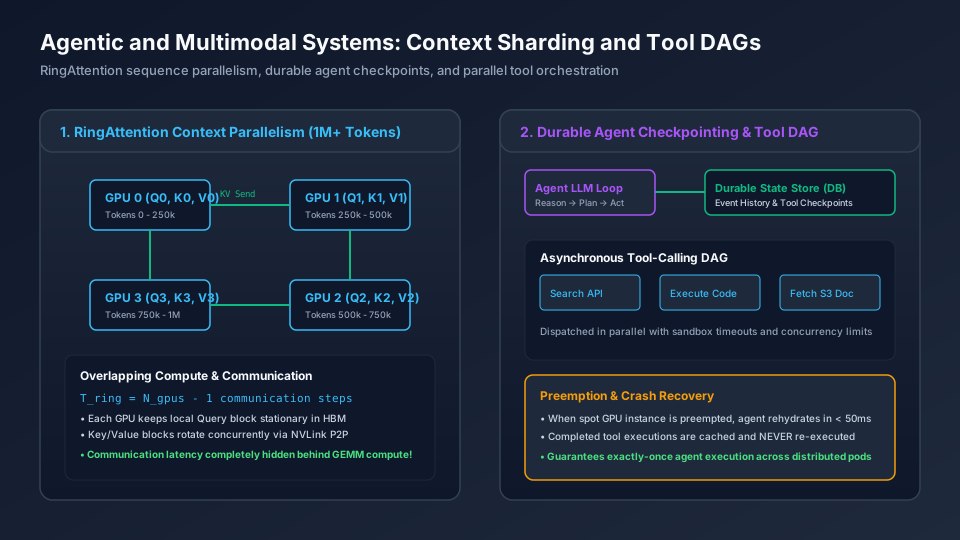
1. GPU 0 (Q0, K0, V0) & GPU 1 (Q1, K1, V1)
Establishes the ingress and structural boundary across GPU 0 (Q0, K0, V0) & GPU 1 (Q1, K1, V1): Tokens 0 - 250k; Tokens 250k - 500k; Tokens 500k - 750k.
2. Agent LLM Loop & Durable State Store (DB)
Coordinates core data-plane execution and state transitions through Agent LLM Loop & Durable State Store (DB): Reason → Plan → Act; Event History & Tool Checkpoints; When spot GPU instance is preempted, agent rehydrates in < 50ms.
3. Agent LLM Loop & Durable State Store (DB)
Enforces durability, state convergence, and output verification across Agent LLM Loop & Durable State Store (DB): Reason → Plan → Act; Event History & Tool Checkpoints; When spot GPU instance is preempted, agent rehydrates in < 50ms.
3. Architectural Mechanisms & Concrete Topologies
3.1 RingAttention Sequence Sharding
In standard Transformer Self-Attention, calculating attention across sequence length requires computing:
In Context Parallelism with RingAttention, the sequence of length is partitioned equally across GPUs: Each GPU holds local blocks of size :
- Local Query block:
- Local Key block:
- Local Value block:
Instead of all-gathering the full sequence, GPUs execute a circular ring communication loop over steps:
- Each GPU computes partial attention between its local Query block and the currently held Key/Value block using the online softmax trick (FlashAttention).
- Asynchronously, GPU sends to GPU and receives from GPU via NVLink.
- The GEMM computation time on modern Tensor Cores exceeds the NVLink transfer time, meaning network communication is 100% hidden.
Step 0: GPU 0 computes (Q0, K0, V0) | GPU 1 computes (Q1, K1, V1)
  -- NVLink P2P Send/Recv in background --
Step 1: GPU 0 computes (Q0, K3, V3) | GPU 1 computes (Q1, K0, V0)
  -- NVLink P2P Send/Recv in background --
Step 2: GPU 0 computes (Q0, K2, V2) | GPU 1 computes (Q1, K3, V3)
  -- NVLink P2P Send/Recv in background --
Step 3: GPU 0 computes (Q0, K1, V1) | GPU 1 computes (Q1, K2, V2)
--> Final Attention Output normalized across all 4 steps!
4. Formal Mathematical Derivations
4.1 RingAttention Memory & Communication Complexity
Let sequence length be , hidden dimension be , number of attention heads be , and head dimension be . Number of GPUs in the context parallel group is .
-
Local KV Cache Memory per GPU: Memory scales strictly as . By doubling GPU count , sequence length can double while keeping per-GPU memory constant.
-
Total Communication Volume: At each step of the ring, each GPU transfers a slice of and of size (where for Grouped-Query Attention models, or for standard Multi-Head Attention). Over steps: Crucially, the communication volume per GPU is independent of cluster size ! It depends only on the total sequence length .
4.2 Online Softmax Rescaling Formula
Because Softmax is non-linear (), computing attention across segmented blocks requires maintaining running maximums and normalization scalars . When merging a previous block’s output with a new block’s calculation :
This allows exact mathematical equivalence to global attention without storing intermediate attention matrices in RAM!
5. Edge Cases, Failure Modes & Distributed Anomalies
5.1 Tool Execution Side-Effect Duplication on Retry
An agent decides to create an AWS S3 bucket customer-data-prod.
- The tool calls AWS API, which creates the bucket.
- The network drops before the HTTP response returns to the agent worker pod.
- The agent framework retries the step.
- The second call fails with
BucketAlreadyExistsException, throwing an unhandled error that crashes the entire agent workflow! The Invariant: All agent tools must be engineered to be strictly idempotent or carry unique client request tokens.
5.2 Context Saturation & Attention Drift
When context windows expand beyond 500,000 tokens, attention weights dilute across millions of tokens (the “needle in a haystack” problem). LLMs experience attention drift, losing track of system instructions placed at the beginning of the prompt. Remediation: Systems utilize Prefix Attention Pinning and structured Context Reranking before feeding massive document trees into RingAttention.
6. Open-Source Architectural Studies
6.1 vLLM & SGLang: Sequence Parallelism Integration
Modern inference serving engines like vLLM integrate RingAttention and DeepSpeed-Ulysses context parallelism into their PagedAttention kernel pipelines. By combining paged block tables with cross-node RingAttention, vLLM serves 1M-token prompts across multi-node H100 clusters while dynamically batching multiple concurrent user conversations.
6.2 Temporal & LangGraph: State Graph Checkpointing
LangGraph models agent workflows as directed graphs where nodes are functions and edges are conditional transitions. Every state update is emitted as an event into a persistent checkpointer (PostgreSQL / SQLite). If a node fails, the workflow engine inspects the checkpoint stream and replays only from the last successful node.
7. Production Incident Post-Mortem (War Stories)
The Preemptible Spot GPU Meltdown
Context: A software development startup ran coding agents on AWS Spot GPU instances to minimize infrastructure costs. Agents routinely ran for 40 minutes, analyzing git histories and generating test suites. The Incident: During an AWS capacity reclamation event, 80% of the startup’s spot GPU instances were terminated simultaneously with a 2-minute notice. The Disaster: Because the agent state was kept in local container memory, 400 active customer coding tasks crashed. When new pods spun up, they had no record of what was already done, restarting from scratch. The simultaneous restart triggered a massive thundering herd against the GitHub API, hitting API rate limits and locking customer repositories for 24 hours. The Fix:
- Implemented Temporal Durable Execution: Every tool execution result and LLM response is snapshotted into Amazon RDS.
- Migrated agents to ephemeral stateless workers that rehydrate their entire context graph from PostgreSQL in under 40 milliseconds upon pod migration.
8. Production-Grade TypeScript Simulation: RingAttention Simulator & Durable Agent State Machine
This simulation models:
- RingAttention circular sequence sharding across 4 simulated GPU workers.
- A durable agent execution engine that records execution checkpoints and resumes without re-executing completed tools.
/**
 * Production Agentic & Multimodal Simulation: RingAttention & Durable Checkpointing
 */

export interface GPUWorker {
  id: number;
  queryBlock: number[];
  keyBlock: number[];
  valueBlock: number[];
  runningMax: number;
  runningSumExp: number;
  accumulatedOutput: number;
}

export class RingAttentionSimulator {
  private gpus: GPUWorker[] = [];

  constructor(numGpus: number, tokensPerGpu: number) {
    for (let i = 0; i < numGpus; i++) {
      // Simulate scalar token embeddings (scaled down to prevent raw exp overflow)
      this.gpus.push({
        id: i,
        queryBlock: [(i + 1) * 0.5],
        keyBlock: [(i + 1) * 0.4],
        valueBlock: [(i + 1) * 10.0],
        runningMax: -Infinity,
        runningSumExp: 0,
        accumulatedOutput: 0,
      });
    }
  }

  public executeRing(): void {
    const N = this.gpus.length;
    console.log(`Starting RingAttention across ${N} GPUs...`);

    // In step 0, each GPU holds its own K and V blocks
    let currentKVBlocks = this.gpus.map((g) => ({
      fromGpu: g.id,
      keyData: g.keyBlock,
      valueData: g.valueBlock,
    }));

    for (let step = 0; step < N; step++) {
      // 1. Compute blockwise attention with Online Softmax Rescaling (Section 4.2)
      for (let i = 0; i < N; i++) {
        const gpu = this.gpus[i];
        const qVal = gpu.queryBlock[0];
        const kVal = currentKVBlocks[i].keyData[0];
        const vVal = currentKVBlocks[i].valueData[0];

        const s_ij = qVal * kVal;
        const m_old = gpu.runningMax;
        const m_new = Math.max(m_old, s_ij);
        const rescaleOld = m_old === -Infinity ? 0 : Math.exp(m_old - m_new);
        const expNew = Math.exp(s_ij - m_new);

        // Online softmax unnormalized numerator update:
        // O_new = O_old * e^(m_old - m_new) + e^(S_ij - m_new) * V_j
        gpu.accumulatedOutput = gpu.accumulatedOutput * rescaleOld + expNew * vVal;
        gpu.runningSumExp = gpu.runningSumExp * rescaleOld + expNew;
        gpu.runningMax = m_new;
      }

      // 2. Rotate Key and Value blocks in a ring (send to right neighbor)
      const rotatedKVBlocks = new Array(N);
      for (let i = 0; i < N; i++) {
        const nextGpu = (i + 1) % N;
        rotatedKVBlocks[nextGpu] = currentKVBlocks[i];
      }
      currentKVBlocks = rotatedKVBlocks;
    }

    // Normalize accumulated outputs by final partition denominator l_new
    for (const gpu of this.gpus) {
      gpu.accumulatedOutput = parseFloat((gpu.accumulatedOutput / gpu.runningSumExp).toFixed(4));
    }
  }

  public getResults(): number[] {
    return this.gpus.map((g) => g.accumulatedOutput);
  }
}

export interface AgentCheckpoint {
  taskId: string;
  completedSteps: string[];
  toolOutputs: Record<string, any>;
}

export class DurableAgentOrchestrator {
  private checkpointStore = new Map<string, AgentCheckpoint>();

  public async executeTask(
    taskId: string,
    steps: { name: string; run: () => Promise<any> }[]
  ): Promise<Record<string, any>> {
    // 1. Rehydrate checkpoint if exists
    let checkpoint = this.checkpointStore.get(taskId) ?? {
      taskId,
      completedSteps: [],
      toolOutputs: {},
    };

    console.log(`[DURABLE ENGINE] Resuming Task ${taskId} from step ${checkpoint.completedSteps.length}`);

    for (const step of steps) {
      if (checkpoint.completedSteps.includes(step.name)) {
        console.log(`  [CACHE HIT] Step '${step.name}' already completed. Skipping side effect.`);
        continue;
      }

      console.log(`  [EXECUTING] Step '${step.name}'...`);
      const output = await step.run();

      // Commit checkpoint atomically to durable store
      checkpoint.completedSteps.push(step.name);
      checkpoint.toolOutputs[step.name] = output;
      this.checkpointStore.set(taskId, { ...checkpoint });
    }

    return checkpoint.toolOutputs;
  }
}

// Verification Routine
export async function runAgentSimulation() {
  console.log("=== 1. RingAttention Context Parallelism Simulation ===");
  const ring = new RingAttentionSimulator(4, 250000); // 4 GPUs, 1M tokens total
  ring.executeRing();
  console.log("GPU Attention Outputs:", ring.getResults());

  console.log("\n=== 2. Durable Agent Checkpoint & Crash Recovery Simulation ===");
  const orchestrator = new DurableAgentOrchestrator();
  const taskId = "task-git-refactor-42";

  let toolExecutionCount = 0;
  const steps = [
    {
      name: "CloneRepo",
      run: async () => {
        toolExecutionCount++;
        return { repo: "system_design_course", branch: "main" };
      },
    },
    {
      name: "RunLinter",
      run: async () => {
        toolExecutionCount++;
        return { errors: 0, warnings: 2 };
      },
    },
    {
      name: "DeployStaging",
      run: async () => {
        toolExecutionCount++;
        return { deploymentId: "dep_984" };
      },
    },
  ];

  // Run first 2 steps then simulate crash
  await orchestrator.executeTask(taskId, [steps[0], steps[1]]);
  console.log(`Total Real Tool Invocations so far: ${toolExecutionCount}`);

  // Simulate pod crash and restart with all 3 steps
  console.log("\n-- Pod Crashes! Worker rescheduled on new machine --");
  await orchestrator.executeTask(taskId, steps);
  console.log(`Total Real Tool Invocations after resumption: ${toolExecutionCount}`);
  console.log("Verified: Steps 1 & 2 were NOT re-executed!");
}

runAgentSimulation();
9. Operational Checklist, Failure Runbooks & Architecture Rules
Agentic System Production Rules
- Never Call External Tools Without Idempotency Tokens:
Generate
idempotency_token = sha256(agent_id + step_number + input_hash)to prevent duplicate payments, emails, or deployments during retries. - Strict Per-Tool Timeout Enforcement: Wrap every tool execution in an OS-level timeout (e.g. 15 seconds). A hanging API call must never block the agent reasoning loop.
- Sandbox Execution for Untrusted Code: Execute agent-generated Python, Bash, or SQL in ephemeral microVMs (AWS Firecracker or gVisor) with network egress restrictions.
10. Guided Applied System Design Exercises & Debugging Drills
Drill 1: Sizing an 8-GPU H100 Cluster for 2M Token Context
A research team requires serving an open-weights 70B parameter model with a 2,000,000-token context window.
- Calculate the total KV cache memory required in FP16 precision.
- Formulate the combination of Tensor Parallelism (TP=8) vs Context Parallelism (CP=8) across 8 NVIDIA H100 (80GB) GPUs.
- Prove why Context Parallelism is strictly required to prevent out-of-memory crashes.
Drill 2: Resolving Duplicate Side Effects in Agent Retry Loops
An AI coding agent executes a tool create_github_issue(title, body). The GitHub API returns HTTP 504 Gateway Timeout, but secretly created the issue on GitHub’s backend.
- If the agent retries, a duplicate issue is created. How can the agent check its durable event history and query GitHub’s issue search before issuing a retry?
- Design an Idempotent Tool Wrapper pattern for non-idempotent third-party APIs.
View Reference Architecture & Worked Solutions (AI-C09-001)
1. Worked Solution — Drill 1: Sizing an H100 Cluster for a -Token Context on Llama-3-70B
- Total KV Cache & Weight Memory in FP16/BF16 ():
- For Llama-3-70B ( layers, , , ), each token requires :
- Adding () of BF16 model weights brings the total footprint to ()—exceeding the entire () HBM3 capacity of a single H100 node!
- TP=8 vs. Context Parallelism (CP / RingAttention) Formulation:
- Why Pure Fails: Even if weights () and KV heads ( KV head per GPU ) are sharded 8-way, , causing an immediate OOM before allocating a single byte for prefill activations. Furthermore, under pure TP, non-sharded sequence activations (, residual streams of shape ) are replicated across all GPUs ( per tensor!).
- Production Topology:
- Option A (Single 8x H100 Node with FP8 KV Cache + RingAttention): Quantize KV cache to FP8 ( total, or ) and shard the sequence across GPUs () so local activations shrink by .
- Option B (2 Nodes / 16x H100 GPUs in Full BF16): Combine Intra-Node (sharding model heads over NVLink) with Inter-Node RingAttention ( tokens per node), requiring weights + KV cache with activation headroom.
2. Worked Solution — Drill 2: Idempotent Tool Wrapper for Non-Idempotent Third-Party APIs
- Why Blind Retries Fail on
HTTP 504: A504 Gateway Timeoutis an ambiguous outcome—the TCP connection dropped after the request reached GitHub’s backend. Retrying blindly creates a duplicate issue. - Two-Phase Idempotent Tool Wrapper Pattern (Write-Ahead Intent + Read-Before-Retry):
- Step A (Deterministic Idempotency Key): Compute
intentKey = "gh-issue-" + sha256(taskId + ":" + stepIndex + ":" + title).slice(0, 16)and embed an invisible HTML marker<!-- idempotency-key: ${intentKey} -->at the bottom of the issuebody. - Step B (Persist
PENDING_INTENTBefore Network Call): Write{ stepName, intentKey, status: "IN_FLIGHT" }to the durable checkpoint store before invoking the external HTTP request. - Step C (Reconciliation on Retry): When a worker resumes after a crash or
504timeout and seesstatus === "IN_FLIGHT", it first queries GitHub’s search API (GET /search/issues?q=${intentKey}+repo:org/repo) before POSTing:- If a matching issue exists, record its
issue_numberinto the checkpoint store, mark the stepCOMPLETED, and return the existing issue without creating a duplicate. - Only if the search confirms zero matches does the wrapper re-issue
POST /repos/:owner/:repo/issues.
- If a matching issue exists, record its
- Step A (Deterministic Idempotency Key): Compute
11. Trade-offs & Orchestration Alternatives
| Agentic Orchestration Pattern | State Durability | Fault Recovery Latency | Tool Idempotency Guarantee | Engineering Fit |
|---|---|---|---|---|
| In-Memory ReAct Loop (LangChain) | None (Ephemeral memory) | Full restart from scratch | None (Blind retries risk duplicate writes) | Rapid prototyping, transient scripts |
| Durable Workflow DAG (Temporal) | Append-only event history WAL | Deterministic resumption (< 1 sec) | Enforced via activity idempotency keys | Mission-critical financial & production automations |
| Graph-State Machine (LangGraph) | Checkpointed state checkpoints | Step-level resumption | Checkpoint-scoped tool state | Complex multi-agent deliberation with cycles |
| Actor-Based Message Bus (Ray) | Distributed object store & actors | Actor restart with state restore | Worker-level isolation | High-throughput distributed multimodal processing |
12. Authoritative References & Architectural Standards
- Hao Liu et al. (2023), “RingAttention with Blockwise Transformers for Near-Infinite Context”, ICLR ‘24 — arxiv.org/abs/2310.01889
- Maxim Fateev and Samar Abbas (2021), “Temporal: Fault-Tolerant, Durable Execution Platform Architecture” — docs.temporal.io
- Harrison Chase et al. (2024), “LangGraph: Multi-Agent Cyclic Graphs and State Persistence” — langchain-ai.github.io/langgraph/
- Version Context: Specifications reflect RingAttention on PyTorch 2.3+ with Temporal 1.24+ and LangGraph 0.1+.