1. The Problem & Why It Matters
In distributed architectures, services do not communicate through shared memory; they communicate through serialized wire contracts.
When systems scale, naive API designs incur catastrophic operational taxes:
- Serialization CPU Tax & Bandwidth Bloat: Text-based JSON APIs repeat long string field names (
"user_first_name_in_latin_script") for every single object in an array. Parsing strings, parsing floating point numbers, and allocating garbage-collected objects in Node.js, Python, or Java consumes up to 30%–50% of total application CPU. - Schema Breakages & Deployment Gridlock: Renaming a field or changing an integer to a string in a JSON API immediately crashes mobile clients and downstream microservices that expect the old contract. Teams are forced into fragile, coordinated “lockstep” deployments.
- The Zombie Request Epidemic: An API gateway with a 1-second timeout drops a slow user request. However, downstream services and databases continue executing heavy aggregations for 30 seconds, oblivious to the fact that the client disconnected.
- The OFFSET Pagination Trap: Navigating to page 10,000 of an order history table using
LIMIT 50 OFFSET 500000causes the database to read 500,050 records from disk, destroying disk I/O and causing query timeouts.
Rigorous API design—using binary Protocol Buffers (gRPC), backwards-compatible schema evolution, cursor pagination, and deadline propagation—is required for high-performance distributed systems.
2. Intuitive Mental Model
Imagine ordering a meal at a restaurant:
- JSON over HTTP/1.1: The waiter writes your order in conversational, florid prose on a large parchment: “Dear Chef, our esteemed patron requests a medium-rare steak with butter sauce, no garlic, and a side of french fries.” Reading and writing takes 2 minutes. The kitchen must read the entire letter to find the word “fries”.
- Protocol Buffers over gRPC: The waiter punches numbers into a compact keypad:
[Item: 4] [Temp: 2] [Mod: 1]. The transmission takes 50 milliseconds. The kitchen reads the digital tokens instantly with zero ambiguity. - Deadline Propagation: The patron tells the waiter: “I have a flight in 20 minutes.” If the kitchen takes 21 minutes to prepare the steak, the waiter immediately halts the chef before they start grilling, preventing wasted food and kitchen gridlock.
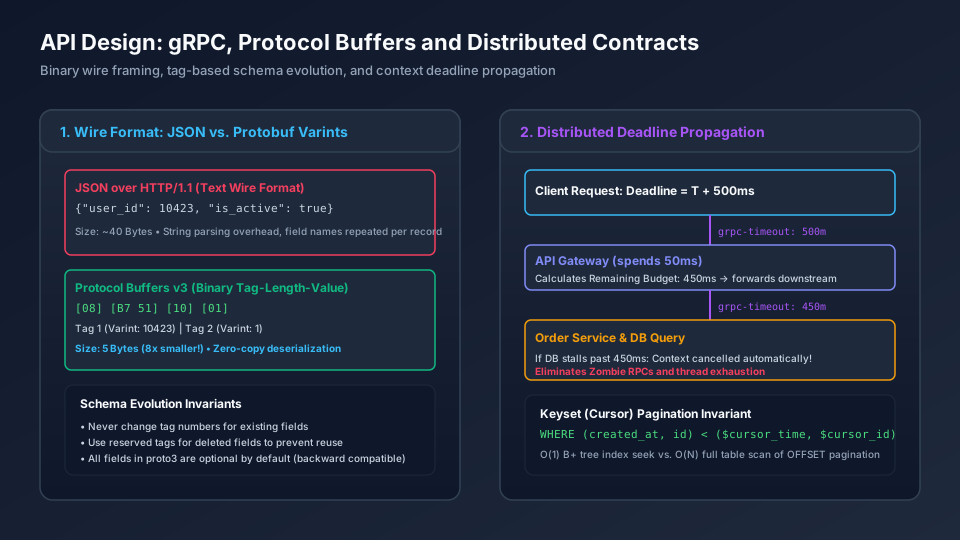
1. JSON over HTTP/1.1 (Text Wire Format) & Protocol Buffers v3 (Binary Tag-Length-Value)
Establishes the ingress and structural boundary across JSON over HTTP/1.1 (Text Wire Format) & Protocol Buffers v3 (Binary Tag-Length-Value): {"user_id": 10423, "is_active": true}; Size: ~40 Bytes • String parsing overhead, field names repeated per record; [08] [B7 51] [10] [01].
2. Client Request: Deadline = T + 500ms & API Gateway (spends 50ms)
Coordinates core data-plane execution and state transitions through Client Request: Deadline = T + 500ms & API Gateway (spends 50ms): Calculates Remaining Budget: 450ms → forwards downstream; If DB stalls past 450ms: Context cancelled automatically! Eliminates Zombie RPCs and thread exhaustion; WHERE (created_at, id) < ($cursor_time, $cursor_id).
3. Client Request: Deadline = T + 500ms & API Gateway (spends 50ms)
Enforces durability, state convergence, and output verification across Client Request: Deadline = T + 500ms & API Gateway (spends 50ms): Calculates Remaining Budget: 450ms → forwards downstream; If DB stalls past 450ms: Context cancelled automatically! Eliminates Zombie RPCs and thread exhaustion; WHERE (created_at, id) < ($cursor_time, $cursor_id).
3. Architectural Mechanisms & Concrete Topologies
3.1 Protocol Buffers Wire Format: Varints & Tags
Protobuf encodes data as sequences of Tag-Length-Value (TLV) or Tag-Value fields. Each field header on the wire is a single Varint combining the Field Number and the Wire Type:
The 3 lower bits define the wire type:
0: Varint (int32,int64,bool,enum)1: 64-bit (fixed64,double)2: Length-delimited (string,bytes, embedded messages, packed repeated fields)5: 32-bit (fixed32,float)
Because wire type uses 3 bits (), field numbers 1 to 15 encode into a single byte on the wire!
3.2 Keyset (Cursor) Pagination vs. OFFSET Pagination
In relational databases, contrast these two access patterns:
-- 1. NAIVE OFFSET (O(N) Disk & Index Scan)
-- Engine must scan through 1,000,000 records, discard them, then read 20.
SELECT id, title, created_at FROM orders
ORDER BY created_at DESC, id DESC
LIMIT 20 OFFSET 1000000;

-- 2. DETERMINISTIC CURSOR / KEYSET (O(1) B+ Tree Seek)
-- Engine seeks directly to the composite index tuple in ~3 IOPS.
SELECT id, title, created_at FROM orders
WHERE (created_at, id) < ('2026-10-31 14:00:00', 984521)
ORDER BY created_at DESC, id DESC
LIMIT 20;
4. Formal Mathematical Derivations
4.1 Varint Encoding Mathematics
A Variable-length integer (Varint) uses the Most Significant Bit (MSB) of each byte as a continuation bit:
- If : more bytes follow.
- If : this is the final byte of the integer.
The remaining 7 bits of each byte hold the payload in little-endian order. For an unsigned integer , the number of bytes required on the wire is:
- Values : 1 byte ().
- Values : 2 bytes ().
- Values : 3 bytes ().
4.2 ZigZag Encoding for Signed Integers
Standard two’s complement negative numbers have their MSB set to 1, causing a 64-bit negative number like to occupy all 64 bits (). ZigZag encoding maps signed integers to unsigned integers so that numbers close to zero occupy few bytes:
In two’s complement bitwise arithmetic for a 32-bit integer:
Signed n       Binary Representation (Two's Complement)       ZigZag Encoded (Z(n))
 0             00000000 00000000 00000000 00000000             0 (1 byte in Varint)
-1             11111111 11111111 11111111 11111111             1 (1 byte in Varint!)
 1             00000000 00000000 00000000 00000001             2 (1 byte in Varint)
-2             11111111 11111111 11111111 11111110             3 (1 byte in Varint!)
5. Edge Cases, Failure Modes & Distributed Anomalies
5.1 Tag Reuse Disaster in Schema Evolution
A developer deletes an obsolete field: string deprecated_tracking_id = 4;.
Six months later, another developer adds a new field: string internal_auth_token = 4;.
The Failure: When an un-upgraded client transmits a message containing deprecated_tracking_id, a newer server decodes the tracking string into internal_auth_token!
The Invariant: Never reuse a tag number. Always mark deleted fields with the reserved keyword:
message Order {
  reserved 4, 12 to 15;
  reserved "deprecated_tracking_id";
  // Safe to add new fields with new tags:
  string internal_auth_token = 16;
}
5.2 Phantom Pagination Updates
When using OFFSET pagination, if a new record is inserted at the top of the table while a user is paginating from page 1 to page 2, all existing records shift down by one position. The user sees the last record from page 1 repeated at the top of page 2. Keyset pagination using an immutable monotonic cursor completely eliminates this anomaly.
6. Open-Source Architectural Studies
6.1 gRPC: HTTP/2 Binary Framing & Multiplexing
gRPC transmits Protocol Buffers over standard HTTP/2 transport. Unlike HTTP/1.1 which requires one TCP connection per concurrent request or suffers head-of-line blocking, HTTP/2 multiplexes hundreds of independent bidirectional RPC streams across a single persistent TCP connection. Each frame includes a 31-bit Stream Identifier, allowing clients to interleave frames from multiple calls without waiting for previous responses.
6.2 Envoy: Header-Based Deadline Enforcement
Envoy automatically parses standard gRPC timeout headers:
grpc-timeout: 200m (200 milliseconds).
If the upstream service does not respond within 200ms, Envoy immediately generates an HTTP/2 RST_STREAM frame with status code CANCELLED and returns DEADLINE_EXCEEDED (code 4) to the client, tearing down downstream socket resources instantly.
7. Production Incident Post-Mortem (War Stories)
The Zombie Cascading Meltdown
Context: A video conferencing service experienced a network blip between the ingress API gateway and the core PostgreSQL database. The Failure: API gateways had a client timeout of 3 seconds. The database query timeout was set to 60 seconds. During the network blip, 10,000 users refreshed their browsers. The Cascade: The API gateway terminated the client HTTP requests at 3 seconds, but the 10,000 underlying PostgreSQL queries continued executing for the full 60 seconds. Every single connection pool slot in PgBouncer was held by a “zombie” query whose caller had already left. The database ran at 100% CPU for 30 minutes until the database daemon was forcefully rebooted. The Remediation: Implemented strict Distributed Deadline Propagation:
- Ingress gateway injects
X-Request-Deadline: <timestamp>. - Downstream services calculate remaining time: .
- PostgreSQL queries are executed with
SET LOCAL statement_timeout = <remaining_ms>.
8. Production-Grade TypeScript Simulation: Varint Encoder & Deadline Context Tree
This simulation implements a complete binary Varint and ZigZag encoder, alongside a hierarchical distributed context cancellation tree that cancels downstream tasks when parent deadlines expire.
/**
 * Production Protocol Simulation: Varint/ZigZag Binary Encoding & Distributed Context
 */

export class ProtobufBinaryCodec {
  /**
   * Encodes a signed 32-bit integer into ZigZag format
   */
  public static encodeZigZag32(n: number): number {
    return ((n << 1) ^ (n >> 31)) >>> 0;
  }

  /**
   * Decodes a ZigZag 32-bit unsigned integer back to signed int
   */
  public static decodeZigZag32(z: number): number {
    return (z >>> 1) ^ -(z & 1);
  }

  /**
   * Encodes an unsigned integer into a Protobuf Varint byte buffer
   */
  public static encodeVarint(value: number): Uint8Array {
    const bytes: number[] = [];
    let temp = value >>> 0;

    while (temp >= 0x80) {
      bytes.push((temp & 0x7f) | 0x80);
      temp >>>= 7;
    }
    bytes.push(temp & 0x7f);
    return new Uint8Array(bytes);
  }

  /**
   * Decodes a Varint byte buffer back to an unsigned integer
   */
  public static decodeVarint(bytes: Uint8Array): { value: number; bytesRead: number } {
    let result = 0;
    let shift = 0;
    let bytesRead = 0;

    for (let i = 0; i < bytes.length; i++) {
      const byte = bytes[i];
      bytesRead++;
      result |= (byte & 0x7f) << shift;
      if ((byte & 0x80) === 0) {
        return { value: result >>> 0, bytesRead };
      }
      shift += 7;
      if (shift >= 35) {
        throw new Error("Varint payload exceeds 32 bits");
      }
    }
    throw new Error("Truncated Varint buffer");
  }
}

export class ExecutionContext {
  public readonly deadlineMs: number;
  private isCancelled = false;
  private readonly children: ExecutionContext[] = [];

  constructor(timeoutMs: number, parent?: ExecutionContext) {
    const now = Date.now();
    const selfDeadline = now + timeoutMs;
    this.deadlineMs = parent ? Math.min(parent.deadlineMs, selfDeadline) : selfDeadline;

    if (parent) {
      parent.children.push(this);
    }
  }

  public cancel(): void {
    this.isCancelled = true;
    for (const child of this.children) {
      child.cancel();
    }
  }

  public getRemainingTimeMs(): number {
    if (this.isCancelled) return 0;
    return Math.max(0, this.deadlineMs - Date.now());
  }

  public checkActive(): void {
    if (this.isCancelled || this.getRemainingTimeMs() <= 0) {
      throw new Error("DEADLINE_EXCEEDED: Operation cancelled by context deadline");
    }
  }
}

// Verification Routine
export async function runProtocolSimulation() {
  console.log("=== 1. Protobuf Varint & ZigZag Encoding Verification ===");
  const testValues = [0, 1, -1, 10423, -10423, 1000000];

  for (const val of testValues) {
    const zigzag = ProtobufBinaryCodec.encodeZigZag32(val);
    const varintBytes = ProtobufBinaryCodec.encodeVarint(zigzag);
    const { value: decodedZigzag } = ProtobufBinaryCodec.decodeVarint(varintBytes);
    const decodedVal = ProtobufBinaryCodec.decodeZigZag32(decodedZigzag);

    console.log(
      `Original: ${val.toString().padStart(8)} | ZigZag: ${zigzag.toString().padStart(8)} | ` +
      `Bytes on wire: ${varintBytes.length} | Decoded: ${decodedVal}`
    );
  }

  console.log("\n=== 2. Distributed Context Deadline Tree Verification ===");
  const rootContext = new ExecutionContext(100); // 100ms root budget
  const serviceBContext = new ExecutionContext(80, rootContext); // 80ms sub-budget
  const serviceCContext = new ExecutionContext(150, serviceBContext); // Clamped to parent 80ms!

  console.log(`Service C remaining budget: ${serviceCContext.getRemainingTimeMs()}ms (clamped to parent)`);

  // Simulate gateway cancel
  rootContext.cancel();
  try {
    serviceCContext.checkActive();
  } catch (err: any) {
    console.log(`Downstream Task Cancelled Successfully: ${err.message}`);
  }
}

runProtocolSimulation();
9. Operational Checklist, Failure Runbooks & Schema Rules
Protobuf Schema Evolution Rules
When updating .proto definitions:
- Rule 1: Never change the numeric tag of any existing field.
- Rule 2: If removing a field, always mark the tag and field name as
reserved:reserved 7, 10 to 12; reserved "old_email_address"; - Rule 3: In proto3, avoid adding fields with required semantics. Design the application layer to gracefully handle default values (0, false, empty string).
10. Guided Applied System Design Exercises & Debugging Drills
Drill 1: The Monolithic Serialization Audit
Your microservice cluster spends $40,000 per month on AWS cross-AZ network traffic fees. All internal service communication uses JSON over HTTP/1.1 with gzip compression. Profiling reveals that 42% of CPU time in your Go microservices is spent in json.Unmarshal.
- Calculate the estimated bandwidth and CPU reduction achieved by migrating internal RPCs to gRPC and Protocol Buffers.
- Formulate a zero-downtime migration strategy using Envoy gRPC-JSON transcoder proxies so frontend web clients can continue using JSON while internal microservices use gRPC.
Drill 2: Eliminating Phantom Rows on Cursor Pagination
A social media feed API uses WHERE id < cursor LIMIT 20. A bug report notes that if an author edits a post, it disappears from the feed, or if two posts have the exact same millisecond timestamp, one of them is permanently skipped during infinite scroll.
- Formulate the composite keyset tuple query using
(created_at, id)to guarantee strict total ordering. - Prove why cursor pagination requires a strictly unique monotonic tie-breaker column.
View Reference Architecture & Worked Solutions (CORE-M12-001)
1. Worked Solution — Drill 1: The Monolithic Serialization Audit (JSON/HTTP1.1 vs. gRPC/Protobuf)
-
Quantitative Bandwidth & CPU Savings:
- Wire Payload & Cross-AZ Transfer Cost Reduction:
- Even against gzip-compressed JSON, binary Protocol Buffers + HTTP/2
HPACKheader compression eliminates repeated JSON key strings in small-to-medium RPC payloads (, where per-message gzip dictionaries have poor compression ratios) and encodes integers/timestamps in compact Varints—typically reducing wire volume by ( smaller). - Applying a conservative bandwidth reduction to the $40,000/month AWS cross-AZ data transfer bill ($0.01/GB each direction = $0.02/GB round-trip, corresponding to of internal RPC traffic) reduces transfer volume to , saving $22,000/month ( $264,000/year) in direct network fees.
- Even against gzip-compressed JSON, binary Protocol Buffers + HTTP/2
- Go Microservice CPU Reduction:
- Go’s standard
encoding/json.Unmarshalrelies heavily on runtime reflection, string scanning, and heap allocations, whereas generated Protobuf code (protoc-gen-go/vtprotobuf) decodes binary TLV tags directly into typed struct fields faster than JSON + gzip. - Reducing the serialization CPU share by (down to of total CPU) reclaims of total cluster compute capacity, allowing the fleet to shrink by one-third.
- Go’s standard
- Wire Payload & Cross-AZ Transfer Cost Reduction:
-
Zero-Downtime Migration Architecture via Envoy
grpc_json_transcoder:- Step 1 (Dual-Protocol Server Startup): Define
.protocontracts annotated withgoogle.api.httpREST mappings and serve gRPC on internal mesh ports while keeping existing HTTP/1.1 JSON handlers active during transition. - Step 2 (Edge Transcoding): Enable the
envoy.filters.http.grpc_json_transcoderfilter on the ingress Envoy gateway. External browser and mobile clients continue sending standardHTTP/1.1orHTTP/2JSON requests (POST /v1/orders), which Envoy validates and transcodes into binary gRPC frames at the edge. - Step 3 (Incremental Internal Cutover): Migrate internal service-to-service callers leaf-to-root to native gRPC clients with
grpc-timeoutdeadline propagation, then decommission legacy JSON handlers once internal JSON request metrics reach zero.
- Step 1 (Dual-Protocol Server Startup): Define
2. Worked Solution — Drill 2: Eliminating Phantom & Skipped Rows in Keyset Cursor Pagination
-
Composite Keyset Pagination Query & Index: Create a composite -Tree index matching the exact sort order:
CREATE INDEX idx_posts_created_id ON posts (created_at DESC, id DESC);Encode the last item of the previous page as an opaque base64 cursor
cursor = base64("2026-10-31T14:00:00.123Z|984521")and execute the row-value tuple comparison:SELECT id, author_id, body, created_at, updated_at FROM posts WHERE (created_at, id) < ('2026-10-31 14:00:00.123Z'::timestamptz, 984521) ORDER BY created_at DESC, id DESC LIMIT 20;(In SQL engines where tuple inequality
(a, b) < (x, y)is not index-optimized, expand to the equivalent disjunctionWHERE created_at < :cursor_ts OR (created_at = :cursor_ts AND id < :cursor_id).) -
Proof of Why an Immutable, Strictly Unique Tie-Breaker Column Is Required:
- Why Mutable Columns (
updated_at) Cause Disappearing/Duplicate Rows: If a feed sorts by a mutable column (updated_at DESC), editing an older post bumps itsupdated_attoNOW(), jumping it backward across the cursor boundary so the user never sees it (or sees another row pushed across the page boundary twice). Sorting by immutable creation time (created_at) anchors each post’s timeline position. - Why Non-Unique Timestamps Skip Rows Without a Tie-Breaker: Suppose posts and share the exact millisecond
created_at = T_0, and aLIMIT 20page ends on .- If the next page queries
WHERE created_at < T_0, post (which also hascreated_at = T_0) fails the strict<predicate and is permanently skipped! - If the next page queries
WHERE created_at <= T_0, post is returned a second time!
- If the next page queries
- Appending a strictly unique monotonic tie-breaker (
id DESC, such as a 64-bit Snowflake ID orBIGSERIAL) establishes a strict total order over all rows (), guaranteeing zero skipped rows and zero duplicates in seek time.
- Why Mutable Columns (
11. Design Alternatives & API Contract Trade-Off Matrix
| API Paradigm | Protocol / Transport | Serialization Format | Contract Enforcement | Best Architectural Fit |
|---|---|---|---|---|
| REST over HTTP/1.1 | JSON / HTTP/1.1 | Text-based JSON | Loose (OpenAPI / JSON Schema) | Public APIs, third-party integrations, browser frontends |
| gRPC over HTTP/2 | Binary frames / Multiplexed | Protocol Buffers (Proto3) | Strict (Compile-time code generation) | Inter-service microservices, low-latency RPCs, streaming |
| GraphQL | JSON over HTTP POST | Text query, JSON payload | Dynamic schema SDL | Complex client-driven UI data aggregation, mobile apps |
| Apache Avro / Kafka | Binary with schema registry | Binary schema-tagged | Schema Registry evolution rules | Asynchronous streaming event pipelines, big data analytics |
12. Authoritative References & Version Context
- Google Protocol Buffers Documentation (Proto3 Language Guide) — protobuf.dev/programming-guides/proto3/
- gRPC Project Documentation (gRPC Core Concepts & Wire Spec) — grpc.io/docs/what-is-grpc/core-concepts/
- IETF RFC 9113 — HTTP/2 Specification (Multiplexing and HPACK) — datatracker.ietf.org/doc/html/rfc9113
- Version Context: Contracts adhere to Proto3 syntax, gRPC 1.60+, HTTP/2 (RFC 9113), and modern schema evolution compatibility rules (BACKWARD, FORWARD, FULL).