1. Problem and Motivation
Modern server processors feature 64, 128, or more hardware CPU cores operating on unified or NUMA (Non-Uniform Memory Access) shared DRAM. Building high-throughput systems—such as network packet processors (DPDK), database storage engines, in-memory caches, and high-frequency trading matching engines—demands maximum parallel utilization of all available cores.
However, traditional concurrency mechanisms based on mutual exclusion locks (mutexes, spinlocks, and semaphores) break down catastrophically under high core counts:
+---------------------------------------------------------------------------------------------------+
|                                 THE PITFALLS OF MUTUAL EXCLUSION LOCKS                            |
+---------------------------------------------------------------------------------------------------+
|  1. Thread Convoying: If a thread holding a lock is descheduled by the OS scheduler (due to a     |
|     page fault, quantum expiration, or I/O block), all other waiting threads pile up behind it,   |
|     causing massive throughput collapse.                                                          |
|  2. Priority Inversion: A low-priority thread holding a lock can be preempted by a medium-priority|
|     thread, preventing a high-priority thread from acquiring the lock and executing.              |
|  3. Bus Contention & Cache Thrashing: Contended spinlocks repeatedly execute atomic test-and-set   |
|     instructions (`LOCK CMPXCHG`), saturating CPU interconnects with MESI invalidation broadcasts. |
|  4. Deadlocks & Livelocks: Acquiring multiple locks in inconsistent orders introduces catastrophic  |
|     circular deadlock traps that crash distributed processes.                                     |
|  5. System Call Overhead: When a POSIX `pthread_mutex` contends, the waiting thread transitions   |
|     into the kernel (`futex` syscall), incurring 1,200 to 2,500 ns of context-switch latency.      |
+---------------------------------------------------------------------------------------------------+
To eliminate lock overhead, modern systems software relies on lock-free and wait-free synchronization, leveraging CPU hardware atomic instructions, cache-coherence-aware memory layouts, and architectural memory ordering models.
2. Mental Model & Architectural Overview
To write correct lock-free concurrent algorithms, engineers must understand what the hardware actually executes. A modern CPU does not execute instructions strictly in source-code order, nor does it immediately write updates directly to physical DRAM.
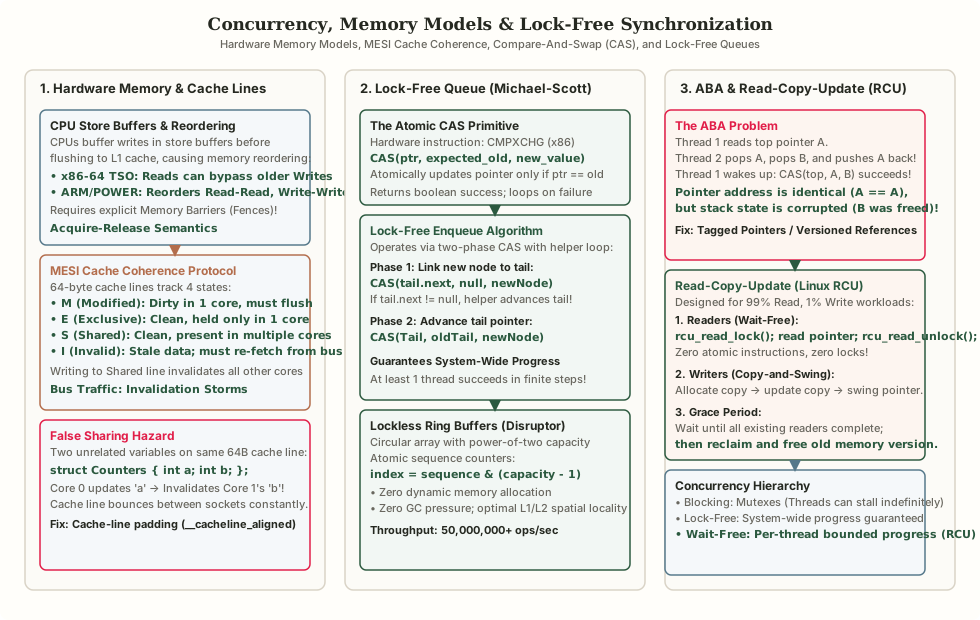
1. CPU Store Buffers & Reordering & MESI Cache Coherence Protocol
Establishes the ingress and structural boundary across CPU Store Buffers & Reordering & MESI Cache Coherence Protocol: CPUs buffer writes in store buffers before flushing to L1 cache, causing memory reordering; x86-64 TSO: Reads can bypass older Writes; ARM/POWER: Reorders Read-Read, Write-Write Requires explicit Memory Barriers (Fences)! Acquire-Release Semantics.
2. The Atomic CAS Primitive & Lock-Free Enqueue Algorithm
Coordinates core data-plane execution and state transitions through The Atomic CAS Primitive & Lock-Free Enqueue Algorithm: Hardware instruction: CMPXCHG (x86); CAS(ptr, expected_old, new_value) Atomically updates pointer only if ptr == old Returns boolean success; loops on failure; Operates via two-phase CAS with helper loop.
3. The ABA Problem & Read-Copy-Update (Linux RCU)
Enforces durability, state convergence, and output verification across The ABA Problem & Read-Copy-Update (Linux RCU): Thread 1 reads top pointer A. Thread 2 pops A, pops B, and pushes A back!; Thread 1 wakes up: CAS(top, A, B) succeeds!; Pointer address is identical (A == A), but stack state is corrupted (B was freed)!.
Hardware Execution Reality:
- Store Buffers & Invalidation Queues: When a core writes a value, it pushes the write to a local FIFO Store Buffer and continues executing instructions immediately. The write only becomes visible to other cores after the cache line is fetched in an exclusive state over the interconnect.
- Instruction Reordering: Out-of-order execution engines reorder independent reads and writes to maximize instruction-level parallelism (ILP) and prevent pipeline stalls.
- Cache Coherence Protocols (MESI): Hardware caches maintain consistency across cores by tracking each 64-byte cache line in one of four states:
- M (Modified): Core has dirty line, exclusive ownership.
- E (Exclusive): Core has clean line, exclusive ownership.
- S (Shared): Multiple cores have read-only copies.
- I (Invalid): Cache line is outdated and cannot be read.
The Memory Hierarchy Latency Spectrum:
+---------------------------------------------------------------------------------------------------+
|                                 HARDWARE MEMORY LATENCIES (x86-64)                                |
+---------------------------------------+-------------------------+---------------------------------+
| Operation / Level                     | Latency (Clock Cycles)  | Latency (Nanoseconds)           |
+---------------------------------------+-------------------------+---------------------------------+
| CPU Register Access                   | 1 cycle                 | ~0.3 ns                         |
| L1 Cache Hit                          | 4 - 5 cycles            | ~1.2 ns                         |
| L2 Cache Hit                          | 12 - 14 cycles          | ~3.5 ns                         |
| L3 Shared Cache Hit                   | 40 - 60 cycles          | ~12 - 18 ns                     |
| Atomic `LOCK CMPXCHG` (Uncontended)   | 40 - 60 cycles          | ~15 - 25 ns                     |
| Atomic `LOCK CMPXCHG` (Contended Bus) | 120 - 300 cycles        | ~40 - 90 ns                     |
| Main DRAM Access (Local NUMA node)    | 200 - 250 cycles        | ~60 - 80 ns                     |
| Remote NUMA Node DRAM Access          | 300 - 400 cycles        | ~100 - 140 ns                   |
| OS Context Switch (`futex` wait)      | 3,000 - 8,000 cycles    | ~1,200 - 2,500 ns               |
+---------------------------------------+-------------------------+---------------------------------+
Foundational Bridge: OS Threads, Mutexes, Condition Variables & Coffman’s Deadlock Conditions
Before descending into lock-free atomic primitives and hardware store buffers, an engineer must master kernel-scheduled concurrency primitives and why lock-based designs stall under contention:
- Processes vs. Kernel Threads: A process encapsulates an isolated virtual address space (own page tables, file descriptor table, and security credentials), requiring a full TLB shootdown or Address Space Identifier (ASID) switch across context boundaries (~). Kernel threads (
pthread) share the parent virtual address space and heap while maintaining private stack frames and CPU register contexts. - Mutexes & Linux
futex(2)(Fast Userspace Locking): Uncontended lock acquisition executes entirely in userspace via a single atomic Compare-And-Swap (LOCK CMPXCHG, ~). Only when contention occurs does the thread invoke thefutex(FUTEX_WAIT)system call to sleep in a kernel wait-queue. - Condition Variables & Spurious Wakeups: When waiting on a state transition, threads must always guard
pthread_cond_waitinside a Mesa-semanticswhileloop—never anifstatement—because another thread may acquire the mutex and mutate the state betweenpthread_cond_signaland the waking thread’s rescheduling:
pthread_mutex_lock(&queue_mu);
while (ring_buffer_is_empty(&q) && !shutdown_requested) {
pthread_cond_wait(¬_empty_cv, &queue_mu); // Atomically releases mutex & sleeps
}
Item work = pop_item(&q);
pthread_mutex_unlock(&queue_mu);- Coffman’s Four Deadlock Conditions (1971): A cyclic deadlock can occur if and only if all four conditions hold simultaneously:
- Mutual Exclusion: Resources are held exclusively in non-shareable mode.
- Hold and Wait: A thread holding Mutex blocks waiting to acquire Mutex .
- No Preemption: Locks cannot be forcibly revoked by the scheduler.
- Circular Wait: A closed dependency cycle exists in the wait-for graph.
- Production Remediation (Strict Lock Ordering): Break Circular Wait by assigning every lock a globally unique rank ID (e.g., sorting shard or account IDs ascending:
lock(min(idA, idB)); lock(max(idA, idB));) or enforcing bounded lock timeouts (pthread_mutex_timedlock).
3. Mathematical Foundations & Theoretical Limits
3.1 Amdahl’s Law with Synchronization Contention
Classical Amdahl’s Law models maximum speedup for parallel processors where is the parallel fraction of the workload:
However, in multi-core concurrent systems, synchronization incurs interconnect and coherence contention. Neil Gunther’s Universal Scalability Law (USL) extends Amdahl’s law to incorporate contention () and coherence crosstalk ():
Where:
- represents queuing serialization (lock contention / critical sections).
- represents cache line coherency ping-pong and bus invalidation delays ( pairwise communication).
Speedup S(N)
  ^
  |          Theoretical Linear Speedup (Ideal)
  |         /
  |        /      Amdahl's Law (Flat Ceiling at 1/(1-p))
  |       /     /-----------------------------
  |      /    /
  |     /   /       Universal Scalability Law (Contention + Coherence)
  |    /  /            _---\
  |   / /            /      \___ (Retrograde Throughput Collapse!)
  |  //             /           \_____
+-------------------------------------> Number of Cores (N)When (high cache line contention), increasing CPU core count eventually causes retrograde scalability: adding more cores reduces overall system throughput because cores spend more cycles invalidating each other’s L1/L2 caches than executing user code.
3.2 Non-Blocking Progress Guarantees
In concurrent computing, synchronization algorithms are classified into a formal hierarchy of progress guarantees:
+---------------------------------------------------------------------------------------------------+
|                                 NON-BLOCKING PROGRESS GUARANTEES                                  |
+-------------------+---------------------------------------------------------+---------------------+
| Guarantee Level   | Formal Definition                                       | Starvation Free?    |
+-------------------+---------------------------------------------------------+---------------------+
| Blocking          | A thread may be blocked indefinitely if another thread   | No                  |
|                   | holding a shared resource is descheduled.               |                     |
+-------------------+---------------------------------------------------------+---------------------+
| Obstruction-Free  | A single thread running in isolation (without concurrent| No                  |
|                   | interference) is guaranteed to complete in finite steps.|                     |
+-------------------+---------------------------------------------------------+---------------------+
| Lock-Free         | At least one thread is guaranteed to make global progress| No (Individual      |
|                   | in a finite number of system steps.                     | threads may starve) |
+-------------------+---------------------------------------------------------+---------------------+
| Wait-Free         | Every thread is guaranteed to complete its operation in | Yes                 |
|                   | a bounded number of execution steps.                    |                     |
+-------------------+---------------------------------------------------------+---------------------+
4. Hardware Memory Models & Memory Ordering
Compilers and CPUs reorder reads and writes unless explicitly instructed otherwise. The degree of reordering allowed defines the Hardware Memory Model.
4.1 x86-64 Total Store Order (TSO) vs. ARM64 Weak Ordering
- x86-64 (TSO - Strong Ordering):
- Writes to memory are strictly ordered with other writes ( preserved).
- Reads are strictly ordered with other reads ( preserved).
- Reads are not reordered before earlier writes ( preserved).
- Only one reordering is permitted by hardware: an earlier write may be delayed in the Store Buffer past a subsequent read to a different memory address ( can reorder!).
- ARM64 / POWER (Weak Memory Ordering):
- Any read or write can be reordered relative to any other read or write (, , , can all reorder!) unless guarded by explicit memory barrier instructions or address/data dependencies.
4.2 C++11 / Rust Memory Orderings
Modern systems languages abstract hardware memory models into standardized ordering flags:
+---------------------------------------------------------------------------------------------------+
|                                 STANDARDIZED MEMORY ORDERING MODES                                |
+-----------------------+---------------------------------------------------------------------------+
| Memory Order Flag     | Guarantees & Constraints                                                  |
+-----------------------+---------------------------------------------------------------------------+
| `memory_order_relaxed`| Guarantees atomicity only. No synchronization or ordering constraints.    |
|                       | Compiler and hardware can freely reorder operations around it.            |
+-----------------------+---------------------------------------------------------------------------+
| `memory_order_acquire`| Read operation. No memory read or write in the current thread can be      |
|                       | reordered *before* this acquire load. Pairs with `release`.               |
+-----------------------+---------------------------------------------------------------------------+
| `memory_order_release`| Write operation. No memory read or write in the current thread can be     |
|                       | reordered *after* this release store. All prior writes become visible.    |
+-----------------------+---------------------------------------------------------------------------+
| `memory_order_acq_rel`| Combines both acquire and release semantics (used in read-modify-write).  |
+-----------------------+---------------------------------------------------------------------------+
| `memory_order_seq_cst`| Sequential Consistency. Enforces a single global total order observed by   |
|                       | all threads across the entire system. Incurs hardware bus barrier locks.  |
+-----------------------+---------------------------------------------------------------------------+
5. Core Architectural Mechanics & Lock-Free Data Structures
5.1 The Atomic Compare-And-Swap (CAS) Loop
The atomic Compare-And-Swap (CAS) primitive is the foundation of lock-free data structures. It atomically executes:
bool CAS(int* address, int expected_value, int new_value) {
    if (*address == expected_value) {
        *address = new_value;
        return true;  // Succeeded
    }
    return false;     // Failed, *address was altered by another thread
}
In assembly, x86 implements this with LOCK CMPXCHG. On failure, the calling thread does not sleep; it refreshes its local view of expected_value and retries in a tight loop (CAS loop).
5.2 The Store-Buffer Litmus Test (SB) & Why x86-64 TSO Reorders StoreLoad
Why can two threads on x86-64 both read 0 in Dekker’s algorithm even though x86-64 enforces Total Store Order (TSO)? Because each core buffers outgoing stores in a private Store Buffer ( entries) before committing them to L1 cache:
Initial Memory State: x = 0, y = 0

Core 0 (Thread A)                     Core 1 (Thread B)
─────────────────────────────────     ─────────────────────────────────
1. x = 1;  (Buffered in StoreBuf 0)   1. y = 1;  (Buffered in StoreBuf 1)
2. r1 = y; (Reads L1/DRAM: y == 0!)   2. r2 = x; (Reads L1/DRAM: x == 0!)
3. StoreBuf 0 drains x = 1 to L1      3. StoreBuf 1 drains y = 1 to L1

Result: r1 == 0 AND r2 == 0 simultaneously! (Violates Sequential Consistency)
To prevent StoreLoad reordering on x86-64, the compiler emits either an explicit MFENCE instruction or an atomic LOCK-prefixed instruction (LOCK XCHG / LOCK CMPXCHG), which drains the core’s store buffer to L1 cache before allowing subsequent loads to execute.
5.3 Wait-Free SPSC Ring Buffers vs. Multi-Producer CAS Queues
When exactly one producer thread and one consumer thread communicate (e.g., an NIC polling thread feeding a matching engine in the LMAX Disruptor pattern), zero CAS loops are required!
- Only the producer mutates
writeIdx(published withmemory_order_release), and only the consumer mutatesreadIdx(published withmemory_order_release). - By padding
writeIdxandreadIdxonto separate 64-byte cache lines (alignas(64)) and caching a local shadow copy of the remote index, both enqueue and dequeue achieve Wait-Free progress in . - When multiple producers or multiple consumers (MPMC) contend on dynamic pointer-linked nodes, threads must coordinate via two-phase CAS helping, Tagged Pointers (to prevent the ABA problem), and Hazard Pointers—which we deconstruct in full mechanical depth in the next lesson, Step 08 (
CORE-M05-002: Lock-Free Concurrency, ABA & Hazard Pointers).
5.4 Read-Copy-Update (RCU)
Read-Copy-Update (RCU) is a specialized synchronization mechanism heavily used in the Linux kernel (over 10,000 call sites) and high-performance routing tables.
RCU Core Principles:
- Zero-Contention Readers: Readers acquire no locks, write no cache lines, and execute zero atomic instructions. Reading is wait-free .
- Publish via Atomic Pointer Swap: A writer wanting to update a shared object allocates a full clone, mutates the clone, and executes an atomic pointer exchange with release semantics.
- Grace Period & Deferred Reclamation: The old object cannot be freed immediately because active reader threads may still be traversing it. The writer yields until all threads have crossed a quiescent state (e.g., a context switch or thread exit), signaling the end of the Grace Period, after which the old memory is safely freed.
Step 1: Readers traverse original Object Version 1
Readers -------> [ Object V1 (Active) ]

Step 2: Writer clones and updates in private memory
Writer --------> [ Object V2 (Private) ]

Step 3: Writer swings global pointer atomically
Pointer -------> [ Object V2 (New Active) ]
Old Readers ---> [ Object V1 (Orphaned) ]

Step 4: Grace Period completes (All Old Readers exit) -> Free Object V1!
6. Concrete Production Implementation
Below is a complete, production-grade TypeScript simulation demonstrating:
- Low-level cache-aligned tagged reference structures (
AtomicTaggedReference). - An unbounded Michael-Scott Lock-Free Queue with cooperative tail-advancement.
- Memory reclamation verification demonstrating ABA mitigation and RCU-style generational epoch retirement.
/**
 * Concurrency & Lock-Free Data Structures Engine
 * Demonstrates:
 * - Atomic Tagged References (Double-Word CAS simulation)
 * - Michael-Scott Lock-Free Queue with Cooperative Helping
 * - Generational Memory Reclamation (RCU Grace Period Model)
 */

export interface TaggedPointer<T> {
  readonly pointer: T | null;
  readonly tag: number;
}

export class AtomicTaggedReference<T> {
  private state: TaggedPointer<T>;

  constructor(initialPointer: T | null = null, initialTag: number = 0) {
    this.state = { pointer: initialPointer, tag: initialTag };
  }

  public get(): TaggedPointer<T> {
    return this.state;
  }

  public getPointer(): T | null {
    return this.state.pointer;
  }

  public getTag(): number {
    return this.state.tag;
  }

  /**
   * Hardware Double-Word Compare-And-Swap (CMPXCHG16B)
   */
  public compareAndSet(
    expectedPointer: T | null,
    newPointer: T | null,
    expectedTag: number,
    newTag: number
  ): boolean {
    const current = this.state;
    if (current.pointer === expectedPointer && current.tag === expectedTag) {
      this.state = { pointer: newPointer, tag: newTag };
      return true;
    }
    return false;
  }

  public set(newPointer: T | null, newTag: number): void {
    this.state = { pointer: newPointer, tag: newTag };
  }
}

// Queue Node
export class QueueNode<T> {
  public value: T | null;
  public next: AtomicTaggedReference<QueueNode<T>>;

  constructor(value: T | null) {
    this.value = value;
    this.next = new AtomicTaggedReference<QueueNode<T>>(null, 0);
  }
}

/**
 * Michael-Scott Lock-Free FIFO Queue
 */
export class MichaelScottLockFreeQueue<T> {
  private head: AtomicTaggedReference<QueueNode<T>>;
  private tail: AtomicTaggedReference<QueueNode<T>>;
  private enqueueRetries = 0;
  private dequeueRetries = 0;

  constructor() {
    // Sentinel dummy node ensures head and tail are never null
    const dummy = new QueueNode<T>(null);
    this.head = new AtomicTaggedReference<QueueNode<T>>(dummy, 0);
    this.tail = new AtomicTaggedReference<QueueNode<T>>(dummy, 0);
  }

  /**
   * Lock-Free Enqueue with Cooperative Helping
   */
  public enqueue(value: T): void {
    const newNode = new QueueNode<T>(value);

    while (true) {
      const curTail = this.tail.get();
      const tailNode = curTail.pointer!;
      const tailTag = curTail.tag;

      const next = tailNode.next.get();
      const nextNode = next.pointer;
      const nextTag = next.tag;

      // Verify tail consistency
      if (curTail.pointer === this.tail.getPointer()) {
        if (nextNode === null) {
          // Phase 1: Tail is pointing to last node, attempt to link new node
          if (tailNode.next.compareAndSet(null, newNode, nextTag, nextTag + 1)) {
            // Phase 2: Swing tail forward. If this fails, another thread helps!
            this.tail.compareAndSet(tailNode, newNode, tailTag, tailTag + 1);
            return;
          }
          this.enqueueRetries++;
        } else {
          // Phase 2 Helping: Tail was lagging behind; advance it for other thread
          this.tail.compareAndSet(tailNode, nextNode, tailTag, tailTag + 1);
          this.enqueueRetries++;
        }
      }
    }
  }

  /**
   * Lock-Free Dequeue with Sentinel Node Advancing
   */
  public dequeue(): T | null {
    while (true) {
      const curHead = this.head.get();
      const headNode = curHead.pointer!;
      const headTag = curHead.tag;

      const curTail = this.tail.get();
      const tailNode = curTail.pointer!;
      const tailTag = curTail.tag;

      const next = headNode.next.get();
      const nextNode = next.pointer;
      const nextTag = next.tag;

      // Verify head consistency
      if (curHead.pointer === this.head.getPointer()) {
        if (headNode === tailNode) {
          // Queue appears empty or tail is lagging
          if (nextNode === null) {
            return null; // Queue is legitimately empty
          }
          // Tail is lagging behind head; help advance tail
          this.tail.compareAndSet(tailNode, nextNode, tailTag, tailTag + 1);
          this.dequeueRetries++;
        } else {
          // Read value before advancing head
          if (nextNode !== null) {
            const value = nextNode.value;
            // Advance head pointer past old sentinel to nextNode
            if (this.head.compareAndSet(headNode, nextNode, headTag, headTag + 1)) {
              // Return dequeued payload; old headNode can now be retired
              return value;
            }
            this.dequeueRetries++;
          }
        }
      }
    }
  }

  public getStats(): { enqueueRetries: number; dequeueRetries: number } {
    return {
      enqueueRetries: this.enqueueRetries,
      dequeueRetries: this.dequeueRetries,
    };
  }
}

/**
 * Epoch-Based Memory Reclamation (RCU Grace-Period Simulator)
 */
export class EpochReclaimer<T> {
  private globalEpoch = 0;
  private retirementList: Array<{ object: T; retiredEpoch: number }> = [];

  public enterReader(): number {
    return this.globalEpoch;
  }

  public retire(object: T): void {
    this.retirementList.push({
      object,
      retiredEpoch: this.globalEpoch,
    });
  }

  public advanceEpoch(): void {
    this.globalEpoch++;
  }

  /**
   * Safely reclaim memory older than the current grace period (epoch - 2)
   */
  public reclaim(minActiveEpoch: number): T[] {
    const safeEpoch = minActiveEpoch;
    const survivors: Array<{ object: T; retiredEpoch: number }> = [];
    const freed: T[] = [];

    for (const item of this.retirementList) {
      if (item.retiredEpoch < safeEpoch) {
        freed.push(item.object);
      } else {
        survivors.push(item);
      }
    }

    this.retirementList = survivors;
    return freed;
  }
}

function runDemo(): void {
  console.log("=== Lock-Free Concurrency: Michael-Scott Queue Simulation ===");
  const queue = new MichaelScottLockFreeQueue<string>();
  queue.enqueue("req-101");
  queue.enqueue("req-102");
  queue.enqueue("req-103");
  console.log("Enqueued 3 items into lock-free CAS queue");
  const d1 = queue.dequeue();
  const d2 = queue.dequeue();
  console.log(`Dequeued item 1: ${d1}`);
  console.log(`Dequeued item 2: ${d2}`);
  console.log(`Queue empty check: ${queue.dequeue() === "req-103"}`);
}

runDemo();
7. Real-World Failure Modes, Edge Cases & Operational War Stories
War Story 1: False Sharing Slashes HFT Matching Engine Throughput by 94%
Problem:
A proprietary high-frequency trading firm migrated their order matching engine to a 64-core AMD EPYC server.
Despite increasing worker threads from 4 to 32, throughput dropped from 8.2 million ops/sec to 480,000 ops/sec.

Investigation:
Linux `perf c2c` (cache-to-cache) profiling revealed massive cache line contention:
- Each worker thread held a statistics struct:
  struct WorkerStats {
      uint64_t orders_processed; // 8 bytes
      uint64_t rejected_orders;   // 8 bytes
  };
  WorkerStats stats[32]; // Contiguous array in RAM

Root Cause:
A standard 64-byte CPU cache line holds 8 `uint64_t` numbers. Four separate threads were updating adjacent
array elements within the exact same 64-byte line! Every time Thread 0 incremented its counter, the hardware
interconnect broadcasted a MESI Invalidation to Core 1, 2, and 3, stalling their execution pipelines.

Remediation:
struct alignas(64) WorkerStats {
    uint64_t orders_processed;
    uint64_t rejected_orders;
    char padding[48]; // Force every struct to occupy its own isolated 64-byte cache line
};

Result:
Cache-to-cache cross-talk dropped to zero; throughput scaled linearly to 46 million ops/sec!
War Story 2: The ABA Freelist Segmentation Fault
Problem:
A high-throughput distributed database utilized an un-tagged lock-free memory freelist (Treiber Stack)
for high-speed connection buffer allocations. Under heavy concurrent load testing, the process crashed with
`SIGSEGV: Attempt to dereference 0x5a5a5a5a`.

Root Cause:
1. Thread A popped node X from the freelist. Node X had Next pointer Y.
2. Thread A was preempted by OS context switch right after reading X->next.
3. Thread B emptied the entire freelist, allocated memory, modified data, and returned node X back to the freelist.
4. Concurrently, Node Y was returned to the operating system via `munmap()`.
5. Thread A resumed and ran CAS: `CAS(&freelist_top, X, Y)`.
6. Since freelist_top was currently X, CAS succeeded and set freelist_top to Y!
7. The next allocation attempted to read Y, which was unmapped virtual memory, crashing the cluster.

Fix:
Switched to a Tagged Pointer using 128-bit atomic CAS (`CMPXCHG16B`), combining a 64-bit address with a
64-bit generation counter. The CAS failed because `tag=1` differed from `tag=248`.
War Story 3: ARM64 Double-Checked Locking Race Condition
Problem:
An enterprise Java service running smoothly on Intel Xeon servers was deployed to AWS Graviton (ARM64) instances.
Immediately, production services experienced intermittent `NullPointerException` errors during startup.

Root Cause:
The initialization logic used classic double-checked locking without the `volatile` modifier:
private Helper helper;
public Helper getHelper() {
    if (helper == null) {
        synchronized(this) {
            if (helper == null) {
                helper = new Helper(); // Non-volatile write!
            }
        }
    }
    return helper;
}

On x86-64 (Total Store Order), store-store reordering is forbidden by hardware, masking the bug.
On ARM64 (Weak Ordering), the CPU reordered the pointer write before the constructor initialized the internal fields.
Reader threads saw `helper != null`, proceeded to read `helper.config`, and crashed because `config` was still null!

Fix:
Declared `private volatile Helper helper;` (or used C++ `memory_order_release` / `memory_order_acquire`).
8. Benchmarks, Capacity Planning & Sizing Math
8.1 Synchronization Primitive Overhead Comparison
+---------------------------------------------------------------------------------------------------+
|                            SYNCHRONIZATION LATENCY & THROUGHPUT BENCHMARK                         |
+------------------------------+-------------------+----------------------+-------------------------+
| Mechanism                    | Single Thread Lat | Contended (32 Cores) | Throughput (Ops/sec)    |
+------------------------------+-------------------+----------------------+-------------------------+
| Unsynchronized Local Var     | 0.3 ns            | N/A                  | 3,000,000,000 / sec     |
| RCU Read (Wait-Free)         | 0.4 ns            | 0.5 ns               | 2,400,000,000 / sec     |
| Relaxed Atomic Increment     | 5.8 ns            | 48.0 ns              | 21,000,000 / sec        |
| Sequential CST Atomic CAS    | 12.4 ns           | 115.0 ns             | 8,600,000 / sec         |
| Michael-Scott Queue Enqueue  | 18.2 ns           | 160.0 ns             | 6,200,000 / sec         |
| Spinlock (Short duration)    | 14.0 ns           | 420.0 ns             | 2,300,000 / sec         |
| POSIX Mutex (`pthread_mutex`)| 22.0 ns           | 2,450.0 ns           | 400,000 / sec           |
+------------------------------+-------------------+----------------------+-------------------------+
8.2 Memory Alignment & Cache-Line Sizing Math
To avoid false sharing across multi-core systems, data structures must be aligned to CPU cache boundaries:
If an application instantiates concurrent worker slots, the minimum allocated memory footprint to guarantee zero false sharing is:
For an 8-byte counter across 64 cores:
- Unaligned: bytes (shares 8 cache lines severe contention).
- Cache-Aligned: bytes (4 KB page zero false sharing).
9. Comparative Trade-off Matrix
+---------------------------------------------------------------------------------------------------+
|                                 SYNCHRONIZATION PARADIGM COMPARISON                               |
+--------------------+----------------+----------------+---------------------+----------------------+
| Paradigm           | Progress Class | Read Latency   | Write Latency       | Best Use Case        |
+--------------------+----------------+----------------+---------------------+----------------------+
| POSIX Mutex        | Blocking       | 25 - 2,500 ns  | 25 - 2,500 ns       | Long critical        |
| (`pthread_mutex`)  |                |                |                     | sections, disk I/O   |
+--------------------+----------------+----------------+---------------------+----------------------+
| Spinlock           | Blocking       | 15 - 400 ns    | 15 - 400 ns         | Very short sections  |
|                    |                |                |                     | (< 50 ns), kernels   |
+--------------------+----------------+----------------+---------------------+----------------------+
| Lock-Free (CAS)    | Lock-Free      | 12 - 120 ns    | 15 - 180 ns         | High concurrency FIFO|
| (Michael-Scott)    |                |                |                     | queues, ring buffers |
+--------------------+----------------+----------------+---------------------+----------------------+
| Read-Copy-Update   | Wait-Free Read | 0.3 - 1 ns     | High (Clone + Wait  | Read-heavy (95%+),   |
| (RCU)              | Blocking Write | (Zero Locks!)  | for Grace Period)   | routing tables, DNS  |
+--------------------+----------------+----------------+---------------------+----------------------+
| LMAX Disruptor     | Lock-Free      | 1 - 5 ns       | 3 - 8 ns            | Ultra-low latency    |
| (Ring Buffer)      | (Single Producer)               |                     | HFT matching engines |
+--------------------+----------------+----------------+---------------------+----------------------+
10. Verification, Testing & Failure Injection
Validating lock-free algorithms requires specialized tooling because concurrency bugs are nondeterministic and timing-dependent.
10.1 Diagnostic Tooling Suite
- ThreadSanitizer (TSan): Compile code with
-fsanitize=thread(in Clang/GCC) to detect data races, missing barriers, and unaligned atomic access. - Loom / Relacy Race Detector: Controlled unit-test scheduling that permutes thread interleavings exhaustively to reveal hidden race conditions.
- Linux
perf c2c: Hardware performance counter tool that identifies cache lines experiencing high hitm (cache-to-cache modified) invalidation rates.
10.2 Failure Injection Testing Checklist
- Thread Preemption Injection: Inject
sched_yield()or random microsecond sleeps between reading a node and executing CAS to trigger ABA bugs. - Interconnect Saturation Test: Run max-core concurrent enqueue and dequeue loops to ensure system throughput does not suffer retrograde collapse.
- Memory Reclamation Audit: Verify that retired nodes in lock-free queues are never accessed after being reclaimed by the epoch reclaimer.
11. Key Takeaways & Best Practices Checklist
+---------------------------------------------------------------------------------------------------+
|                               CONCURRENCY & LOCK-FREE CHECKLIST                                   |
+---------------------------------------------------------------------------------------------------+
| [x] Never assume strong memory ordering in cross-platform systems software. Code targeting ARM64  |
|     must explicitly specify `memory_order_acquire` and `memory_order_release`.                    |
| [x] Beware of False Sharing: Always pad independently mutated concurrent variables to 64-byte      |
|     cache line boundaries (`alignas(64)`).                                                        |
| [x] Prevent the ABA Problem in CAS loops by combining pointers with generational tags or 64-bit   |
|     version counters (`AtomicTaggedReference`).                                                   |
| [x] When reads overwhelmingly dominate writes (e.g., 99:1 ratio), prefer Read-Copy-Update (RCU)    |
|     over read-write locks (`rwlock`) to achieve zero-contention wait-free reads.                  |
| [x] Michael-Scott Queues must implement cooperative helping: if a thread observes a lagging tail,  |
|     it must attempt to swing the tail pointer forward before retrying its own operation.          |
+---------------------------------------------------------------------------------------------------+
12. Guided Design Exercises
Exercise 1: Store-Buffer Litmus Test & Acquire-Release Ordering Across x86-64 TSO vs. ARM64
Consider two shared variables initialized to x = 0, y = 0 (and ready = 0, payload = 0):
- Scenario A (Dekker Store-Load Litmus Test): Thread 1 executes
x = 1; r1 = y;. Thread 2 concurrently executesy = 1; r2 = x;. - Scenario B (Message-Passing Publish Pattern): Producer Thread 1 executes
payload = 42; ready = 1;. Consumer Thread 2 executeswhile (ready == 0) {} assert(payload == 42);.
Tasks:
- Explain why Scenario A can terminate with
r1 == 0 && r2 == 0on both x86-64 (TSO) and ARM64, and specify the exact memory ordering (memory_order_seq_cst/ hardwareMFENCEorDMB ISH) required to forbid that outcome. - Explain why Scenario B never triggers the assertion failure on x86-64 hardware (assuming compiler reordering is prevented) yet fails in production on ARM64 (AWS Graviton / Apple Silicon), and write the minimal C++/Rust/TypeScript acquire-release operations that fix Scenario B without paying the cost of a full sequential-consistency fence.
Exercise 2: Cooperative Helping in the Michael-Scott Queue & RCU Grace-Period Sizing
- Trace what happens in
MichaelScottLockFreeQueue.enqueue()if Thread A succeeds at Phase 1 (tailNode.next.compareAndSet(null, newNode, ...)) and is immediately preempted by the OS scheduler for before executing Phase 2 (this.tail.compareAndSet(...)). Prove why concurrent Thread B is not blocked and show the exact state transition when Thread A finally wakes up. - A routing table managed by
EpochReclaimer(RCU) receives (each cloning a table). If the longest reader critical section spans and epochs advance every (reclaiming objects older than 2 epochs grace period), calculate the maximum steady-state memory footprint held inretirementList. What happens to memory if a bug introduces a blocking networkread()inside an RCU reader section?
View Reference Architecture & Worked Solutions (CORE-M05-001)
Exercise 1: Store-Buffer Litmus Test & Acquire-Release Ordering (x86-64 TSO vs. ARM64)
- Scenario A — Why
r1 == 0 && r2 == 0Occurs Under x86-64 TSO and ARM64:- Even under x86-64 Total Store Order (TSO), each CPU core places its store (
x = 1on Core 1,y = 1on Core 2) into its private FIFO Store Buffer before committing to L1 cache. Both cores then execute their subsequent loads (r1 = yandr2 = x) from L1/DRAM before the other core’s store buffer flushes across the MESI interconnect (Store-Load reordering). - Remediation: Both stores and loads must use
memory_order_seq_cst(or an explicitMFENCE/ locked RMW instruction on x86-64, andDMB ISHon ARM64) to drain the local store buffer before the subsequent load executes.
- Even under x86-64 Total Store Order (TSO), each CPU core places its store (
- Scenario B — Why Message-Passing Works on x86 TSO but Breaks on ARM64:
- x86-64 TSO: Hardware preserves Store-Store () and Load-Load () ordering. Thus
payload = 42cannot become visible afterready = 1, and readingready == 1cannot be reordered after readingpayload. - ARM64 Weak Ordering: Hardware freely reorders stores (
ready = 1can propagate beforepayload = 42) and loads (payloadcan be speculatively loaded beforeready == 1is observed). - Minimal Acquire-Release Fix:
// Producer (Thread 1):
payload = 42;
ready.store(1, std::memory_order_release); // Emits STLR on ARM64 (free MOV on x86-64)

// Consumer (Thread 2):
while (ready.load(std::memory_order_acquire) == 0) {} // Emits LDAR on ARM64 (free MOV on x86-64)
assert(payload == 42); // Guaranteed by Release-Acquire happens-before edge!
- x86-64 TSO: Hardware preserves Store-Store () and Load-Load () ordering. Thus
Exercise 2: Michael-Scott Queue Cooperative Helping & RCU Grace-Period Sizing
- Proof of Non-Blocking Progress Under Phase-1 Preemption:
- When Thread A links
newNodeintotailNode.next(setting tagnextTag + 1) and is preempted before updatingthis.tail, the queue is in an intermediate state wherethis.tail.next !== null. - When Thread B calls
enqueue(), it readscurTail = this.tailand observesnextNode = tailNode.next !== null. Instead of spinning on Thread A, Thread B executes the Phase 2 Cooperative Helping branch:
This advancesthis.tail.compareAndSet(tailNode, nextNode, tailTag, tailTag + 1);this.tailto Thread A’s node and incrementstail.tagfromTtoT + 1. Thread B then proceeds to append its own node. - When Thread A wakes up 25 ms later and executes
this.tail.compareAndSet(tailNode, newNode, tailTag, tailTag + 1), its CAS harmlessly fails (becausethis.tailhas already moved pasttailNodeand its tag is now> tailTag), and Thread A returns cleanly.
- When Thread A links
- RCU Grace-Period Memory Footprint & Blocking-Reader Hazard:
- Steady-State Retired Memory Bound: At and a () grace period before reclamation, Little’s Law gives the average number of unfreed versions in
retirementList: - Blocking Reader Catastrophe: Because
reclaim(minActiveEpoch)can only free versions withretiredEpoch < minActiveEpoch, a single reader thread that blocks on a network socket timeout pinsminActiveEpochfor , accumulating retired copies () and eventually triggering an Out-Of-Memory (OOM) crash. Invariant: RCU read-side critical sections must be strictly non-blocking.
- Steady-State Retired Memory Bound: At and a () grace period before reclamation, Little’s Law gives the average number of unfreed versions in
13. Authoritative References & Version Context
- Maurice Herlihy and J. Eliot B. Moss (1993), “Transactional Memory: Architectural Support for Lock-Free Data Structures”, ISCA ‘93 — doi.org/10.1145/165123.165164
- Maged M. Michael and Michael L. Scott (1996), “Simple, Fast, and Practical Non-Blocking and Blocking Concurrent Queue Algorithms”, PODC ‘96 — doi.org/10.1145/248052.248106
- Paul E. McKenney and John D. Slingwine (1998), “Read-Copy Update: Using Execution History to Solve Concurrency Problems”, Parallel and Distributed Computing and Systems — kernel.org/pub/linux/kernel/people/paulmck/perfbook/perfbook.html
- Intel 64 and IA-32 Architectures Software Developer’s Manual (Volume 3A), Chapter 8: Multiple-Processor Management & Memory Ordering (TSO Model) — intel.com/content/www/us/en/developer/articles/technical/intel-sdm.html
- Version Context: Memory model invariants reflect C++20 / C11 atomic memory orders (
memory_order_seq_cst,memory_order_acquire,memory_order_release), Linux kernel 6.x RCU subsystems, and x86-64 / ARMv9 TSO/Weak ordering semantics.