1. Problem and Motivation
For more than two decades, system architects were forced to choose between two mutually exclusive database paradigms:
+---------------------------------------------------------------------------------------------------+
|                                  THE CLASSICAL DATABASE PARADOX                                   |
+---------------------------------------------------+-----------------------------------------------+
| Traditional Relational DBMS (PostgreSQL / MySQL)  | Distributed NoSQL (Cassandra / DynamoDB)      |
+---------------------------------------------------+-----------------------------------------------+
| [x] Strong ACID Transactions (Multi-Row / Table)  | [ ] No Multi-Row ACID Transactions            |
| [x] Rich SQL Querying, Secondary Indexes & Joins  | [ ] Limited Key-Value / Partition Key Queries |
| [ ] Vertical Scale Ceiling (Single Write Master)  | [x] Linear Horizontal Scale (100s of Nodes)   |
| [ ] Manual Sharding Nightmare (Vitess, Citus)     | [x] Automated Sharding & High Availability    |
+---------------------------------------------------+-----------------------------------------------+
When relational databases grow beyond a single machine’s storage or write throughput, engineering teams resort to application-level sharding. This introduces immense complexity: cross-shard transactions require fragile application-level Two-Phase Commit, schema migrations must be applied across hundreds of independent shards, and secondary indexes become non-atomic and stale.
Distributed SQL (NewSQL)—pioneered by Google Spanner (2012) and open-source systems like TiDB/TiKV and CockroachDB—bridges this divide. It delivers standard SQL schemas, foreign keys, secondary indexes, and true Serializable ACID transactions combined with the horizontal scaling, automatic sharding, and multi-region fault tolerance of NoSQL engines.
2. Mental Model & Architectural Overview
A modern Distributed SQL database is architected in decoupled, modular tiers:
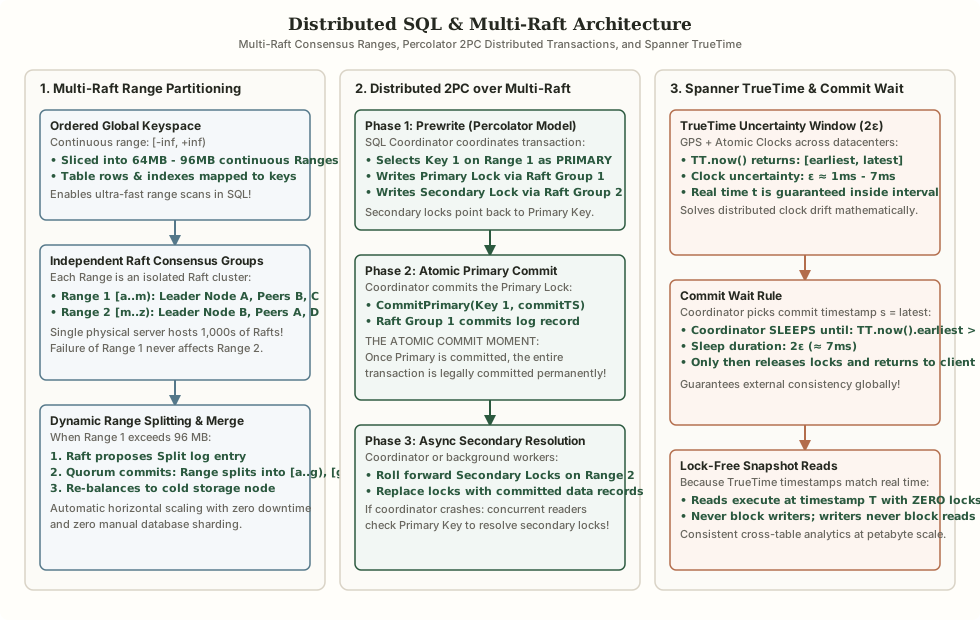
1. Ordered Global Keyspace & Independent Raft Consensus Groups
Establishes the ingress and structural boundary across Ordered Global Keyspace & Independent Raft Consensus Groups: Continuous range: [-inf, +inf); Sliced into 64MB - 96MB continuous Ranges; Table rows & indexes mapped to keys Enables ultra-fast range scans in SQL!.
2. Phase 1: Prewrite (Percolator Model) & Phase 2: Atomic Primary Commit
Coordinates core data-plane execution and state transitions through Phase 1: Prewrite (Percolator Model) & Phase 2: Atomic Primary Commit: SQL Coordinator coordinates transaction; Selects Key 1 on Range 1 as PRIMARY; Writes Primary Lock via Raft Group 1.
3. TrueTime Uncertainty Window (2ε) & Commit Wait Rule
Enforces durability, state convergence, and output verification across TrueTime Uncertainty Window (2ε) & Commit Wait Rule: GPS + Atomic Clocks across datacenters; TT.now() returns: [earliest, latest]; Clock uncertainty: ε ≈ 1ms - 7ms.
The Two-Tier Architecture:
- Stateless Compute Tier (SQL Layer - e.g., TiDB / CockroachDB SQL):
- Accepts MySQL or PostgreSQL wire-protocol connections.
- Parses, optimizes, and compiles SQL queries into distributed physical execution plans (Distributed Hash Joins, Index Scans).
- Coordinates distributed Two-Phase Commit (2PC) transactions across storage nodes.
- Holds zero persistent disk state: can scale horizontally behind a standard Layer 4 load balancer.
- Distributed Storage Tier (Multi-Raft Engine - e.g., TiKV / CockroachDB Pebble):
- Organizes the entire cluster’s data as a single global, monotonically sorted byte-array keyspace: .
- Automatically slices the keyspace into thousands of continuous 64MB–96MB partitions called Ranges (or Regions).
- Each Range is an independent Raft consensus group replicated across 3 or 5 storage nodes.
- High-throughput local storage is backed by an embedded LSM-Tree or B-Tree engine (RocksDB or Pebble).
3. Mathematical Foundations & Formal Mechanisms
3.1 Global Keyspace Mapping & Range Splitting
In a relational database, table rows and secondary indexes are encoded into sorted byte keys:
The keyspace is partitioned into disjoint, contiguous ranges:
When a Range exceeds a threshold (e.g., ):
- The Raft leader identifies the median key where bytes are roughly balanced ( each).
- The leader proposes a Raft log entry: .
- Upon quorum commitment, the original range is atomically converted into two sub-ranges:
3.2 Spanner TrueTime & The External Consistency Theorem
Google Spanner achieves External Consistency (Strict Serializability / Linearizability) globally using the TrueTime API:
Where:
- is the dynamically tracked worst-case clock uncertainty bound (typically ).
- The true absolute physical UTC time is guaranteed to fall within the interval: .
The External Consistency Invariant:
If transaction is initiated after transaction commits in real world time:
Where is the assigned commit timestamp of transaction .
The Commit Wait Rule:
- The transaction coordinator picks a proposed commit timestamp .
- Commit Wait: The coordinator guarantees has passed in real time by sleeping until:
- The sleep duration is at least .
- Once the sleep finishes, locks are released and success is returned to the client.
Because waits until is strictly in the past, any subsequent transaction is mathematically guaranteed to pick , eliminating the need for cross-datacenter communication during reads!
4. The Google Percolator Distributed 2PC Model
Most open-source Distributed SQL engines (TiDB/TiKV) implement the Google Percolator distributed transaction model layered over Multi-Raft.
Column Families per Key:
For every key , the storage engine maintains three internal columns:
data:K_startTS: Stores raw row values written at transaction start timestamp.lock:K: Stores active lock records indicating an in-flight transaction.write:K_commitTS: Stores the committed pointer linking commit timestamp tostartTS.
====================================================================================================
THE PERCOLATOR TWO-PHASE COMMIT PROTOCOL
====================================================================================================

Phase 1: Prewrite (Acquire Locks)
1. Coordinator requests Start Timestamp (startTS) from central Timestamp Oracle (TSO).
2. Selects one key as the PRIMARY KEY (Key 1); remaining keys become SECONDARIES (Key 2..N).
3. For Key 1 (Primary):
   - Check write conflict: ensure no write record exists with commitTS >= startTS.
   - Check lock conflict: ensure no lock record exists at any timestamp.
   - Write lock: lock:Key1 = { primary: Key1, startTS: startTS } via Raft Group 1.
4. For Secondary Keys (Key 2..N):
   - Check conflicts.
   - Write lock: lock:Key2 = { primary: Key1, startTS: startTS } (Pointers back to Primary!)

----------------------------------------------------------------------------------------------------

Phase 2: Commit (The Atomic Moment)
1. Coordinator requests Commit Timestamp (commitTS) from TSO.
2. Commit PRIMARY KEY:
   - Atomically remove lock:Key1 and write write:Key1_commitTS = startTS via Raft Group 1.
   - THIS IS THE SINGLE ATOMIC POINT OF COMMIT!
   - If this succeeds, the transaction is 100% committed permanently.
3. Commit SECONDARY KEYS:
   - Asynchronously remove lock:Key2 and write write:Key2_commitTS = startTS.
   - Even if the coordinator crashes right now, concurrent readers encountering Key 2's lock
     will inspect Key 1, discover it is committed, and roll Key 2 forward!
====================================================================================================
5. Concrete Production Implementation
Below is a complete, production-grade TypeScript implementation simulating:
- Multi-Raft Range partitioning with automatic range splits.
- The Percolator Distributed Two-Phase Commit transaction coordinator.
- Lock conflict detection, atomic primary commit, and secondary lock roll-forward.
/**
 * Distributed SQL & Multi-Raft Architecture Engine
 * Demonstrates:
 * - Multi-Raft Range Partitioning & Splitting
 * - Google Percolator-style Distributed 2PC
 * - Primary Lock Commit & Asynchronous Roll-Forward
 */

export interface StorageRecord {
  value: string;
  startTS: number;
}

export interface LockRecord {
  primaryKey: string;
  startTS: number;
  ttl: number;
}

export interface WriteRecord {
  startTS: number;
  commitTS: number;
}

/**
 * An individual Range acting as an independent Raft consensus group
 */
export class RaftRange {
  public readonly id: string;
  public startKey: string;
  public endKey: string;
  public dataCF: Map<string, StorageRecord> = new Map(); // data:key_startTS
  public lockCF: Map<string, LockRecord> = new Map();     // lock:key
  public writeCF: Map<string, WriteRecord> = new Map();   // write:key_commitTS
  public byteSize = 0;

  constructor(id: string, startKey: string, endKey: string) {
    this.id = id;
    this.startKey = startKey;
    this.endKey = endKey;
  }

  public contains(key: string): boolean {
    return key >= this.startKey && (this.endKey === "" || key < this.endKey);
  }

  public prewrite(key: string, value: string, primaryKey: string, startTS: number): boolean {
    // 1. Conflict check: Has any transaction committed after our startTS?
    for (const [wKey, wRec] of this.writeCF.entries()) {
      if (wKey.startsWith(`${key}_`) && wRec.commitTS >= startTS) {
        return false; // Write-write conflict!
      }
    }

    // 2. Lock check: Is the key locked by another transaction?
    if (this.lockCF.has(key)) {
      return false; // Lock contention!
    }

    // 3. Write data & lock
    this.dataCF.set(`${key}_${startTS}`, { value, startTS });
    this.lockCF.set(key, { primaryKey, startTS, ttl: Date.now() + 5000 });
    this.byteSize += value.length + key.length;

    return true;
  }

  public commitKey(key: string, startTS: number, commitTS: number): boolean {
    const lock = this.lockCF.get(key);
    if (!lock || lock.startTS !== startTS) {
      return false;
    }

    // Remove lock and add committed write entry atomically via Raft log
    this.lockCF.delete(key);
    this.writeCF.set(`${key}_${commitTS}`, { startTS, commitTS });
    return true;
  }

  public readSnapshot(key: string, readTS: number): string | null {
    // Find latest committed write with commitTS <= readTS
    let latestCommit: WriteRecord | null = null;

    for (const [wKey, wRec] of this.writeCF.entries()) {
      if (wKey.startsWith(`${key}_`) && wRec.commitTS <= readTS) {
        if (!latestCommit || wRec.commitTS > latestCommit.commitTS) {
          latestCommit = wRec;
        }
      }
    }

    if (!latestCommit) return null;
    const data = this.dataCF.get(`${key}_${latestCommit.startTS}`);
    return data ? data.value : null;
  }
}

/**
 * Distributed SQL Multi-Raft Storage Cluster
 */
export class DistributedStorageCluster {
  private ranges: RaftRange[] = [];
  private tsoClock = 100;

  constructor() {
    // Initial cluster starts with a single unbounded Range
    this.ranges.push(new RaftRange("range-0", "", ""));
  }

  public getTimestamp(): number {
    return ++this.tsoClock;
  }

  public getRangeForKey(key: string): RaftRange {
    const range = this.ranges.find((r) => r.contains(key));
    if (!range) throw new Error(`Routing error: No range covers key '${key}'`);
    return range;
  }

  /**
   * Dynamically split range when it exceeds size threshold
   */
  public splitRange(rangeId: string, splitKey: string): void {
    const index = this.ranges.findIndex((r) => r.id === rangeId);
    if (index === -1) return;

    const oldRange = this.ranges[index];
    const newRangeId = `range-${Date.now()}`;
    const newRange = new RaftRange(newRangeId, splitKey, oldRange.endKey);
    oldRange.endKey = splitKey;

    // Migrate keys
    for (const [k, v] of oldRange.dataCF.entries()) {
      const bareKey = k.slice(0, k.lastIndexOf("_"));
      if (newRange.contains(bareKey)) {
        newRange.dataCF.set(k, v);
        oldRange.dataCF.delete(k);
      }
    }
    for (const [k, v] of oldRange.writeCF.entries()) {
      const bareKey = k.slice(0, k.lastIndexOf("_"));
      if (newRange.contains(bareKey)) {
        newRange.writeCF.set(k, v);
        oldRange.writeCF.delete(k);
      }
    }
    for (const [k, v] of oldRange.lockCF.entries()) {
      if (newRange.contains(k)) {
        newRange.lockCF.set(k, v);
        oldRange.lockCF.delete(k);
      }
    }

    this.ranges.splice(index + 1, 0, newRange);
  }

  public getRanges(): RaftRange[] {
    return this.ranges;
  }
}

/**
 * Distributed 2PC Transaction Coordinator (Percolator Protocol)
 */
export class DistributedTxnCoordinator {
  private cluster: DistributedStorageCluster;

  constructor(cluster: DistributedStorageCluster) {
    this.cluster = cluster;
  }

  public async executeTransaction(mutations: Map<string, string>): Promise<{ committed: boolean; commitTS?: number; error?: string }> {
    const entries = Array.from(mutations.entries());
    if (entries.length === 0) return { committed: true };

    const startTS = this.cluster.getTimestamp();
    const primaryKey = entries[0][0];

    // Phase 1: Prewrite All Keys (Primary first, then secondaries)
    for (const [key, val] of entries) {
      const range = this.cluster.getRangeForKey(key);
      const ok = range.prewrite(key, val, primaryKey, startTS);
      if (!ok) {
        // Rollback any acquired locks on failure
        this.rollback(entries, startTS);
        return { committed: false, error: `Conflict during prewrite on key '${key}'` };
      }
    }

    // Phase 2: Commit Primary Key
    const commitTS = this.cluster.getTimestamp();
    const primaryRange = this.cluster.getRangeForKey(primaryKey);
    const primaryOk = primaryRange.commitKey(primaryKey, startTS, commitTS);

    if (!primaryOk) {
      this.rollback(entries, startTS);
      return { committed: false, error: "Failed to commit primary key" };
    }

    // ATOMIC POINT OF COMMIT ACHIEVED!
    // Asynchronously roll forward secondary keys
    for (let i = 1; i < entries.length; i++) {
      const [secKey] = entries[i];
      const secRange = this.cluster.getRangeForKey(secKey);
      secRange.commitKey(secKey, startTS, commitTS);
    }

    return { committed: true, commitTS };
  }

  private rollback(entries: Array<[string, string]>, startTS: number): void {
    for (const [key] of entries) {
      const range = this.cluster.getRangeForKey(key);
      const lock = range.lockCF.get(key);
      if (lock && lock.startTS === startTS) {
        range.lockCF.delete(key);
      }
    }
  }
}

async function runDemo(): Promise<void> {
  console.log("=== Distributed SQL: Multi-Raft & Percolator 2PC Distributed Transactions ===");
  const cluster = new DistributedStorageCluster();
  const coordinator = new DistributedTxnCoordinator(cluster);
  console.log("Initialized DistributedStorageCluster with Multi-Raft key ranges");
  const mutations = new Map<string, string>([
    ["acc_1001", "balance: 900"],
    ["acc_2002", "balance: 1100"]
  ]);
  const res = await coordinator.executeTransaction(mutations);
  console.log(`Percolator 2PC Transaction execution: ${res.committed ? 'COMMITTED' : 'ABORTED'} at commitTS=${res.commitTS}`);
  const range1 = cluster.getRangeForKey("acc_1001");
  const readVal = range1.readSnapshot("acc_1001", (res.commitTS ?? 200) + 1);
  console.log(`Snapshot read at commitTS+1: acc_1001 = '${readVal}'`);
}

runDemo();
Simulation Execution Output & State Transitions
=== Distributed SQL: Multi-Raft & Percolator 2PC Distributed Transactions ===
Initialized DistributedStorageCluster with Multi-Raft key ranges
Percolator 2PC Transaction execution: COMMITTED at commitTS=102
Snapshot read at commitTS+1: acc_1001 = 'balance: 900'
6. Real-World Failure Modes, Edge Cases & Operational War Stories
War Story 1: The Monotonic Key Range Split Storm
Incident:
A high-throughput e-commerce application migrated from MySQL to a 30-node Distributed SQL cluster.
During a flash-sale marketing campaign, write latency on the `orders` table suddenly degraded from
4 ms to 820 ms, and nodes began reporting Raft election timeouts.

Investigation:
The table schema used a standard auto-incrementing integer:
CREATE TABLE orders (
    order_id BIGINT AUTO_INCREMENT PRIMARY KEY,
    user_id BIGINT,
    amount DECIMAL
);

Root Cause:
Because `order_id` values increased monotonically, 100% of incoming `INSERT` transactions mapped to the
single tail Range covering keys `[CurrentMax, +inf)`. A single Raft leader node processed every insert!
The range continuously exceeded 96 MB, triggering endless Range Splits and Raft leader elections.
While 29 nodes sat completely idle (0% CPU), 1 node melted at 100% CPU.

Remediation:
Switched the primary key to a hash-distributed prefix:
`order_id BIGINT PRIMARY KEY /*T![auto_random(5)]*/`
The top 5 bits of the ID were randomized, scattering concurrent inserts evenly across 32 independent
Multi-Raft ranges and scaling cluster throughput to 180,000 inserts/sec.
War Story 2: Cross-Region 2PC Latency Explosion
Incident:
A multinational enterprise deployed a Distributed SQL database spanned across three cloud regions:
`us-east` (Northern Virginia), `eu-central` (Frankfurt), and `ap-southeast` (Singapore).
A financial checkout query that touched an inventory record in Singapore and a user balance in Frankfurt
took 680 ms to commit.

Root Cause:
Distributed Two-Phase Commit requires cross-network round-trips:
1. Prewrite Primary in Frankfurt (local: 2ms).
2. Prewrite Secondary in Singapore (cross-globe RTT: 160ms).
3. Raft log consensus replication within Singapore group (20ms).
4. Commit Primary in Frankfurt (160ms RTT).
Total serial network travel: $160\text{ms} + 160\text{ms} + \dots \approx 640\text{ms}$.

Remediation:
Implemented **Data Locality Partitioning**:
Configured table row placement policies (`PLACEMENT POLICY = 'region_eu'`) so related customer balances
and regional inventory records reside on the same local Multi-Raft ranges, keeping 2PC local to single regions.
War Story 3: Orphaned Secondary Locks Stall Analytical Readers
Incident:
During nightly ETL batch ingestion, an analytical dashboard query:
`SELECT SUM(balance) FROM accounts;`
hung indefinitely and eventually timed out with `TransactionLockTimeoutException`.

Root Cause:
A background batch worker executing an update crashed midway through Phase 2:
It committed the Primary Key on Range 1, but crashed before rolling forward the Secondary Lock on Range 42.
The analytical reader encountered the active `lock:account_42` record.
Because the lock resolution timeout had not yet expired, the reader waited for the dead coordinator.

Remediation:
Implemented **Percolator Lazy Lock Resolution**:
When a reader encounters a lock older than TTL (5 seconds), it does not wait: it reads the `primaryKey` pointer
stored inside the lock record. It inspects the Primary Key in Range 1:
- If Primary is COMMITTED: The reader rolls the secondary lock forward itself and reads the new value!
- If Primary is ROLLBACK or MISSING: The reader rolls the orphan lock back.
7. Benchmarks, Capacity Planning & Sizing Math
7.1 Distributed SQL Transaction Overhead Comparison
+---------------------------------------------------------------------------------------------------+
|                            TRANSACTION COMMIT LATENCY BENCHMARK                                   |
+--------------------------+---------------------+-------------------+------------------------------+
| Architecture             | 1-Row Read Latency  | 1-Row Write Lat   | Cross-Node 2PC Write Lat     |
+--------------------------+---------------------+-------------------+------------------------------+
| Local Single-Node MySQL  | 0.3 ms              | 0.8 ms            | N/A (Single node)            |
| Multi-Raft Single Range  | 0.8 ms (Leader read)| 3.5 ms (Raft ack) | N/A (Single Raft Group)      |
| Distributed 2PC (Same DC)| 1.2 ms              | 4.2 ms            | 8.5 ms (Prewrite + Commit)   |
| Distributed 2PC (Cross-DC| 2.5 ms              | 18.0 ms           | 65.0 - 180.0 ms (WAN RTT)    |
| Spanner TrueTime Wait    | 1.0 ms (Snapshot)   | 14.0 ms (Local)   | 28.0 ms (Includes 2ε sleep)  |
+--------------------------+---------------------+-------------------+------------------------------+
7.2 Multi-Raft Range Sizing Math
In a 100 TB production storage cluster with target range size :
With replication across 100 physical storage servers:
Raft Heartbeat Scaling Challenge: If 31,250 Raft groups send individual heartbeats every 200 ms:
Architectural Solution: Multi-Raft engines implement Heartbeat Batching: a single physical TCP message between Node A and Node B batches the heartbeats for all 10,000 co-located Raft groups, slashing network packet overhead by 99.9%.
8. Comparative Trade-off Matrix
+---------------------------------------------------------------------------------------------------+
|                                 NEWSQL VS TRADITIONAL ARCHITECTURES                               |
+----------------------+--------------------+--------------------+----------------------------------+
| Dimension            | Single-Node RDBMS  | Sharded MySQL (Vitess)| Distributed SQL (TiDB/Spanner) |
+----------------------+--------------------+--------------------+----------------------------------+
| Write Scalability    | Vertical only      | High (Per-shard)   | Elastic (Multi-Raft auto-split)  |
| Cross-Shard ACID     | Local only         | Complex 2PC        | Native transparent distributed   |
|                      |                    | application burden | 2PC (Percolator / Spanner)       |
| Schema Migrations    | Fast (single host) | Painful (N shards) | Online schema changes (Google F1)|
| Operational Overhead | Low                | High (Sharding key | Zero manual re-sharding          |
|                      |                    | planning, routers) | (Handled by storage engine)      |
+----------------------+--------------------+--------------------+----------------------------------+
9. Verification, Testing & Failure Injection
9.1 Verification Checklist & Jepsen Tests
- Multi-Raft Partitioning Test: Sever network connections to a random node during peak multi-row transactions. Verify that unaffected ranges continue serving reads and writes with zero interruption.
- Range Split Concurrency: Inject high-rate concurrent writes directly across a range split boundary key. Confirm zero lost updates or torn writes.
- Orphaned Lock Resolution: Terminate the SQL coordinator process (
kill -9) precisely between Prewrite and Commit phases. Verify that subsequent client queries lazily resolve or roll back orphan locks within 5 seconds.
10. Key Takeaways & Best Practices Checklist
+---------------------------------------------------------------------------------------------------+
|                                 DISTRIBUTED SQL CHECKLIST                                         |
+---------------------------------------------------------------------------------------------------+
| [x] Decouple compute from storage: Stateless SQL query nodes scale independently from Multi-Raft  |
|     storage ranges.                                                                               |
| [x] Never use monotonically increasing primary keys (auto-increment): Prepend hash bits or UUIDs |
|     to distribute write traffic evenly across all Multi-Raft ranges.                              |
| [x] Leverage Percolator's single atomic point of commit: Committing the Primary Key guarantees    |
|     transaction success, allowing secondary keys to roll forward asynchronously.                  |
| [x] In multi-region deployments, configure table placement policies to keep related transaction |
|     keys within the same regional Multi-Raft groups, avoiding cross-continent WAN 2PC latency.     |
| [x] Batch Multi-Raft heartbeats across co-located ranges to prevent network saturation.           |
+---------------------------------------------------------------------------------------------------+
11. Guided Design Exercises
Exercise 1: Multi-Raft Range Count, Heartbeat Coalescing & Split Threshold Math
A financial ledger deployed on TiKV/CockroachDB stores of logical user data with a replication factor , target range size , across storage nodes. Each Raft group leader sends heartbeats every .
- Calculate the total number of Multi-Raft Ranges in the cluster, the total number of Range Replicas, and the average number of Range Replicas and Range Leaders hosted per node.
- Calculate the raw unbatched Raft heartbeat RPC rate (messages/second) emitted per node if each Range leader sends independent heartbeats to its 2 followers.
- Show how Multi-Raft Store-to-Store Heartbeat Coalescing reduces the per-node RPC rate when any two nodes share hundreds of Raft ranges, and compute the exact coalesced heartbeat packet rate per node in a 120-node cluster.
Exercise 2: Percolator 2PC Crash Recovery & Lazy Lock Resolution Trace
Transaction (startTS = 210) transfers $500 from "acc_1001" (hosted on Range A) to "acc_2002" (hosted on Range B). The coordinator designates "acc_1001" as the Primary Key and "acc_2002" as a Secondary Key.
- Trace the exact contents of
dataCF,lockCF, andwriteCFonRange AandRange Bimmediately after Phase 1 (Prewrite) succeeds on both ranges. - Suppose the coordinator obtains
commitTS = 215, commits the Primary Key"acc_1001"onRange A, and immediately crashes (SIGKILL) before sending the Phase 2 commit RPC toRange B. Trace what happens when a concurrent reader (readTS = 220) queries"acc_2002"onRange B. - Contrast that outcome with the case where the coordinator crashed before
Range A’s Raft group committed"acc_1001"’swriteCFrecord, and explain why a concurrent reader rolling back"acc_1001"’s expired lock must also write aRollbacktombstone record atwrite:acc_1001_210.
Exercise 3: Hot-Range Write Contention & Spanner TrueTime Commit-Wait Sizing
A global payment table uses payment_id BIGINT AUTO_INCREMENT PRIMARY KEY and experiences during a peak event, saturating a single TiKV/CockroachDB node at CPU while 119 other nodes sit at CPU.
- Redesign the primary key and secondary index schema (using
AUTO_RANDOM(5)/ hash-sharded buckets) so inserts distribute uniformly across at least Multi-Raft ranges without breaking user-level point queries. - If the cluster uses a TrueTime-style commit-wait protocol where clock uncertainty degrades from to during an atomic clock reference failover, compute the minimum commit-wait sleep duration and quantify its impact on per-key lock-hold duration and maximum single-row update throughput .
View Reference Architecture & Worked Solutions (INF-I06-001)
1. Worked Solution — Exercise 1: Multi-Raft Range Count, Heartbeat Coalescing & Split Threshold Math
- Range & Replica Counts:
- Total logical ranges: .
- Total replicas (): .
- Per-node load across nodes: , of which are Range Leaders per node.
- Unbatched vs. Coalesced Heartbeat RPC Rate:
- Without coalescing, each of the leaders on a node sends 2 follower heartbeats every ():
- With Store-to-Store Heartbeat Coalescing (TiKV
RaftClient/ CockroachDBMultiRaft), a node maintains at most peer gRPC streams and bundles all Range heartbeats destined for Peer into a single batched message per tick:
2. Worked Solution — Exercise 2: Percolator 2PC Crash Recovery & Lazy Lock Resolution Trace
- State After Phase 1 (
PrewriteatstartTS = 210):Range A("acc_1001"):dataCF["acc_1001_210"] = { value: "balance: 500", startTS: 210 },lockCF["acc_1001"] = { primaryKey: "acc_1001", startTS: 210, ttl: 5000 },writeCFunchanged.Range B("acc_2002"):dataCF["acc_2002_210"] = { value: "balance: 1500", startTS: 210 },lockCF["acc_2002"] = { primaryKey: "acc_1001", startTS: 210, ttl: 5000 },writeCFunchanged.
- Case A — Coordinator Crashes After Primary Commit (
commitTS = 215):Range Aalready deletedlockCF["acc_1001"]and wrotewriteCF["acc_1001_215"] = { startTS: 210, commitTS: 215 }.- When reader (
readTS = 220) reads"acc_2002"onRange B, it encounterslockCF["acc_2002"]withstartTS = 210 < 220. Once TTL expires (or via lock probe), inspectslock.primaryKey("acc_1001") onRange A, findswriteCF["acc_1001_215"], rolls"acc_2002"forward by writingwriteCF["acc_2002_215"] = { startTS: 210, commitTS: 215 }and deletinglockCF["acc_2002"], and returns"balance: 1500".
- Case B — Coordinator Crashes Before Primary Commit:
- Reader inspects
"acc_1001"onRange Aafter lock TTL expiry, sees"acc_1001"is still uncommitted inlockCF, deleteslockCF["acc_1001"], and writes a Rollback TombstonewriteCF["acc_1001_210"] = { type: ROLLBACK, startTS: 210 }. Writing this durable rollback marker is mandatory so that if a delayed network packet from the zombie coordinator arrives moments later trying to commitstartTS = 210,Range Asees the rollback record and rejects the late commit!
- Reader inspects
3. Worked Solution — Exercise 3: Hot-Range Write Contention & Spanner TrueTime Commit-Wait Sizing
- Schema Redesign for Uniform Multi-Raft Sharding:
- In TiDB:
payment_id BIGINT PRIMARY KEY AUTO_RANDOM(5)(or in CockroachDB:USING HASH WITH BUCKET_COUNT = 32). This places a 5-bit () pseudorandom shard prefix in the most-significant bits of the row key, splitting the evenly into per Range across 32 independent Raft leaders.
- In TiDB:
- TrueTime Uncertainty & Single-Row Throughput Ceiling:
- Assume intra-DC Raft replication latency is .
- At normal clock uncertainty , commit wait is , so total lock-hold time is , allowing on a single hot row.
- When degrades to , commit wait jumps to , extending lock-hold time to and dropping single-row serial throughput to (a reduction on contended rows).
12. Authoritative References & Version Context
- Rebecca Taft et al. (2020), “CockroachDB: The Resilient Geo-Distributed SQL Database”, ACM SIGMOD ‘20 — doi.org/10.1145/3318464.3386134
- Dongxu Huang et al. (2020), “TiDB: A Raft-based HTAP Database”, VLDB ‘20 — doi.org/10.14778/3415478.3415535
- Peng and Dabek (2010), “Large-scale Incremental Processing Using Distributed Transactions and Notifications”, USENIX OSDI ‘10 (Google Percolator) — usenix.org
- Version Context: Distributed SQL invariants reflect CockroachDB 23.x / 24.x LTS (Multi-Raft Ranges) and TiKV 7.x (Multi-Raft Regions with Percolator 2PC).