1. The Core Engineering Challenge: Financial Integrity
In standard web applications, an occasional glitch—a dropped push notification, a duplicate like on a social media post, or a stale follower count—is tolerated. In financial infrastructure, failure is catastrophic.
If your payment service:
- Double-charges a user due to a retry timeout, customer trust collapses and chargeback fees mount.
- Silently drops a credit ledger entry when an external webhook drops, books fail auditing and regulators initiate enforcement actions.
- Uses IEEE 754 floating-point math, rounding errors accumulate into millions of dollars in un-reconciled variance.
+-------------------------------------------------------------------------------+
|                       The Cardinal Rules of Money                             |
|                                                                               |
|  1. Money is Never Created or Destroyed: Every movement is a zero-sum transfer|
|  2. Never Mutate State In-Place: Ledgers are append-only, immutable journals  |
|  3. Every Side Effect Must Be Idempotent: Network retries must never double-bill|
|  4. Everything Must Reconcile: Never trust external APIs without verification  |
+-------------------------------------------------------------------------------+
This lesson deconstructs the architecture required to build fault-tolerant payment processors, credit ledgers, and marketplace settlement platforms.
2. Mental Model & Anatomy: The Payment Pipeline
A production payment and ledger platform consists of four distinct, decoupled subsystems:
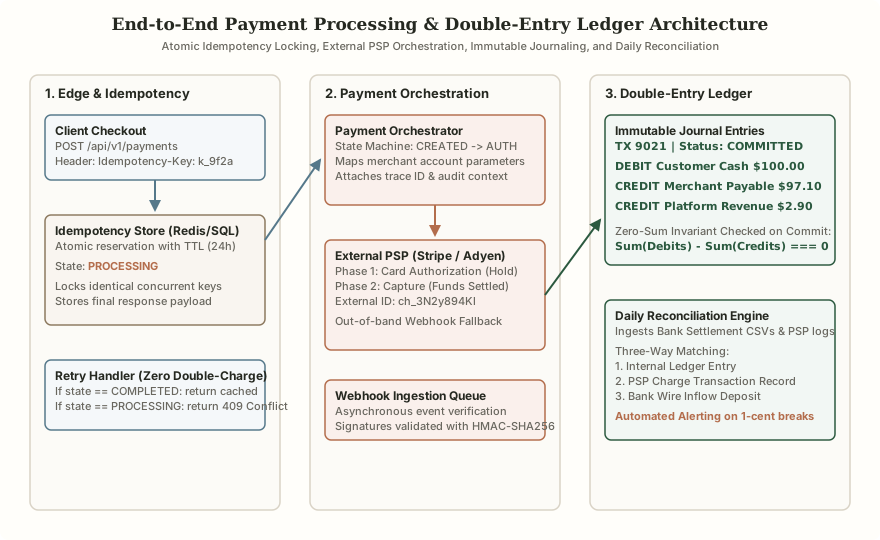
1. Client Checkout & Idempotency Store (Redis/SQL)
Establishes the ingress and structural boundary across Client Checkout & Idempotency Store (Redis/SQL): POST /api/v1/payments; Header: Idempotency-Key: k_9f2a; Atomic reservation with TTL (24h).
2. Payment Orchestrator & External PSP (Stripe / Adyen)
Coordinates core data-plane execution and state transitions through Payment Orchestrator & External PSP (Stripe / Adyen): State Machine: CREATED -> AUTH; Maps merchant account parameters Attaches trace ID & audit context; Phase 1: Card Authorization (Hold).
3. Webhook Ingestion Queue & Immutable Journal Entries
Enforces durability, state convergence, and output verification across Webhook Ingestion Queue & Immutable Journal Entries: Asynchronous event verification Signatures validated with HMAC-SHA256; TX 9021 | Status: COMMITTED DEBIT Customer Cash $100.00 CREDIT Merchant Payable $97.10 CREDIT Platform Revenue $2.90 Zero-Sum Invariant Checked on Commit: Sum(Debits) - Sum(Credits) === 0; Ingests Bank Settlement CSVs & PSP logs Three-Way Matching.
- Idempotency Gate: Intercepts every inbound mutation request at the API edge. Ensures that network retries, client double-clicks, and mobile connection drops never execute duplicate charges.
- Payment Orchestrator: Manages state machine transitions across external Payment Service Providers (PSPs like Stripe, Adyen, JPMorgan Chase). Handles the two-phase lifecycle of Authorization (placing a hold on cardholder funds) and Capture (settling the movement of cash).
- Double-Entry Ledger: The authoritative, append-only system of record. Enforces mathematical conservation of money through zero-sum journal entries across double-entry balance sheets.
- Reconciliation Engine: Asynchronous reconciliation workers that perform Three-Way Matching between internal ledger transactions, external PSP settlement logs, and daily bank statement files.
3. Double-Entry Bookkeeping for Systems Engineers
Invented by Florentine merchants in the 13th century and codified by Luca Pacioli in 1494, double-entry bookkeeping is one of the most resilient algorithms in human history.
The Single-Entry Flaw (In-Place Mutation)
Junior engineers frequently model accounts using a single table:
-- ANTI-PATTERN: DO NOT USE IN PRODUCTION
CREATE TABLE accounts (
    id VARCHAR(64) PRIMARY KEY,
    balance DECIMAL(12, 2) NOT NULL
);

-- When User A pays User B $100:
UPDATE accounts SET balance = balance - 100.00 WHERE id = 'user_A';
UPDATE accounts SET balance = balance + 100.00 WHERE id = 'user_B';
Why this fails in production:
- Zero Lineage: If
user_A’s balance is $450, you have no way to prove how it reached $450 without reconstructing arbitrary application logs. - Lost Updates & Deadlocks: Concurrent transfers across hot accounts cause database lock contention, serialized bottleneck queues, and deadlocks.
- Audit Impossibility: If a software bug deducts money from User A but fails to credit User B, money has vanished into the void, violating accounting conservation laws.
The Double-Entry Invariant
In double-entry bookkeeping, an account balance is never stored as a mutable number. Instead:
- Every economic event is recorded as an immutable Transaction containing two or more Entries.
- Every entry is categorized as either a Debit or a Credit.
- The Conservation Invariant: For every transaction, the sum of all debits must equal the sum of all credits:
The Five Fundamental Account Categories
In accounting, Debits and Credits do not mean “good” or “bad”, or “plus” and “minus”. Their effect depends on the category of the account:
| Account Type | Description | Debit () Effect | Credit () Effect | Normal Balance |
|---|---|---|---|---|
| Asset | Cash, bank deposits, accounts receivable | Increases () | Decreases () | Debit |
| Liability | Money owed to users, merchant payables | Decreases () | Increases () | Credit |
| Equity | Retained earnings, shareholder capital | Decreases () | Increases () | Credit |
| Revenue | Platform fees, processing income | Decreases () | Increases () | Credit |
| Expense | Interchange fees, server infrastructure | Increases () | Decreases () | Debit |
Worked Example: A $100 E-Commerce Payment
When a customer buys a $100 jacket from a merchant on an e-commerce platform with a 2.9% platform take-rate:
Transaction ID: tx_98021
Timestamp:      2026-10-31T02:00:00Z
Description:    "Order #4812 - Jacket Purchase"

Entry 1 (Asset):      DEBIT  Stripe Clearing Account (Cash Asset)       $100.00
Entry 2 (Liability):  CREDIT Merchant Settlement Payable (Liability)     $97.10
Entry 3 (Revenue):    CREDIT Platform Processing Fee (Revenue)            $2.90
--------------------------------------------------------------------------------
Verification:         Total Debits: $100.00 | Total Credits: $100.00 (Zero-Sum!)
Notice what happened:
- The platform’s cash asset increased by $100.00.
- The platform recognized an obligation (liability) to pay the merchant $97.10 upon bank settlement.
- The platform earned $2.90 in revenue.
- The equation is perfectly balanced. Not a single penny was unaccounted for.
4. Distributed Idempotency: The Reservation Pattern
Because distributed networks are inherently unreliable (as proven in CORE-M17-001), every network call can fail with a Timeout. When a checkout client experiences a timeout, it retries.
Without idempotency, every retry initiates a duplicate credit card charge:
Client                             Payment Gateway                 Payment Service Provider (PSP)
  |                                       |                                    |
  +--- 1. POST /charge ($50) ------------>|                                    |
  |                                       +--- 2. Authorize ($50) ------------>|
  |                                       |    (Card Charged: $50)             |
  |                                       |<-- 3. Success Response ------------+
  |    X (Network drops packet)           |                                    |
  |                                       |                                    |
  +--- 4. RETRY POST /charge ($50) ------>|                                    |
  |                                       +--- 5. Authorize ($50) ------------>|
  |                                       |    (Card Charged AGAIN: $50!)      |
  |                                       |<-- 6. Success Response ------------+
  |<-- 7. OK ($50) -----------------------+                                    |
  (Disaster: Customer billed $100 for a $50 purchase!)
The Idempotency State Machine
To prevent duplicate side effects, every mutating request must include a client-generated Idempotency Key (typically a UUIDv4). The gateway coordinates an atomic state machine:
                          Client Request (Key: k_123)
                                      |
                                      v
                        +---------------------------+
                        | Atomic Check & Reserve    |
                        | (Redis SETNX / SQL Insert)|
                        +---------------------------+
                                  /       \
                        (Key Exists)     (Key New)
                            /                 \
                           /                   v
        +-------------------------+    Set State: PROCESSING (Lock TTL 120s)
        | Inspect Existing State  |            |
        +-------------------------+            v
           /         |         \       Execute External PSP Call
          /          |          \              |
    (COMPLETED) (PROCESSING)  (FAILED)         v
        |            |          \      Record Final Ledger Transaction
        v            v           \             |
   Return Cached  Return 409      \            v
     Response     Conflict         v   Set State: COMPLETED + Cache Response
                              Allow Retry
Critical Implementation Details
- Request Fingerprinting: What if an attacker or buggy client sends the same
Idempotency-Keywith a completely different payload (e.g., changing the amount from $10 to $10,000)?- The gateway must hash the canonical request body:
hash = SHA256(method + path + body + user_id). - Store the fingerprint alongside the key. If an incoming request presents an existing key with a mismatched fingerprint, reject immediately with
422 Unprocessable Entity.
- The gateway must hash the canonical request body:
- Lock Expiration (TTL): If the payment orchestrator crashes mid-execution, the key must not remain locked in
PROCESSINGforever. A TTL (e.g., 60–120 seconds) releases the lock, or a background sweeper checks the PSP for in-doubt charges.
5. Two-Phase Money Movement: Authorize and Capture
Credit card payment processing does not settle money instantly. It operates in two distinct phases:
+---------------------------------------------------------------------------------+
|                       The Two-Phase Payment Lifecycle                           |
|                                                                                 |
| 1. Authorization (Auth):                                                        |
|    - Validates card authenticity, expiration, CVV, and available credit limit.  |
|    - Places a temporary HOLD on customer funds (typically lasts 7 days).       |
|    - No money has changed hands yet! Merchants cannot withdraw funds.           |
|                                                                                 |
| 2. Capture:                                                                     |
|    - Executed when goods are physically dispatched or services fulfilled.       |
|    - Converts the authorized hold into an irrevocable settlement claim.         |
|    - Funds are transferred through card networks (Visa/Mastercard) at midnight. |
+---------------------------------------------------------------------------------+
Why Decouple Auth and Capture?
- Inventory Fulfillment Risks: If a customer orders an item that is subsequently found to be out of stock, voiding an authorization costs nothing and releases the cardholder’s hold immediately. In contrast, refunding a captured charge incurs non-refundable interchange fees (~1.5%–3.0%) and takes 3–5 business days to clear!
- Dynamic Tip / Final Amount Adjustment: In ride-sharing (Uber/Lyft) and restaurants, an authorization holds the estimated fare (e.g., $30). Upon trip completion, the capture is finalized with the exact metered amount and driver tip (e.g., $34.50).
6. The Production Ledger Schema
A robust double-entry ledger is typically implemented on top of a relational database guaranteeing Serializability or Read Committed with Row-Level Locking (e.g., PostgreSQL, CockroachDB, AWS Aurora).
-- 1. Accounts Table: Identifies entities and normal balances
CREATE TABLE ledger_accounts (
    id UUID PRIMARY KEY DEFAULT gen_random_uuid(),
    code VARCHAR(64) UNIQUE NOT NULL, -- e.g., 'assets:cash:stripe', 'liabilities:merchant_payable'
    type VARCHAR(32) NOT NULL,        -- 'ASSET', 'LIABILITY', 'EQUITY', 'REVENUE', 'EXPENSE'
    currency VARCHAR(3) NOT NULL,     -- ISO 4217, e.g., 'USD', 'EUR'
    created_at TIMESTAMPTZ NOT NULL DEFAULT NOW()
);

-- 2. Journal Transactions: Groups atomic multi-entry movements
CREATE TABLE ledger_transactions (
    id UUID PRIMARY KEY DEFAULT gen_random_uuid(),
    idempotency_key VARCHAR(128) UNIQUE NOT NULL,
    description TEXT NOT NULL,
    posted_at TIMESTAMPTZ NOT NULL DEFAULT NOW()
);

-- 3. Journal Entries: The individual debit and credit legs
CREATE TABLE ledger_entries (
    id UUID PRIMARY KEY DEFAULT gen_random_uuid(),
    transaction_id UUID NOT NULL REFERENCES ledger_transactions(id) ON DELETE RESTRICT,
    account_id UUID NOT NULL REFERENCES ledger_accounts(id) ON DELETE RESTRICT,
    direction VARCHAR(6) NOT NULL CHECK (direction IN ('DEBIT', 'CREDIT')),
    amount_cents BIGINT NOT NULL CHECK (amount_cents > 0),
    created_at TIMESTAMPTZ NOT NULL DEFAULT NOW()
);

-- Indexing for instantaneous historical balance rollups
CREATE INDEX idx_entries_account_created ON ledger_entries(account_id, created_at);
How Balances are Calculated
An account’s balance is never updated via an UPDATE statement. It is computed as a deterministic query:
SELECT
    a.code,
    a.type,
    SUM(CASE
        WHEN a.type IN ('ASSET', 'EXPENSE') THEN
            CASE WHEN e.direction = 'DEBIT' THEN e.amount_cents ELSE -e.amount_cents END
        ELSE
            CASE WHEN e.direction = 'CREDIT' THEN e.amount_cents ELSE -e.amount_cents END
    END) AS net_balance_cents
FROM ledger_accounts a
JOIN ledger_entries e ON a.id = e.account_id
WHERE a.id = :target_account_id
GROUP BY a.code, a.type;
For high-volume accounts, systems maintain Snapshot Balance Tables (periodic checkpoints calculated every hour or midnight) to avoid scanning millions of historical rows.
7. Mathematical Modeling: Minor Units & Floating Point Disasters
The IEEE 754 Floating-Point Hazard
Computers represent floating-point numbers in base 2. In base 2, fractions like () cannot be represented cleanly; they produce infinite recurring binary expansions:
// Floating-point arithmetic in standard JavaScript / Python:
0.1 + 0.2 === 0.30000000000000004 // true!

let balance = 100.00;
balance -= 0.10; // 99.9
balance -= 0.10; // 99.8
balance -= 0.10; // 99.70000000000001
If an e-commerce ledger processes 10,000,000 transactions with tiny rounding errors of $0.00000000000001, the platform accumulates thousands of dollars of phantom balance breaks that make clean automated audits impossible.
The Integer Minor Unit Standard
Financial ledgers store every monetary amount as a signed 64-bit integer (BIGINT) scaled by the ISO 4217 currency exponent :
| Currency | Minor Unit () | Example Major Amount | Stored Integer Value | Data Type |
|---|---|---|---|---|
| USD / EUR / GBP | Cents (, ) | $10.50 | 1050 | int64 / BIGINT |
| JPY / KRW | Whole unit (, ) | ¥1,050 | 1050 | int64 / BIGINT |
| BHD / KWD / OMR | Fils / Millimes (, ) | 10.500 KWD | 10500 | int64 / BIGINT |
| Sub-cent FX / Metering | Micro-units (, ) | $10.500000 | 10500000 | int64 / BIGINT |
Remainder Allocation (Preventing Penny Drift on Splits)
Even with integer minor units, percentage fees and multi-party splits require deterministic remainder allocation. For example, splitting $100.00 (10000 cents) equally across co-sellers yields quotient cents with remainder cent. Distributing cent to the first legs produces postings (3334, 3333, 3333) whose sum is exactly 10000 cents, preserving without losing cent!
8. Asynchronous Three-Way Reconciliation
No matter how pristine your internal software is, external reality is messy:
- Webhooks from Stripe or PayPal get delayed or lost.
- Bank wire transfers clear in batch windows at 4:00 PM EST.
- Chargebacks occur 30 days after the original transaction.
Reconciliation is the automated process that verifies internal ledger truth against external banking truth:
+-----------------------------------------------------------------------------------+
|                        Three-Way Matching Architecture                            |
|                                                                                   |
|  [ Internal Ledger Journal ]      [ PSP Transaction Logs ]      [ Bank Settlement ]
|        (Our Database)                  (Stripe / Adyen)             (Bank CSV/BAI2)
|              |                                |                            |
|              v                                v                            v
|     tx_102: $100.00                   ch_3N1: $100.00              Deposit: $97.10
|     fee_102: $2.90                    fee: $2.90                   Fee: $2.90
|              \                                /                            /
|               +------------------------------+----------------------------+
|                                              |
|                                              v
|                          [ Reconciliation Engine Matcher ]
|                                              |
|                      +-----------------------+-----------------------+
|                      |                                               |
|             (Matched: Diff == $0)                                (Discrepancy)
|                      |                                               |
|               Mark Settled                                   Raise Alert / Break
+-----------------------------------------------------------------------------------+
The Three Reconciliation Tiers
- Transaction-Level Matching: Pairs every internal payment intent ID with the external PSP
charge_id. - Settlement Batch Matching: Verifies that the net lump-sum bank wire received at midnight matches the sum of individual captured charges minus merchant fees.
- Discrepancy Resolution (Break Management): If an external bank statement shows $1,000,000 deposited, but our internal ledger expected $999,998.50, an automated Break of $1.50 is created, flagged to the finance operations team, and tracked until resolved.
9. Operational Failure Modes & Incident Playbooks
Failure Mode 1: The Zombie In-Doubt Payment
Scenario: The payment orchestrator sends an authorization request to Stripe. The network connection drops before Stripe’s response arrives. The client’s HTTP request times out.
Hazard: Did Stripe charge the card? If the engine assumes “failure” and the user re-orders, they are double-billed. If the engine assumes “success” and it failed, the merchant ships goods without payment!
Playbook:
- Never mark an in-doubt transaction as
FAILEDimmediately upon timeout. - Mark the local transaction as
PENDING_RECOVERY. - Background reconciliation worker queries Stripe’s GET API with the original
Idempotency-Key. - If Stripe has the record: adopt Stripe’s status and complete the ledger entries.
- If Stripe has no record: safely mark the local transaction
FAILED.
Failure Mode 2: Hot-Account Lock Serialization
Scenario: In a marketplace platform, all 50,000 daily payments credit a single shared platform cash account (assets:cash:clearing). If the ledger locks that account row in PostgreSQL for each transaction, all concurrent checkouts serialize behind a single database lock!
Playbook:
- Never lock the account row. Since double-entry ledgers are append-only, inserts into
ledger_entriesdo not block each other! - Compute account balances via append-only delta streams or sharded sub-accounts (
assets:cash:clearing:shard_0throughshard_15), aggregating across shards for reporting.
10. Concrete Implementation: Double-Entry Ledger Engine
The following complete TypeScript implementation demonstrates an immutable double-entry ledger with atomic idempotency control, zero-sum balance validation, and account balance calculation:
export type AccountType = 'ASSET' | 'LIABILITY' | 'EQUITY' | 'REVENUE' | 'EXPENSE';
export type Direction = 'DEBIT' | 'CREDIT';

export interface LedgerAccount {
  id: string;
  code: string;
  type: AccountType;
  currency: string;
}

export interface EntryInput {
  accountCode: string;
  direction: Direction;
  amountCents: bigint;
}

export interface LedgerEntry extends EntryInput {
  id: string;
  transactionId: string;
  createdAt: Date;
}

export interface LedgerTransaction {
  id: string;
  idempotencyKey: string;
  description: string;
  entries: LedgerEntry[];
  postedAt: Date;
}

function computePayloadFingerprint(payload: string): string {
  const bytes = new TextEncoder().encode(payload);
  let h1 = 0x811c9dc5;
  let h2 = 0x01000193;
  for (let i = 0; i < bytes.length; i++) {
    h1 ^= bytes[i];
    h1 = Math.imul(h1, 0x01000193);
    h2 ^= bytes[i] + (i & 0xff);
    h2 = Math.imul(h2, 0x85ebca6b);
  }
  return (h1 >>> 0).toString(16).padStart(8, '0') + (h2 >>> 0).toString(16).padStart(8, '0');
}

export class DoubleEntryLedgerEngine {
  private accounts = new Map<string, LedgerAccount>();
  private transactions = new Map<string, LedgerTransaction>();
  private idempotencyStore = new Map<string, { state: 'PROCESSING' | 'COMPLETED'; response?: LedgerTransaction; hash: string }>();

  createAccount(code: string, type: AccountType, currency = 'USD'): LedgerAccount {
    if (this.accounts.has(code)) {
      throw new Error(`Account code '${code}' already exists`);
    }
    const account: LedgerAccount = { id: crypto.randomUUID(), code, type, currency };
    this.accounts.set(code, account);
    return account;
  }

  /**
   * Post an atomic financial transaction with zero-sum invariant enforcement
   */
  postTransaction(
    idempotencyKey: string,
    description: string,
    entries: EntryInput[]
  ): LedgerTransaction {
    // 1. Request fingerprinting for idempotency
    const canonicalJson = JSON.stringify(
      { description, entries },
      (_, v) => (typeof v === 'bigint' ? v.toString() : v)
    );
    const payloadHash = computePayloadFingerprint(canonicalJson);

    const existingLock = this.idempotencyStore.get(idempotencyKey);
    if (existingLock) {
      if (existingLock.hash !== payloadHash) {
        throw new Error(`Idempotency key '${idempotencyKey}' reused with mismatched payload`);
      }
      if (existingLock.state === 'PROCESSING') {
        throw new Error(`Concurrent transaction with idempotency key '${idempotencyKey}' is in-flight`);
      }
      return existingLock.response!;
    }

    this.idempotencyStore.set(idempotencyKey, { state: 'PROCESSING', hash: payloadHash });

    try {
      if (entries.length < 2) {
        throw new Error('A transaction must contain at least two entries');
      }

      const firstAccount = this.accounts.get(entries[0].accountCode);
      if (!firstAccount) {
        throw new Error(`Account code '${entries[0].accountCode}' not found`);
      }
      const currency = firstAccount.currency;

      let totalDebits = 0n;
      let totalCredits = 0n;

      for (const entry of entries) {
        const account = this.accounts.get(entry.accountCode);
        if (!account) {
          throw new Error(`Account code '${entry.accountCode}' not found`);
        }
        if (account.currency !== currency) {
          throw new Error('Cross-currency transaction requires explicit FX conversion entries');
        }
        if (entry.amountCents <= 0n) {
          throw new Error(`Entry amount must be positive. Received ${entry.amountCents}`);
        }

        if (entry.direction === 'DEBIT') {
          totalDebits += entry.amountCents;
        } else {
          totalCredits += entry.amountCents;
        }
      }

      // 3. ZERO-SUM INVARIANT: Sum(Debits) === Sum(Credits)
      if (totalDebits !== totalCredits) {
        throw new Error(
          `Double-entry imbalance! Total Debits (${totalDebits} cents) != Total Credits (${totalCredits} cents). Difference: ${totalDebits - totalCredits} cents`
        );
      }

      // 4. Commit transaction and append immutable entries
      const transactionId = crypto.randomUUID();
      const committedEntries: LedgerEntry[] = entries.map((e) => ({
        ...e,
        id: crypto.randomUUID(),
        transactionId,
        createdAt: new Date(),
      }));

      const transaction: LedgerTransaction = {
        id: transactionId,
        idempotencyKey,
        description,
        entries: committedEntries,
        postedAt: new Date(),
      };

      this.transactions.set(transactionId, transaction);
      this.idempotencyStore.set(idempotencyKey, { state: 'COMPLETED', response: transaction, hash: payloadHash });

      return transaction;
    } catch (err) {
      this.idempotencyStore.delete(idempotencyKey);
      throw err;
    }
  }

  /**
   * Derive net account balance by aggregating immutable journal entries
   */
  getAccountBalance(accountCode: string): bigint {
    const account = this.accounts.get(accountCode);
    if (!account) throw new Error(`Account '${accountCode}' not found`);

    let balance = 0n;
    for (const tx of this.transactions.values()) {
      for (const entry of tx.entries) {
        if (entry.accountCode === accountCode) {
          if (account.type === 'ASSET' || account.type === 'EXPENSE') {
            balance += entry.direction === 'DEBIT' ? entry.amountCents : -entry.amountCents;
          } else {
            balance += entry.direction === 'CREDIT' ? entry.amountCents : -entry.amountCents;
          }
        }
      }
    }
    return balance;
  }
}

function runDemo(): void {
  console.log('=== Double-Entry Accounting & Ledger Idempotency Engine ===');
  const ledger = new DoubleEntryLedgerEngine();
  const cash = ledger.createAccount('assets:cash:stripe', 'ASSET');
  const merchantPayable = ledger.createAccount('liabilities:merchant_payable', 'LIABILITY');
  const feeRevenue = ledger.createAccount('revenue:platform_fees', 'REVENUE');
  console.log(`Created accounts: ${cash.code}, ${merchantPayable.code}, ${feeRevenue.code}`);

  const txn = ledger.postTransaction('ord_4812_capture', 'Order #4812 - Jacket Purchase', [
    { accountCode: 'assets:cash:stripe', direction: 'DEBIT', amountCents: 10000n },
    { accountCode: 'liabilities:merchant_payable', direction: 'CREDIT', amountCents: 9710n },
    { accountCode: 'revenue:platform_fees', direction: 'CREDIT', amountCents: 290n },
  ]);
  console.log(`Posted balanced 3-leg transaction: ${txn.id}`);

  const duplicate = ledger.postTransaction('ord_4812_capture', 'Order #4812 - Jacket Purchase', [
    { accountCode: 'assets:cash:stripe', direction: 'DEBIT', amountCents: 10000n },
    { accountCode: 'liabilities:merchant_payable', direction: 'CREDIT', amountCents: 9710n },
    { accountCode: 'revenue:platform_fees', direction: 'CREDIT', amountCents: 290n },
  ]);
  console.log(`Idempotent retry matched original tx=${duplicate.id === txn.id}`);
  console.log(
    `Balances (cents): cash=${ledger.getAccountBalance('assets:cash:stripe')}, payable=${ledger.getAccountBalance('liabilities:merchant_payable')}, fee=${ledger.getAccountBalance('revenue:platform_fees')}`
  );
}
runDemo();
11. Design Alternatives & Storage Engine Trade-Off Matrix
| Ledger Architecture | Write Throughput | Overdraft Guard | Auditability | Operational Trade-Off |
|---|---|---|---|---|
| In-Place Mutable Balance Row | High on cold keys, collapses on hot keys | Row lock balance >= 0 | None (history overwritten) | Anti-pattern for regulated financial systems |
PostgreSQL SERIALIZABLE Journal | SSI predicate check + periodic snapshots | Complete SQL audit lineage | Rich relational reporting; requires sharded clearing accounts for hot keys | |
| Distributed SQL (CockroachDB / Google Spanner) | Horizontally scalable across regions | Multi-region Raft/Paxos serializability | Complete geo-replicated lineage | Higher cross-region commit RTT () |
| Purpose-Built Accounting DB (TigerBeetle) | (batched) | Native two-phase pending/posted balances | Strict immutable double-entry core | Specialized fixed-schema engine paired with analytical read store |
12. Summary & Decision Guide
+-----------------------------------------------------------------------------------+
|                        Financial Architecture Decision Matrix                     |
+--------------------------+-----------------------+--------------------------------+
| Component                | Recommended Pattern   | Anti-Pattern to Avoid          |
+--------------------------+-----------------------+--------------------------------+
| Ledger Storage Model     | Append-Only Journal   | Mutable In-Place Balance Rows  |
| Data Types               | int64 Minor Units     | IEEE 754 Floating-Point Numbers|
| Distributed Idempotency  | Fingerprinted Token   | Blindly Retrying Nonce-less    |
|                          | State Machine         | Network Requests               |
| Money Movement           | Two-Phase Auth/Capture| Immediate Single-Phase Capture |
| Auditability             | Three-Way Reconciler  | Trusting External PSP Webhooks |
+--------------------------+-----------------------+--------------------------------+
The Financial Engineer’s Checklist
- Never Trust Network Success Codes: Treat timeouts as
UNKNOWN. Implement backpressure-safe retry loops with client idempotency keys. - Every Dollar in Transit Must Have an Account: Use explicit transit and clearing accounts (
assets:clearing:stripe) so in-flight money is accounted for on the balance sheet. - Automate Reconciliation Daily: Catch rounding errors, interchange fee shifts, and dropped events within 24 hours before books close.
13. Guided Design Exercises
Exercise 1: Hot-Account Lock Contention & Sharded Clearing Sub-Accounts
Scenario: During a marketplace promotion, simultaneously credit the platform’s central clearing account (assets:cash:stripe) and revenue account (revenue:platform_fees).
- If a naive implementation acquires an exclusive row lock (
SELECT ... FOR UPDATE) on theassets:cash:stripebalance row for per transaction, calculate the maximum single-account throughput and explain why the workload collapses. - Calculate the minimum number of sharded clearing sub-accounts (
assets:cash:stripe:shard_0 .. shard_{K-1}) required to sustain while keeping per-shard lock utilization at , and show how an append-onlyledger_entriesjournal with hourly snapshot rollups eliminates hot-account write locks altogether.
Exercise 2: Multi-Party Split Remainder Allocation & Zero-Sum Proof
Scenario: A group-buying order of $250.00 (25000 cents) incurs a platform fee, and the net proceeds must be split equally among co-merchants.
- Compute the exact integer minor-unit platform fee (using half-even rounding) and the net distributable merchant amount in cents.
- Derive the exact
amount_centscredited to each of the merchant payable accounts using deterministic remainder allocation so that holds to the exact cent.
Exercise 3: Idempotency Fingerprint Mismatch & In-Doubt PSP Recovery Drill
Scenario: A mobile checkout client submits POST /v1/payments with Idempotency-Key: ik_9941 for amount_cents = 5000. After , the client connection drops while the payment orchestrator is still awaiting Stripe’s response. Two seconds later, a buggy retry loop sends Idempotency-Key: ik_9941 with amount_cents = 5500, followed by a third retry with the original amount_cents = 5000.
- Trace the exact HTTP status codes and state machine transitions returned for both retries while the original call is in
PROCESSINGand after it transitions toCOMPLETED. - Formulate the automated recovery protocol if the payment orchestrator pod crashes (
SIGKILL) after calling Stripe’s Charge API but before committing the PostgreSQLledger_transactionsrow.
View Reference Architecture & Worked Solutions (APP-A06-001)
1. Reference Solution — Exercise 1: Hot-Account Lock Contention & Sharded Clearing Sub-Accounts
- Step 1 (Single-Row Lock Throughput Ceiling):
- With exclusive lock hold duration :
- Arrival rate exceeds capacity by , causing unbounded lock-queue growth ( accumulating in
pg_locks), connection pool starvation, andlock_timeoutaborts.
- Step 2 (Sharded Sub-Account Count & Append-Only Journal Design):
- At target utilization , each shard safely handles :
- Append-Only Elimination of Hot Locks: For pure cash-in clearing accounts (
assets:cash:stripe) and fee revenue accounts (revenue:platform_fees) that cannot overdraft on incoming credits, transactions simplyINSERTimmutable legs intoledger_entrieswith zeroFOR UPDATElock onledger_accounts. An asynchronous rollup worker aggregatesSUM(amount_cents)per(account_id, hour_bucket)into a snapshot table, while customer wallet debits (which do require overdraft checks) only lock the individual customer’s account row (1user per wallet, zero cross-user contention).
2. Reference Solution — Exercise 2: Multi-Party Split Remainder Allocation & Zero-Sum Proof
- Step 1 (Fee & Net Distributable Pool in Integer Cents):
- Gross Debit to
assets:cash:stripe: ($250.00). - Platform Fee (): . Under
round_half_even(banker’s rounding to nearest even integer), ($6.88). - Net Merchant Pool: ($243.12).
- Gross Debit to
- Step 2 (7-Way Deterministic Remainder Allocation):
- Base share per merchant: ().
- Remainder: .
- Allocate to the first merchant (ordered deterministically by
merchant_account_id ASC):- Merchant 1 Credit: ($34.74)
- Merchants 2..7 Credits (6 merchants): each ($34.73 $208.38)
- Zero-Sum Proof:
3. Reference Solution — Exercise 3: Idempotency Fingerprint Mismatch & In-Doubt PSP Recovery Drill
- Step 1 (Retry Responses by Fingerprint & State):
- Retry 1 (
ik_9941, mutatedamount_cents = 5500): The gateway computesSHA256(method + path + body)and compares it against the stored fingerprint forik_9941(amount_cents = 5000). Because the hashes differ, the gateway immediately rejects withHTTP 422 Unprocessable Entity(IdempotencyKeyPayloadMismatch) regardless of whether the key isPROCESSINGorCOMPLETED. - Retry 2 (
ik_9941, originalamount_cents = 5000):- While the original execution is still in
PROCESSING: returnsHTTP 409 ConflictwithRetry-After: 2so no second PSP call is fired. - Once the original execution transitions to
COMPLETED: returnsHTTP 200 OKwith the exact cachedLedgerTransactionJSON body (Idempotent-Replayed: true).
- While the original execution is still in
- Retry 1 (
- Step 2 (Crash Recovery of In-Doubt
PROCESSINGLease):- Before invoking Stripe, the orchestrator persists the idempotency record
(idempotency_key = 'ik_9941', state = 'PROCESSING', lease_expires_at = NOW() + 60s)in PostgreSQL/Redis and forwardsIdempotency-Key: ik_9941in the outbound Stripe HTTP header. - When the pod crashes and
lease_expires_atpasses, a background reconciliation worker claims expiredPROCESSINGkeys, queries Stripe (GET /v1/chargesor replays the idempotent POST withik_9941), discovers the settled chargech_3N1..., writes the balanced 3-legledger_transactions+ledger_entriesrows inside an ACID transaction, and flipsik_9941toCOMPLETED.
- Before invoking Stripe, the orchestrator persists the idempotency record
14. Authoritative References & Version Context
- Brandur Leach / Stripe Engineering: Designing Robust and Predictable APIs with Idempotency (atomic reservation points, request payload fingerprinting, and recovery of in-doubt external PSP mutations).
- IETF HTTPAPI Working Group: The
Idempotency-KeyHTTP Header Field Specification (409 Conflictin-flight semantics and422 Unprocessable Contentpayload mismatch handling). - TigerBeetle Documentation — Financial Accounting & Double-Entry Data Model: Double-Entry Accounting for Engineers (immutable debit/credit transfers, two-phase pending holds, and hot-account throughput design).
- PostgreSQL Official Documentation — Transaction Isolation (
SERIALIZABLESSI): PostgreSQL 16/17 Concurrency Control (Serializable Snapshot Isolation and integerBIGINTminor-unit schema design; baseline stack: PostgreSQL 16+, CockroachDB 24.x, Redis 7.2+).