1. The Core Engineering Challenge: Linearizability Under Crash Faults
Project Identity, Version & License Baseline
| Project Component | Canonical Repository | Pinned Release | Governance / License | Edition Boundary |
|---|---|---|---|---|
| HashiCorp Raft | hashicorp/raft | v1.6 | HashiCorp (MPL 2.0) | Open source library |
| etcd Raft | etcd-io/raft | v3.5 | CNCF Graduated (Apache 2.0) | Open source library |
| TiKV Raft-rs | tikv/raft-rs | v0.7 | CNCF Graduated (Apache 2.0) | Open source Rust crate |
In a single-node database, guaranteeing linearizable consistency is straightforward: incoming write requests queue behind a mutex, update an in-memory B-Tree or Write-Ahead Log (WAL), flush to an NVMe drive, and return success. The database engine provides a single, unambiguous timeline of reality.
However, a single physical server is a Single Point of Failure (SPOF). Power supplies blow capacitors, kernel upgrades trigger panic loops, top-of-rack switches drop packets, and cosmic rays induce bit flips.
To survive hardware failure, we replicate data across multiple physical machines. But replication introduces the defining problem of distributed computing:
The Distributed Split-Brain Nightmare:
---------------------------------------------------------------------------------
            +-------------------------------------------+
            |         Client A: "set balance = $500"    |
            +-------------------------------------------+
                                  |
                   [ NETWORK PARTITION CUTS LINK ]
                                  |
            +---------------------+---------------------+
            |                                           |
            v                                           v
+-----------------------+                   +-----------------------+
|  Datacenter US-East   |                   |  Datacenter US-West   |
|  Server 1 (Leader?)   |                   |  Server 2 (Leader?)   |
|  Writes balance=$500  |                   |  Writes balance=$100  |
+-----------------------+                   +-----------------------+
            ^                                           ^
            |                                           |
            +-------------------------------------------+
            |         Client B: "set balance = $100"    |
            +-------------------------------------------+
-> Two servers both believe they are the authoritative leader!
-> Data silently diverges; transactions contradict; state corrupted!
If the network links between datacenters sever, both partitions might attempt to accept writes. This is Split-Brain: the catastrophic divergence of system state where two or more nodes independently act as the authoritative master.
To prevent split-brain and provide Linearizability (the illusion that there is only one copy of the data, and every read observes the latest committed write), the cluster must achieve Consensus: a collection of independent processes must agree on values or state machine transitions, even if some of the processes fail or messages are lost or delayed.
2. Mental Model: The Replicated State Machine (RSM)
Modern distributed consensus systems do not solve consensus for isolated, disconnected values. Instead, they implement the Replicated State Machine (RSM) architecture.
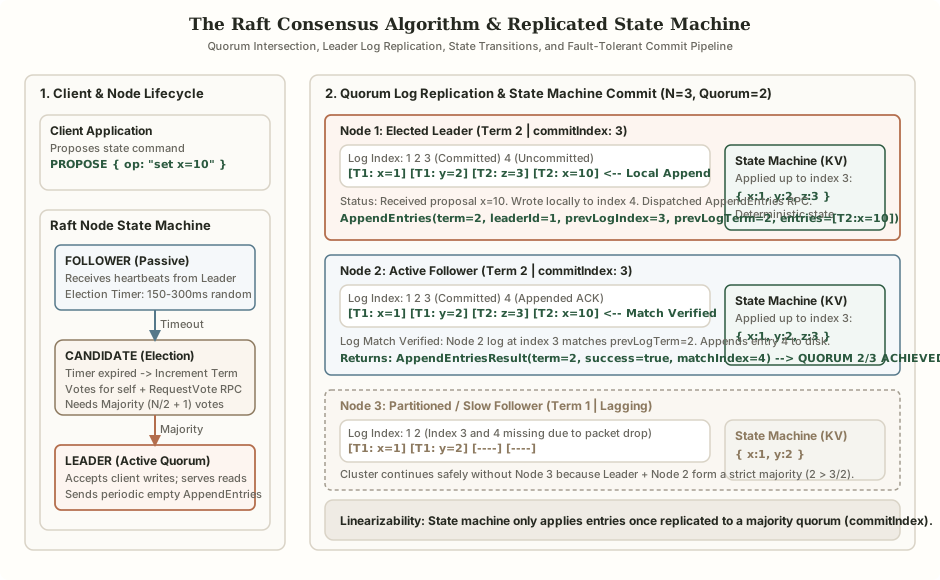
1. Client Proposes State Machine Command
Client issues PROPOSE { op: 'set x=10' } to Node 1 (Elected Leader, Term 2). Leader assigns log index 4.
2. Leader Uncommitted Local Log Append
Leader writes entry [T2: x=10] to its local log at index 4. The entry remains UNCOMMITTED until replicated to a majority.
3. Dispatch AppendEntries RPC to Peers
Leader broadcasts AppendEntries(term=2, leaderId=1, prevLogIndex=3, prevLogTerm=2, entries=[T2:x=10]) to Node 2 and Node 3.
4. Follower Match Verification & ACK
Node 2 verifies prevLogIndex 3 matches term 2. It appends entry 4 to disk and returns AppendEntriesResult(success=true, matchIndex=4).
5. Commit Index Advance & State Machine Apply
Leader advances commitIndex to 4. Leader applies command 'set x=10' to its in-memory KV state machine and responds to the client.
The Deterministic State Machine Principle
A deterministic state machine is a program that transitions through a sequence of discrete states:
If two identical, deterministic state machines start in the exact same initial state and apply the exact same sequence of input commands:
They are mathematically guaranteed to arrive at the exact same final state , yielding identical results for every query.
The Role of Consensus in RSM
The consensus algorithm’s sole responsibility is ordering the distributed Write-Ahead Log (WAL):
- Clients submit state machine operations (e.g.,
set x = 10,create_pod web-frontend). - The Consensus Module (Raft) ensures that every replica’s log contains the exact same entries in the exact same sequence.
- Once an entry is committed by consensus, the State Machine applies the command sequentially to its local data structure.
By reducing system coordination to replicated log synchronization, Raft enables complex distributed databases (etcd, CockroachDB, TiKV) to build arbitrary transactional capabilities on top of a rock-solid, ordered log foundation.
3. Quorum Mathematics: Majority Intersections & The Bound
Why does a Raft cluster require 3 nodes to tolerate 1 failure, and 5 nodes to tolerate 2 failures? Why can a 4-node cluster still only tolerate 1 failure?
The answer lies in the Pigeonhole Principle and Quorum Intersection.
Mathematical Derivation of Quorums
Let be the total number of voting nodes in a cluster. A Quorum is defined as a strict majority of nodes:
Now consider any two arbitrary majorities . Because and are integers strictly greater than , their sum satisfies (for both odd and even ):
(Specifically, when is odd, and when is even.) Since the total number of physical nodes in the cluster satisfies , by the Pigeonhole Principle the two majorities must intersect by at least one node:
Quorum Majority Intersection:
---------------------------------------------------------------------------------
Cluster of N = 5 Nodes: { Node 1, Node 2, Node 3, Node 4, Node 5 }
Majority Quorum Size = 3

Quorum 1 (Nodes that committed Entry X):      { Node 1, Node 2, Node 3 }
Quorum 2 (Nodes that elect Leader Y):                  { Node 3, Node 4, Node 5 }
                                                          ^
                                                INTERSECTION NODE!
-> Node 3 witnessed Entry X AND voted for Leader Y.
-> Node 3 guarantees Leader Y learns about Entry X before taking office!
Fault Tolerance Bound:
If we want a distributed system to remain fully operational when nodes crash, the surviving nodes must still constitute a strict majority:
Since must be an integer, the minimal number of nodes required to survive crash faults is:
+-------------------------------------------------------------------------------+
|                      CLUSTER SIZE & QUORUM FAULT TOLERANCE                    |
+-------------------------------------------------------------------------------+
| Total Nodes (N) | Majority Quorum | Crash Faults Tolerated (f) | Evaluation   |
+-----------------+-----------------+----------------------------+--------------+
| 1               | 1 (100%)        | 0                          | SPOF         |
| 2               | 2 (100%)        | 0 (Loss of 1 kills quorum) | Wasteful     |
| 3               | 2 (66.7%)       | 1                          | Minimal Prod |
| 4               | 3 (75.0%)       | 1 (Same as N=3, more msgs) | Antipattern  |
| 5               | 3 (60.0%)       | 2                          | Recommended  |
| 7               | 4 (57.1%)       | 3                          | High-Security|
+-------------------------------------------------------------------------------+Why Even-Numbered Clusters Are an Operational Antipattern: An even-numbered cluster (e.g. ) requires a quorum of 3 nodes. If 1 node fails, 3 survive (system works). But if a second node fails, only 2 survive (, system halts). A 4-node cluster tolerates the exact same number of failures as a 3-node cluster (), but incurs the network overhead of extra RPCs and increases the statistical probability of cluster downtime!
4. The Raft Consensus Algorithm: Deconstructed
Historically, distributed systems used Multi-Paxos (Lamport, 1998) for consensus. However, Paxos is notoriously opaque, lacking clean abstractions for leader election and cluster membership changes.
In 2014, Diego Ongaro and John Ousterhout (Stanford University) introduced Raft, designed explicitly for understandability and operational tractability.
Raft decomposes consensus into three independent subproblems:
- Leader Election: When an existing leader fails, a new leader must be elected.
- Log Replication: The leader accepts log entries from clients and forces followers to duplicate its log.
- Safety: If any server has applied an entry to its state machine, no other server may ever apply a different entry for that log index.
1. The Three Node States
At any given millisecond, every server in a Raft cluster exists in one of three mutually exclusive states:
        +----------------------------------------------------+
        |                                                    |
        v                                                    | Discovers server
+---------------+  Times out, starts election  +---------------+ with higher term
|   FOLLOWER    | ---------------------------> |   CANDIDATE   | ---------------+
+---------------+                              +---------------+                |
        ^                                              |                        |
        |                                              | Wins election          |
        | Discovers server with higher term            v (Majority votes)       |
        |                                      +---------------+                |
        +------------------------------------- |    LEADER     |                |
                                               +---------------+                |
                                                       |                        |
+------------------------+- Follower: Passive state. Responds to incoming RPCs from leaders and candidates. Never issues requests. If no communication is received within an election timeout, transitions to Candidate.
- Candidate: Active election state. Increments the current term, votes for itself, and broadcasts
RequestVoteRPCs to all peers. - Leader: Authoritative master. Handles all client reads and writes, drives log replication, and dispatches periodic heartbeats to maintain its authority.
2. Terms as Distributed Logical Clocks
Physical time cannot coordinate servers. Raft divides time into arbitrary Terms, represented by strictly increasing integers ():
- Terms act as Lamport Logical Clocks (covered in
CORE-M17-002). - Each term begins with an election. If an election results in a split vote, the term ends with no leader, and a new term begins immediately.
- Fundamental Rule of Terms: If a node observes a message with a term greater than its own current term (), the node immediately updates its current term to and drops down to the Follower state.
- If a leader or candidate receives an RPC with an obsolete term (), it rejects the request immediately.
3. Leader Election & Split-Vote Mitigation
How does Raft elect a single leader without deadlocking in tied votes?
Randomized Election Timers (150ms - 300ms):
---------------------------------------------------------------------------------
Node 1: [========= Timer: 162ms =========] -> TIMES OUT! Becomes Candidate!
Node 2: [=================== Timer: 248ms ===================]
Node 3: [============================= Timer: 291ms =============================]

1. Node 1 times out first:
   - Increments currentTerm (e.g. Term 1 -> 2)
   - Votes for itself (votesCount = 1)
   - Broadcasts RequestVote RPC to Node 2 and Node 3

2. Node 2 and Node 3 receive RequestVote(term=2):
   - Term 2 > local Term 1 -> update term to 2
   - Node 2 has not voted yet in Term 2 -> grants vote to Node 1!
   - Node 1 now has 2 votes out of 3 (Majority achieved!)

3. Node 1 transitions to LEADER:
   - Dispatches empty AppendEntries heartbeat to assert authority
   - Node 2 and Node 3 reset their election timers upon receiving heartbeat
Split-Vote Mitigation via Randomized Timers
If multiple followers time out at the exact same millisecond, they all become candidates and split the votes (e.g., in a 4-node cluster, Candidate A gets 2 votes, Candidate B gets 2 votes). Neither achieves a majority ().
Raft prevents split-vote deadlocks using Randomized Election Timeouts chosen uniformly from an interval (typically within an availability zone, or across multi-region WANs):
- Because timeouts are randomized, one node will almost always time out before its peers.
- That node increments its term and collects majority votes before any competing candidate’s timer expires.
- If a tie occurs, the candidates time out again with fresh random timers, breaking the tie in the subsequent election round.
The Formal Raft Liveness Timing Inequality
While Raft’s safety properties hold unconditionally regardless of network delays, clock skew, or GC pauses, election liveness (converging on and maintaining a stable leader) requires the cluster to satisfy Ongaro & Ousterhout’s timing inequality:
- : Average time for a server to send RPCs in parallel to all peers, persist state (
votedFor/ WALfdatasync) where required, and receive replies (typically on local NVMe + intra-region Ethernet). - : Randomized election timeout window, sized at to (e.g., when ), with periodic leader heartbeats dispatched every to () so a single dropped UDP/TCP packet never triggers a spurious election.
- : Mean Time Between Failures of an individual server (typically months, ). When and , leader failover consumes less than () of cluster wall-clock uptime.
4. Log Replication & The AppendEntries RPC
Once elected, the leader serves client writes through the AppendEntries RPC:
+-------------------------------------------------------------------------------+
|                       AppendEntries RPC Payload Anatomy                       |
+-------------------------------------------------------------------------------+
| Parameter    | Type       | Description                                       |
+--------------+------------+---------------------------------------------------+
| term         | int        | Leader's current term number                      |
| leaderId     | int        | Leader identifier (so followers can redirect CLI) |
| prevLogIndex | int        | Index of log entry immediately preceding new ones |
| prevLogTerm  | int        | Term of prevLogIndex entry                        |
| entries[]    | Entry[]    | Log entries to store (empty for periodic heartbeat|
| leaderCommit | int        | Leader's commitIndex                              |
+-------------------------------------------------------------------------------+
5. The Formal Raft Safety Invariants
Consensus algorithms cannot be validated by casual testing; they require mathematical proofs of correctness. Raft guarantees five fundamental safety invariants at all times:
+-------------------------------------------------------------------------------+
|                         THE 5 RAFT SAFETY INVARIANTS                          |
+-------------------------------------------------------------------------------+
| Invariant               | Formal Guarantee                                    |
+-------------------------+-----------------------------------------------------+
| 1. Election Safety      | At most one leader can be elected in a given term.  |
|                         |                                                     |
| 2. Leader Append-Only   | A leader never overwrites or truncates its own log; |
|                         | it only appends new entries.                        |
|                         |                                                     |
| 3. Log Matching Property| If two logs contain an entry with the same index    |
|                         | and term, then the logs are identical in all        |
|                         | entries up through the given index.                 |
|                         |                                                     |
| 4. Leader Completeness  | If a log entry is committed in a given term, that   |
|                         | entry will be present in the logs of the leaders    |
|                         | for all higher-numbered terms.                      |
|                         |                                                     |
| 5. State Machine Safety | If a server has applied an entry at a given index   |
|                         | to its state machine, no other server will ever     |
|                         | apply a different log entry for the same index.     |
+-------------------------------------------------------------------------------+
Deep Dive: The Log Matching Property Proof
The Log Matching Property rests on an elegant inductive check executed during every single AppendEntries RPC:
- Induction Base: Log index 0 matches trivially across all nodes (empty entry).
- Consistency Check: When a leader sends
AppendEntries, it includes(prevLogIndex, prevLogTerm). - A follower refuses the append if it does not find an entry in its local log at
prevLogIndexwith matching termprevLogTerm. - Therefore, whenever
AppendEntriessucceeds, the leader knows that the follower’s log is 100% identical to its own up to that index.
Follower Log Conflict & Repair:
---------------------------------------------------------------------------------
Leader Log:     [T1:idx1] [T1:idx2] [T2:idx3] [T3:idx4] [T3:idx5] (Leader Term 3)
                                        ^
                                        prevLogIndex=3, prevLogTerm=2

Follower A Log: [T1:idx1] [T1:idx2] [T2:idx3] <- Matches! Appends [T3:idx4], [T3:idx5].

Follower B Log: [T1:idx1] [T1:idx2] [T1:idx3] <- CONFLICT! Term at Index 3 is T1 != T2!
                                                 Entry fails prevLogTerm check!
                                                 Follower B returns false!
                                                 Leader decrements nextIndex to 3,
                                                 matches (prevLogIndex=2, T1), and
                                                 overwrites Follower B's uncommitted tail!
6. Log Compaction & Snapshot Transfer
In a long-running system, the append-only log cannot grow indefinitely. An etcd cluster processing generates log entries per day ( of disk space).
Raft resolves this via Log Compaction using State Machine Snapshots:
Log Compaction Pipeline:
---------------------------------------------------------------------------------
WAL Log before Compaction:
Index:   1       2       3       4       5       6       7       8       9
Log:   [x=1]   [y=2]   [x=3]   [z=9]   [x=7]   [y=5]   [a=1]   [z=4]   [x=2]

1. State Machine takes Snapshot at Index 6:
   { x: 7, y: 5, z: 9 }  <-- Compact state representation!

2. Discard Log Entries 1 through 6:
   Retain metadata: lastIncludedIndex = 6, lastIncludedTerm = 2

WAL Log after Compaction:
[ SNAPSHOT at Index 6, Term 2 ]  -->  [Index 7: a=1]  [Index 8: z=4]  [Index 9: x=2]
The InstallSnapshot RPC
If a follower crashes, remains offline for three days, and reconnects, the leader will have already compacted and deleted the log entries the follower needs.
In this scenario, the leader bypasses AppendEntries and transmits an InstallSnapshot RPC:
- The leader streams the serialized snapshot file across the network in chunks.
- The lagging follower discards its entire local log, resets its state machine to the snapshot’s
lastIncludedIndex, and resumes standardAppendEntriessynchronization.
7. Real-World Architecture: etcd, TiKV, and Kafka KRaft
Consensus is not a theoretical exercise; it powers the mission-critical control planes of modern computing:
+-------------------------------------------------------------------------------+
|                       PRODUCTION RAFT IMPLEMENTATIONS                         |
+-------------------------------------------------------------------------------+
| System        | Implementation Role                 | Scale Architecture      |
+---------------+-------------------------------------+-------------------------+
| etcd          | Kubernetes cluster brain: stores    | Single Raft consensus   |
| (Go)          | cluster state, API objects, locks   | group (3 or 5 nodes)    |
|               |                                     |                         |
| TiKV          | Distributed ACID SQL storage engine | Multi-Raft: millions of |
| (Rust)        | for TiDB                            | consensus groups/range  |
|               |                                     |                         |
| Kafka KRaft   | Metadata management replacing       | Event-driven Raft quorum|
| (Java)        | ZooKeeper                           | of controller brokers   |
|               |                                     |                         |
| CockroachDB   | Distributed SQL transactional MVCC  | Multi-Raft across 64MB  |
| (Go)          | database                            | range partitions        |
+-------------------------------------------------------------------------------+
Multi-Raft: Breaking the Scalability Bottleneck
A single Raft consensus group is bottlenecked by the leader’s network bandwidth and single-core write serialization (typically peaking at ).
To scale to millions of operations per second, modern distributed databases (such as TiKV and CockroachDB) use Multi-Raft:
- The global keyspace is split into contiguous chunks called Ranges (e.g. each).
- Each Range runs its own independent, lightweight Raft consensus group.
- A cluster with servers can host independent Raft consensus groups simultaneously.
- A server can act as a Leader for Range 1, a Follower for Range 2, and a Follower for Range 3.
- Writes to distinct keys execute in parallel across different Raft groups with zero coordination overhead!
8. Cluster Membership Reconfiguration: Joint Consensus
In production, servers fail permanently, hardware is decommissioned, and clusters must be resized (e.g., expanding from 3 nodes to 5 nodes).
A naive transition from Old Configuration to New Configuration is disastrous: because nodes update their configurations at different moments, two independent majorities can form simultaneously, causing immediate split-brain!
The Membership Reconfiguration Split-Brain Hazard:
---------------------------------------------------------------------------------
Cluster resizing from 3 nodes to 5 nodes:
C_old = { Node 1, Node 2, Node 3 }          (Majority = 2)
C_new = { Node 1, Node 2, Node 3, 4, 5 }    (Majority = 3)

Timeline:
- Node 1 and Node 2 switch to C_new: need 3 nodes for quorum -> { 1, 2, 3 }
- Node 3 has NOT received the update yet: still operates under C_old!
- Node 3 forms a quorum under C_old with Node 2 -> { 2, 3 }!
-> Two disjoint majorities elect two distinct leaders simultaneously!
The Joint Consensus Solution
Raft prevents this vulnerability via Joint Consensus: a two-phase configuration transition over the combined server set where any quorum must satisfy independent majorities from BOTH the old and new configurations simultaneously:
- Phase 1: Log : Leader appends the joint configuration entry to its log. As soon as a node appends (even before commit), it uses the joint quorum rule. Once is committed, no leader can be elected without winning majorities in both and .
- Phase 2: Log : Once is committed, the leader appends to its log. Once commits, removed nodes from can be safely decommissioned. (Note: Ongaro’s 2014 dissertation also proves an even simpler Single-Server Membership Change protocol—adding or removing strictly 1 voting node per committed step—which guarantees overlapping majorities without an explicit joint entry.)
9. Design Alternatives & Trade-offs: Raft vs. Multi-Paxos vs. Zab vs. EPaxos
| Dimension | Raft (etcd, TiKV, KRaft) | Multi-Paxos (Google Spanner, Chubby) | Zab (Apache ZooKeeper) | Egalitarian Paxos (EPaxos) |
|---|---|---|---|---|
| Leadership Model | Strong single leader; log flows strictly Leader Followers | Distinguished proposer, but any node can win an individual log slot | Single primary with epoch-ordered FIFO TCP channels | Leaderless: any replica proposes non-conflicting commands directly |
| Election Eligibility | Candidate log must already be at least as up-to-date as a majority | Any node can become leader, then pulls missing committed slots during Phase 1 | Node with highest (zxid_epoch, counter) wins synchronization phase | No leader election required on single-node crash |
| Out-of-Order Commit | Strictly sequential prefix commits (no log holes) | Allows out-of-order slot commits, creating temporary log holes before RSM apply | Strict FIFO broadcast order (ZXID) | Dependency-graph execution (complex cycle resolution) |
| WAN Latency Trade-off | Clients far from leader pay WAN RTT to leader + local majority RTT | Same single-leader WAN penalty unless Multi-Paxos groups are geo-partitioned | Same single-leader WAN penalty | Optimal 1 local-quorum RTT when commands commute |
| Engineering Complexity | Clean modular decomposition; industry standard for modern systems | Difficult to engineer log compaction, holes, and dynamic reconfiguration | Tightly coupled to ZooKeeper’s primary-backup broadcast semantics | Very high implementation complexity during dependency graph recovery |
10. Operational Failure Modes & Production Troubleshooting
+-------------------------------------------------------------------------------+
|                    PRODUCTION RAFT FAILURE MODES & FIXES                      |
+-------------------------------------------------------------------------------+
| Failure Mode            | Root Cause                | Mitigation Strategy     |
+-------------------------+---------------------------+-------------------------+
| 1. fsync Disk Stalls    | NVMe write barrier or     | Isolate WAL onto        |
|    Triggering Elections | SSD garbage collection    | dedicated NVMe disk;    |
|                         | delays AppendEntries fsync| tune election timeout   |
|                         |                           |                         |
| 2. Asymmetric Network   | Node A can reach Node B;  | Pre-Vote Protocol       |
|    Partitions           | Node B cannot reach A;    | (check election chances |
|                         | disrupts stable leader    | before incrementing term|
|                         |                           |                         |
| 3. Snapshot Transfer    | Slow follower saturated   | Rate-limit snapshot sync|
|    Network Starvation   | network link, starving    | bandwidth; separate     |
|                         | heartbeats to peers       | replication network     |
|                         |                           |                         |
| 4. Phantom Reads on     | Partitioned leader serves | ReadIndex / LeaseRead:  |
|    Stale Leader         | local reads without       | confirm leader validity |
|                         | verifying quorum presence | with majority heartbeat |
+-------------------------------------------------------------------------------+
Deep Dive: The Pre-Vote Protocol
Consider an asymmetric network partition where Node 3 can transmit packets to peers, but cannot receive heartbeats from Leader 1.
- Node 3’s election timer expires.
- Node 3 increments its term () and broadcasts
RequestVote. - When Leader 1 receives , the leader is forced to step down to follower, disrupting cluster throughput.
- Node 3 cannot win (it lacks up-to-date log entries), so another election occurs.
- Node 3 repeatedly times out, incrementing terms and continuously dethroning legitimate leaders!
Remediation: The Pre-Vote Protocol: Before incrementing its term, a candidate enters a speculative Pre-Vote phase. It asks peers: “If I were to call an election, would you vote for me?” Peers reject the pre-vote if they are receiving regular heartbeats from a valid leader. Node 3 remains isolated without incrementing its term, protecting the cluster from disruptive term inflation.
11. Concrete Implementation: Mini-Raft Consensus Node
The following complete, runnable TypeScript implementation models the core Raft consensus mechanics: state transitions, randomized election timeouts, RequestVote, and AppendEntries quorum handling.
// mini-raft.ts
import { EventEmitter } from 'node:events';

export type NodeRole = 'FOLLOWER' | 'CANDIDATE' | 'LEADER';

export interface LogEntry {
  term: number;
  index: number;
  command: string;
}

export interface RequestVoteArgs {
  term: number;
  candidateId: number;
  lastLogIndex: number;
  lastLogTerm: number;
}

export interface RequestVoteReply {
  term: number;
  voteGranted: boolean;
}

export interface AppendEntriesArgs {
  term: number;
  leaderId: number;
  prevLogIndex: number;
  prevLogTerm: number;
  entries: LogEntry[];
  leaderCommit: number;
}

export interface AppendEntriesReply {
  term: number;
  success: boolean;
  matchIndex: number;
}

export class RaftNode extends EventEmitter {
  public readonly id: number;
  public readonly peers: Map<number, RaftNode> = new Map();

  // Persistent state on all servers
  public currentTerm = 0;
  public votedFor: number | null = null;
  public log: LogEntry[] = [{ term: 0, index: 0, command: 'NOOP' }]; // 1-based indexing

  // Volatile state on all servers
  public commitIndex = 0;
  public lastApplied = 0;
  public role: NodeRole = 'FOLLOWER';

  // Leader-specific volatile state
  public nextIndex: Map<number, number> = new Map();
  public matchIndex: Map<number, number> = new Map();

  // Timers
  private electionTimer: NodeJS.Timeout | null = null;
  private heartbeatTimer: NodeJS.Timeout | null = null;

  constructor(id: number) {
    super();
    this.id = id;
  }

  public start(): void {
    this.resetElectionTimer();
  }

  public stop(): void {
    if (this.electionTimer) clearTimeout(this.electionTimer);
    if (this.heartbeatTimer) clearInterval(this.heartbeatTimer);
  }

  private resetElectionTimer(): void {
    if (this.electionTimer) clearTimeout(this.electionTimer);
    // Randomized election timeout between 150ms and 300ms
    const timeout = Math.floor(Math.random() * 150) + 150;
    this.electionTimer = setTimeout(() => this.startElection(), timeout);
  }

  public startElection(): void {
    this.role = 'CANDIDATE';
    this.currentTerm += 1;
    this.votedFor = this.id;
    let votesReceived = 1; // Vote for self

    this.resetElectionTimer();
    const lastEntry = this.log[this.log.length - 1];

    const args: RequestVoteArgs = {
      term: this.currentTerm,
      candidateId: this.id,
      lastLogIndex: lastEntry.index,
      lastLogTerm: lastEntry.term,
    };

    // Broadcast RequestVote to all peers
    for (const [peerId, peer] of this.peers.entries()) {
      peer.handleRequestVote(args).then((reply) => {
        if (this.role !== 'CANDIDATE' || reply.term !== this.currentTerm) return;

        if (reply.term > this.currentTerm) {
          this.currentTerm = reply.term;
          this.role = 'FOLLOWER';
          this.votedFor = null;
          this.resetElectionTimer();
          return;
        }

        if (reply.voteGranted) {
          votesReceived += 1;
          const totalNodes = this.peers.size + 1;
          const quorum = Math.floor(totalNodes / 2) + 1;

          if (votesReceived >= quorum) {
            this.becomeLeader();
          }
        }
      });
    }
  }

  private becomeLeader(): void {
    this.role = 'LEADER';
    if (this.electionTimer) clearTimeout(this.electionTimer);

    // Initialize leader volatile state
    for (const peerId of this.peers.keys()) {
      this.nextIndex.set(peerId, this.log.length);
      this.matchIndex.set(peerId, 0);
    }

    // Send immediate heartbeat and start periodic heartbeat interval (50ms)
    this.broadcastHeartbeat();
    this.heartbeatTimer = setInterval(() => this.broadcastHeartbeat(), 50);
    this.emit('leader_elected', { term: this.currentTerm, leaderId: this.id });
  }

  private broadcastHeartbeat(): void {
    for (const [peerId, peer] of this.peers.entries()) {
      const pIndex = this.nextIndex.get(peerId) || this.log.length;
      const prevEntry = this.log[pIndex - 1] || { term: 0, index: 0 };
      const entriesToSend = this.log.slice(pIndex);

      const args: AppendEntriesArgs = {
        term: this.currentTerm,
        leaderId: this.id,
        prevLogIndex: prevEntry.index,
        prevLogTerm: prevEntry.term,
        entries: entriesToSend,
        leaderCommit: this.commitIndex,
      };

      peer.handleAppendEntries(args).then((reply) => {
        if (reply.term > this.currentTerm) {
          this.currentTerm = reply.term;
          this.role = 'FOLLOWER';
          this.votedFor = null;
          if (this.heartbeatTimer) clearInterval(this.heartbeatTimer);
          this.resetElectionTimer();
          return;
        }

        if (this.role === 'LEADER') {
          if (reply.success) {
            this.matchIndex.set(peerId, reply.matchIndex);
            this.nextIndex.set(peerId, reply.matchIndex + 1);
            this.checkAndAdvanceCommitIndex();
          } else {
            // Log mismatch: decrement nextIndex and retry
            const cur = this.nextIndex.get(peerId) || 2;
            this.nextIndex.set(peerId, Math.max(1, cur - 1));
          }
        }
      });
    }
  }

  private checkAndAdvanceCommitIndex(): void {
    // If there exists an N > commitIndex, a majority of matchIndex[i] >= N,
    // and log[N].term == currentTerm: set commitIndex = N
    for (let N = this.log.length - 1; N > this.commitIndex; N--) {
      if (this.log[N].term !== this.currentTerm) continue;

      let count = 1; // Self
      for (const mIndex of this.matchIndex.values()) {
        if (mIndex >= N) count += 1;
      }

      const totalNodes = this.peers.size + 1;
      if (count >= Math.floor(totalNodes / 2) + 1) {
        this.commitIndex = N;
        this.emit('entry_committed', { index: N, command: this.log[N].command });
        break;
      }
    }
  }

  public async handleRequestVote(args: RequestVoteArgs): Promise<RequestVoteReply> {
    if (args.term > this.currentTerm) {
      this.currentTerm = args.term;
      this.role = 'FOLLOWER';
      this.votedFor = null;
    }

    const lastEntry = this.log[this.log.length - 1];
    const logOk =
      args.lastLogTerm > lastEntry.term ||
      (args.lastLogTerm === lastEntry.term && args.lastLogIndex >= lastEntry.index);

    const canVote =
      args.term === this.currentTerm &&
      (this.votedFor === null || this.votedFor === args.candidateId) &&
      logOk;

    if (canVote) {
      this.votedFor = args.candidateId;
      this.resetElectionTimer();
      return { term: this.currentTerm, voteGranted: true };
    }

    return { term: this.currentTerm, voteGranted: false };
  }

  public async handleAppendEntries(args: AppendEntriesArgs): Promise<AppendEntriesReply> {
    if (args.term < this.currentTerm) {
      return { term: this.currentTerm, success: false, matchIndex: 0 };
    }

    this.resetElectionTimer();

    if (args.term > this.currentTerm || this.role === 'CANDIDATE') {
      this.currentTerm = args.term;
      this.role = 'FOLLOWER';
      this.votedFor = null;
    }

    // Verify log matching property at prevLogIndex
    if (args.prevLogIndex > 0) {
      const entry = this.log[args.prevLogIndex];
      if (!entry || entry.term !== args.prevLogTerm) {
        return { term: this.currentTerm, success: false, matchIndex: 0 };
      }
    }

    // Append new entries and truncate conflicts
    for (let i = 0; i < args.entries.length; i++) {
      const newEntry = args.entries[i];
      const existing = this.log[newEntry.index];
      if (existing) {
        if (existing.term !== newEntry.term) {
          this.log = this.log.slice(0, newEntry.index);
          this.log.push(newEntry);
        }
      } else {
        this.log.push(newEntry);
      }
    }

    if (args.leaderCommit > this.commitIndex) {
      this.commitIndex = Math.min(args.leaderCommit, this.log.length - 1);
    }

    return {
      term: this.currentTerm,
      success: true,
      matchIndex: args.prevLogIndex + args.entries.length,
    };
  }

  public clientPropose(command: string): boolean {
    if (this.role !== 'LEADER') return false;

    const entry: LogEntry = {
      term: this.currentTerm,
      index: this.log.length,
      command,
    };
    this.log.push(entry);
    this.broadcastHeartbeat();
    return true;
  }
}

async function runDemo(): Promise<void> {
  console.log("=== Raft Consensus Algorithm: Election & Replicated Log ===");
  const cluster = [new RaftNode(1), new RaftNode(2), new RaftNode(3)];
  for (const node of cluster) {
    for (const peer of cluster) {
      if (node.id !== peer.id) node.peers.set(peer.id, peer);
    }
  }

  try {
    console.log("Initialized Raft cluster of 3 nodes in FOLLOWER state (Term 0)");
    console.log("Node 1 election timeout triggered! Starting election for Term 1...");
    cluster[0].startElection();
    await new Promise((resolve) => setTimeout(resolve, 10));

    console.log(`Election result: Node 1 role is now '${cluster[0].role}' with term ${cluster[0].currentTerm}`);
    if (cluster[0].role === 'LEADER') {
      const accepted = cluster[0].clientPropose("SET counter=100");
      await new Promise((resolve) => setTimeout(resolve, 10));
      console.log(`Proposed command 'SET counter=100' to leader: ${accepted}`);
      console.log(`Leader commitIndex: ${cluster[0].commitIndex}, Node 2 log length: ${cluster[1].log.length}, Node 3 commitIndex: ${cluster[2].commitIndex}`);
    }
  } finally {
    for (const node of cluster) node.stop();
  }
}

runDemo();
Simulation Execution Output & State Transitions
=== Raft Consensus Algorithm: Election & Replicated Log ===
Initialized Raft cluster of 3 nodes in FOLLOWER state (Term 0)
Node 1 election timeout triggered! Starting election for Term 1...
Election result: Node 1 role is now 'LEADER' with term 1
Proposed command 'SET counter=100' to leader: true
Leader commitIndex: 1, Node 2 log length: 2, Node 3 commitIndex: 0Notice Node 3 commitIndex: 0 immediately after the first AppendEntries round: followers learn the new leaderCommit = 1 on the next periodic AppendEntries heartbeat (or next write batch), matching the standard two-phase commit notification pipeline of Raft!
12. Exercises with Observable Deliverables
Exercise 1: Simulate the Raft 3-Node Cluster Lifecycle
Deliverable: Using the RaftNode implementation above:
- Initialize a 3-node cluster: Node 1, Node 2, and Node 3. Connect their peer maps.
- Start all three nodes and observe leader election. Capture which node becomes leader.
- Call
leader.clientPropose("set x=100"). Verify thatcommitIndexadvances on the leader and that the entry appears in all 3 nodes’ logs. - Simulate a network partition: remove the leader from the other two nodes’ peer maps. Verify that the two surviving nodes elect a new leader in a higher term.
Exercise 2: Prove the Leader Completeness Edge Case
Scenario: Review Figure 8 from the Raft paper (Ongaro & Ousterhout).
- Explain why a leader in Term 4 cannot commit an entry from Term 2 merely because it is stored on 3 out of 5 servers.
- Write a short proof detailing how an older leader could be elected and overwrite that entry unless the leader commits an entry from its own current term first.
View Reference Architecture & Worked Solutions (INF-I02-001)
1. Worked Solution — Exercise 1: Simulate the Raft 3-Node Cluster Lifecycle
- Cluster Initialization & Election Trace:
- Nodes 1, 2, and 3 start in
FOLLOWERrole atcurrentTerm = 0, each seeded with sentinel log entry[{ term: 0, index: 0, command: 'NOOP' }]. - Suppose Node 1’s randomized election timer () expires first (or
cluster[0].startElection()is invoked). Node 1 transitions toCANDIDATE, incrementscurrentTerm = 1, setsvotedFor = 1, and sendsRequestVote(term=1, candidateId=1, lastLogIndex=0, lastLogTerm=0)to Nodes 2 and 3. - Nodes 2 and 3 observe
args.term (1) > this.currentTerm (0), updatecurrentTerm = 1, verifylogOk === true, grant their votes (votesReceived = 3 >= 2), and Node 1 transitions toLEADER.
- Nodes 1, 2, and 3 start in
- Log Proposal & Partition Failover:
- Calling
leader.clientPropose("set x=100")appends{ term: 1, index: 1, command: "set x=100" }to Node 1’s log (log.length = 2) and triggersbroadcastHeartbeat(). - Nodes 2 and 3 validate
prevLogIndex = 0, prevLogTerm = 0, append index 1, and returnmatchIndex = 1. Node 1’scheckAndAdvanceCommitIndex()counts 3 replicas quorum (2) incurrentTerm = 1and advancescommitIndex = 1. - Simulating Network Partition: Removing Node 1 from
node2.peersandnode3.peers(and stopping Node 1’s outbound heartbeats) causes either Node 2 or Node 3’s election timer to expire. The first to time out incrementscurrentTerm = 2, wins the vote of the other surviving peer ( majority), and becomes the new leader for Term 2 with{ term: 1, index: 1, command: "set x=100" }intact.
- Calling
2. Worked Solution — Exercise 2: Prove the Leader Completeness Edge Case (Figure 8)
- Why Counting Replicas of a Prior-Term Entry Is Unsafe:
- Consider a 5-node cluster ():
- In Term 2, Leader appends entry
(index=2, term=2)and replicates it to before crashing. - In Term 3, wins election with votes from (none of which have
(index=2, term=2)), appends a local entry(index=2, term=3), and crashes before replicating it. - In Term 4, is re-elected (with votes from ) and replicates its old entry
(index=2, term=2)to . Now(index=2, term=2)resides on a majority: ( nodes). - The Hazard: If marked
(index=2, term=2)committed right now and then crashed, could win election in Term 5 with votes from because ‘s last log term () is strictly greater than ‘s last log term ()! would then overwrite(index=2, term=2)across the cluster with(index=2, term=3), violating State Machine Safety.
- In Term 2, Leader appends entry
- Consider a 5-node cluster ():
- How Current-Term Commit Solves It:
- Raft requires Leader in Term 4 to append and replicate a Term 4 entry (e.g.,
(index=3, term=4)—even a blankNOOPupon election) to a majority before advancingcommitIndex. Once holdlastLogTerm = 4, (lastLogTerm = 3) can never collect a majority of votes in any future term, permanently sealing(index=2, term=2).
- Raft requires Leader in Term 4 to append and replicate a Term 4 entry (e.g.,
13. Summary & Architectural Decision Guide
+-------------------------------------------------------------------------------+
|                    THE RAFT ENGINEER'S DECISION GUIDE                         |
+-------------------------------------------------------------------------------+
| Problem Dimension         | Battle-Tested Architectural Pattern               |
+---------------------------+---------------------------------------------------+
| Cluster Sizing            | Always deploy odd node counts (3 or 5 nodes)      |
| Fault Tolerance           | N = 2f + 1 nodes mathematically tolerate f faults |
| Split-Vote Prevention     | Randomized election timeouts (150ms - 300ms)      |
| Log Synchronization       | Inductive prefix match via (prevLogIndex, term)   |
| Stale Read Prevention     | ReadIndex / LeaseRead (verify quorum before read) |
| Large State Storage       | Periodic snapshotting + InstallSnapshot RPC       |
| Throughput Scaling        | Multi-Raft (partition keyspace into 64MB ranges)  |
| Asymmetric Split Defense  | Pre-Vote protocol before term increments          |
+-------------------------------------------------------------------------------+- Consensus is Overkill for Unordered Data: Do not deploy Raft when weak consistency or Last-Write-Wins suffices. Consensus incurs mandatory disk fsync and network round-trip overhead on every write.
- Never Commit Cross-Term Entries Directly: A Raft leader must only advance
commitIndexby counting replicas for entries from its current term. Older entries are committed transitively. - Isolate the Write-Ahead Log: The #1 cause of Raft election instability in production is disk write contention. Always mount the Raft WAL directory onto a dedicated NVMe SSD drive separate from application logging or general storage.
- Odd Nodes Always: A 4-node cluster provides the exact same failure tolerance as a 3-node cluster () while doubling the probability of node failures and increasing network traffic. Never deploy even-sized consensus clusters in production.
14. Authoritative References & Version Context
- Version Baseline: Raft implementation references align with
etcd-io/raftv3.5+, HashiCorp Raft v1.6+,tikv/raft-rsv0.7, and Apache Kafka KRaft v3.7+/v4.0 (KIP-595). - Ongaro, D., & Ousterhout, J. (2014). In Search of an Understandable Consensus Algorithm (Extended Version). Proceedings of the 2014 USENIX Annual Technical Conference (USENIX ATC ‘14).
- Ongaro, D. (2014). Consensus: Bridging Theory and Practice. Ph.D. Dissertation, Stanford University (formalizing Pre-Vote §9.6, ReadIndex §6.4, and Single-Server Membership Changes §4.1).
- etcd Project Authors. go.etcd.io/raft/v3 Package Architecture & State Machine Specification.
- Lamport, L. (2001). Paxos Made Simple. ACM SIGACT News, 32(4), 51–58.