As digital platforms scale to serve hundreds of millions of users across the Americas, Europe, and Asia-Pacific, running services in a single cloud region becomes an unacceptable risk. A single regional fiber cut, severe storm, or cloud provider control-plane outage can take down the entire business. Furthermore, users in Sydney or Singapore connecting to a data center in Virginia experience of speed-of-light round-trip latency on every interaction.
Deploying a Globally Distributed Active-Active Architecture solves availability and latency, but introduces the hardest problems in distributed systems:
- Speed-of-Light Physics: The immutable round-trip time between continents.
- Data Sovereignty & Legal Compliance: Strict regulations (GDPR, BDSG, PIPL) requiring citizen records to remain within sovereign national borders.
- Global Ingress & Routing: Directing users to the optimal regional edge via BGP Anycast and Geo-DNS.
- Automated Regional Evacuation: Executing zero-data-loss failover under live traffic.
1. Context & Architecture Setting
+-------------------------------------------------------------------------------+
|                      GLOBAL SPEED-OF-LIGHT LATENCY REALITY                    |
+-------------------------------------------------------------------------------+
| City Pair                       | Fiber Distance  | Minimum Physical WAN RTT  |
+---------------------------------+-----------------+---------------------------+
| New York to London              | ~5,600 km       | ~56 ms (One-way: 28 ms)   |
| London to Frankfurt             | ~650 km         | ~12 ms                    |
| San Francisco to Tokyo          | ~8,300 km       | ~110 ms                   |
| London to Sydney                | ~17,000 km      | ~220 ms                   |
+---------------------------------+-----------------+---------------------------+
Because of this physical reality, synchronous consensus across continents for every write is impossible if interactive application performance () is desired. A system that executes a 2-Phase Commit across US, EU, and Asia will take over to complete a single database update.
The architectural solution is Active-Active with Local Consensus & Geo-Partitioning:
- Transactions are partitioned so that of user writes achieve quorum locally within the user’s home region ().
- Asynchronous replication streams update distant regions in the background ( lag).
- Read operations are served entirely from local regional caches and read replicas.
2. Architectural Mental Model: Ingress & Storage Topologies
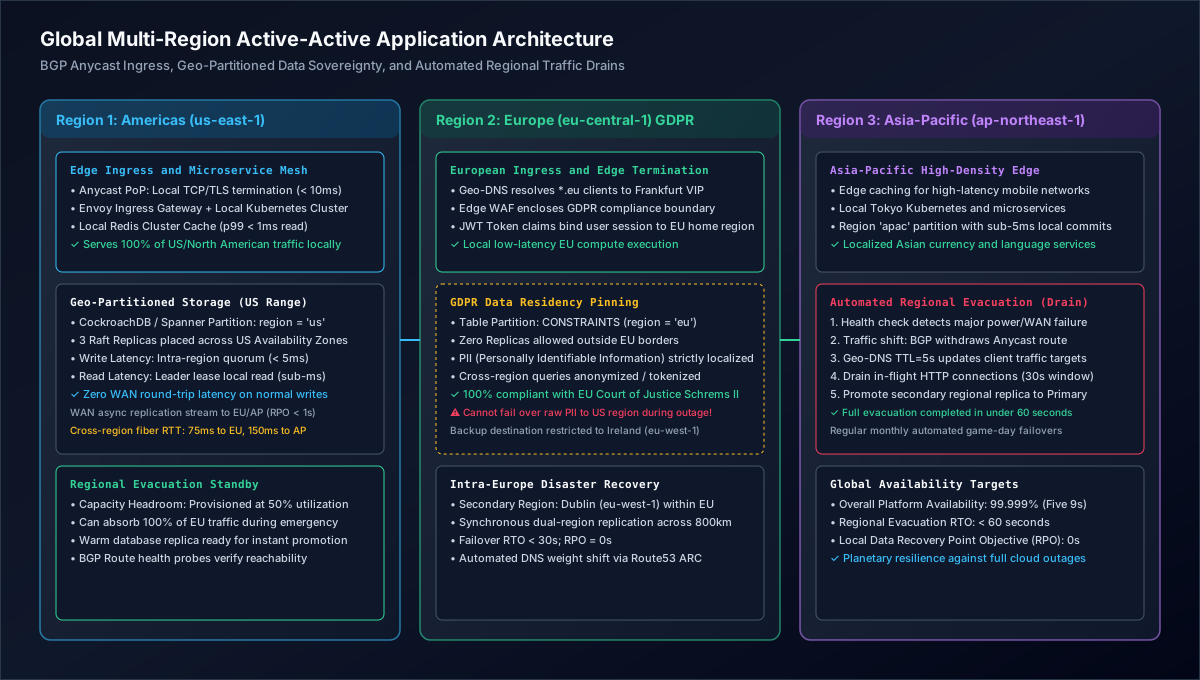
1. Region 1: Americas (us-east-1) & Edge Ingress and Microservice Mesh
Establishes the ingress and structural boundary across Region 1: Americas (us-east-1) & Edge Ingress and Microservice Mesh: Anycast PoP: Local TCP/TLS termination (< 10ms); Envoy Ingress Gateway + Local Kubernetes Cluster; Local Redis Cluster Cache (p99 < 1ms read).
2. Region 2: Europe (eu-central-1) GDPR & European Ingress and Edge Termination
Coordinates core data-plane execution and state transitions through Region 2: Europe (eu-central-1) GDPR & European Ingress and Edge Termination: Geo-DNS resolves *.eu clients to Frankfurt VIP; Edge WAF encloses GDPR compliance boundary; JWT Token claims bind user session to EU home region.
3. Region 3: Asia-Pacific (ap-northeast-1) & Asia-Pacific High-Density Edge
Enforces durability, state convergence, and output verification across Region 3: Asia-Pacific (ap-northeast-1) & Asia-Pacific High-Density Edge: Edge caching for high-latency mobile networks; Local Tokyo Kubernetes and microservices; Region 'apac' partition with sub-5ms local commits.
+-------------------------------------------------------------------------------+
|                          GLOBAL MULTI-REGION TOPOLOGY                         |
+-------------------------------------------------------------------------------+
|                                [Global Users]                                 |
|                                       |                                       |
|                  +--------------------+--------------------+                  |
|                  | (BGP Anycast Routing / Geo-DNS VIPs)    |                  |
|                  v                                         v                  |
|        [Edge PoP: New York]                      [Edge PoP: Frankfurt]        |
|        (TLS Terminated < 10ms)                   (TLS Terminated < 10ms)      |
|                  |                                         |                  |
|                  v                                         v                  |
|       +---------------------+                   +---------------------+       |
|       | Region 1: US-East   |                   | Region 2: EU-Central|       |
|       | Kubernetes Microserv|                   | Kubernetes Microserv|       |
|       | Local Redis Cache   |                   | Local Redis Cache   |       |
|       | Local Quorum (US)   |                   | Local Quorum (EU)   |       |
|       +----------+----------+                   +----------+----------+       |
|                  |                                         |                  |
|                  +====== Asynchronous WAN Replication =====+                  |
|                          (Cross-Region CDC Stream)                            |
+-------------------------------------------------------------------------------+
3. Global Ingress: BGP Anycast vs. Latency-Based Geo-DNS
Directing millions of users to their nearest healthy region requires understanding two network routing primitives:
| Feature | BGP Anycast Routing | Latency-Based Geo-DNS |
|---|---|---|
| Layer of Operation | Layer 3 / Layer 4 (Network routing) | Layer 7 (Application name resolution) |
| Failover Convergence | Under 10 seconds (BGP route withdraw) | 5 to 30 minutes (DNS resolver caching) |
| DDoS Absorption | Massive (Traffic dispersed to nearest PoPs) | Limited (All traffic targets resolved IPs) |
| Granularity | Coarse (BGP AS-path hops) | Fine-grained (Can route by country/city) |
| Ideal Role | Edge TLS termination & TCP proxying | Initial application routing & regional pinning |
The Modern Hybrid Blueprint
Production architectures (such as Cloudflare, AWS Global Accelerator, and Google Cloud External Load Balancer) combine both:
- BGP Anycast at the Edge: Users connect to an Anycast VIP announced at over 300 global edge locations. TCP handshakes and TLS sessions are terminated in single-digit milliseconds at the edge.
- Private Backhaul: Traffic is proxied from the edge PoP to the target application region over the cloud provider’s dedicated fiber backbone, bypassing the public, lossy internet.
4. Data Sovereignty & Geo-Partitioned Storage
Under privacy frameworks like the European Union’s GDPR and Germany’s BDSG, personal records cannot be transferred or stored outside compliant geographic jurisdictions without legal mechanisms.
Modern distributed SQL databases (such as CockroachDB and Google Spanner) solve this via Declarative Row-Level Geo-Partitioning:
-- Define table with geographic region partition key
CREATE TABLE customer_profiles (
  id UUID NOT NULL,
  region VARCHAR(10) NOT NULL,
  full_name VARCHAR(100),
  billing_address TEXT,
  PRIMARY KEY (region, id)
) PARTITION BY LIST (region);

-- Pin European records strictly to EU data center nodes
PARTITION eu_customers VALUES IN ('eu')
  CONFIGURE ZONE USING
    constraints = '[+region=eu-central-1, +region=eu-west-1]',
    lease_holder_preference = '[+region=eu-central-1]';

-- Pin American records strictly to US data center nodes
PARTITION us_customers VALUES IN ('us')
  CONFIGURE ZONE USING
    constraints = '[+region=us-east-1, +region=us-west-2]',
    lease_holder_preference = '[+region=us-east-1]';
Invariants Maintained
- Low-Latency Writes: An EU user writing data achieves quorum across Frankfurt and Dublin in . Zero packets cross the Atlantic Ocean.
- Legal Compliance: Raft replicas for European citizens are physically forbidden from being scheduled on North American hardware.
- Unified Global Schema: Global microservices can still query
customer_profilesas a single logical database.
5. Automated Regional Evacuation (Drain) Protocol
When a data center region suffers a catastrophic event (such as a multi-hour cloud outage or fiber severed by construction), the platform must execute an automated Regional Evacuation:
+-------------------+      +-------------------+      +-------------------+      +-------------------+
| 1. Detect Failure | ---> | 2. Shift Ingress  | ---> | 3. Drain In-Flight| ---> | 4. Promote Data   |
| (Synthetic Probes |      | (BGP withdraw /   |      | (Wait 30s for     |      | (Promote standby  |
|  Heartbeat Lost)  |      |  Route53 ARC)     |      |  requests to end) |      |  replicas to lead)|
+-------------------+      +-------------------+      +-------------------+      +-------------------+
Safety Guardrail: Compliance-Aware Evacuation
If the failing region is Europe (Frankfurt):
- Traffic CANNOT be shifted to the United States due to GDPR constraints.
- Traffic MUST be shifted to the secondary European sovereign zone: Dublin (
eu-west-1). - The evacuation orchestrator must enforce geographic compliance constraints in its failover topology matrix.
6. Practical Engineering Simulation: Global Multi-Region Router & Evacuation Engine
The following self-contained TypeScript simulation models a planetary multi-region router enforcing Geo-DNS resolution, localized data residency constraints, latency emulation, and automated regional evacuation.
/**
 * Systems Notebook - Global Multi-Region Router & Evacuation Simulation
 */

type RegionId = 'us-east-1' | 'eu-central-1' | 'ap-northeast-1' | 'eu-west-1';

interface CloudRegion {
  id: RegionId;
  name: string;
  isHealthy: boolean;
  complianceZone: 'US' | 'EU' | 'APAC';
  allocatedCapacityQps: number;
}

interface ClientRequest {
  id: string;
  clientIp: string;
  userHomeRegion: RegionId;
  dataClassification: 'PUBLIC' | 'SOVEREIGN_PII';
  timestampMs: number;
}

class PlanetaryMultiRegionRouter {
  private regions: Map<RegionId, CloudRegion> = new Map();
  private secondaryPairings: Map<RegionId, RegionId> = new Map();

  constructor() {
    this.regions.set('us-east-1', { id: 'us-east-1', name: 'N. Virginia', isHealthy: true, complianceZone: 'US', allocatedCapacityQps: 50000 });
    this.regions.set('eu-central-1', { id: 'eu-central-1', name: 'Frankfurt', isHealthy: true, complianceZone: 'EU', allocatedCapacityQps: 40000 });
    this.regions.set('eu-west-1', { id: 'eu-west-1', name: 'Dublin', isHealthy: true, complianceZone: 'EU', allocatedCapacityQps: 40000 });
    this.regions.set('ap-northeast-1', { id: 'ap-northeast-1', name: 'Tokyo', isHealthy: true, complianceZone: 'APAC', allocatedCapacityQps: 30000 });

    // Define legally compliant disaster recovery pairings
    this.secondaryPairings.set('us-east-1', 'eu-central-1');
    this.secondaryPairings.set('eu-central-1', 'eu-west-1'); // GDPR strictly bound to EU!
    this.secondaryPairings.set('ap-northeast-1', 'us-east-1');
  }

  /**
   * Route Inbound Request based on Geo-Affinity and Compliance
   */
  public routeRequest(req: ClientRequest): {
    routedRegion: RegionId;
    networkLatencyMs: number;
    status: number;
    notes: string;
  } {
    let targetRegionId = req.userHomeRegion;
    let targetRegion = this.regions.get(targetRegionId)!;

    // Check if target primary region is healthy
    if (!targetRegion.isHealthy) {
      const backupRegionId = this.secondaryPairings.get(targetRegionId);
      if (!backupRegionId) {
        return { routedRegion: targetRegionId, networkLatencyMs: 0, status: 503, notes: 'No Disaster Recovery target defined' };
      }

      const backupRegion = this.regions.get(backupRegionId)!;

      // Enforce Data Sovereignty rule
      if (req.dataClassification === 'SOVEREIGN_PII' && backupRegion.complianceZone !== targetRegion.complianceZone) {
        return {
          routedRegion: targetRegionId,
          networkLatencyMs: 0,
          status: 451, // Unavailable For Legal Reasons
          notes: `GDPR Compliance Violation: Cannot failover sovereign PII from ${targetRegion.complianceZone} to ${backupRegion.complianceZone}`
        };
      }

      targetRegionId = backupRegionId;
      targetRegion = backupRegion;
    }

    // Emulate physical speed-of-light network transit (4ms local, 18ms intra-continent EU/US failover, 78ms trans-oceanic)
    const homeZone = this.regions.get(req.userHomeRegion)?.complianceZone;
    const latencyMs =
      targetRegionId === req.userHomeRegion
        ? 4
        : homeZone === targetRegion.complianceZone
        ? 18
        : 78;

    return {
      routedRegion: targetRegionId,
      networkLatencyMs: latencyMs,
      status: 200,
      notes: targetRegionId === req.userHomeRegion ? 'Routed directly to home region' : `Evacuated to compliant standby: ${targetRegionId}`
    };
  }

  /**
   * Trigger Regional Evacuation (Drain)
   */
  public evacuateRegion(regionId: RegionId): void {
    const region = this.regions.get(regionId);
    if (!region) return;

    console.log(`[EVACUATION] Initiating emergency regional drain on ${regionId} (${region.name})...`);
    region.isHealthy = false;
    console.log(`[EVACUATION] BGP Anycast routes withdrawn. Traffic diverted to standby pairings.`);
  }
}

// -------------------------------------------------------------
// Verification Execution
// -------------------------------------------------------------
function runGlobalDemo(): void {
  const router = new PlanetaryMultiRegionRouter();

  console.log('=== Step 1: Normal Steady-State Planetary Routing ===');
  const req1 = router.routeRequest({
    id: 'req-001',
    clientIp: '194.12.4.1',
    userHomeRegion: 'eu-central-1',
    dataClassification: 'SOVEREIGN_PII',
    timestampMs: 1000
  });
  console.log('EU Citizen Request:', req1);

  console.log('\n=== Step 2: Catastrophic Outage in Frankfurt (eu-central-1) ===');
  router.evacuateRegion('eu-central-1');

  console.log('\n=== Step 3: Evacuated Traffic Steering with GDPR Sovereignty Enforcement ===');
  const reqAfterEvacuation = router.routeRequest({
    id: 'req-002',
    clientIp: '194.12.4.1',
    userHomeRegion: 'eu-central-1',
    dataClassification: 'SOVEREIGN_PII',
    timestampMs: 2000
  });
  console.log('Evacuated Request Result:', reqAfterEvacuation);
}

runGlobalDemo();
7. Observability & SRE Metrics
+-------------------------------------------------------------------------------+
|                       MULTI-REGION SRE TELEMETRY DASHBOARD                    |
+-------------------------------------------------------------------------------+
| Metric Indicator       | Prometheus Metric       | Critical Alert Threshold   |
+------------------------+-------------------------+----------------------------+
| Cross-Region Replication| replication_lag_seconds | Alert if lag > 5 seconds;  |
| Lag                    | {src_region, dst_region}| RPO SLA at risk!           |
| Cross-Region WAN Latency| probe_wan_rtt_seconds   | Alert if RTT exceeds       |
|                        |                         | baseline physical floor +25%|
| BGP Route Flapping     | bgp_session_flaps_total | Alert if > 2 flaps in 10m; |
|                        |                         | edge route oscillation     |
| Standby Region Headroom| region_cpu_headroom_pct | Alert if headroom < 40%;   |
|                        |                         | cannot absorb evacuation   |
+------------------------+-------------------------+----------------------------+
8. Comprehensive Architectural Summary
Planetary-scale multi-region engineering harmonizes physical reality with international regulatory law:
- Physics Dictates Topology: Speed of light makes synchronous consensus across oceans unviable; systems must utilize geo-partitioned local consensus quorums with asynchronous cross-region streams.
- BGP Anycast & Edge Acceleration: Terminating TLS handshakes and TCP sessions at the edge Point of Presence eliminates round-trip connection overhead for global users.
- Sovereign Disaster Recovery: Automated regional evacuation must preserve data sovereignty boundaries, routing European citizen records strictly within compliant legal jurisdictions.
9. Global Multi-Region Architecture Alternatives & Trade-Offs
| Multi-Region Architecture | Write Latency | Cross-Region Consistency | Disaster Recovery RPO | Regulatory Compliance |
|---|---|---|---|---|
| Active-Passive (Read Replicas) | Single-region (< 5ms local) | Eventual on replicas | RPO > 0 (Async replication lag) | Challenging (Sovereign data in replica) |
| Active-Active Multi-Primary | Local (< 5ms) | Eventual (Conflict resolution needed) | Near-zero | Moderate (Requires conflict tables) |
| Geo-Partitioned Spanner/CockroachDB | Sub-10ms local consensus | Strong External Consistency | RPO = 0 (Consensus quorums) | Maximum (Data stays in jurisdiction) |
| Edge Compute + Central DB | WAN round-trip (150-250ms) | Strong at central origin | Bounded by central DB | Poor (All writes leave local borders) |
10. Failure Modes, Sovereign Data Incidents & Recovery
| Failure Scenario | Root Cause | Impact | Automated Recovery Action |
|---|---|---|---|
| Transatlantic Cable Severance | Physical fiber cut | RTT spikes to 450ms via Pacific | BGP Anycast reroutes traffic to alternative terrestrial backbones |
| Inadvertent Sovereign Spillover | Automated failover routes EU DB to US | Regulatory GDPR violation | Failover controller restricted to strictly intra-EU regional pairings |
| Split-Brain Write Conflict | Network partition between active primaries | Divergent record histories | CRDT or Last-Write-Wins (LWW) deterministic conflict resolution |
| Stale DNS Blackholing | ISP recursive resolvers ignore 5s TTL | Users sent to dead IP | BGP Anycast route withdrawal instantly redirects traffic at Tier 1 transit |
11. Guided Design Exercises
Exercise 1: Multi-Region Consensus Quorum Placement & WAN Latency Derivation
Scenario: You are deploying a 5-replica Raft/Paxos consensus group for European customer orders (PARTITION eu_customers) with a strict write commit SLA of and across a full-region outage. Available EU regions and pairwise fiber RTTs are:
- Frankfurt (
eu-central-1) Zurich (eu-central-2): RTT - Frankfurt (
eu-central-1) Dublin (eu-west-1): RTT - Zurich (
eu-central-2) Dublin (eu-west-1): RTT
- Design the 5-voting-replica placement across Frankfurt, Zurich, and Dublin (with Frankfurt as leaseholder) so that:
- Steady-state quorum ( replicas) commits in network RTT.
- A total catastrophe destroying all of Frankfurt still leaves a surviving majority quorum inside the EU with .
- Calculate the exact Raft commit RTT before and after Frankfurt fails (when leaseholder leadership transfers to Zurich).
Exercise 2: Regional Evacuation Capacity & Standby Headroom Sizing
Scenario: Your European sovereign zone operates across active regions—Frankfurt (eu-central-1: ), Dublin (eu-west-1: ), and Paris (eu-west-3: )—with a policy that any two regions must safely absorb 100% of the third region’s traffic during an emergency evacuation without exceeding CPU utilization.
- Derive the minimum provisioned QPS capacity required per region and the maximum permissible steady-state CPU utilization during normal 3-region operation.
- Quantify the end-to-end Recovery Time Objective () budget across failure detection (3 synthetic probes at intervals), BGP Anycast route withdrawal, Raft leader lease expiration (), and connection pool warm-up.
Exercise 3: Split-Brain Conflict Resolution & Sovereign Spillover Guardrails
Scenario: A trans-continental submarine cable cut isolates ap-northeast-1 (Tokyo) from us-east-1 (Virginia) for . During the partition, a roaming user updates their notification preferences in Tokyo (t = 1000.050s) while an automated billing job updates the same preferences row in Virginia (t = 1000.010s).
- Compare what happens during the partition and upon partition heal under (a) Geo-Partitioned Raft (
RPO = 0, single home-region leaseholder) versus (b) Active-Active Multi-Primary asynchronous replication with CRDT / LWW conflict resolution. - Explain why the
PlanetaryMultiRegionRouterreturnedHTTP 451 Unavailable For Legal Reasonswhenap-northeast-1failed over tous-east-1forSOVEREIGN_PII, and update the topology pairing so Tokyo fails over to Osaka (ap-northeast-3, RTT) within theAPACcompliance zone.
View Reference Architecture & Worked Solutions (APP-A12-001)
1. Reference Solution — Exercise 1: Multi-Region Consensus Quorum Placement & WAN Latency Derivation
- Step 1 (5-Replica Sovereign EU Topology for ):
- Place 2 voting replicas in Frankfurt (
eu-central-1, AZ-a & AZ-b), 2 voting replicas in Zurich (eu-central-2, AZ-a & AZ-b), and 1 voting replica in Dublin (eu-west-1, AZ-a), withlease_holder_preference = '[+region=eu-central-1]'. - Why never place replicas in Frankfurt? If of replicas sat in Frankfurt, a total Frankfurt outage would wipe out replicas simultaneously, losing majority quorum () and halting writes until manual unsafe quorum recovery! With a split, losing any single region leaves at least (a full majority quorum with ).
- Place 2 voting replicas in Frankfurt (
- Step 2 (Raft Commit RTT Before & After Frankfurt Failure):
- Normal Steady State (Leaseholder in Frankfurt): Frankfurt holds 2 local votes (AZ-a in , AZ-b in ) and needs only 1 remote vote from Zurich ( RTT) to reach majority. With NVMe WAL
fsync, commit latency is (well below the SLA!). - During Frankfurt Outage (Leaseholder Promoted to Zurich): Zurich holds 2 local votes (AZ-a & AZ-b, ) and obtains its 3rd vote from Dublin ( RTT). Commit latency is , still satisfying with zero data loss!
- Normal Steady State (Leaseholder in Frankfurt): Frankfurt holds 2 local votes (AZ-a in , AZ-b in ) and needs only 1 remote vote from Zurich ( RTT) to reach majority. With NVMe WAL
2. Reference Solution — Exercise 2: Regional Evacuation Capacity & Standby Headroom Sizing
- Step 1 (Minimum Provisioned Regional Capacity & Steady-State Utilization):
- Total EU traffic across the 3 regions: .
- If Frankfurt () fails and traffic splits evenly between Dublin and Paris, each surviving region must carry .
- To keep post-evacuation CPU utilization at :
- During normal 3-region operation (), steady-state CPU utilization must not exceed:
- Step 2 (End-to-End Budget Breakdown):
- Health-check failure detection ( consecutive missed probes):
- BGP Anycast withdrawal & edge proxy reroute:
- Raft leader lease expiration & Zurich leaseholder election (overlapping with BGP drain):
- Standby connection pool & JIT cache warm-up:
- Total Evacuation : ( target SLA).
3. Reference Solution — Exercise 3: Split-Brain Conflict Resolution & Sovereign Spillover Guardrails
- Step 1 (Partition Behavior: Geo-Partitioned Raft vs. Multi-Primary LWW/CRDT):
- Geo-Partitioned Raft: The user’s row belongs to a single Raft group whose quorum is pinned to
ap-northeast-1. During the trans-Pacific cable cut, the Tokyo user’s local write succeeds immediately (), whereas the Virginia billing job cannot reach the Tokyo leaseholder and fails closed (RPC Timeout/ retry queue), guaranteeing strict linearizability and zero split-brain divergence. - Multi-Primary Asynchronous Replication: Both Tokyo and Virginia accept local writes during the partition. When the cable heals, naive timestamp Last-Write-Wins (LWW) compares
1000.050svs.1000.010sand silently overwrites the Virginia mutation (RPO > 0for overwritten fields), unless the preferences map is modeled as a per-field LWW-Element-Set CRDT so disjoint preference keys merge cleanly.
- Geo-Partitioned Raft: The user’s row belongs to a single Raft group whose quorum is pinned to
- Step 2 (Compliant APAC Sovereign Failover Pairing):
- Because
ap-northeast-1(complianceZone: 'APAC') was paired withus-east-1(complianceZone: 'US'),routeRequestblocked the cross-jurisdiction failover ofSOVEREIGN_PIIwithHTTP 451. - Adding Osaka (
ap-northeast-3,complianceZone: 'APAC') and settingthis.secondaryPairings.set('ap-northeast-1', 'ap-northeast-3')keeps failover strictly inside Japan’s APPI jurisdiction at intra-zone latency withstatus: 200.
- Because
12. Authoritative References & Global System Standards
- James C. Corbett et al. (2012), “Spanner: Google’s Globally-Distributed Database”, OSDI ‘12 — usenix.org/conference/osdi12/technical-sessions/presentation/corbett
- Rebecca Taft et al. (2020), “CockroachDB: The Resilient Geo-Distributed SQL Database”, SIGMOD ‘20 — doi.org/10.1145/3318464.3386134
- European Parliament and Council (2016), “General Data Protection Regulation (GDPR) Regulation (EU) 2016/679” — eur-lex.europa.eu/eli/reg/2016/679/oj
- Version Context: Specifications reflect CockroachDB 24.1+ geo-partitioning and Google Cloud Spanner multi-region configurations.