1. Context & Architecture Reality
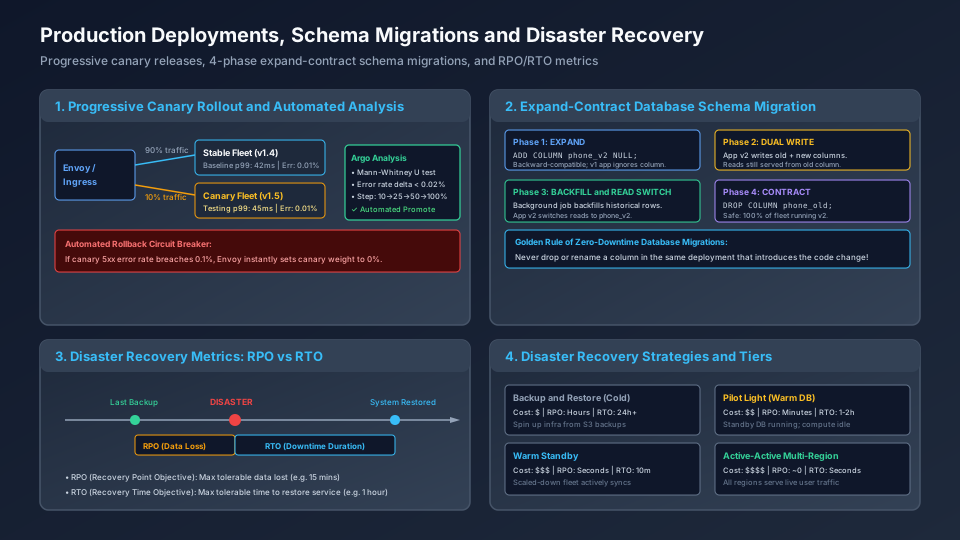
1. Envoy / & Stable Fleet (v1.4)
Establishes the ingress and structural boundary across Envoy / & Stable Fleet (v1.4): Ingress 90% traffic; Baseline p99: 42ms | Err: 0.01%; Testing p99: 45ms | Err: 0.01%.
2. Phase 1: EXPAND & Phase 2: DUAL WRITE
Coordinates core data-plane execution and state transitions through Phase 1: EXPAND & Phase 2: DUAL WRITE: ADD COLUMN phone_v2 NULL; Backward-compatible; v1 app ignores column; App v2 writes old + new columns. Reads still served from old column; Background job backfills historical rows. App v2 switches reads to phone_v2.
3. Progressive Canary Rollout and Automated Analysis & Expand-Contract Database Schema Migration
Enforces durability, state convergence, and output verification across Progressive Canary Rollout and Automated Analysis, Expand-Contract Database Schema Migration, Disaster Recovery Metrics: RPO vs RTO, Disaster Recovery Strategies and Tiers within the Production Deployments, Schema Migrations and Disaster Recovery architecture.
In the early days of web software, deploying a new release meant scheduling a “maintenance window” at 2:00 AM on Sunday, displaying a maintenance page to users, stopping backend processes, running SQL migration scripts, and starting the new application version. If the database migration failed or the new code had an unhandled exception, engineers endured high-stress rollback procedures under severe downtime pressure.
In modern global distributed systems:
- There is no maintenance window: users in Tokyo, London, and New York generate continuous traffic 24 hours a day.
- Systems are deployed dozens of times a day across hundreds of microservices.
- At any given second during a rollout, Version and Version of an application run concurrently in the cluster, sharing the exact same production database.
Achieving zero downtime requires mastering two tightly linked disciplines:
- Progressive Deployment Topologies: Routing traffic incrementally (Canary rollouts) with automated metric analysis and instant automated rollbacks.
- Expand-Contract Schema Migrations: Structuring database schema evolutions into decoupled, backward-compatible phases so that old and new application code operate harmoniously on the same database.
+--------------------------------------------------------------------------------------------------+
|                            PROGRESSIVE CANARY DEPLOYMENT TOPOLOGY                                |
|                                                                                                  |
|                              User Requests (100% Ingress)                                        |
|                                           |                                                      |
|                                           v                                                      |
|                             [Envoy Ingress Traffic Router]                                       |
|                                     /           \                                                |
|                   (90% Traffic)   /               \   (10% Traffic)                              |
|                                 v                   v                                            |
|                 +-----------------------+   +-----------------------+                            |
|                 | Baseline Fleet (v1.4) |   |  Canary Fleet (v1.5)  |                            |
|                 | Error Rate: 0.01%     |   |  Error Rate: 0.01%    |                            |
|                 | p99 Latency: 42ms     |   |  p99 Latency: 45ms    |                            |
|                 +-----------+-----------+   +-----------+-----------+                            |
|                             \                           /                                        |
|                              v                         v                                         |
|                   +-------------------------------------------------+                            |
|                   |   Shared Production Database (Expand Phase)     |                            |
|                   |   Both v1.4 and v1.5 operate without conflicts  |                            |
|                   +-------------------------------------------------+                            |
+--------------------------------------------------------------------------------------------------+
2. Core Problem & Failure Modes
Zero-downtime deployments encounter four severe failure modes:
-
The Exclusive Lock Catastrophe: Relational databases (PostgreSQL, MySQL) require an exclusive metadata lock (
AccessExclusiveLock) to alter table definitions. If a slow analytic query is running on tableorders, a seemingly trivialALTER TABLE orders ADD COLUMN status VARCHAR(20);queues up waiting for the read lock to release. Crucially, all subsequent incoming queries queue behind the DDL statement, exhausting the database connection pool within seconds and bringing the entire company down. -
The Rollback Trap: An engineer deploys Code v2 and runs a migration that immediately renames column
emailtouser_email. Code v2 encounters a critical bug, and the team triggers an emergency code rollback to Code v1. However, Code v1 still expects columnemail, which no longer exists! The database schema is now incompatible with Code v1, turning a standard 30-second code rollback into an hours-long outage. -
Asynchronous Replication Loss (RPO Violations): During regional disaster recovery failovers, companies relying on asynchronous database replication (e.g., AWS RDS Cross-Region Read Replicas) promote the secondary replica to primary. If the replica lagged behind by when the primary datacenter lost power, those 45 seconds of committed customer transactions are permanently lost.
-
Split-Brain Disaster Recovery: If an automated DR failover promotes Region B to primary while Region A is merely experiencing a temporary network partition (and still accepting writes from local clients), both regions write contradictory data to their respective databases, corrupting data integrity irreparably.
3. Technical Deep Dive
The 4-Phase Expand-Contract Migration Pattern
To safely evolve schemas without table locks and without creating rollback traps, every non-trivial schema change (renaming columns, changing column types, adding non-null constraints, moving data across tables) must be split into four distinct phases spanning at least two deployment cycles.
+--------------------------------------------------------------------------------------------------+
| PHASE 1: EXPAND                                                                                  |
| - Add new column as NULLABLE: ALTER TABLE users ADD COLUMN phone_e164 VARCHAR(32) NULL;          |
| - Backward compatibility: Code v1 completely ignores the new column.                            |
+--------------------------------------------------------------------------------------------------+
                                               |
                                               v
+--------------------------------------------------------------------------------------------------+
| PHASE 2: DUAL WRITE                                                                              |
| - Deploy Code v2.                                                                                |
| - Writes: Code v2 writes to BOTH phone_legacy and phone_e164.                                    |
| - Reads: Code v2 continues reading from phone_legacy.                                            |
| - Safety: If Code v2 is rolled back to v1, zero data is lost and v1 continues operating cleanly. |
+--------------------------------------------------------------------------------------------------+
                                               |
                                               v
+--------------------------------------------------------------------------------------------------+
| PHASE 3: BACKFILL & SWITCH READS                                                                 |
| - Run idempotent background batch job to convert & copy historical data from legacy to new.      |
| - Deploy Code v2.1: Switches reads to phone_e164. (Still dual-writes).                           |
+--------------------------------------------------------------------------------------------------+
                                               |
                                               v
+--------------------------------------------------------------------------------------------------+
| PHASE 4: CONTRACT                                                                                |
| - Ensure 100% of the fleet is running Code v2.1+.                                                |
| - Code v3 drops dual-write logic (writes only to phone_e164).                                    |
| - DDL: DROP COLUMN phone_legacy;                                                                 |
+--------------------------------------------------------------------------------------------------+
PostgreSQL DDL Lock Mechanics
In PostgreSQL, every DDL command acquires a lock on the target table:
SELECTqueries acquireAccessShareLock.INSERT,UPDATE,DELETEacquireRowExclusiveLock.ALTER TABLEacquiresAccessExclusiveLock, which conflicts with all other lock modes.
To prevent connection pool exhaustion, production DDL migrations must always configure a strict lock_timeout:
-- Protect production from DDL lock queue buildup
SET lock_timeout = '2s';
ALTER TABLE users ADD COLUMN phone_e164 VARCHAR(32);
If the lock cannot be acquired within 2 seconds, PostgreSQL cancels the DDL query, allowing concurrent production queries to proceed unhindered.
Disaster Recovery: RPO and RTO Formulation
Let:
- : Exact timestamp when disaster strikes the primary datacenter.
- : Timestamp of the latest transaction successfully acknowledged on the recovery replica.
- : Timestamp when the recovery site begins successfully serving production traffic.
The two fundamental disaster recovery metrics are defined as:
Last Sync Point                       Disaster Occurs                      Service Restored
      |                                      |                                     |
      +------------------+-------------------+------------------+------------------+
                         |                                      |
                         |<------------- RPO ------------------>|<------ RTO ----->|
                         |        (Lost Data Window)            | (Outage Duration)|
4. System Design Patterns & Trade-offs
+----------------------------------------------------------------------------------------------------+
| TRADEOFF MATRIX: DEPLOYMENT TOPOLOGIES                                                             |
+--------------------------+-----------------------+-----------------------+-------------------------+
| Feature                  | Rolling Update        | Blue-Green Deployment | Progressive Canary      |
+--------------------------+-----------------------+-----------------------+-------------------------+
| Infrastructure Cost      | Baseline (+20% surge) | 2x Infrastructure     | Baseline (+10% surge)   |
| Rollback Speed           | Slow (rolling reverse)| Instant (DNS/Router)  | Instant (Set weight 0%) |
| Blast Radius             | Medium (20-50% users) | High (100% switch)    | Minimal (1% to 10%)     |
| Automated Metric Analysis| Limited               | Manual or binary test | Statistical (Mann-Wh.)  |
+--------------------------+-----------------------+-----------------------+-------------------------+
| Feature                  | Cold Backup (S3)      | Warm Standby          | Active-Active           |
+--------------------------+-----------------------+-----------------------+-------------------------+
| RPO Target               | Hours to 24h          | Seconds to Minutes    | Near Zero               |
| RTO Target               | 12 to 48 Hours        | 5 to 15 Minutes       | Seconds (< 30s)         |
| Cost Multiplier          | 1.05x                 | 1.5x - 1.8x           | 2.5x - 3.5x             |
+--------------------------+-----------------------+-----------------------+-------------------------+
5. Practical Implementation
Below is a complete TypeScript zero-downtime deployment orchestrator demonstrating:
- Expand-Contract Phase Execution State Machine.
- Canary Traffic Shifter with automated statistical error rate evaluation.
- Automated Instant Rollback Circuit Breaker when canary error thresholds are breached.
export type MigrationPhase = 'EXPAND' | 'DUAL_WRITE' | 'BACKFILL_AND_SWITCH_READ' | 'CONTRACT';

export interface CanaryMetrics {
  totalRequests: number;
  failedRequests: number;
  p99LatencyMs: number;
}

export interface DeploymentStatus {
  phase: MigrationPhase;
  canaryWeightPercent: number;
  isAborted: boolean;
  abortReason?: string;
}

/**
 * Production Zero-Downtime Deployment & Canary Orchestrator
 */
export class ZeroDowntimeOrchestrator {
  private currentPhase: MigrationPhase = 'EXPAND';
  private canaryWeight: number = 0;
  private aborted: boolean = false;
  private abortReason?: string;

  constructor(
    private readonly maxAllowedCanaryErrorRate: number = 0.01, // 1% error ceiling
    private readonly maxAllowedP99LatencyMs: number = 150
  ) {}

  public advanceMigrationPhase(targetPhase: MigrationPhase): void {
    const validTransitions: Record<MigrationPhase, MigrationPhase> = {
      EXPAND: 'DUAL_WRITE',
      DUAL_WRITE: 'BACKFILL_AND_SWITCH_READ',
      BACKFILL_AND_SWITCH_READ: 'CONTRACT',
      CONTRACT: 'CONTRACT'
    };

    if (validTransitions[this.currentPhase] === targetPhase) {
      this.currentPhase = targetPhase;
    } else {
      throw new Error(`Illegal migration transition: ${this.currentPhase} -> ${targetPhase}`);
    }
  }

  /**
   * Evaluates Canary metrics and promotes traffic weight or triggers automated rollback
   */
  public evaluateCanary(metrics: CanaryMetrics): DeploymentStatus {
    if (this.aborted) {
      return this.getStatus();
    }

    // Safety Check 1: Calculate error rate
    const errorRate = metrics.totalRequests > 0 ? metrics.failedRequests / metrics.totalRequests : 0;
    if (errorRate > this.maxAllowedCanaryErrorRate) {
      this.triggerAutomatedRollback(
        `Canary error rate ${(errorRate * 100).toFixed(2)}% breached threshold ${(this.maxAllowedCanaryErrorRate * 100).toFixed(2)}%`
      );
      return this.getStatus();
    }

    // Safety Check 2: Verify p99 latency
    if (metrics.p99LatencyMs > this.maxAllowedP99LatencyMs) {
      this.triggerAutomatedRollback(
        `Canary p99 latency ${metrics.p99LatencyMs}ms breached SLA ${this.maxAllowedP99LatencyMs}ms`
      );
      return this.getStatus();
    }

    // Progressive Promotion: 10% -> 25% -> 50% -> 100%
    if (this.canaryWeight === 0) this.canaryWeight = 10;
    else if (this.canaryWeight === 10) this.canaryWeight = 25;
    else if (this.canaryWeight === 25) this.canaryWeight = 50;
    else if (this.canaryWeight === 50) this.canaryWeight = 100;

    return this.getStatus();
  }

  private triggerAutomatedRollback(reason: string): void {
    this.aborted = true;
    this.abortReason = reason;
    this.canaryWeight = 0; // Instantly cut canary traffic to 0%
  }

  public getStatus(): DeploymentStatus {
    return {
      phase: this.currentPhase,
      canaryWeightPercent: this.canaryWeight,
      isAborted: this.aborted,
      abortReason: this.abortReason
    };
  }
}

function runDemo(): void {
  console.log('=== Zero-Downtime Deployments & Automated Canary Analysis ===');
  const orchestrator = new ZeroDowntimeOrchestrator();
  console.log('Initial deployment status: phase=' + orchestrator.getStatus().phase);
  const canaryCheck = orchestrator.evaluateCanary({ totalRequests: 10000, failedRequests: 2, p99LatencyMs: 45 });
  console.log('Canary health evaluation: healthy=' + !canaryCheck.isAborted + ' (weight=' + canaryCheck.canaryWeightPercent + '%)');
  orchestrator.advanceMigrationPhase('DUAL_WRITE');
  console.log('Advanced deployment to: phase=' + orchestrator.getStatus().phase);
}
runDemo();
Simulation Execution Output & State Transitions
=== Zero-Downtime Deployments & Automated Canary Analysis ===
Initial deployment status: phase=EXPAND
Canary health evaluation: healthy=true (weight=10%)
Advanced deployment to: phase=DUAL_WRITE
6. Failure Scenarios & Edge Cases
1. The Blocked DDL Lock Queue Disaster
An engineer executes ALTER TABLE payments ADD COLUMN status_v2 INT;. Because an analytic batch query is holding a read lock, the DDL waits. Under high concurrency, 500 new incoming user payments queue behind the DDL lock within 2 seconds. The application runs out of database connections, triggering a sitewide outage.
- Mitigation: Never run raw DDL on busy tables. Use online schema migration tools like gh-ost (GitHub’s triggerless online schema tool) or pg-roll. These tools create a shadow table, stream changes via binary logs, backfill data in micro-chunks, and perform an atomic cutover table swap via fast lock renaming with
lock_timeout.
2. DNS TTL Caching Preventing Fast Regional DR Failover
A primary datacenter suffers a total fiber cut. The SRE team updates Amazon Route53 DNS records to point the apex domain to the secondary region. However, millions of residential Internet Service Providers (ISPs) and corporate DNS resolvers ignore the 30-second TTL, hardcoding records for 24 hours.
- Mitigation: Ingress architectures must terminate traffic on BGP Anycast IP addresses (e.g., Cloudflare, AWS Global Accelerator). When a region fails, BGP route withdrawals instantly redirect network packets at the Internet routing layer within 10 seconds, bypassing DNS caching completely.
7. Production Operations & Observability
Automated Canary Metric Guardrails
+----------------------------------------------------------------------------------------------------+
| CANARY EVALUATION GATES (ARGO ROLLOUTS / KAYENTA)                                                  |
+--------------------------+-----------------------+-------------------------------------------------+
| Metric                   | Evaluation Method     | Rollback Condition                              |
+--------------------------+-----------------------+-------------------------------------------------+
| HTTP 5xx Error Rate      | Relative to Baseline  | Canary 5xx rate > Baseline 5xx rate + 0.02%     |
+--------------------------+-----------------------+-------------------------------------------------+
| p99 Request Latency      | Mann-Whitney U test   | Canary p99 > Baseline p99 * 1.15 (p < 0.05)     |
+--------------------------+-----------------------+-------------------------------------------------+
| Pod Restart Count        | Absolute Counter      | Canary pod restarts > 0 in 5-minute window      |
+--------------------------+-----------------------+-------------------------------------------------+
| Unhandled Exceptions     | Sentry / Log Count    | New unhandled exception type detected in canary |
+--------------------------+-----------------------+-------------------------------------------------+
Regular Disaster Recovery Drills (Chaos DR)
A Disaster Recovery plan that is never tested does not work. Elite engineering teams execute quarterly scheduled failovers:
- Dry-run simulation: Verify replica replication lag and execute read-only promotion checks.
- Live traffic evacuation: Redirect 100% of production traffic away from primary region to test capacity autoscaling in standby regions under authentic user load.
8. Security & Compliance
- Cross-Border Data Residency in DR: Under GDPR (Europe) and financial sovereignty regulations, customer data cannot be replicated to backup datacenters located outside approved sovereign geographic boundaries. Disaster recovery replication topologies must respect cryptographic partition boundaries.
- Encrypted Snapshot Immutability: Ransomware attacks frequently seek out cloud backups and delete them before encrypting production databases. Configure S3 Object Lock (WORM: Write Once, Read Many) with Compliance Mode on backup buckets so that snapshots cannot be deleted by any credential, including cloud root accounts.
9. Real-World Case Studies
GitLab January 2017 Backup & Restore Outage
During an operational incident to address replication lag in a 300 GB PostgreSQL database, an engineer accidentally deleted the directory containing live database files on the primary server.
- The Catastrophe: When the team attempted to restore from backups, they discovered that:
- The automated backup snapshot webhook was broken and had failed silently for months without alerting.
- The disk snapshots were configured for the wrong region.
- Five distinct backup and restore mechanisms all failed simultaneously.
- Resolution & Takeaway: GitLab recovered from a developer’s 6-hour-old manual staging snapshot. Never assume backups work without continuous, automated, automated-restore verification tests!
10. Technology Comparison Matrix
+----------------------------------------------------------------------------------------------------+
| DEPLOYMENT & DATABASE MIGRATION TOOLS                                                              |
+----------------------+--------------------+--------------------+-----------------------------------+
| Tool                 | Category           | Primary Mechanism  | Zero-Downtime Guarantee           |
+----------------------+--------------------+--------------------+-----------------------------------+
| Argo Rollouts        | Deployment Engine  | Progressive Canary | Auto-promotes/rolls back on metrics|
+----------------------+--------------------+--------------------+-----------------------------------+
| gh-ost               | DB Migration       | Ghost Table & Binlog| Triggerless, throttleable MySQL  |
+----------------------+--------------------+--------------------+-----------------------------------+
| pg-roll              | DB Migration       | Views & Multi-Phase| Rollback-safe PostgreSQL migrations|
+----------------------+--------------------+--------------------+-----------------------------------+
| AWS Route53          | DNS Routing        | Latency & Failover | Dependent on client DNS TTL honoring|
+----------------------+--------------------+--------------------+-----------------------------------+
| Global Accelerator   | Anycast IP Routing | BGP Anycast routes | Instant packet rerouting (< 10s)  |
+----------------------+--------------------+--------------------+-----------------------------------+
11. Design Challenge & Exercise
Scenario: High-Volume E-Commerce Table Migration
You are the Principal Database Architect for an e-commerce platform processing on the orders table (800 million rows). The business needs to change the total_amount column from INT (cents) to NUMERIC(12, 4) (sub-cents) and add a foreign key to a new currency table.
Constraints:
- You cannot acquire a table lock exceeding .
- You cannot impact user checkout latencies by more than .
- If the new payment calculation logic fails in Code v2, you must be able to roll back to Code v1 instantly with zero data corruption.
Deliverables:
- Draft the SQL DDL commands for Phase 1 (Expand) including lock timeouts.
- Outline the dual-write and asynchronous backfill batch runner logic.
- Define the rollback plan if Code v2 fails 10 minutes into the Phase 2 rollout.
View Reference Architecture & Worked Solutions (CORE-M29-001)
1. Phase 1 (Expand) SQL DDL with Strict Lock & Validation Guards
To avoid holding an AccessExclusiveLock beyond on the 800-million-row orders table (), we add the new columns as nullable without triggering a full-table validation scan, using FOREIGN KEY ... NOT VALID and CREATE INDEX CONCURRENTLY:
SET lock_timeout = '200ms';
SET statement_timeout = '2000ms';

-- Step 1a: Add nullable metadata-only columns (instantaneous in PostgreSQL)
ALTER TABLE orders
  ADD COLUMN total_amount_v2 NUMERIC(12, 4),
  ADD COLUMN currency_code CHAR(3);

-- Step 1b: Attach foreign key constraint with NOT VALID so existing 800M rows are not scanned under lock
ALTER TABLE orders
  ADD CONSTRAINT fk_orders_currency
  FOREIGN KEY (currency_code) REFERENCES currencies(code) NOT VALID;
If SET lock_timeout = '200ms' fails to acquire the lock due to an active query, the migration runner aborts immediately and retries with exponential jitter rather than blocking incoming checkout queries in the lock queue.
2. Phase 2 Dual-Write & Throttled Keyset-Paginated Backfill Runner
- Dual-Write in Code v2: Every
INSERTandUPDATEin Code v2 writes bothtotal_amount(in integer cents, e.g.,1999) andtotal_amount_v2 = total_amount / 100.0(e.g.,19.9900) pluscurrency_code = 'USD', while all read paths continue reading fromtotal_amount(governed by a runtime feature flagread_orders_v2 = false). - Throttled Backfill Worker:
- Never execute a monolithic
UPDATE orders SET total_amount_v2 = total_amount / 100.0;, which would generate 800 million dead MVCC tuples, bloat the table by , and stall autovacuum. - Instead, run a keyset-paginated worker scanning primary key ranges (
WHERE id > $last_id AND id <= $last_id + 2000 AND total_amount_v2 IS NULL) in micro-batches of . - At (, adding only IOPS overhead to the primary), the 800-million-row backfill completes in while keeping replication lag and checkout latency impact .
- Once backfill completes, run
ALTER TABLE orders VALIDATE CONSTRAINT fk_orders_currency;(which acquires only aShareUpdateExclusiveLockthat does not block reads or writes).
- Never execute a monolithic
3. Instant Zero-Data-Loss Rollback Plan (10 Minutes into Phase 2)
Because Code v2 dual-writes to both total_amount (v1 format) and total_amount_v2 (v2 format) and Code v1 only reads/writes total_amount:
- Immediate Traffic Cutover (): Argo Rollouts shifts of traffic back to the Code v1 replica set (or flips the feature flag
dual_write_orders_v2 = false) and halts the backfill worker. - Zero Data Corruption: Every order created during the 10-minute canary window () already has a valid
total_amountinteger populated. Any rows written by Code v1 after rollback simply leavetotal_amount_v2asNULL. - Post-Fix Resumption: Once the bug in Code v2’s sub-cent calculation is fixed, redeploy Code v2 and re-run the idempotent backfill query (
WHERE total_amount_v2 IS NULL OR updated_at >= $incident_start) to repair the affected window before advancing to Phase 3 (Read Switch) and Phase 4 (Contract).
12. Assessment
Review the 4 scenario-based quiz questions at the top of this lesson to test your mastery of progressive canary deployments, Expand-Contract migrations, and disaster recovery engineering.
13. Summary & Architectural Decision Guide
- Adopt Canary Rollouts as Default: Validate new code with 1%–5% of real traffic before wide promotion to eliminate catastrophic regression outages.
- Never Run Breaking DB Migrations: Always execute multi-stage Expand-and-Contract migrations so older and newer application pods can co-exist safely during rollouts.
- Quantify RPO and RTO Explicitly: Match backup and replication topologies (async vs sync) to business disaster recovery requirements.
- Test Disaster Recovery Drills Periodically: Backups that have never undergone live restoration testing are not real backups.
14. Authoritative References & Version Context
- Jez Humble and David Farley (2010), “Continuous Delivery: Reliable Software Releases through Build, Test, and Deployment Automation”, Addison-Wesley — continuousdelivery.com
- Google Site Reliability Engineering Team (2016), “Site Reliability Engineering: How Google Runs Production Systems” (Chapter 27: Reliable Product Launches at Scale) — sre.google/sre-book/table-of-contents/
- AWS Disaster Recovery Whitepaper (2023), “Disaster Recovery of Workloads on AWS: Recovery in the Cloud” — docs.aws.amazon.com/whitepapers/latest/disaster-recovery-workloads-on-aws/
- Version Context: Deployment methodologies reflect Kubernetes 1.28+ RollingUpdate/Argo Rollouts, Istio 1.20+ traffic shifting, and Flyway/Liquibase migration lifecycles.