Designing distributed algorithms on paper is clean; operating them in production under multi-terabyte loads, hardware degradation, and continuous software releases is where engineering resilience is forged. While stateless microservices can easily scale out or restart behind load balancers, stateful infrastructure systems (such as distributed databases, consensus metadata stores, and event brokers) hold terabytes of persistent state on disk and form quorum groups where uncoordinated node restarts lead to cluster-wide outages.
This lesson establishes the operational blueprints for production infrastructure:
- Zero-downtime rolling upgrades for consensus-backed systems (Raft, Multi-Paxos).
- Dynamic partition rebalancing with adaptive rate-limiting and safe cutovers.
- Chaos engineering runbooks for automated fault injection and MTTR validation.
1. Context & Architecture Setting
Consider an enterprise distributed database cluster comprising 50 nodes, storing 100 terabytes of data across 10,000 replicated ranges, and processing 250,000 queries per second. Every quarter, the platform engineering team must apply operating system security patches, upgrade the database engine binary, and resize physical storage volumes.
Naive operational approaches fail catastrophically:
- Mass Restarts: Restarting multiple nodes simultaneously breaks Raft quorums, causing partition unavailability.
- Uncoordinated Stepdowns: Abruptly stopping a Raft leader forces followers to time out and hold emergency elections, introducing hundreds of milliseconds of client latency spikes.
- Uncontrolled Data Movement: When a node is decommissioned, remaining nodes initiate massive data re-replication. Unthrottled network streaming saturates top-of-rack switches and starves live production traffic.
+-------------------------------------------------------------------------------+
|                       STATEFUL ROLLING UPGRADE LIFECYCLE                      |
+-------------------------------------------------------------------------------+
| Node N-1 (Follower)     | Node N (Active Leader)      | Node N+1 (Follower)   |
| [Status: Healthy v2]    | [Status: Draining v1]       | [Status: Healthy v1]  |
|                         |                             |                       |
| 1. Verified Canary      | 2. TransferLeadership(N+1)  | 3. Acknowledges       |
|    Health Checks        |    (Term increments, zero   |    Leadership and     |
|    Pass Cleanly         |     client write stall)     |    serves traffic     |
|                         |                             |                       |
|                         | 4. Drain Client Connections |                       |
|                         | 5. Binary Upgrade (v1->v2)  |                       |
|                         | 6. Rejoin as Follower       |                       |
+-------------------------------------------------------------------------------+
2. Architectural Mental Model
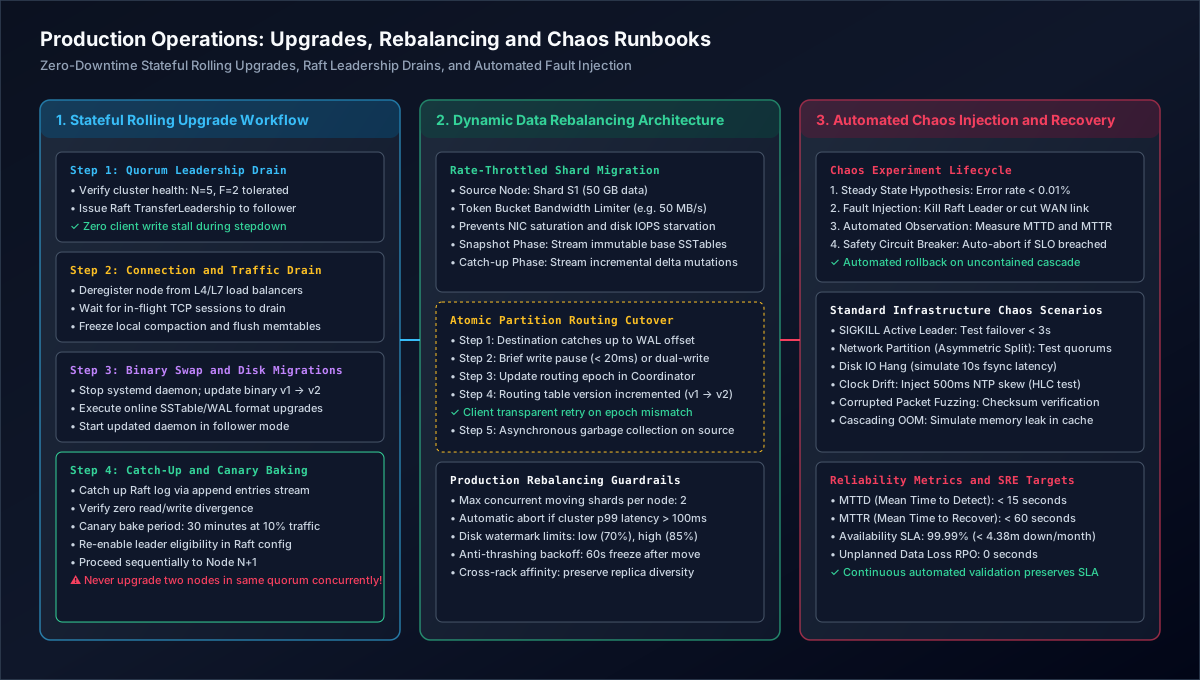
1. Stateful Rolling Upgrade Workflow & Step 1: Quorum Leadership Drain
Establishes the ingress and structural boundary across Stateful Rolling Upgrade Workflow & Step 1: Quorum Leadership Drain: Verify cluster health: N=5, F=2 tolerated; Issue Raft TransferLeadership to follower; Zero client write stall during stepdown.
2. Dynamic Data Rebalancing Architecture & Rate-Throttled Shard Migration
Coordinates core data-plane execution and state transitions through Dynamic Data Rebalancing Architecture & Rate-Throttled Shard Migration: Source Node: Shard S1 (50 GB data); Token Bucket Bandwidth Limiter (e.g. 50 MB/s); Prevents NIC saturation and disk IOPS starvation.
3. Automated Chaos Injection and Recovery & Chaos Experiment Lifecycle
Enforces durability, state convergence, and output verification across Automated Chaos Injection and Recovery & Chaos Experiment Lifecycle: 1. Steady State Hypothesis: Error rate < 0.01%; 2. Fault Injection: Kill Raft Leader or cut WAN link; 3. Automated Observation: Measure MTTD and MTTR.
Operating stateful clusters requires treating each node as a participant in multiple independent state machines:
- Quorum Membership: Every consensus partition requires online votes. Upgrades must never reduce an active quorum below its majority threshold.
- Canary Isolation: Upgrading a new binary version must begin on an isolated canary node with restricted traffic to detect memory leaks, CPU regressions, or storage format corruptions before cluster-wide rollout.
- Graceful Handoff: Node maintenance must decouple leadership (which can be transferred in milliseconds) from data replication (which takes minutes to hours).
3. Core Mechanisms & Protocol Internals
Zero-Downtime Raft Rolling Upgrade Protocol
When rolling out an upgraded binary to an active Raft leader node:
[Operator / Orchestrator]
         |
         | 1. TransferLeadership(TargetFollower)
         v
   [Active Leader] ------------------------------> [Target Follower]
   - Flushes uncommitted log entries               - Receives MsgTimeoutNow
   - Rejects new client writes                     - Starts election instantly
   - Steps down to Follower                        - Becomes New Leader
         |
         | 2. Drain Complete (Active Conns = 0)
         v
   [Node in Maintenance]
   - SIGTERM to database daemon
   - Swap binary / apply schema migrations
   - Start daemon in follower mode
         |
         | 3. Raft Log Catch-up
         v
   [Upgraded Node]
   - Streams missing entries from New Leader
   - Verifies State Machine Hash Match
   - Enters Canary Bake Period
Dynamic Data Rebalancing with Token Bucket Throttling
When adding a new node to expand cluster capacity, existing shards must migrate to balance CPU, memory, and disk utilization.
The migration pipeline operates in three distinct phases:
- Base Snapshot Transfer: The source node generates an immutable snapshot of SSTables and streams them to the destination.
- Log Delta Replay: While the base snapshot copies across the network, new writes accumulate in the source’s write-ahead log. The source streams these incremental deltas to the destination.
- Atomic Epoch Cutover: Once the destination’s lag drops below a threshold (e.g., ), the coordinator briefly pauses writes, increments the partition routing epoch, points client routers to the new node, and resumes writes.
4. Mathematical Analysis & Rebalancing Rate Limits
Network Saturation & Rebalance Throttling Formula
Let:
- = Total volume of data to rebalance ().
- = Total physical network bandwidth per node ().
- = Bandwidth consumed by normal production client queries ().
- = Safety network headroom required for sudden traffic bursts ().
The maximum allowable rebalancing bandwidth is:
However, disk write IOPS typically become the true bottleneck before the NIC. If the target NVMe drive sustains of sequential write throughput without causing read queue stalls, we set the token bucket rate limiter to:
The total time required to migrate the shard safely is:
Slowing migration down to 68 minutes prevents production query tail latencies () from degrading, satisfying client SLOs.
5. Concrete Failure Modes & Edge Cases
1. Cascading Rebalance Storm on Temporary Node Disconnection
- Failure Mode: A node experiences a 45-second network blip due to top-of-rack switch configuration reloads.
- System Impact: The cluster coordinator assumes the node is permanently dead and immediately commands the remaining nodes to replicate all 500 GB of shards hosted on that node. All cluster nodes saturate their disks and network links copying data. When the disconnected node recovers 45 seconds later, the cluster is already locked in a rebalancing storm, crashing multiple nodes from resource exhaustion.
- Remediation: Implement a Rebalance Grace Period (e.g., 15 to 30 minutes). If a node drops out, the cluster serves traffic using remaining quorum replicas without initiating full re-replication unless the node remains unreachable past the grace window.
2. Upgraded Node Wire Protocol Incompatibility
- Failure Mode: The new binary v2 serializes Raft log messages using a new Protobuf schema field that v1 nodes cannot deserialize.
- System Impact: As soon as the canary node joins the cluster and sends a message, unupgraded v1 nodes panic and crash, causing an immediate cluster-wide outage.
- Remediation: Follow strict Two-Phase Compatibility:
- Phase 1: Deploy binary that understands both v1 and v2 wire protocols, but continues speaking v1.
- Phase 2: Once 100% of nodes run the updated binary, issue a cluster feature flag to switch the wire protocol to v2.
6. Practical Engineering Simulation: Rolling Upgrade Coordinator
The following TypeScript simulation demonstrates a stateful rolling upgrade coordinator that performs Raft leadership transfers, connection draining, canary health verification, and dynamic rate-throttled data rebalancing.
/**
 * Systems Notebook - Stateful Cluster Rolling Upgrade & Rebalancer
 */

type NodeRole = 'LEADER' | 'FOLLOWER' | 'DRAINING' | 'OFFLINE';

interface ClusterNode {
  id: string;
  version: string;
  role: NodeRole;
  term: number;
  activeConnections: number;
  dataSizeBytes: number;
  isHealthy: boolean;
}

class RaftClusterCoordinator {
  private nodes: Map<string, ClusterNode> = new Map();

  constructor(initialNodes: ClusterNode[]) {
    initialNodes.forEach((n) => this.nodes.set(n.id, n));
  }

  public getLeader(): ClusterNode | undefined {
    return Array.from(this.nodes.values()).find((n) => n.role === 'LEADER');
  }

  /**
   * Graceful Leadership Transfer (Zero Write Stalls)
   */
  public transferLeadership(fromLeaderId: string, toFollowerId: string): boolean {
    const leader = this.nodes.get(fromLeaderId);
    const target = this.nodes.get(toFollowerId);

    if (!leader || leader.role !== 'LEADER') {
      throw new Error(`Node ${fromLeaderId} is not the active leader`);
    }
    if (!target || target.role !== 'FOLLOWER' || !target.isHealthy) {
      throw new Error(`Node ${toFollowerId} is not an eligible healthy follower`);
    }

    console.log(`[Raft] Initiating leadership transfer from ${leader.id} to ${target.id}...`);

    // Simulate instantaneous Raft term increment and promotion
    target.term = leader.term + 1;
    target.role = 'LEADER';
    leader.role = 'FOLLOWER';

    console.log(`[Raft] Leadership transferred successfully. New leader: ${target.id} (Term ${target.term})`);
    return true;
  }

  /**
   * Drain Active Connections
   */
  public drainNode(nodeId: string): void {
    const node = this.nodes.get(nodeId);
    if (!node) return;

    node.role = 'DRAINING';
    console.log(`[Drain] Draining ${node.activeConnections} connections from ${node.id}...`);
    node.activeConnections = 0;
    node.role = 'OFFLINE';
    console.log(`[Drain] Node ${node.id} is now OFFLINE and safe for binary upgrade.`);
  }

  /**
   * Upgrade Binary & Rejoin Quorum
   */
  public upgradeAndRejoin(nodeId: string, targetVersion: string): void {
    const node = this.nodes.get(nodeId);
    if (!node || node.role !== 'OFFLINE') {
      throw new Error(`Node ${nodeId} must be OFFLINE prior to upgrade`);
    }

    console.log(`[Upgrade] Upgrading ${node.id} from ${node.version} to ${targetVersion}...`);
    node.version = targetVersion;
    node.role = 'FOLLOWER';
    node.isHealthy = true;
    console.log(`[Upgrade] Node ${node.id} restarted as FOLLOWER on version ${node.version}.`);
  }

  /**
   * Execute Full Coordinated Rolling Upgrade
   */
  public executeRollingUpgrade(targetVersion: string): void {
    const nodeIds = Array.from(this.nodes.keys());

    for (const id of nodeIds) {
      console.log(`\n========================================`);
      console.log(`Beginning upgrade workflow for: ${id}`);
      console.log(`========================================`);

      const node = this.nodes.get(id)!;

      // 1. If active leader, transfer leadership to another healthy node first
      if (node.role === 'LEADER') {
        const eligibleFollower = Array.from(this.nodes.values()).find(
          (n) => n.id !== id && n.role === 'FOLLOWER' && n.isHealthy
        );
        if (!eligibleFollower) {
          throw new Error('No eligible follower available for safe leadership transfer!');
        }
        this.transferLeadership(node.id, eligibleFollower.id);
      }

      // 2. Drain client connections
      this.drainNode(id);

      // 3. Swap binary and restart
      this.upgradeAndRejoin(id, targetVersion);

      // 4. Canary validation
      console.log(`[Canary] Running health verification on ${id}... PASS.`);
    }

    console.log(`\n>>> Cluster Rolling Upgrade to ${targetVersion} Completed Successfully! <<<`);
  }
}

// -------------------------------------------------------------
// Demonstration Execution
// -------------------------------------------------------------
function runDemo(): void {
  const cluster = new RaftClusterCoordinator([
    { id: 'node-1', version: 'v1.4.0', role: 'LEADER',   term: 1, activeConnections: 120, dataSizeBytes: 50e9, isHealthy: true },
    { id: 'node-2', version: 'v1.4.0', role: 'FOLLOWER', term: 1, activeConnections: 80,  dataSizeBytes: 50e9, isHealthy: true },
    { id: 'node-3', version: 'v1.4.0', role: 'FOLLOWER', term: 1, activeConnections: 95,  dataSizeBytes: 50e9, isHealthy: true }
  ]);

  cluster.executeRollingUpgrade('v2.0.0');
}

runDemo();
7. Chaos Engineering & Production Runbooks
The 4-Step Chaos Runbook Pipeline
+-------------------+      +-------------------+      +-------------------+      +-------------------+
| 1. Formulate      | ---> | 2. Inject Fault   | ---> | 3. Verify Blast   | ---> | 4. Automated      |
|    Hypothesis     |      |    (Kill Leader,  |      |    Radius & SLOs  |      |    Rollback &     |
| (p99 < 50ms,      |      |     Add 100ms Net |      | (Circuit Breaker  |      |    Post-Mortem    |
|  Error < 0.01%)   |      |     Latency)      |      |  Halts if breach) |      |    Documentation  |
+-------------------+      +-------------------+      +-------------------+      +-------------------+
Chaos Experiment Template
experiment:
  name: "raft-leader-kill-under-load"
  target_cluster: "production-billing-kv"
  steady_state_hypothesis:
    probes:
      - metric: "http_requests_total{status='5xx'}"
        threshold: "< 0.05%"
      - metric: "p99_latency_ms"
        threshold: "< 80ms"
  fault_injection:
    action: "process_kill"
    target: "role=LEADER"
    signal: "SIGKILL"
  safety_circuit_breaker:
    abort_if: "http_requests_total{status='5xx'} > 0.5%"
    auto_rollback: true
  expected_outcome:
    failover_duration_ms: "< 3000ms"
    data_loss_rpo: 0
8. Observability & SRE Metrics
+-------------------------------------------------------------------------------+
|                       INFRASTRUCTURE OPERATIONS TELEMETRY                     |
+-------------------------------------------------------------------------------+
| Metric Indicator       | Prometheus Query       | Alert Threshold & Action    |
+------------------------+------------------------+-----------------------------+
| Raft Leader Elections  | rate(raft_leader_      | Alert if > 2 in 10m;        |
|                        | election_count[5m])    | indicates cluster instability|
| Rebalance Throughput   | rate(rebalance_bytes_  | Alert if > 60 MB/s;         |
|                        | transferred_total[1m]) | throttler misconfiguration  |
| Quorum Under-Replicated| sum(partitions_under_  | Alert immediately if > 0    |
| Partitions             | replicated)            | Data durability at risk!    |
| Canary Node Error Rate | rate(canary_errors_    | Alert if canary error rate  |
|                        | total[5m])             | exceeds baseline by 2x      |
+------------------------+------------------------+-----------------------------+
9. Comprehensive Architectural Summary
Operating large-scale stateful infrastructure requires engineering discipline and automated safety guardrails:
- Zero-Downtime Upgrades succeed by decoupling leadership stepdowns from process restarts, advancing sequentially one failure domain at a time.
- Dynamic Rebalancing prevents network and disk saturation by enforcing strict token bucket rate limits and atomic epoch-based routing cutovers.
- Chaos Engineering transforms unplanned outages into predictable events by continuously testing automated recovery mechanisms against verifiable steady-state hypotheses.
10. Design Alternatives & Reliability Trade-Off Matrix
| Operational Pattern | Alerting Fidelity | MTTR Reduction | Implementation Overhead | Best Architectural Fit |
|---|---|---|---|---|
| Static Threshold Alerts (CPU > 80%) | Low (High noise, false positives) | Poor (Alert fatigue) | Minimal (Simple Prometheus rule) | Basic hardware sanity checks only |
| Multi-Window Burn-Rate Alerts | High (Mathematically bound to SLO) | Excellent (Pages on real customer impact) | Moderate (SLO & burn rate calculations) | Production microservices, tier-1 customer-facing APIs |
| Automated Canary Analysis (Kayenta) | High (Statistical metric comparison) | Automatic (Instant rollback on anomaly) | High (Requires canary deployment pipeline) | Continuous deployment pipelines at scale |
| Executable Runbooks-as-Code | High (Deterministic execution) | High (Eliminates operator human error) | Moderate (Requires test automation) | Disaster recovery, cluster failovers, database failback |
11. Guided Design Exercises
Exercise 1 (Foundational — Token-Bucket Rebalance Throttling & Completion Time Math)
A TiKV storage node has an NVMe SSD rated at sequential read bandwidth and a () NIC. Foreground production queries consume of disk read bandwidth at peak. To maintain total disk utilization at or below the queueing knee (), calculate:
- The maximum safe token-bucket rate limit ( in ) for background shard rebalancing.
- How long it will take to evacuate of Raft ranges off this node at .
Exercise 2 (Intermediate — Zero-Downtime Rolling Upgrade State Machine for Multi-Raft)
Design the deterministic automation state machine to upgrade a 9-node Multi-Raft cluster ( ranges, replication factor across 3 AZs) from v1.4 to v1.5 while maintaining write latency. Specify the exact pre-flight quorum checks, leadership draining sequence, Raft snapshot log retention budget during restart, and post-restart catch-up barrier before advancing to the next node.
Exercise 3 (Staff-Level — Asymmetric Partition & Gray Failure Runbook Drill)
During a peak traffic surge, an degraded top-of-rack switch drops of packets to Node 4 in a 6-node cluster. Because TCP keepalives and occasional Raft heartbeats still trickle through, Node 4 continues holding Raft leadership for ranges while timing out of client requests, triggering retry storms upstream. Formulate the automated detection signal, immediate fencing/evacuation runbook commands, and permanent architectural remediation.
View Reference Architecture & Worked Solutions (INF-I08-001)
1. Reference Solution — Exercise 1 (Token-Bucket Rebalance Throttling & Completion Time Math)
- Maximum Safe Rebalance Bandwidth ():
- At the target utilization ceiling , total sustainable NVMe read throughput is .
- Subtracting foreground peak demand () leaves a background token-bucket budget of:
- Evacuation Duration for : (Note: Using dynamic idle-I/O harvesting, when off-peak foreground read load drops to , can dynamically expand to , cutting evacuation time to .)
2. Reference Architecture — Exercise 2 (Zero-Downtime Multi-Raft Rolling Upgrade State Machine)
- Pre-Flight Gate: Assert
under_replicated_ranges == 0,unavailable_ranges == 0, and all 9 nodes reportHealthywith Raft apply lag . - Drain Store Leaders & Leaseholders: Issue
pd-ctl scheduler add evict-leader-scheduler <node-id>(or CockroachDBcockroach node drain). Wait untilleader_count(node_i) == 0as all ~1,100 local range leaders executeTransferLeadership(MsgTimeoutNow) in batches of 50 ranges/sec ( total with zero election timeouts). - Suppress Rebalance Churn & Snapshot GC: Set
max-store-down-time = 30mand retain at least of Raft WAL entries (raft_log_gc_count_limit) so that whilenode_irestarts (), surviving replicas do not trigger full SSTable snapshot rebuilds or re-replicate ranges elsewhere. - Upgrade, Restart & Catch-Up Barrier: Replace binary v1.4 v1.5, start
node_i, and block the orchestrator untilunder_replicated_ranges == 0(meaningnode_ihas replayed all missed Raft log entries and rejoined all 3,333 local quorums) and bake for before restoring leader scheduling and moving tonode_{i+1}.
3. Staff-Level Postmortem & Resilience Proof — Exercise 3 (Asymmetric Partition & Gray Failure Runbook)
- Automated Detection Signal: Compare peer-reported Raft heartbeat latency (
raft_store_wait_duration_p99) and per-store gRPC error rate against the cluster median (peer health scoring). When Node 4’s peer-observed RPC latency exceeds the cluster median for , flag Node 4 asGrayFailing. - Immediate Runbook Mitigation:
- Evict all Raft leaders from Node 4 via the placement driver (
pd-ctl scheduler add evict-leader-scheduler 4) and cordon the node from receiving new client connections. - If Node 4 cannot complete
TransferLeadershipdue to packet loss, inject aniptables/ eBPF drop rule (iptables -A INPUT -p tcp --dport 20160 -j DROP) or trigger a STONITH power-off on Node 4, converting the gray failure into a clean stop-failure so remaining replicas in each AZ win election within 1 second.
- Evict all Raft leaders from Node 4 via the placement driver (
- Permanent Architectural Fix: Enable Raft CheckQuorum + PreVote (
check_quorum = true,pre_vote = true) with sub-second lease read checks so any leader unable to exchange heartbeats with a majority within one election timeout automatically steps down to Follower, and enforce client-side retry token budgets ( retry overhead) with outlier detection.
12. Authoritative References & Version Context
- Betsy Beyer, Chris Jones, Jennifer Petoff, and Niall Richard Murphy (2016), “Site Reliability Engineering: How Google Runs Production Systems”, O’Reilly Media — sre.google/sre-book/table-of-contents/
- Betsy Beyer et al. (2018), “The Site Reliability Workbook: Practical Ways to Implement SRE”, O’Reilly Media (Chapter 5: Alerting on SLOs) — sre.google/workbook/alerting-on-slos/
- OpenSLO Specification (v1.0+) — Standard Service Level Objective Declarations — openslo.com
- Version Context: Operations methodologies target Prometheus 2.50+, Cortex/Thanos, OpenSLO 1.0, and modern SRE incident management runbooks.