1. The problem
Imagine you are scaling an in-memory cache cluster (e.g. Memcached or Redis) across servers to store 10 million user sessions.
The traditional approach to partitioning keys across servers is Modulo Hashing:
Server 0: hash(key) % 4 == 0
Server 1: hash(key) % 4 == 1
Server 2: hash(key) % 4 == 2
Server 3: hash(key) % 4 == 3
This works well—until the cluster needs to scale.
The Modulo Rehash Disaster
Suppose traffic spikes and you add a 5th server ():
- A key with :
- Previously:
- Now:
- A key with :
- Previously:
- Now:
(By the Chinese Remainder Theorem, since over a uniform hash space , only out of residue pairs satisfy , leaving unchanged and remapping .)
When scaling from 9 to 10 nodes, of all cached keys remap to different servers. The entire cache is effectively wiped clean simultaneously. Incoming traffic bypasses the cache and floods the primary database (Cache Stampede / Thundering Herd), driving the database into complete outage.
We need a partitioning algorithm where adding or removing a node migrates only the minimum necessary keys, leaving all other mappings undisturbed.
2. Mental model: The Circular Hash Ring
Instead of mapping keys to a discrete array of slots, Consistent Hashing (introduced by Karger et al. at MIT in 1997) maps both servers and data keys onto a continuous circular coordinate space: the Hash Ring.
                               Token 0 / 2^32
                                     ▲
                                     │
                 [ Node D ]          │          [ Node A ]
                   (315°)            │            (45°)
                                     │
           270° ─────────────────────┼───────────────────── 90°
                                     │
                                     │
                 [ Node C ]          │          [ Node B ]
                   (225°)            │            (135°)
                                     │
                                     ▼
Token 2^31- Imagine an analog clock face ranging from to (for a standard 32-bit hash function like MurmurHash3).
- Place Servers on the Ring: Hash each server’s identifier (e.g. IP address or hostname) to a position on the ring.
- Place Keys on the Ring: Hash each data key to a position on the same ring.
- Routing Rule: To find which server owns a key, start at the key’s position on the ring and walk clockwise until you encounter the first server.
3. Internal workings
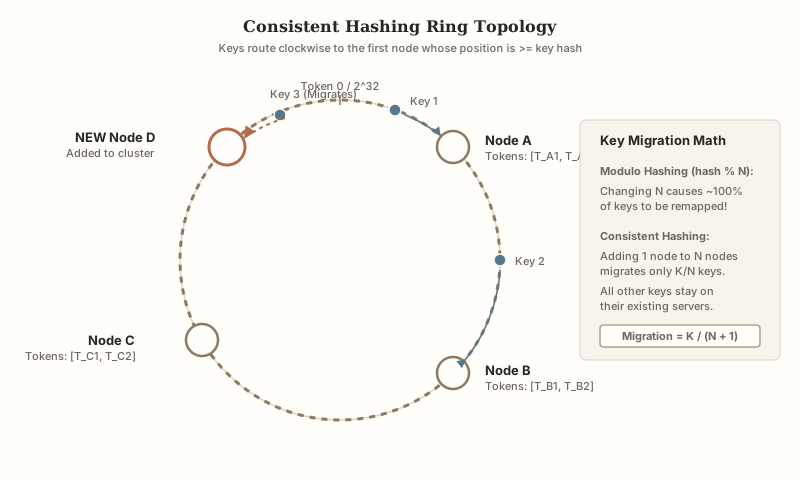
1. Uniform Ring Token Placement
Nodes A, B, and C are hashed onto the 32-bit integer ring [0, 2^32 - 1] using MD5/Murmur3. Each server owns a continuous token arc.
2. Key 1 Clockwise Routing
hash('item:alpha') evaluates to token ~20°. The coordinator walks clockwise along the ring to locate the first node with token >= hash (Node A).
3. Key 2 Clockwise Routing
hash('item:beta') evaluates to token ~90°. Following the ring clockwise leads directly to Node B.
4. Cluster Expansion: Node D Joins Ring
A new server (Node D) is introduced at token position ~315°. It takes responsibility for the segment between Node C and Node D.
5. Minimal Key Migration Math
Only Key 3 (located between Node C and Node D) migrates from Node A to Node D. All keys on Node B and Node C remain completely untouched!
1. Key Assignment
To locate the owning server for a key :
- Calculate the token: .
- Search clockwise for the first server whose token .
- If is greater than all server tokens, wrap around to the first server on the ring (at the top).
2. Node Addition (Graceful Scaling)
Suppose we have servers , and we insert a new server between and :
- Only the keys that fall between and on the ring are re-assigned from to .
- Keys owned by server and server are completely unaffected.
- On average, exactly of keys migrate!
3. Node Removal / Failure
If server crashes:
- Only keys previously owned by migrate to its immediate clockwise successor ().
- All keys on servers and remain completely untouched.
4. The Two Fundamental Flaws of Naive Consistent Hashing
A simple ring with one token per server exhibits two fatal failure modes in production:
Flaw 1: Non-Uniform Key Distribution (Hotspots)
When servers are assigned random positions on the ring, partition sizes vary wildly. By chance, two servers might be positioned close together, leaving another server responsible for of the ring’s arc.
Flaw 2: Cascading Domino Failover
If Node crashes, 100% of Node ‘s traffic lands on its single immediate clockwise neighbor (Node ). Node now receives its own traffic plus all of ‘s load ( traffic). Node promptly crashes under overload, dumping traffic onto the next node, triggering a cascading total cluster blackout.
4. The Solution: Virtual Nodes (Vnodes)
To achieve uniformity and fault isolation, real-world systems (Cassandra, DynamoDB, Discord) do not place physical machines directly on the ring. Instead, they use Virtual Nodes (Vnodes).
Physical Server A ──► Hashes 128 times ──► [ A#1, A#2, A#3, ..., A#128 ]
Physical Server B ──► Hashes 128 times ──► [ B#1, B#2, B#3, ..., B#128 ]
Physical Server C ──► Hashes 128 times ──► [ C#1, C#2, C#3, ..., C#128 ]
Each physical machine is assigned multiple tokens (typically 128 to 256) distributed randomly across the ring:
Ring Order: [ A#12 ] ──► [ B#4 ] ──► [ C#99 ] ──► [ A#45 ] ──► [ B#77 ] ──► [ C#3 ] ...Why Vnodes Transform Cluster Reliability:
- Statistical Balance: By the Law of Large Numbers, distributing hundreds of points per server ensures every physical node owns an almost identical total fraction of the ring ( variance).
- Distributed Failover: If physical server crashes, its 128 virtual tokens are scattered across the ring. Their immediate clockwise successors are split evenly between Server and Server . Instead of one neighbor absorbing of the failure load, the load is distributed across all surviving machines in the cluster.
- Heterogeneous Hardware Weighting: A powerful server with 128 GB RAM can be allocated 256 vnodes, while an older 64 GB server is assigned 128 vnodes, proportionally balancing load according to hardware capacity.
5. Mathematical foundations
1. Key Migration Comparison
| Algorithm | Cluster Change | Fraction of Keys Migrated |
|---|---|---|
| Modulo Hashing () | ( when ) | |
| Consistent Hashing | ( when ) |
For a cluster of nodes storing keys:
- Modulo hashing forces keys to move.
- Consistent hashing moves only keys ( less data movement!).
2. Load Variance vs. Number of Vnodes
Let physical nodes each place independent, uniformly distributed tokens onto the unit ring ( total tokens). Each node’s total owned ring fraction is the sum of out of symmetric Dirichlet spacings, so with mean . Its coefficient of variation (standard deviation relative to mean node load) is:
| Virtual Nodes per Server () | Relative Std. Dev. () | Typical Production Profile |
|---|---|---|
| vnode (Naive) | Severe hotspots (individual nodes often hold – mean load) | |
| vnodes (Cassandra 4.0+/5.0 default) | (random) / (deterministic allocation) | Paired in Cassandra 4.0+ with allocate_tokens_for_local_replication_factor to balance load with low repair overhead |
| vnodes | Moderate random imbalance | |
| vnodes | Strong random balance across mid-sized cache clusters | |
| vnodes (Cassandra 2.x/3.x default) | Near-uniform random balance, at the cost of higher anti-entropy repair fan-out |
3. Lookup Algorithmic Complexity
In a cluster with physical nodes and virtual nodes per server:
- Total tokens on the ring: .
- Tokens are stored in a balanced binary search tree (e.g.
std::mapin C++,java.util.TreeMapin Java, or a sorted array). - Lookup Time: using binary search.
- Memory Footprint: Storing 100 nodes vnodes = 25,600 integer tokens (trivially fits in L2/L3 CPU cache).
6. Implementation: Minimal Consistent Hash Ring in TypeScript
/**
 * Portable Consistent Hash Ring using 32-bit MurmurHash3 (x86_32)
 * Zero Node-specific dependencies; runs identically in browser and server runtimes.
 */
export class ConsistentHashRing {
  private readonly vnodesPerNode: number;
  private readonly ring: Map<number, string> = new Map();
  private sortedTokens: number[] = [];
  private readonly encoder = new TextEncoder();

  constructor(vnodesPerNode = 128) {
    this.vnodesPerNode = vnodesPerNode;
  }

  private murmurHash3_32(value: string, seed = 0x9747b28c): number {
    const data = this.encoder.encode(value);
    const len = data.length;
    const c1 = 0xcc9e2d51;
    const c2 = 0x1b873593;
    let h1 = seed >>> 0;
    const roundedEnd = len & ~0x3;

    for (let i = 0; i < roundedEnd; i += 4) {
      let k1 =
        (data[i] & 0xff) |
        ((data[i + 1] & 0xff) << 8) |
        ((data[i + 2] & 0xff) << 16) |
        ((data[i + 3] & 0xff) << 24);
      k1 = Math.imul(k1, c1);
      k1 = (k1 << 15) | (k1 >>> 17);
      k1 = Math.imul(k1, c2);

      h1 ^= k1;
      h1 = (h1 << 13) | (h1 >>> 19);
      h1 = (Math.imul(h1, 5) + 0xe6546b64) >>> 0;
    }

    let k1 = 0;
    switch (len & 3) {
      case 3:
        k1 ^= (data[roundedEnd + 2] & 0xff) << 16;
      // falls through
      case 2:
        k1 ^= (data[roundedEnd + 1] & 0xff) << 8;
      // falls through
      case 1:
        k1 ^= data[roundedEnd] & 0xff;
        k1 = Math.imul(k1, c1);
        k1 = (k1 << 15) | (k1 >>> 17);
        k1 = Math.imul(k1, c2);
        h1 ^= k1;
    }

    h1 ^= len;
    h1 ^= h1 >>> 16;
    h1 = Math.imul(h1, 0x85ebca6b);
    h1 ^= h1 >>> 13;
    h1 = Math.imul(h1, 0xc2b2ae35);
    h1 ^= h1 >>> 16;
    return h1 >>> 0; // Unsigned 32-bit integer in [0, 2^32 - 1]
  }

  public addNode(node: string): void {
    for (let i = 0; i < this.vnodesPerNode; i++) {
      let attempt = 0;
      let token = this.murmurHash3_32(`${node}#vnode-${i}`);
      while (this.ring.has(token) && this.ring.get(token) !== node) {
        attempt++;
        token = this.murmurHash3_32(`${node}#vnode-${i}#${attempt}`);
      }
      if (!this.ring.has(token)) {
        this.sortedTokens.push(token);
      }
      this.ring.set(token, node);
    }
    this.sortedTokens.sort((a, b) => a - b);
  }

  public removeNode(node: string): void {
    for (const [token, owner] of this.ring.entries()) {
      if (owner === node) {
        this.ring.delete(token);
      }
    }
    this.sortedTokens = this.sortedTokens.filter((t) => this.ring.has(t));
  }

  public getNode(key: string): string | null {
    if (this.sortedTokens.length === 0) return null;
    const token = this.murmurHash3_32(key);

    // Binary search for first token >= key token (clockwise walk)
    let low = 0;
    let high = this.sortedTokens.length - 1;
    let index = 0;

    while (low <= high) {
      const mid = (low + high) >>> 1;
      if (this.sortedTokens[mid] >= token) {
        index = mid;
        high = mid - 1;
      } else {
        low = mid + 1;
      }
    }

    // Wrap around to ring origin if token > all server tokens
    if (low >= this.sortedTokens.length) {
      index = 0;
    }

    return this.ring.get(this.sortedTokens[index]) ?? null;
  }

  public getTokenCount(): number {
    return this.sortedTokens.length;
  }
}

function runDemo(): void {
  console.log("=== Consistent Hashing: Virtual Nodes & Minimal Key Migration ===");
  const ring = new ConsistentHashRing(128);
  const nodes = ["cache-node-A", "cache-node-B", "cache-node-C"];
  for (const n of nodes) ring.addNode(n);

  const TOTAL_KEYS = 10000;
  const beforeMapping = new Map<string, string>();
  const counts: Record<string, number> = { "cache-node-A": 0, "cache-node-B": 0, "cache-node-C": 0 };

  for (let i = 0; i < TOTAL_KEYS; i++) {
    const key = `session:user-${i}`;
    const owner = ring.getNode(key)!;
    beforeMapping.set(key, owner);
    counts[owner]++;
  }

  console.log(`[1] Initialized 3 nodes (${ring.getTokenCount()} total vnode tokens):`);
  for (const n of nodes) {
    console.log(`    ${n}: ${counts[n]} keys (${((counts[n] / TOTAL_KEYS) * 100).toFixed(1)}%)`);
  }

  ring.addNode("cache-node-D");
  let migrated = 0;
  for (let i = 0; i < TOTAL_KEYS; i++) {
    const key = `session:user-${i}`;
    if (ring.getNode(key) !== beforeMapping.get(key)) {
      migrated++;
    }
  }
  console.log(
    `[2] Added cache-node-D (${ring.getTokenCount()} tokens): migrated ${migrated}/${TOTAL_KEYS} keys (${((migrated / TOTAL_KEYS) * 100).toFixed(1)}%, theoretical 1/(N+1) = 25.0%)`
  );
}

runDemo();
7. Real-world implementations
1. Apache Cassandra & Amazon DynamoDB
- Both databases use a distributed token ring for partitioning rows by primary key partition token.
- Apache Cassandra’s
Murmur3Partitioner(org.apache.cassandra.dht.Murmur3Partitioner) hashes partition keys into a 64-bit signed integer token space ( to , with reserved as the minimum sentinel). - Replication: To replicate a key with replication factor , the coordinator walks clockwise along the ring and places copies on the first 3 distinct physical nodes (and distinct racks when
NetworkTopologyStrategyis enabled).
2. Discord Gateway Architecture
- Discord routes millions of active WebSocket guild connections using consistent hashing (via Elixir’s hash-ring routing).
- When gateway instances restart or scale out during peak hours, only of stateful guild processes migrate, preventing cluster-wide reconnect storms.
8. Failure modes and limitations
- The Celebrity / Super-Hot Key: Consistent hashing guarantees uniform distribution across distinct random keys. However, if a single key (e.g. a viral livestream room or breaking news counter) receives 1 million requests/second, that entire load hits the single replica set owning that key. Mitigation: Apply key salting / write sharding () for writes and scatter-gather or tiered local edge caching for reads, or use Consistent Hashing with Bounded Loads (Mirrokni et al., 2017) to cap any server at times average load.
- Replication Overlap & Repair Fan-Out with High Vnode Counts:
When selecting successive nodes clockwise on the ring, virtual tokens from the same physical node might appear consecutively, so the ring walker must skip physical nodes (and racks) already in the replica set. Furthermore, with random vnodes, every physical node shares token ranges with almost every other node in the cluster, increasing simultaneous multi-node failure correlation and slowing anti-entropy Merkle-tree repairs—which motivated Cassandra 4.0+ to reduce default
num_tokensto 16 with deterministic token allocation. - Ring State Inconsistency: If Node A and Node B hold temporarily divergent ring membership views during gossip convergence or network partitions, they route the same key to different servers, causing cache incoherence or quorum read/write retries (handled via sloppy quorums and hinted handoff in Dynamo-style stores).
9. Operational perspective
What to Monitor in Production
- Token Skew Ratio: Measure maximum-to-minimum data ownership across physical storage nodes: A ratio on equal-sized hardware indicates either insufficient vnode count without deterministic token allocation or low-entropy partition keys.
- Node Join Streaming Bandwidth: When adding or decommissioning a node, cap background streaming throughput (e.g.
stream_throughput_outbound_megabits_per_secin Cassandra) so rebalancing traffic does not starve foreground client p99 latency.
10. Knowledge check
Complete the interactive assessment quiz at the end of this lesson to test your understanding of modulo remapping math, vnode variance bounds, and ring lookups.
11. Exercises
Exercise 1: Multi-Node Migration Math
- Scenario: A distributed cache cluster currently runs equal-capacity servers storing uniformly hashed objects. During a traffic surge, 2 new servers are added simultaneously ().
- Questions:
- Under traditional modulo hashing (), assuming a uniform 64-bit hash space, what fraction and exact expected count of objects remap to a different server? (Hint: check via the Chinese Remainder Theorem.)
- Under consistent hashing with 128 balanced vnodes per server, how many objects migrate to the two new servers, and how many objects move between the original 15 servers?
Exercise 2: Vnode Load Variance & Domino Failover Sizing
- Scenario: You operate an node caching cluster where each server is provisioned to run at memory and CPU utilization under balanced traffic.
- Questions:
- Using the Dirichlet/Beta coefficient of variation formula , calculate the relative load standard deviation () for (naive ring) vs. vnodes per node. How many vnodes are required so that ?
- If 1 physical server crashes, compare the peak utilization of the hottest surviving neighbor under versus vnodes, and explain why triggers a cascading cluster outage when nodes crash at utilization.
View Reference Architecture & Worked Solutions (CORE-M08-002)
1. Worked Solution — Exercise 1: Multi-Node Migration Math (, )
-
Part 1 — Modulo Hashing ():
- Because , by the Chinese Remainder Theorem, a uniform hash maps with equal probability to all residue pairs .
- An object remains on the same server index if and only if , which holds for exactly out of the residue pairs ().
- Fraction Unchanged: .
- Fraction Remapped (Invalidated): .
- Exact Expected Objects Remapped: invalidated simultaneously!
-
Part 2 — Consistent Hashing with Balanced Vnodes ():
- Each of the 2 new nodes claims an expected of the circular hash space, so together they claim of the ring.
- Expected Objects Migrated to the 2 New Servers: (roughly objects per new node, pulled evenly from all 15 existing nodes).
- Objects Moved Between the Original 15 Servers: —inserting new tokens on the ring only splits existing arcs owned by their clockwise successors and never transfers ownership from one existing node to another.
2. Worked Solution — Exercise 2: Vnode Load Variance & Domino Failover Sizing ()
-
Part 1 — Coefficient of Variation () & Vnode Sizing:
- For and (naive single token per node):
- For and vnodes per node:
- To achieve (): (Or use deterministic token allocation as in Cassandra 4.0+/5.0 to achieve variance with only vnodes.)
-
Part 2 — Failover Load Redistribution ( Baseline Utilization):
- Under (Naive Ring): When 1 server crashes, of its token arc falls onto its single immediate clockwise neighbor. That neighbor’s load jumps from to , immediately exceeding its hardware ceiling and crashing it. The next clockwise neighbor then receives load, causing a total cluster domino blackout.
- Under Vnodes: The crashed server’s tokens are interleaved across all surviving servers. Each surviving server absorbs of the failed node’s load (), raising average utilization from to —comfortably below the saturation limit with zero cascading failures.
12. Summary, Design Alternatives & Decision Guide
| Partitioning Strategy | Resize Migration () | Lookup Time & Memory | Arbitrary Node Removal? | Best Used For |
|---|---|---|---|---|
| Modulo Hashing () | () | time, memory | Poor (remaps all slots) | Static, fixed-size shard arrays that never resize online |
| Consistent Hashing (with Vnodes) | time, memory | Yes (any node can join/leave) | Dynamic caches, Dynamo-style NoSQL rings (Cassandra, DynamoDB) | |
| Rendezvous / HRW Hashing | time (or skeleton), memory | Yes (any node can join/leave) | Small-to-medium node pools () needing zero ring metadata sync (CDN PoP selection) | |
| Jump Consistent Hash | time, memory (zero ring table!) | No (only supports sequential bucket IDs ) | Stateless shard numbering where failed shards are replaced in-place rather than removed | |
| Range-Based Partitioning | Local split only | range directory | Yes (via range split/merge) | Ordered range scans and transactional SQL workloads (TiKV, CockroachDB, Spanner) |
13. Authoritative References & Version Context
- Karger, D., Lehman, E., Leighton, T., Panigrahy, R., Levine, M., & Lewin, D. (1997). Consistent Hashing and Random Trees: Distributed Caching Protocols for Relieving Hot Spots on the World Wide Web. Proceedings of the 29th Annual ACM Symposium on Theory of Computing (STOC ‘97), pp. 654–663. https://dl.acm.org/doi/10.1145/258533.258660
- DeCandia, G., Hastorun, D., Jampani, M., Kakulapati, G., Lakshman, A., Pilchin, A., Sivasubramanian, S., Vosshall, P., & Vogels, W. (2007). Dynamo: Amazon’s Highly Available Key-value Store. ACM SOSP ‘07, pp. 205–220. https://www.allthingsdistributed.com/files/amazon-dynamo-sosp2007.pdf
- Lamping, J., & Veach, E. (2014). A Fast, Minimal Memory, Consistent Hash Algorithm (Jump Consistent Hash). Google Technical Report. https://arxiv.org/abs/1406.2294
- Mirrokni, V., Thorup, M., & Zadimoghaddam, M. (2018). Consistent Hashing with Bounded Loads. ACM-SIAM SODA ‘18. https://arxiv.org/abs/1608.01350
- Apache Cassandra Official Documentation (v4.1 / v5.0 baseline). Dynamo Ring Architecture, Virtual Nodes (
num_tokens: 16default in 4.0+), andMurmur3Partitioner. https://cassandra.apache.org/doc/latest/cassandra/architecture/dynamo.html