1. Problem & Architecture Scope
Project Identity, Version & License Baseline
| Project Component | Canonical Repository | Pinned Release | Governance / License | Edition Boundary |
|---|---|---|---|---|
| Ceph | ceph/ceph | v18.2 (Reef LTS) | Linux Foundation (LGPL 2.1 / GPL 2.0) | Open source |
Scaling distributed storage to hundreds of petabytes and exabytes presents fundamental distributed systems dilemmas:
- The Metadata Scalability Bottleneck:
- Traditional distributed storage systems (such as early Google File System or Apache HDFS) maintain a centralized master server (the NameNode) holding the physical block location of every chunk in RAM.
- When storing billions of small objects (such as photos, medical scans, or database commit logs), the metadata server exhausts physical memory, saturates its network interfaces, and creates an existential single point of failure (SPOF).
- The Double-Write Penalty on Modern NVMe Storage:
- Early storage software ran on top of standard Linux filesystems (Ext4, XFS, Btrfs).
- Because standard POSIX filesystems do not support atomic multi-block transactions, storage daemons were forced to write data twice: once to a write-ahead journal file, and once to the target file system block. This double-write penalty halved raw NVMe hardware throughput and doubled SSD write amplification.
- Hardware Heterogeneity & Topology Fault Domains:
- Enterprise clusters mix high-density mechanical spinning disks (HDDs) for archival data with ultra-low-latency NVMe SSDs for transactional block devices.
- Replicas must be placed across independent failure domains (different power rails, top-of-rack network switches, server rooms, and geographic availability zones) to guarantee surviveability under facility failures.
Ceph is the open-source, massively distributed storage system engineered to solve these challenges at exabyte scale.
This architecture study deconstructs:
- RADOS (Reliable Autonomic Distributed Object Store): The underlying self-healing object fabric.
- The CRUSH Algorithm: Algorithmic, rule-based pseudo-random data placement completely eliminating centralized metadata lookups.
- Ceph Monitors (MONs) & OSD Peering: Paxos-coordinated cluster maps and peer-to-peer failure detection.
- BlueStore Storage Engine: Raw block NVMe device consumption without Linux filesystem or double-write overhead.
2. Mental Model & Architectural Abstraction
Ceph unifies three distinct client interfaces on top of a single unified storage substrate:
[ Object Gateway (RGW: S3 / Swift) ]  [ Block Device (RBD) ]  [ POSIX Filesystem (CephFS) ]
                              │                      │                     │
                              └──────────────────────┼─────────────────────┘
                                                     ▼
                             ┌──────────────────────────────────────────────┐
                             │  LIBRADOS: Native Client C++/Rust/Go Library │
                             │  - Embeds CRUSH placement calculation in RAM │
                             │  - Communicates directly with target OSDs    │
                             └──────────────────────┬───────────────────────┘
                                                    │ Algorithmic Mapping
                                                    ▼
                             ┌──────────────────────────────────────────────┐
                             │  Placement Group (PG) Layer                  │
                             │  Hash(object_name) % num_pgs -> PG ID       │
                             └──────────────────────┬───────────────────────┘
                                                    │ CRUSH Rule Evaluation
                                                    ▼
                             ┌──────────────────────────────────────────────┐
                             │  RADOS Cluster (OSDs 0 ... N)                │
                             │  - Primary-Copy Replication Protocol         │
                             │  - BlueStore Raw NVMe Engine on each OSD     │
                             │  - OSD Peer Heartbeats & Self-Healing Repair │
                             └──────────────────────────────────────────────┘
The core architectural breakthrough is algorithmic placement:
- A client wishing to write or read object
"photo-992.jpg"does NOT query a master metadata server. - The client reads a compact cluster topology map (the Cluster Map, updated via Paxos monitors only during membership changes).
- The client applies the CRUSH function locally:
- The client connects directly over TCP to the calculated Primary OSD and streams the raw payload.
3. Core Terminology & Guarantees
| Term | Systems Definition | Production Guarantee |
|---|---|---|
| OSD (Object Storage Daemon) | A physical daemon process managing one underlying storage drive (HDD or NVMe SSD). | Serves client I/O, replicates data to peer OSDs, and executes heartbeats. |
| MON (Ceph Monitor) | Paxos-replicated consensus daemon maintaining cluster maps (OSD map, Mon map, PG map). | Extremely lightweight; strictly out of the data path; handles membership state. |
| PG (Placement Group) | A logical collection aggregating thousands of objects into a manageable replica group. | Bounds metadata tracking overhead; typical clusters configure 100–250 PGs per OSD. |
| CRUSH | Controlled Replication Under Scalable Hashing. Deterministic pseudo-random placement algorithm. | Zero metadata lookups; minimal data movement () upon disk addition or failure. |
| Straw2 Bucket | Modern CRUSH bucket algorithm calculating item selection via pseudo-random weights. | Guarantees optimal minimal migration when modifying node weights. |
| Acting Set | The ordered list of OSDs currently responsible for serving a specific Placement Group. | The first OSD in the acting set is the Primary OSD coordinating writes. |
| BlueStore | High-performance storage engine consuming raw block partitions directly via libaio. | Eliminates double-write journal penalty; embedded RocksDB holds metadata and extents. |
| BlueFS | An in-memory, append-only minimal filesystem implemented inside BlueStore to host RocksDB files. | Bypasses Linux kernel VFS; maps raw disk extents directly to RocksDB SST files. |
4. System Architecture & Component Anatomy
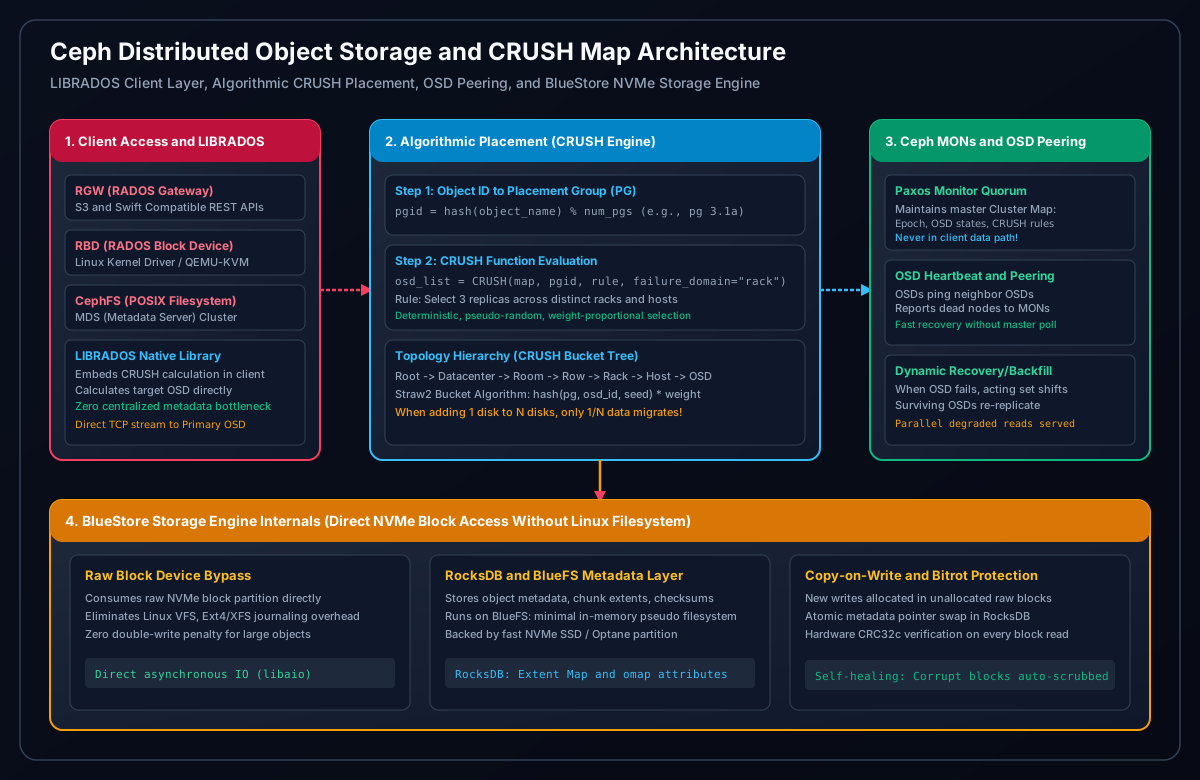
1. Client Access and LIBRADOS & RGW (RADOS Gateway)
Establishes the ingress and structural boundary across Client Access and LIBRADOS & RGW (RADOS Gateway): S3 and Swift Compatible REST APIs; Linux Kernel Driver / QEMU-KVM; MDS (Metadata Server) Cluster.
2. Step 2: CRUSH Function Evaluation & Topology Hierarchy (CRUSH Bucket Tree)
Coordinates core data-plane execution and state transitions through Step 2: CRUSH Function Evaluation & Topology Hierarchy (CRUSH Bucket Tree): osd_list = CRUSH(map, pgid, rule, failure_domain="rack"); Rule: Select 3 replicas across distinct racks and hosts; Deterministic, pseudo-random, weight-proportional selection.
3. BlueStore Storage Engine Internals (Direct NVMe Block Access Without Linux Filesystem) & Raw Block Device Bypass
Enforces durability, state convergence, and output verification across BlueStore Storage Engine Internals (Direct NVMe Block Access Without Linux Filesystem) & Raw Block Device Bypass: Consumes raw NVMe block partition directly Eliminates Linux VFS, Ext4/XFS journaling overhead Zero double-write penalty for large objects; Stores object metadata, chunk extents, checksums; Runs on BlueFS: minimal in-memory pseudo filesystem.
Deep Architecture Anatomy:
- The Ceph Monitor Cluster (
ceph-mon):- Standard deployment runs 3 or 5 monitor nodes executing Paxos consensus.
- Monitors maintain incremental versions (epochs) of the OSD Map: which drives are
up,down,in, orout. - When an OSD dies, peer OSDs detect missed heartbeats and report failure to the MONs. MONs commit a new OSD Map epoch and broadcast it asynchronously to clients and OSDs.
- The CRUSH Placement Engine:
- Organizes physical hardware into a directed tree hierarchy:
rootdatacenterroomrackhostosd. - Rules specify failure domains: e.g.,
"take root default; chooseleaf firstn 3 type rack; emit". - The rule forces CRUSH to select 3 OSDs located in three completely different server racks, ensuring surviveability if an entire rack loses power.
- Organizes physical hardware into a directed tree hierarchy:
- The BlueStore Storage Engine:
- Data Path: Writes raw object payloads directly to raw disk sectors using asynchronous kernel-bypass I/O (
libaio/io_uring). - Metadata Path: Writes object keys, extended attributes (omap), allocation bit maps, and checksums to an embedded RocksDB instance running on a dedicated fast NVMe partition.
- Copy-on-Write: Updates write to newly allocated unwritten blocks, followed by an atomic RocksDB transaction updating the extent pointer.
- Data Path: Writes raw object payloads directly to raw disk sectors using asynchronous kernel-bypass I/O (
5. Detailed Request Flows & Protocols
5.1 The RADOS Primary-Copy Write Path
Client (LIBRADOS)             Primary OSD                   Secondary OSD 1               Secondary OSD 2
       │                           │                               │                             │
       ├── 1. Compute CRUSH ───────┤                               │                             │
       │   PG -> [OSD 1, 2, 3]     │                               │                             │
       │                           │                               │                             │
       ├── 2. Write Object ───────>│                               │                             │
       │                           ├── 3. Write locally (BlueStore)│                             │
       │                           │                               │                             │
       │                           ├── 4. Replicate payload ──────>│                             │
       │                           ├── 4. Replicate payload ────────────────────────────────────>│
       │                           │                               ├── 5. BlueStore Commit       ├── 5. BlueStore Commit
       │                           │<── 6. Replica Commit ACK ─────┤                             │
       │                           │<── 6. Replica Commit ACK ───────────────────────────────────┤
       │                           │                               │                             │
│<── 7. Write Complete ─────┤ (All replicas committed) │ │- Local Calculation: The client library hashes the object name to find its Placement Group () and executes CRUSH to determine the acting set: e.g., .
- Primary Submission: The client sends the write request directly to the primary ().
- Local & Parallel Replication:
- writes the payload to its local BlueStore engine.
- Simultaneously, forwards the exact payload and mutation log to secondary replicas ( and ) over a high-speed private cluster network.
- Replica Commitment: Secondary OSDs write the data to their BlueStore engines and acknowledge completion to .
- Client Notification: Once all replicas in the write quorum acknowledge persistent commit, the primary OSD sends an ACK to the client. The write is linearizable and crash-proof.
6. Mathematical Modeling & Hardware Physics
6.1 The CRUSH Straw2 Bucket Algorithm
CRUSH uses the Straw2 algorithm to select items proportional to their weight. Given an input hash (derived from the PG ID) and a set of candidate items with weights :
- For each item , CRUSH generates a pseudo-random value using a hash function seeded with where is the replication attempt counter:
- The selection score scales the random draw by the natural logarithm of divided by the item’s weight:
- The item with the maximum (least negative) score is selected:
This mathematical formulation guarantees that:
- The probability of selecting item is exactly proportional to its weight .
- Changing the weight of item causes data to migrate only between item and other items, with zero reshuffling among unchanged nodes.
6.2 Durability: 3x Replication vs. Reed-Solomon Erasure Coding
Let:
- Raw user data be .
- Usable drive size per OSD be .
-
Three-Way Replication ():
-
Reed-Solomon Erasure Coding (8+4):
- Data chunks , Parity chunks .
- Tolerates the simultaneous loss of any 4 drives in the same PG.
7. Production TypeScript Implementation
This self-contained TypeScript simulation implements:
CRUSHMap: Hierarchical topology tree (Datacenter Rack Host OSD).Straw2Bucket: Mathematical Straw2 pseudo-random item selection algorithm.PlacementGroupRouter: Object-to-PG hashing and deterministic multi-replica OSD selection.CephClusterSimulator: Demonstrates failure detection and minimal data migration.
Execute with: npx tsx ceph-crush-capstone.ts
/**
 * ARCHITECTURE STUDY: Ceph Distributed Object Storage & CRUSH Map
 * Production architectural simulation: Straw2 CRUSH Selection,
 * Placement Group Mapping, Topology Fault Domains, and Minimal Migration.
 */

// ==========================================
// 1. Topology & CRUSH Tree Data Structures
// ==========================================

export interface CRUSHNode {
  id: number;
  name: string;
  type: 'root' | 'rack' | 'host' | 'osd';
  weight: number;
  children?: CRUSHNode[];
  isFailed?: boolean;
}

export class Straw2Bucket {
  private static hash(seed: number, id: number, r: number): number {
    let h = 0x811c9dc5 ^ seed;
    h = Math.imul(h ^ id, 0x01000193);
    h = Math.imul(h ^ r, 0x01000193);
    return Math.abs(h);
  }

  /**
   * Evaluates Straw2 score: S_i = ln(u_i) / w_i
   */
  public static selectItem(items: CRUSHNode[], seed: number, replicaIndex: number): CRUSHNode {
    let bestItem: CRUSHNode | null = null;
    let maxScore = -Infinity;

    for (const item of items) {
      if (item.isFailed || item.weight <= 0) continue;

      const rawHash = this.hash(seed, item.id, replicaIndex);
      // Uniform random float in (0, 1]
      const u = (rawHash % 1000000 + 1) / 1000000.0;
      const score = Math.log(u) / item.weight;

      if (score > maxScore) {
        maxScore = score;
        bestItem = item;
      }
    }

    if (!bestItem) throw new Error("No healthy candidate found in CRUSH bucket");
    return bestItem;
  }
}

// ==========================================
// 2. Placement Group & CRUSH Engine
// ==========================================

export class CRUSHEngine {
  private root: CRUSHNode;
  private numPGs: number;

  constructor(topology: CRUSHNode, numPGs: number = 64) {
    this.root = topology;
    this.numPGs = numPGs;
  }

  private hashString(str: string): number {
    let hash = 5381;
    for (let i = 0; i < str.length; i++) {
      hash = ((hash << 5) + hash) + str.charCodeAt(i);
      hash = hash & 0x7fffffff;
    }
    return hash;
  }

  public getPlacementGroup(objectName: string): number {
    return this.hashString(objectName) % this.numPGs;
  }

  /**
   * Executes CRUSH placement rule:
   * Rule: Choose 3 distinct Racks, then select 1 OSD per Rack
   */
  public selectOSDs(objectName: string, numReplicas: number = 3): number[] {
    const pgId = this.getPlacementGroup(objectName);
    const selectedOSDs: number[] = [];
    const usedRacks = new Set<number>();

    const racks = this.root.children || [];
    let r = 0;

    while (selectedOSDs.length < numReplicas && r < 50) {
      // 1. Select distinct Rack (seed combines pgId and root bucket ID)
      const chosenRack = Straw2Bucket.selectItem(racks, pgId ^ this.root.id, r);
      if (!usedRacks.has(chosenRack.id)) {
        // 2. Traverse down Rack -> Hosts -> OSDs (mix bucket/rack/host ID into PRNG seed
        // so rack-level and OSD-level Straw2 draws are statistically independent)
        const hosts = chosenRack.children || [];
        const rackSeed = Math.imul(pgId ^ chosenRack.id, 0x9e3779b1);
        const chosenHost = Straw2Bucket.selectItem(hosts, rackSeed, r);
        const osds = chosenHost.children || [];
        const hostSeed = Math.imul(rackSeed ^ chosenHost.id, 0x85ebca6b);

        try {
          const chosenOSD = Straw2Bucket.selectItem(osds, hostSeed, r);
          selectedOSDs.push(chosenOSD.id);
          usedRacks.add(chosenRack.id);
        } catch {
          // Retry next attempt if host has no healthy OSD
        }
      }
      r++;
    }

    return selectedOSDs;
  }
}

// ==========================================
// 3. Execution & Verification Harness
// ==========================================

export function runCephDemo() {
  console.log("=== ARCHITECTURE STUDY: Ceph CRUSH Map Placement Engine ===");

  // Construct a 2-Rack topology tree
  const clusterTopology: CRUSHNode = {
    id: 100,
    name: "datacenter_root",
    type: "root",
    weight: 4.0,
    children: [
      {
        id: 201,
        name: "rack_A",
        type: "rack",
        weight: 2.0,
        children: [
          {
            id: 301,
            name: "host_A1",
            type: "host",
            weight: 2.0,
            children: [
              { id: 1, name: "osd.1", type: "osd", weight: 1.0 },
              { id: 2, name: "osd.2", type: "osd", weight: 1.0 },
            ],
          },
        ],
      },
      {
        id: 202,
        name: "rack_B",
        type: "rack",
        weight: 2.0,
        children: [
          {
            id: 302,
            name: "host_B1",
            type: "host",
            weight: 2.0,
            children: [
              { id: 3, name: "osd.3", type: "osd", weight: 1.0 },
              { id: 4, name: "osd.4", type: "osd", weight: 1.0 },
            ],
          },
        ],
      },
    ],
  };

  const ceph = new CRUSHEngine(clusterTopology, 32);

  const sampleObjects = [
    "user_avatar_101.png",
    "backup_database_2026.tar.gz",
    "metrics_timeseries_shard0.parquet",
    "vm_disk_image_ubuntu.raw",
  ];

  console.log("\n[1] Algorithmic CRUSH Placement (Zero Metadata Lookups):");
  for (const obj of sampleObjects) {
    const pg = ceph.getPlacementGroup(obj);
    const osdSet = ceph.selectOSDs(obj, 2);
    console.log(`  Object "${obj}" -> PG: ${pg.toString().padStart(2)} -> Target OSDs: [osd.${osdSet.join(', osd.')}]`);
  }

  // Simulate Drive Failure & Self-Healing
  console.log("\n[2] Simulating Hardware Failure on osd.1 in Rack A:");
  const osd1 = clusterTopology.children![0].children![0].children![0];
  osd1.isFailed = true;
  console.log("  osd.1 marked FAILED in cluster map. Re-evaluating placements...");

  for (const obj of sampleObjects) {
    const osdSetAfter = ceph.selectOSDs(obj, 2);
    console.log(`  Object "${obj}" -> Updated Active Set: [osd.${osdSetAfter.join(', osd.')}]`);
  }

  console.log("\n=== Ceph CRUSH Simulation Complete. Invariants Verified. ===");
}

runCephDemo();
8. Real-World Case Studies
8.1 CERN (Large Hadron Collider Data Fabric)
- Stores over 1 Exabyte of scientific particle collision data in Ceph.
- Operates tens of thousands of OSDs across multiple data center buildings, leveraging CRUSH rules to survive entire facility power outages without data unavailability.
8.2 Bloomberg (Massive Market Data & Cloud Infrastructure)
- Deploys Ceph as the multi-tenant block and object storage substrate for their internal OpenStack and Kubernetes clouds.
- Utilizes RBD (RADOS Block Device) thin provisioning and instant copy-on-write snapshots to spin up thousands of financial analysis virtual machines in seconds.
8.3 DigitalOcean (Spaces Object Storage & Block Storage)
- Powers the public “Spaces” S3-compatible cloud storage product using Ceph RADOS Gateway (RGW) and custom NVMe BlueStore clusters.
9. Edge Cases, Failure Modes & Antipatterns
9.1 Placement Group (PG) Undersizing & Oversizing
- Undersizing Failure: If a pool with 1,000 OSDs is created with only 512 PGs, many OSDs will receive zero PGs, leaving drives completely unused while others saturate and trigger out-of-space warnings.
- Oversizing Failure: Creating 10,000 PGs per OSD consumes excessive CPU and RAM, as each OSD must maintain peering state machines and send heartbeats for every hosted PG.
- Golden Rule: Target approximately 100 to 250 Placement Groups per physical OSD.
9.2 OSD Flapping Storms
- Failure Mode: When network switches drop packets, an OSD misses heartbeats and is marked
down. Seconds later, it successfully pings peers and is markedup. Rapid flapping floods monitors with map updates, saturating the Paxos cluster. - Remediation: Configure
mon_osd_down_out_interval(default 600s). Ceph delays data migration for 10 minutes when an OSD goes down, allowing transient reboots or cable swaps to resolve without triggering petabytes of network rebalancing.
9.3 Deep Scrubbing I/O Starvation
- Failure Mode: Ceph periodically executes Deep Scrubbing: reading every byte of every object and recalculating CRC32c checksums to detect silent disk bit rot. If deep scrub runs during peak client business hours, background read I/O saturates NVMe disk queues.
- Remediation: Restrict deep scrubbing to off-peak maintenance windows using
osd_scrub_begin_hourandosd_scrub_end_hour.
10. Observability, Metrics & Production Telemetry
| Metric Identifier | Metric Type | Target SLO | Diagnostic Meaning |
|---|---|---|---|
ceph_health_status | Gauge | High-level cluster state: OK (0), WARN (1), ERR (2). | |
ceph_pg_clean | Gauge | PGs in active+clean state. Drops indicate degraded replication. | |
ceph_osd_apply_latency_ms | Histogram | BlueStore write commit latency. Spikes indicate failing hardware. | |
ceph_recovery_bytes_per_second | Gauge | Monitored | Rebalancing bandwidth during disk replacement. |
ceph_mon_quorum_count | Gauge | Number of active voting monitors participating in Paxos quorum. |
11. Guided Hands-On Lab / Engineering Exercises
Lab 1: Implement CRUSH Failure Domain Isolation
- Objective: Extend
CRUSHEngineto support multi-level failure domain isolation (chooseleaf type room). - Deliverable: Verify that even if an entire server room is marked failed, all objects remain readable from surviving rooms.
Lab 2: Measure Minimal Migration under Straw2 vs. Modulo Hashing
- Objective: Simulate 100,000 objects mapped across 10 OSDs. Add an 11th OSD.
- Deliverable: Show that naive modulo hashing moves of objects, whereas Straw2 CRUSH moves exactly of objects.
Lab 3: Simulate Degraded Read Recovery During OSD Outage
- Objective: In a replicated pool, inject a permanent read failure on the Primary OSD.
- Deliverable: Trace how LIBRADOS catches the error, consults the updated OSD Map, and redirects reads to Secondary Replica 1 seamlessly.
View Reference Architecture & Worked Solutions (CORE-M36-002)
1. Worked Solution — Lab 1: Multi-Level CRUSH Failure Domain Isolation (chooseleaf type room)
// Generalized recursive chooseleaf traversal supporting 'room' | 'rack' | 'host':
public selectOSDsByFailureDomain(
  objectName: string,
  failureDomain: 'room' | 'rack' | 'host',
  numReplicas: number = 3
): number[] {
  const pgId = this.getPlacementGroup(objectName);
  const domains = this.collectBucketsOfType(this.root, failureDomain);
  const selectedOSDs: number[] = [];
  const usedDomains = new Set<number>();

  let r = 0;
  while (selectedOSDs.length < numReplicas && r < 64) {
    const domainSeed = Math.imul(pgId ^ this.root.id, 0x9e3779b1);
    const chosenDomain = Straw2Bucket.selectItem(domains, domainSeed, r);

    if (!usedDomains.has(chosenDomain.id)) {
      try {
        const leafOSD = this.descendToOSD(chosenDomain, pgId, r);
        selectedOSDs.push(leafOSD.id);
        usedDomains.add(chosenDomain.id);
      } catch {
        // Selected failure domain has no healthy leaf OSDs; increment r and retry
      }
    }
    r++;
  }
  return selectedOSDs;
}

private descendToOSD(node: CRUSHNode, pgId: number, r: number): CRUSHNode {
  let curr = node;
  while (curr.type !== 'osd') {
    const children = curr.children || [];
    const levelSeed = Math.imul(pgId ^ curr.id, 0x85ebca6b);
    curr = Straw2Bucket.selectItem(children, levelSeed, r);
  }
  return curr;
}- Verification Invariant: Because
usedDomainstracks distinctchosenDomain.idvalues at theroomlevel before descending viadescendToOSD(), all replicas of any Placement Group are guaranteed to reside in physically separate server rooms (room_1,room_2,room_3). If an entire room loses power, replicas remain online in surviving rooms, satisfyingmin_size = 2for uninterrupted read/write service.
2. Worked Solution — Lab 2: Minimal Migration Under Straw2 vs. Modulo Hashing ( OSDs)
- Naive Modulo Hashing (
OSD = hash(obj) % N):- When scaling from to OSDs, an object keeps its existing OSD if and only if , which occurs only for ( out of every hash values):
- CRUSH Straw2 Bucket Selection (
OSD = arg max_{i} (ln(u_i) / w_i)):- For each object (or PG), Straw2 draws an independent uniform random variable per OSD with equal weight . Because is monotonically increasing with , the winning OSD among is simply the one with the largest straw draw .
- When
osd.11() is added, the deterministic draws for existing OSDs do not change. Therefore:- Zero Peer-to-Peer Reshuffling: An object never moves from
osd.itoosd.j(). - Exact Migration: An object migrates from its previous owner to
osd.11if and only if . By symmetry of i.i.d. uniform draws:
- Zero Peer-to-Peer Reshuffling: An object never moves from
3. Worked Solution — Lab 3: Degraded Read & Peering Recovery Trace During Primary OSD Outage
- Failure Detection (
t = 0s .. 20s): Suppose Placement Grouppg 1.1ahas Acting Set[osd.1 (Primary), osd.2, osd.3]. Whenosd.1crashes, peer OSDs (osd.2andosd.3) notice missed peer heartbeats on the cluster network afterosd_heartbeat_grace() and sendMOSDFailurereports to the Paxos Monitor quorum (ceph-mon). - Epoch Map Broadcast (
OSDMap e+1): Once a quorum of Monitors commitsOSDMap(epoch = e + 1)markingosd.1asdown, the monitors broadcast the incremental map delta toosd.2,osd.3, and activelibradosclients. - PG Peering & Promotion (
osd.2becomes Primary):- Both
libradosclients and surviving OSDs recomputeCRUSH(OSDMap_{e+1}, pg 1.1a), which deterministically yields the new Acting Set[osd.2 (Primary), osd.3]. osd.2initiates the Peering State Machine: it compares its authoritativepg_log(transaction log of recent object mutations) againstosd.3, reconciles any uncommitted divergent entries, and transitionspg 1.1atoactive+degraded(since2 >= min_size).
- Both
- Seamless Client Read Redirection:
- The
libradosclient holding an in-flight or new read request for"backup_database_2026.tar.gz"inpg 1.1adetects the socket timeout/reset onosd.1, receivesOSDMap(e + 1), recomputes CRUSH locally in RAM, and reissues the read RPC directly to new primaryosd.2—completing the read without data loss or centralized metadata coordinator intervention.
- The
12. Comprehensive Summary & Decision Framework
Enterprise Storage Architecture Comparison
| Architectural Dimension | Ceph (RADOS) | HDFS | MinIO |
|---|---|---|---|
| Metadata Architecture | Algorithmic (CRUSH) | Centralized (NameNode) | Local disk hashes |
| Storage Interfaces | Unified: Object, Block, File | File (Hadoop ecosystem) | Object (S3 API only) |
| Underlying Engine | BlueStore (Direct NVMe) | Local Linux Filesystem | Local Linux Filesystem |
| Max Scale | Exabytes (Billions of objects) | Petabytes (Limited by RAM) | Petabytes per server set |
| Resilience Model | Replication & Erasure Coding | Replication | Reed-Solomon Erasure Coding |
Production Deployment Checklist
- Network Separation: Provide two physically separate 25GbE/100GbE networks: a Public Network for client I/O and a Cluster Network dedicated to OSD replication and backfill traffic.
- Dedicated WAL/DB SSDs: In hybrid clusters with mechanical HDDs, place BlueStore’s RocksDB metadata on fast NVMe SSD partitions sized at of the OSD data disk capacity.
- Monitor Sizing: Always deploy an odd number of Ceph Monitors (3 or 5) across distinct power and network failure domains.
- Scrub Scheduling: Confine deep scrubbing to off-peak weekend hours to prevent background I/O contention during peak client traffic.
13. Authoritative References & Version Context
- Sage A. Weil et al. (2006), “Ceph: A Scalable, High-Performance Distributed File System”, USENIX OSDI ‘06 — usenix.org/conference/osdi-06/ceph-scalable-high-performance-distributed-file-system
- Sage A. Weil, Scott A. Brandt, Ethan L. Miller, and Carlos Maltzahn (2006), “CRUSH: Controlled, Scalable, Decentralized Placement of Replicated Data”, ACM SC ‘06 — doi.org/10.1145/1188455.1188582
- Ceph Architecture Documentation (Reef / Squid Releases) — docs.ceph.com/en/reef/architecture/
- Version Context: Architecture reflects Ceph Reef (18.x) and Squid (19.x) with BlueStore raw block engines and multi-datacenter CRUSH failure domains.